From Paragraph's cancellation of custom designs to the ownership balance in Web3
TechFlow Selected TechFlow Selected
From Paragraph's cancellation of custom designs to the ownership balance in Web3
Paragraph can arbitrarily change the visual presentation of blogs, leaving creators powerless.
 Navigating Web3 tides with focused insights
Author: 0xAntidote.eth
Translation: Zen, PANews
A recent update from Paragraph—a company that acquired the well-known Web3 content platform Mirror—has introduced some changes. One point not widely discussed is that it removed the ability to customize CSS for blog designs. The Paragraph team stated that only a small number of creators used this feature, but I happened to be one of them. I had spent considerable time meticulously crafting my brand's visual identity, giving my blog a unique style. But this update completely undermined those efforts—the custom fonts and background colors were removed, leaving the overall design in disarray.
Although I had plans to continue publishing content on Paragraph and grow my audience, my blog isn't large enough yet. Paragraph wouldn’t lose significant users if I left. Every product team has limited resources—sometimes due to funding constraints, sometimes developer bandwidth, or differing product priorities. Therefore, it’s impossible to satisfy everyone’s needs.
That said, I should add that the Paragraph team has always treated me kindly. They featured my article as “Editor’s Pick” twice, carefully listened to my feedback, and provided professional explanations during our communications.
While I understand their decision, I believe the underlying mindset reflects how existing Web2 content platforms operate—standardizing content appearance to strengthen centralized control over distribution. I still wish the Paragraph team all the best, but for me, the current version of Paragraph no longer addresses a core problem worth solving, so I’ve decided to leave.
Paragraph’s Value Proposition
Judging from its official description, Paragraph’s core value proposition centers around “content ownership.”
In short, Paragraph is a crypto-based blogging/newsletter platform. Articles are stored on Arweave and can be sold as digital collectibles, enabling creators to monetize content directly. In theory, this model strengthens creators’ ownership over their content.
However, upon closer reflection, I don’t think creating content on Paragraph means you truly own it.
What Is True “Ownership”?
"Ownership" has long been a central concept in the Web3 narrative. One origin story of Ethereum involves Vitalik questioning digital asset ownership: What happens to your in-game items if the game developer shuts down the server?
This line of thinking led to Ethereum and later smart contract platforms, advancing the concept of “ownership.” Today, blockchain technology allows nearly any type of asset to be “owned.”
But ownership isn’t just about possessing something; it involves more complex dimensions.
In a world of multi-party interactions, ownership must include four key elements:
-
Possession: Are you universally recognized as the owner of the asset?
-
Monetization: Can you sell the asset or charge non-owners for access?
-
Appearance: Does the external presentation of the asset align with your intentions?
-
Distribution: Can your asset reach a wide audience, reinforcing recognition of your ownership?
If any one of these four aspects fails, true ownership cannot exist.
Paragraph’s Shortcomings in Ownership
Blockchains improve many aspects of ownership through decentralized ledgers and cryptography. But if critical components fail, ownership can still be eroded. For example:
-
If everyone mistakenly believes you own something else, are you still the real owner?
-
If your video can only be viewed with a sepia filter (because YouTube or your ISP forces it), is it still your content?
This is exactly the situation Paragraph is in now—it can arbitrarily change how blogs visually appear, and creators have no recourse.
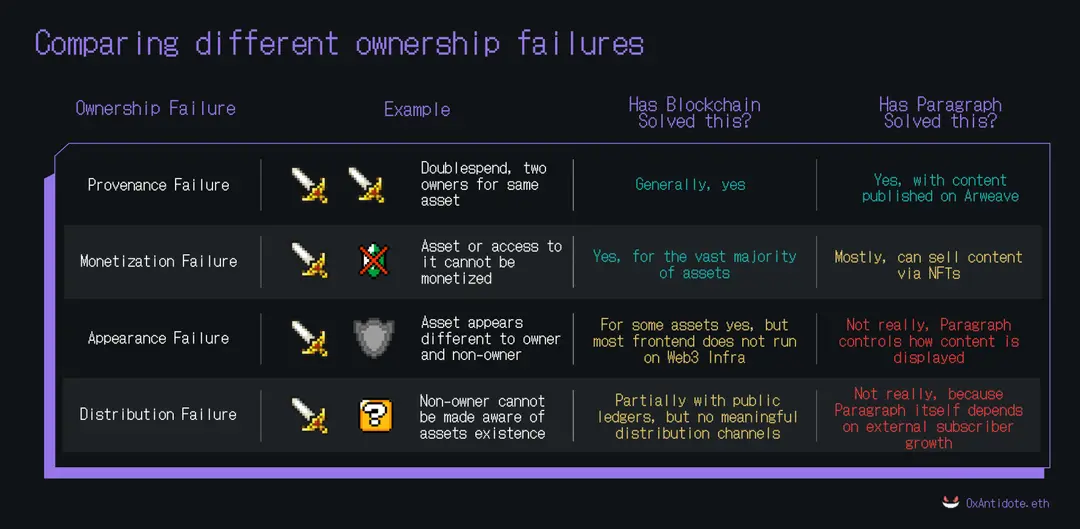
As shown in the image above, Paragraph improves ownership in possession and monetization, but contributes little—or even negatively impacts—appearance and distribution.
The Trade-offs in Ownership
Of course, perfect ownership is an ideal state, perhaps unattainable in full. Yet we can assess whether we're moving toward it. I believe over the past decade, we've generally been progressing toward this ideal. Blockchain has played a role, but so have other technological advances such as decentralized energy production (mainly renewables) or Starlink (providing high-speed internet globally).
Still, today everything involves compromise. The key question is: among the four aspects of ownership—possession, monetization, appearance, and distribution—which ones are you willing to sacrifice?
Different assets and platforms involve different trade-offs.
For instance, with certain assets like memecoins, teams often willingly give up control over “appearance” and “distribution,” leveraging X (formerly Twitter) and Discord to promote their projects for broader market reach. These projects make such compromises because traditional social media platforms offer massive audiences. Even with content restrictions, the exposure far outweighs what they'd get on ownership-focused but smaller open platforms like Farcaster or Lens. The rise of memecoins into a multi-billion dollar industry proves such trade-offs work in practice.
However, the case is different for media content. X restricts links to external media platforms like Substack. Memecoin-related content expands X’s TAM (Total Addressable Market), while linking to external media shrinks it. This is a common challenge for many Web3 media platforms—they only realize their value once they reach scale. Until then, for most digital creators, sacrificing certain aspects of ownership for better distribution may make more economic sense.
This is especially evident with Web3 media platforms like Paragraph. By failing to fully optimize possession, monetization, appearance, and distribution, they end up in an awkward middle ground—offering insufficient additional ownership control to justify creators giving up distribution advantages.
What Are the Alternatives?
So where will I publish my future content? I see several possible paths that better align with my ownership principles.
-
Moving to other writing platforms such as Medium, Mirror, Substack, or Ghost. Each has pros and cons, but compared to Paragraph, none represent a fundamental improvement. Switching would be more of a lateral move than a meaningful upgrade.
-
Distributing via X and/or Farcaster while hosting content elsewhere. This splits different aspects of ownership across platforms. A potentially optimal approach: publish first on X/Farcaster to ensure strong distribution, then archive articles on a CSS-customizable blog to maintain control over appearance and presentation quality.
-
Continuing to use Paragraph, hoping for improved product positioning. This might be viable, but future adjustments to appearance would require extra effort. For now, I’ll keep my Paragraph blog online but won’t use it as my primary publishing channel unless there are substantial improvements.
Currently, I lean toward the second option.
Farcaster, in particular, offers a good balance across the different aspects of ownership. Additionally, Frames might become a solution, allowing long-form content publication with full control over both appearance and monetization.
Join TechFlow official community to stay tuned
Telegram:https://t.me/TechFlowDaily
X (Twitter):https://x.com/TechFlowPost
X (Twitter) EN:https://x.com/BlockFlow_News
 @paragraph_xyz