Looking Beyond Real Yields: Understanding the Future of DeFi Protocols
TechFlow Selected TechFlow Selected
Looking Beyond Real Yields: Understanding the Future of DeFi Protocols
DeFi, which remains in its early stages, has long been criticized for its "fragility," and high-leverage practices such as circular lending have exacerbated this issue.
 Navigating Web3 tides with focused insights
Written by: Morty, TechFlow
DeFi, still in its early stages, has long been criticized for its "fragility," and practices such as circular lending and high leverage have only exacerbated this issue.
The development of DeFi is closely tied to broader crypto market cycles. Undeniably, during bull markets, leveraged positions amplify price increases. However, in bear markets, leverage becomes a disaster for investors, with ruthless liquidations delivering devastating blows to the market.
Now, after the market has purged excessive leverage, on-chain TVL has returned to levels seen before the DeFi Summer. Clearly, another crossroads has arrived—what lies ahead for DeFi protocols?
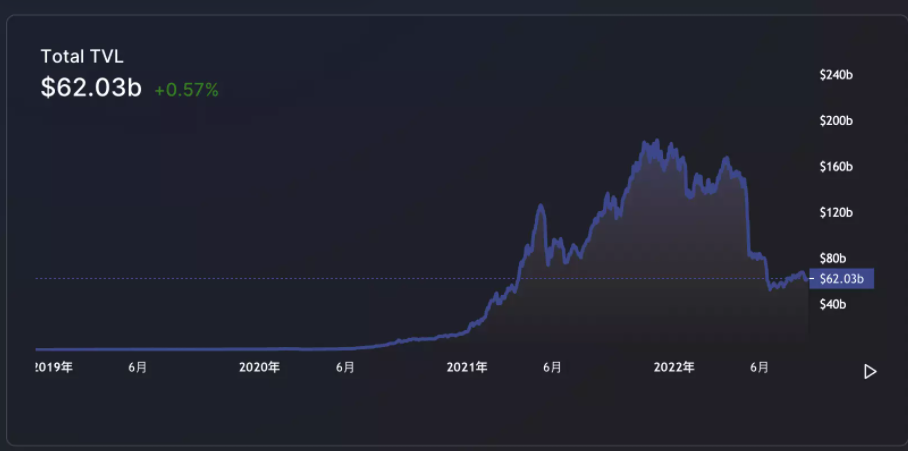
Let’s begin by examining value capture in DeFi tokens.
Which DeFi Token Economic Model Holds an Advantage?
An interesting data point circulating on Crypto Twitter compares the performance of different DeFi token economic models from the beginning of this year to now. The best-performing category has been Productive Tokens—tokens that are inherently productive in nature.
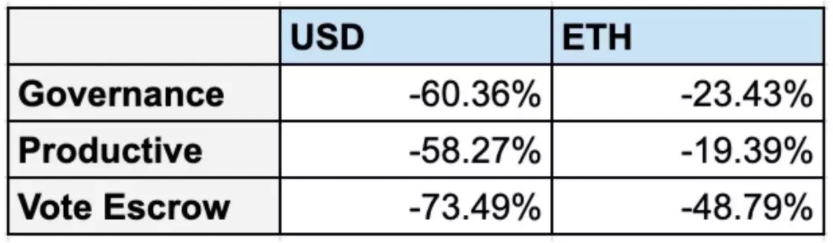
Put simply, Productive Tokens are directly tied to protocol operations and have clear utility. In contrast, Governance and Vote Escrow (ve) tokens primarily serve governance functions. Although ve-token models, led by Curve, are popular among on-chain users and help reduce overall token circulation, they come with trade-offs.
Over time, ve-token models result in massive token emissions. For example, Curve currently distributes over 1 million CRV daily to liquidity providers.
From the perspective of sustainable tokenomics, productive tokens hold greater long-term advantages.
Protocols behind productive tokens often generate real revenue, and these revenue-generating DeFi protocols are driving new trends.
What Is Real Income?
Recently, “Real Yield” has become a buzzword on Crypto Twitter. As the term suggests, it refers to DeFi protocols that generate genuine returns—not just rewards from token emissions.
Twitter user TheDeFiedge defines the concept as follows:
1) Product-market fit: The protocol is used regardless of market conditions or token incentives.
2) The protocol generates on-chain income through its products.
3) Income > Operating costs + token emissions: As long as revenue is strong, some level of token emission is sustainable.
4) They share profits with token holders in stable assets: ETH and stablecoins are the most preferred.
Take Synthetix as an example:
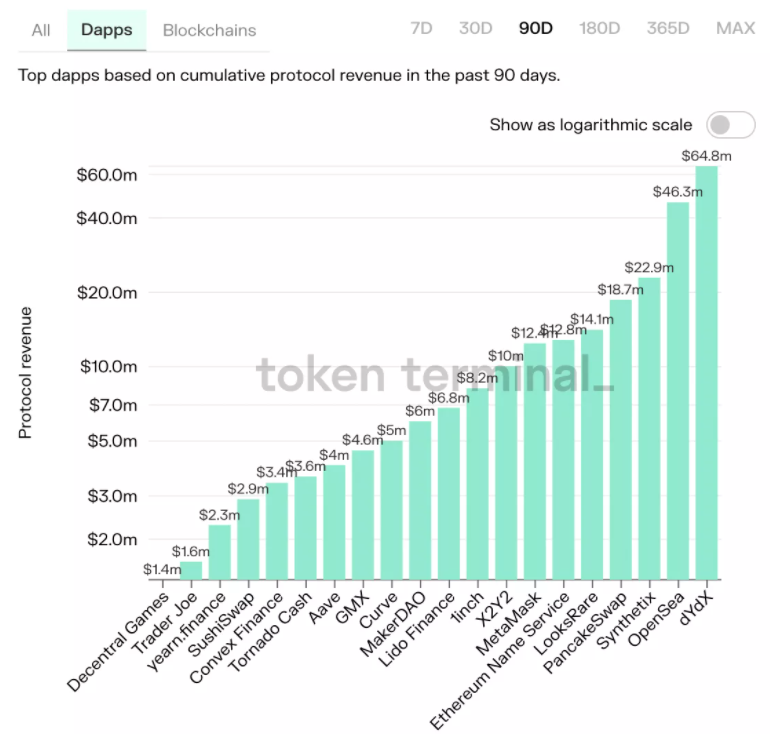
According to Terminal data, over the past three months, Synthetix ranked third among all DApps in terms of revenue, generating over $46 million—a remarkable feat for a protocol once criticized for having only a handful of daily active users. Its growth during a bear market is nothing short of miraculous.
How did Synthetix achieve this turnaround?
Synthetix is a decentralized synthetic asset issuance protocol that allows the creation of synthetic assets (Synths) without requiring the underlying physical assets. We can use synthetics to track any valuable asset in the real or crypto world (short crypto positions, USD, stocks, gold, oil, etc.). All synthetic assets are backed by SNX, the native token of Synthetix, and whales enjoy near-zero slippage when making large trades.
Synthetix's resurgence stems from continuous protocol upgrades and adaptations made by the team in response to market dynamics.
Two key initiatives drove this surge:
-
Implementation of SIP-120: Changed settlement times for synthetic asset trades from 10 minutes to instant atomic swaps.
-
Integration with aggregators like 1inch: Synthetix and Curve’s low-slippage trading paths became optimal routes (Uniswap was bypassed).
For instance, if you want to buy ETH with USDC, the path becomes:
- USDC → sUSD (low slippage via Curve)
- sUSD → sETH (zero slippage via Synthetix)
- sETH → ETH (low slippage via Curve)
After successfully outcompeting Uniswap, Synthetix began sharing protocol revenue with SNX stakers. While SNX stakers are exposed to systemic debt risk (a unique feature where stakers act as counterparties to all synthetic asset trades, meaning their debt position can fluctuate), the revenue-sharing mechanism incentivizes many DeFi users to stake SNX.
There are now protocols that help users hedge against debt volatility, allowing SNX stakers to mitigate risks while capturing protocol dividends.
Beyond Synthetix: Other Protocols Capturing Real Yield
GMX, a decentralized perpetual exchange built on Arbitrum and Avalanche, offers up to 30x leverage. GMX converts 30% of trading and funding fees into ETH/AVAX and distributes them to GMX stakers.
Gains Network, built on Polygon, launched gTrade—an efficient, powerful decentralized leveraged trading platform offering up to 150x leverage on cryptocurrencies, 100x on forex, and 100x on stocks. When the DAI vault balance exceeds 130% of its TVL, a buyback-and-burn mechanism is triggered.
Trader Joe, the top DEX on Avalanche, allows JOE staked as sJOE to earn rewards in the stablecoin USDC.
In Conclusion
Returning to our original question: Which types of protocols will achieve sustainable growth in the future DeFi landscape?
Will real-yield protocols lead the way?
The top three revenue-generating protocols shown earlier—dYdX, OpenSea, and PancakeSwap—are all real-income protocols. Yet, the challenge remains: some lack tokens altogether, while others have tokens without meaningful protocol utility.
At its core, without utility, a token cannot provide a strong moat—more user-friendly competitors can easily attract users and displace existing protocols.
Herein lies the advantage of productive tokens: they act as a moat, continuously attracting user attention and capital, enabling shared value between the protocol and its users. dYdX plans to address its current lack of token utility in its upcoming V4 launch by enhancing value capture—an emerging priority across the DeFi space.
Generating real income reflects a protocol’s competitiveness within the DeFi ecosystem and provides the financial foundation for ongoing development. Productive tokens will serve as the moat, enabling protocols to share captured value with users.
These two elements will prove critical in helping DeFi protocols withstand highly volatile markets.
So far, we’ve discussed the logic of value capture and the evolving trajectory of DeFi protocols. As time progresses, more innovative and competitive projects will emerge, pushing the industry forward. Whether DeFi will replace CeFi is beyond the scope of this article. A more likely future is one of convergence—where DeFi and CeFi integrate, each excelling in their respective domains to achieve superior capital efficiency.
Join TechFlow official community to stay tuned
Telegram:https://t.me/TechFlowDaily
X (Twitter):https://x.com/TechFlowPost
X (Twitter) EN:https://x.com/BlockFlow_News
 雨中狂睡Sleeping in the Rain