Can a public blockchain backed by Korea's "Facebook" shine?
TechFlow Selected TechFlow Selected
Can a public blockchain backed by Korea's "Facebook" shine?
Klaytn is preparing for Klaytn 2.0, which includes scaling L2 solutions, metaverse documentation, tools for creating DAOs, and more infrastructure.
 Navigating Web3 tides with focused insights
Written by: Ignas
Translated by: TechFlow intern
Klaytn is South Korea's (unofficial) public blockchain, launched in 2019. It is:
-
One of only four blockchains supported by OpenSea;
-
Ranked 14th in TVL within DeFi;
-
$KLAY is ranked 66th by market cap;
Yet, few outside of South Korea have heard of it. In this KBW, let’s dive into what Klaytn is all about.
Klaytn is backed by Kakao—the "Facebook" of South Korea. Kakao is the most widely used messaging app in South Korea, with 53 million active users. These users can access a Klaytn blockchain wallet directly within the Kakao app. Imagine having an Ethereum wallet inside Facebook Messenger or WhatsApp—this kind of integration could bring massive traffic to Web3.

Klaytn was originally a fork of Ethereum and focuses on scalability and performance through its Governance Council (GC). Its operators are DAOs and multinational organizations such as:
-
LG;
-
MakerDAO;
-
Binance;
-
Hashed/Ozys;
-
Kakao, and others.

Thanks to these strong supporters, Klaytn became the second blockchain integrated into OpenSea—even before Polygon or Solana. As members of their KBW team told me, they reached out to OpenSea early on, back when the NFT space wasn’t yet booming.

Klaytn’s DeFi ecosystem also took a hit in April, with TVL dropping from $1.2 billion to its current $415 million. Currently, the most popular dApps on its chain are:
-
DEX—KLAYswap and Kokonutswap;
-
Lending market Klapfinance;
-
Liquidity staking for KLAY;
Although KlaySwap alone accounts for 50% of its TVL.

With that in mind, Klaytn’s primary focus is the metaverse. Sangmin SEO, Chief of Klaytn, presented his vision and positioning of Klaytn within the crypto ecosystem at KBW.
I attended his talk. Here’s what he said:
Forget TPS. For different metaverse user experiences on blockchains, low latency is essential. Transaction latency = time transaction is included in a block minus time it was submitted to the network—that’s the delay between input and receiving output.

According to Klaytn’s own research, Klaytn has the lowest transaction latency, averaging 2.1 seconds. NEAR follows with 2–5 seconds, Solana with 2–30 seconds, while Polygon averages 10.9 seconds—and often exceeds 100 seconds.
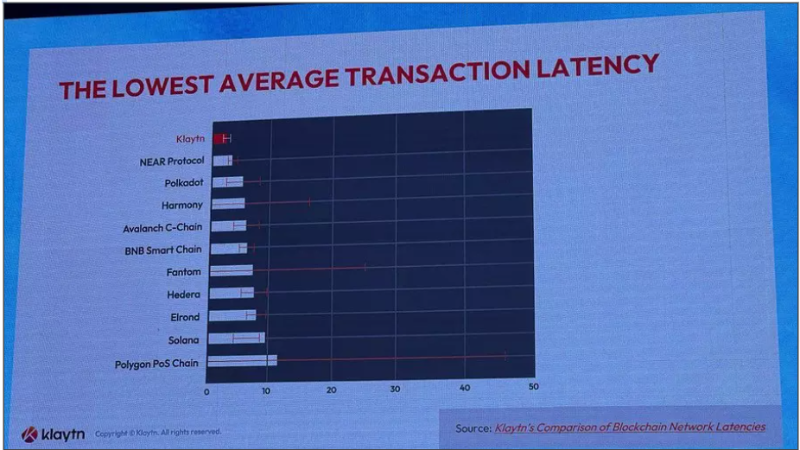
More importantly, Klaytn achieves 1-second block generation and instant finality. By comparison, $ETH requires 14 network confirmations before a transaction is considered finalized on-chain.

However, in terms of transactions per second (TPS), it does not make Klaytn the fastest blockchain. At 4k TPS, it lags far behind Polygon, Fantom, or Solana—but Klaytn plans to improve on this.
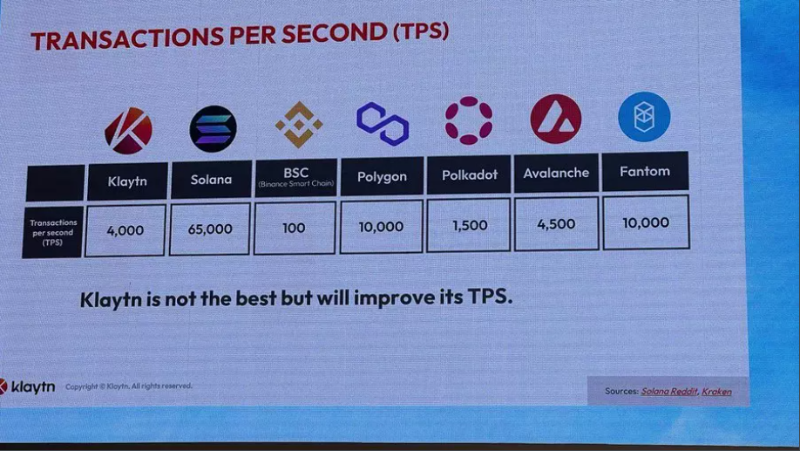
Finally, Klaytn is preparing for Klaytn 2.0, which includes scaling via L2 solutions, metaverse-specific features, tools for creating DAOs, and further infrastructure enhancements.
Join TechFlow official community to stay tuned
Telegram:https://t.me/TechFlowDaily
X (Twitter):https://x.com/TechFlowPost
X (Twitter) EN:https://x.com/BlockFlow_News