Dialogue with Klaytn: The Asian market holds enormous potential; the next key step is completing the merger with Finschia
TechFlow Selected TechFlow Selected
Dialogue with Klaytn: The Asian market holds enormous potential; the next key step is completing the merger with Finschia
Due to the large amount of work required, the merger will be carried out in phases: first establishing a new unified foundation, followed by phased implementation of community and technical integration to ensure continuous availability.
 Navigating Web3 tides with focused insights
Interviewee: Sam, Director of the Klaytn Foundation
Author: 1912212.eth, Foresight News
Introduction
Since the Terra incident, the entire crypto industry has suffered a heavy blow. Fortunately, starting last year, the industry has finally begun to recover and steadily move forward again.
In South Korea, apart from the Terra blockchain, another early-mover public chain—Klaytn—is now making frequent moves. After revising the KLAY tokenomics last year, Klaytn announced plans to build an RWA tokenization support system covering token-based product development, issuance, asset custody, and trading. Additionally, it partnered with MAP Protocol to achieve cross-chain interoperability.
At the beginning of this year, prominent market maker DWF applied to join Klaytn’s Governance Council, pledging to purchase five million KLAY tokens. Under the influence of these positive developments, we’ve seen the KLAY token price slowly climbing over recent months.
However, the biggest event so far is undoubtedly the approval of the merger proposal between Klaytn’s mainnet and LINE’s blockchain project, Finschia—a move that will pave the way for its expansion into the Asian market.
What are Klaytn’s future plans? How does it intend to gain an edge in the fiercely competitive battle among public chains? And how will it establish its own dominant position across Asia?
Foresight News: You started deeply exploring Bitcoin and blockchain back in 2017 and hold a PhD in high-performance computing. Could you briefly introduce yourself?
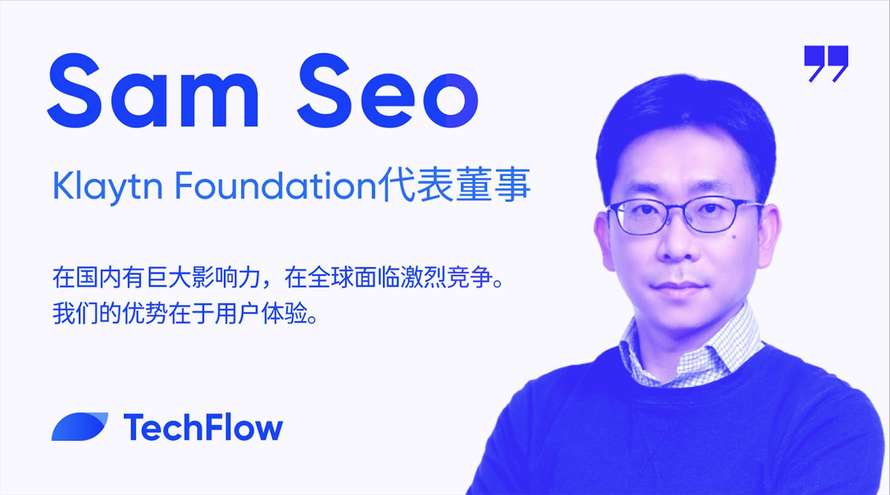
Sam: I’m Sam Seo, currently serving as the Representative Director of the Klaytn Foundation. The Klaytn Foundation is a non-profit organization dedicated to advancing the global adoption and ecosystem maturity of Klaytn. Previously, I served as Chief Knowledge Officer at Krust Universe, leading the development and operations of Klaytn. I also held the role of Chief Technology Officer at GroundX, Kakao’s blockchain subsidiary in Korea, and worked as an Assistant Computer Scientist at Argonne National Laboratory.
Differentiation Is Key
Foresight News: In the previous cycle's public chain wars, only a handful survived and remain active. What sets Klaytn apart from other public chains? Where do your advantages lie?
The core differentiating advantage lies in user experience. Many L1s are designed around one specific strength—such as TPS, decentralization, or privacy—but Klaytn was built as a technology platform focused on practicality. This means we're not a single-skill L1 but rather an all-rounder capable of attracting both developers and users. Ultimately, long-term success depends on real-world adoption.
With just a 1-second block time, instant finality, account abstraction, and fee delegation, Klaytn delivers a solid Web3 user experience—making interactions feel as fast and smooth as Web2. We maintain Ethereum equivalence to simplify DApp development, offer low gas fees to ensure global accessibility, and design our tokenomics to encourage stable and sustainable growth. Beyond technology and token economics, we provide comprehensive support beyond just financial grants, ensuring projects launching on Klaytn can fully realize their potential.
Foresight News: Do you see clear differences between Western (European and American) users and those in the Asia-Pacific region? Any insights to share about Klaytn’s strategy for expanding into the APAC market?
While every region has diverse user types, one key difference between Web3 users in Europe and the U.S. versus those in the Asia-Pacific region is that APAC users tend to place less emphasis on decentralization and exhibit higher trust in institutions—whether governmental or financial.
At the Klaytn Foundation, we believe entering the APAC market means embracing the cultural and social diversity of Asia, striving locally to create Web3 services that bring maximum benefit to each national community.
Ecosystem Fragmentation and Project Consolidation
Foresight News: Years ago, Coinbase CEO predicted that some blockchain projects would eventually merge, and we’re already seeing this trend unfold. Do you think such consolidations will continue? Recently, Klaytn merged with Japan’s Finschia blockchain—could you elaborate on the reasons and strategic thinking behind this move?
As mentioned earlier, we believe the blockchain industry will consolidate over time into fewer, more dominant chains. Fragmentation hinders mass adoption, so once we successfully complete the merger with Finschia, we wouldn’t be surprised if other chains follow suit.
There were multiple strategic reasons behind our decision to merge with Finschia. To summarize: Asia accounts for 34.7% of global GDP and 77.9% of spot crypto trading volume, yet blockchain platforms based in Asia represent only 4.9% of total network value. We believe this gap stems from fragmentation and competition among Asia-based blockchains. There’s a significant opportunity for a dominant player to emerge and close this value gap.
We chose Finschia for several reasons, including our shared corporate roots—Klaytn was initiated by Kakao, while Finschia originated from LINE. Each chain integrates with its parent company’s messaging app, which are immensely popular communication tools across many Asian countries. This allows us to complement each other in building a Web3 infrastructure and service ecosystem. Through this merger, we aim to create Asia’s largest Web3 ecosystem and business network, with a potential user base of over 250 million Asian Web3 users, 420+ DApps, 45+ governance partners, and 450+ Web3 resources.
L2 or L1?
Foresight News: In the blockchain world, there's always been debate over L1s versus L2s, and some even argue that many upcoming public chains will become L2s. Can Klaytn share any plans regarding L2 development?
As blockchain services grow in popularity, users naturally gravitate toward more established ecosystems, which in turn attract more developers—making consolidation inevitable. This may happen in various ways, including L1s choosing to become L2s within more mature ecosystems. Our recent approval of the merger with LINE’s Finschia blockchain represents another path toward integration.
Regarding our L2 plans, we’ve already provided easily deployable service chains for developers needing dedicated throughput and customizable performance. While the foundation currently has no plans to launch its own L2, anyone is free to develop and deploy an L2 on top of Klaytn.
The Roadmap Ahead
Foresight News: After the Terra incident, do you think South Korea has recovered from its negative impact? What lessons did Klaytn learn from this event?
Although Terra was a project headquartered in South Korea, the incident affected Web3 users globally, and the entire market is still recovering. After the Terra collapse, credibility became paramount. Decentralized governance, along with transparent and sustainable token economics, has become critical for Web3 projects—including L1 blockchains.
Foresight News: What do you see as Klaytn’s focus going forward? What are the most urgent challenges? And what strategies are in place to address them?
Given that our merger proposal with Finschia has recently been approved, our top priority right now is executing and completing this merger. Due to the scale of work involved, we’ll carry out the integration in phases—first establishing a new unified foundation, followed by staged community and technical integration to ensure continuous availability.
Foresight News: Are there any upcoming events or major announcements from Klaytn you can share?
Beyond the merger with Finschia, we’ve been steadily expanding our RWA ecosystem. Recent highlights include the launch of tokenized gold in the form of $GPC, U.S. Treasury bonds via Elysia, tokenized financing in partnership with KORINDO, and a collaboration with Tokeny to support RWA compliance. We welcome builders looking to launch RWA-based projects to join our rapidly growing ecosystem and help drive broader blockchain adoption across Asia.
Join TechFlow official community to stay tuned
Telegram:https://t.me/TechFlowDaily
X (Twitter):https://x.com/TechFlowPost
X (Twitter) EN:https://x.com/BlockFlow_News
 Foresight News