Interview with Klaytn Foundation Board Representative: South Korea's Web3 Navigational Map
TechFlow Selected TechFlow Selected
Interview with Klaytn Foundation Board Representative: South Korea's Web3 Navigational Map
We have significant influence domestically, while facing intense competition globally. Our strength lies in user experience.
 Navigating Web3 tides with focused insights
TechFlow: Sunny, David & Zolo
Klaytn Foundation: Sam Seo
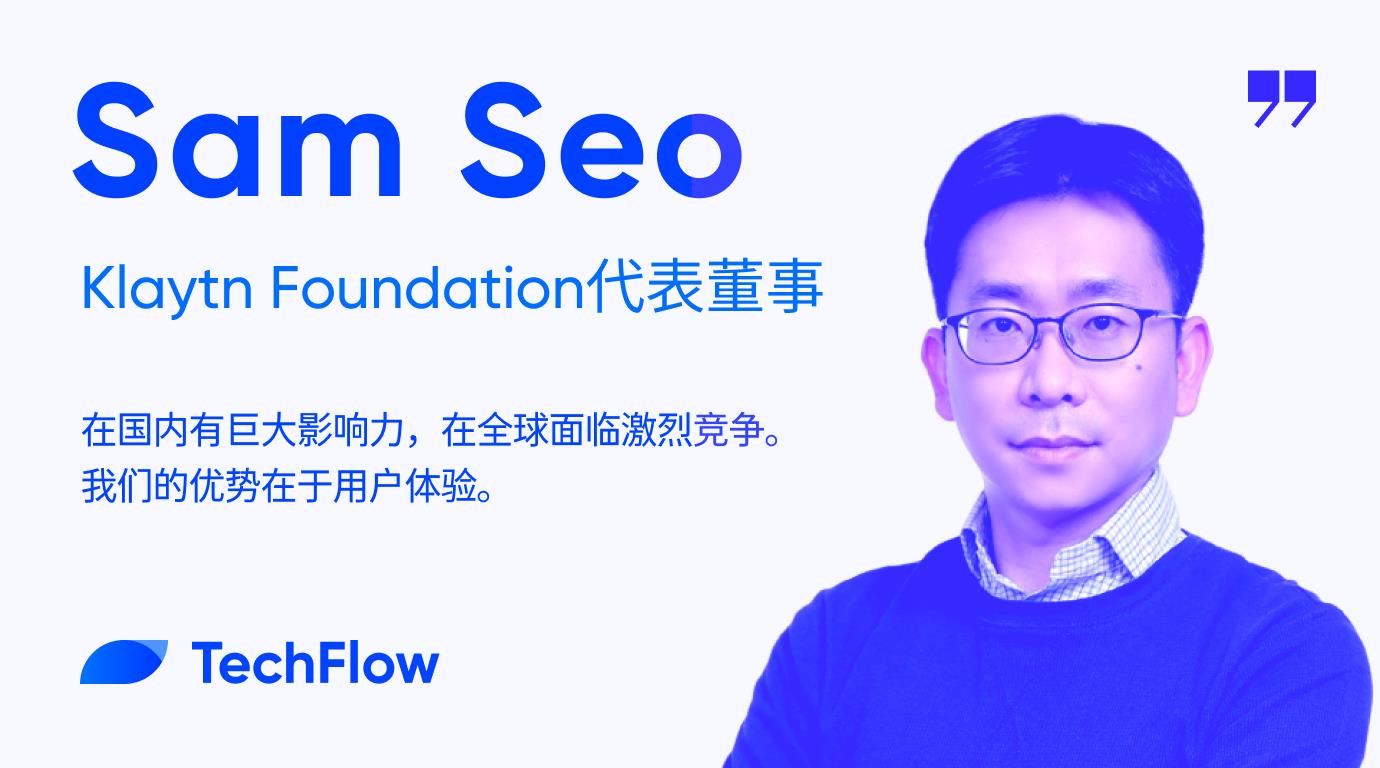
"We have significant influence domestically but face intense global competition. Our advantage lies in user experience."
-- Sam Seo, Representative Director of Klaytn Foundation
Preface
After Token2049, the crypto market has once again turned its attention to Asia. While there is a general consensus that Asian crypto industries lag behind Western counterparts in infrastructure innovation, Asia excels in internet application engineering, government policy tolerance, and tightly-knit communities—sometimes even surpassing Europe and the U.S.
South Korea, a nation thrust into the spotlight last year by the Luna crash, has only grown more resilient.
On the regulatory front, the local government continues to promote policies protecting crypto investors. Tech giants are actively building regional public blockchains, leveraging centralized engineering strengths to dramatically improve end-user experiences. In international expansion, they adopt a long-term strategy: strengthening domestic crypto ecosystems while establishing footholds in Singapore, leveraging superior user experience to capture the Asia-Pacific and Southeast Asian markets, all while cautiously observing developments in Europe and North America.
Take KakaoTalk as an example—an instant messaging app with over 95% market share in South Korea, equivalent to WeChat in China. Within KakaoTalk, users can transfer funds via a built-in crypto wallet where gas fees are abstracted away in the backend. Industry-standard account abstraction protocols are already implemented. Given the level of governmental support and tech-led initiatives, South Korea’s crypto ecosystem delivers relatively strong user experiences.
In the real-world asset (RWA) space, Korean crypto firms are collaborating closely with the Korea Gold Exchange to tokenize gold assets, enhancing both liquidity and transaction volume in the gold market.
Which leading project stands behind these strategies?
Klaytn is a public blockchain project backed by Kakao, a major South Korean internet conglomerate. Every strategic move Klaytn makes reflects deep understanding of Korean internet users and a bold willingness to challenge norms. Kakao Group, similar to Tencent in China, is a pivotal tech company with diversified services spanning messaging, gaming, e-commerce, and fintech.
Below is the conversation between TechFlow and Sam Seo, Representative Director of the Klaytn Foundation—an exchange that may offer insights or resonance for readers interested in neighboring crypto markets and their development.

Background and Thoughts on Web3
TechFlow: Could you introduce yourself and share how you first got involved with Klaytn?
Sam:
I completed my Ph.D. in computer science, specializing in high-performance computing with a focus on software performance optimization. Before entering Web3, I worked at a research institute, primarily improving code efficiency and developer usability. In 2017, while working as a research engineer at Samsung, a friend introduced me to Bitcoin, prompting me to study the whitepaper and related materials. That marked the beginning of my deep dive into Bitcoin and blockchain technology.
I found Bitcoin’s philosophy enlightening—especially its emphasis on decentralization and transparent systems capable of transforming decision-making and finance. As I learned about Ethereum and its unique vision, I became convinced it could shape the future of the internet and software architecture. Inspired by this vision, I joined Ground X, Kakao’s blockchain subsidiary, as a software and protocol engineer. On the core development team, I helped design and implement Klaytn as a public blockchain.
TechFlow:
You hold a Ph.D. in high-performance computing and were exposed to the Bitcoin whitepaper early in your career. From your perspective, given your strong software background, what is the intersection between traditional networks and blockchain?
Additionally, many believe blockchain's primary application is in finance. Even Elon Musk mentioned on Lex Fridman’s podcast that he believes blockchain will ultimately solve financial problems. However, he didn’t emphasize other potential applications. From your standpoint, how should blockchain empower the next generation of the internet beyond fintech?
Sam:
First, I agree with others that blockchain’s most widespread current application is in finance. However, I believe blockchain and smart contracts extend far beyond financial systems. Web3 was originally envisioned as a decentralized internet. Yet due to operational and technical challenges, Web1 and Web2—the current internet—evolved into centralized systems controlled by large corporations. But the original design of the internet was decentralized. We had browsers and interfaces—frontends—and backends where data was stored and owned. Today, for efficiency and security, companies like Google and Meta own and manage all user data.
With Web3, blockchain, and smart contracts, everything becomes transparent and accessible. The system itself is highly secure, with cryptography-based blockchain technology ensuring data integrity. Data is securely stored, and ownership can be returned to creators and users. By owning their data, individuals can monetize or use it without relying on third-party intermediaries. However, large companies may still be necessary to deliver optimal user experiences. But in terms of data ownership and transfer, blockchain and Web3 enable decentralized approaches. That’s the key difference—and what sets Web3 apart from traditional technologies or legal frameworks.
Enhancing Web3 User Experience Is Klaytn’s Mission
TechFlow:
I know Klaytn is building the foundational trust layer for Web3, the metaverse, and the future internet. Currently, there are many Layer 1 blockchain platforms. To my knowledge, Klaytn has achieved large-scale adoption in the Korean market. Beyond regional differences, what distinguishes Klaytn from other blockchain platforms?
Sam:
Klaytn prioritizes superior user experience, which requires low-latency platforms and high throughput. While blockchain platforms are generally secure (unless vulnerabilities exist), many still lag behind existing Web2 systems in speed and responsiveness. Users are accustomed to fast, high-performance systems like mobile apps. Yet when using blockchain, they often perceive slowness and must manage private keys and hacking risks.
Solving these UX issues is crucial, and Klaytn differentiates itself by offering second-level block finality and consistency. When using Klaytn, users won’t notice any difference between Web2 and Web3 applications. Moreover, while Klaytn doesn’t claim to be the best, it aims to deliver high throughput and transactions per second (TPS), enabling developers to build apps in high-performance environments. Finally, Klaytn offers native fee delegation from day one, allowing users and services to abstract away complex gas fee payments. This feature sets Klaytn apart from other public chains and enhances the overall Web3 user experience.
TechFlow:
In blockchain, people constantly grapple with the trilemma of scalability, decentralization, and security. If Klaytn achieves low latency and high throughput, matching Web2 speeds, which aspect of the trilemma is being sacrificed to achieve this?
Sam:
Initially, we often sacrifice some degree of decentralization to address scalability. Security remains non-negotiable. When prioritizing scalability, decentralization may be compromised. Nevertheless, our technical team is actively researching ways to enhance decentralization without sacrificing performance, and we’ve made significant progress.
Preferences of 6 Million Korean Crypto Users
TechFlow:
South Korea has become a major player in blockchain and Web3 thanks to its significant advancements. How would you describe the current state of Korea’s Web3 industry? I understand your headquarters are now in Singapore, indicating confidence in Korea’s domestic market. What unique characteristics or advantages does Korea’s Web3 sector have compared to other countries?
Sam:
As you noted, Klaytn originated in Korea. Although our headquarters are now in Singapore, our primary market remains Korea. Understanding the Korean market is essential.
The Korean market differs significantly from Western ones, especially in user preferences—whether crypto users or general internet users. They value credibility and usability more than decentralization. Notably, they tend to use centralized exchanges more frequently.
In Korea, there are over 6 million crypto users. While not all use blockchain wallets, many have accounts on centralized exchanges—a uniquely Korean trait. This preference stems from the usability of centralized exchanges: faster, cheaper, and more convenient than decentralized ones. Users don’t need to manage private keys and tend to trust exchange operators.
Given this, Korea’s Web3 and blockchain industries revolve around the activities and user experiences of centralized exchanges. Klaytn’s goal in Korea is to bring these CEX users into the Web3 world. While many are currently focused on trading, if we can provide better DeFi experiences and enhance their overall experience on Klaytn, they may explore and adopt Web3 services.
One way we’re achieving this is by integrating a crypto wallet into KakaoTalk. With over 95% penetration in Korea, we embedded the Klaytn wallet, hiding complexities like private keys and addresses. Users can seamlessly send tokens and use DeFi services within KakaoTalk. This integration encourages developers to bring Web2 users into Web3 and onto Klaytn.
TechFlow: That’s impressive. Have you observed other Korean projects addressing user experience? Are these applications driving mass adoption in the Klaytn ecosystem?
Sam:
One area gaining traction on Klaytn is gaming. Though not new, adoption of gaming on Klaytn has been consistently high. To address user adoption barriers, they leverage Klaytn’s fee delegation.
A game called SuperWalk offers two modes: free and pro. In pro mode, users need NFTs to participate—a hurdle requiring them to acquire tokens and buy NFTs. But in free mode, this complexity disappears. The SuperWalk team uses Klaytn’s fee delegation to cover gas fees, allowing users to play effortlessly without handling tokens. They hide the complex interface, offering a Web2-like entry point. Gradually, users are introduced to premium features requiring token purchases.
They also integrated the aforementioned Klip wallet. KakaoTalk users can easily access this DeFi app using their existing wallet—even without initial tokens. Over time, they learn about purchasing NFTs and deeper gameplay. This approach helped SuperWalk gain more Korean users and expand into Japan and other countries. Their focus on seamless UX—without upfront token concerns—lets users start playing immediately, switching to pro mode later. This effectively solves UX challenges in emerging games.
Looking ahead, the team is exploring digital asset organizations for real-world assets. While still in progress, one expected service is gold tokenization. The Korea Gold Exchange aims to bring transparency and liquidity to physical gold by enabling users and investors to buy, sell, and trade gold tokens on-chain. Though not yet launched, this service is expected later this month or early next month. Once live on Klaytn, it will bridge the on-chain world with tangible assets like gold. Users can purchase gold on Klaytn without physical storage, as the gold will be securely held by the exchange. This development could unlock various applications built atop these gold tokens.
Global Expansion or Focus on Asia First?
TechFlow:
I know Kakao is a key partner and supporter of Klaytn. What role does this partnership play in the project’s development? What challenges would Klaytn face without it?
Sam:
We recognize that competing with other public chains outside Korea is challenging. Domestically, we have strong influence, but globally, we must compete. However, we have a key advantage: expertise in user experience. We’ve successfully developed and deployed numerous use cases and applications on Klaytn in Korea. These serve as blueprints. By partnering with local teams abroad, we can adapt our proven experiences to new markets and applications. This is our strategy and a key differentiator. We possess firsthand knowledge of how to make Web3 and DeFi intuitive and comfortable for users. This is how we leverage existing expertise and partnerships to enter new markets.
TechFlow:
Klaytn’s international team has been based in Singapore for some time. How would you describe the relationship between the Korean and broader Asian market teams? And what must Klaytn do locally to leverage its UX expertise and boost competitiveness in Asia?
Sam:
Our strategy involves collaborating with local teams in each country to localize Klaytn’s services. For example, this year we’re focusing on increasing visibility in Vietnam. We’ve hired local team members and partnered with Vietnamese marketing agencies. Rather than relying solely on internal staff, we empower local teams to introduce our history, partners, and ecosystem to their markets. This has led to numerous collaborations with local entities.
When engaging local markets, we don’t just highlight our success in Korea. We emphasize our goal of fostering Web3 industry growth in the target country. This makes Klaytn more relatable and easier to accept. Our strategy is to localize content and DeFi products to meet each country’s specific needs.
TechFlow:
Let’s compare the builder ecosystems in Vietnam and Korea. The Korean market places high value on user experience. But in Vietnam, builders prioritize differently. From both builder and user perspectives, what aspects matter most?
Sam:
Based on my experience and understanding of Vietnam, local builders prioritize practicality. Despite having many developers, their experience and maturity in web technologies remain at an early stage. Hence, they focus on small-scale or quickly deployable projects. In contrast, Koreans place greater emphasis on enhancing user experience. Many Korean users and developers already have experience building Web3 applications.
In Vietnam, both the market and developers are still nascent, lacking rich experience. As an ecosystem and Layer 1, we strive to reduce trial and error. Without our support, Vietnamese developers would face countless failures independently. The key difference is limited experience, leading them to focus on smaller projects and rapid service launches.
TechFlow:
Exactly. I think that’s the beauty of Web3. Despite competition, collaboration is possible because local teams, markets, and builders across countries each have unique strengths and weaknesses. Web3 is about combining these diverse elements into a truly global formula.
Beyond Asia, has Klaytn considered entering larger markets such as Europe, the U.S., or South America?
Sam:
We attempted expansion into the U.S. and Europe last year. However, due to limited resources and cultural differences, these efforts weren’t very successful. Therefore, this year we’ve decided to focus primarily on Asian markets. Our plan is to first establish a strong user base and community in Asia before considering further expansion. Currently, our main focus is Asia. While we have partners in the U.S. and Europe, our target audience does not specifically include users from those regions. We collaborate with partners in various ways, but our primary user focus is Asia.
Symbiosis with Ethereum
TechFlow:Regarding development strategy, it’s worth noting that Klaytn is an EVM-compatible Layer 1 public chain. Given this compatibility, what kind of symbiotic relationship exists between Klaytn and Ethereum?
Sam:
As an EVM-compatible chain, we deeply value Ethereum and EVM technological advances. We continuously monitor Ethereum and EVM updates and actively contribute to the technical development and growth of the Ethereum developer community.
Though our contributions may be modest, we occasionally submit EIPs (Ethereum Improvement Proposals). When we design features on Klaytn that we believe could benefit the broader community, we propose them via EIPs, contributing to ecosystem development.
Since Klaytn is EVM-compatible, our smart contracts are primarily written in Solidity. Thus, we invest heavily in educating developers about Solidity and the EVM environment. Interestingly, a member of the Ethereum Foundation told us that Klaytn has greatly contributed to the growth of Solidity and Web3 developers in Korea by actively supporting education and training within the community.
TechFlow:I know many EIP editors and authors come from Asia and have witnessed practitioners across the Asia-Pacific region contributing to the broader ecosystem. Now, in Asian markets, have you encountered competition from Ethereum in market penetration?
Sam:
No, because Ethereum currently positions itself as a settlement or data availability layer. They are focusing on scaling through Layer 2 solutions and other advanced technologies.
I wouldn’t say we’re in direct competition with Ethereum. Instead, we see our relationship as collaborative—growing the market and expanding the user base together. As an Ethereum-compatible chain, we appreciate Ethereum’s technology and adopt it where applicable. We also aim to help Ethereum grow its community and market. So I wouldn’t characterize our relationship as competitive, but rather Klaytn competing in its own niche.
Post-Luna Crash Korea: Market Expansion Is No Longer the Priority
TechFlow:Last year, we experienced the Luna collapse, triggering a crisis across the industry. How did this impact the Korean crypto market?
Sam:
Indeed, that event significantly impacted Korea’s digital economy. Terra was one of Korea’s largest projects, and many Koreans invested in its tokens. Numerous teams were building decentralized file systems (DFS) on Terra, with some operating live services. After the crash, some teams migrated to other chains, while others ceased operations entirely. This had profound effects on both businesses and investors.
Due to the Terra incident, the Korean government intensified its regulatory scrutiny. Although regulations were already being drafted, the event shifted focus toward investor protection over mere industry expansion. Today, regulations aim to balance industry growth with safeguarding investors from fraud and scams.
The Terra Luna collapse drew heightened attention from policymakers and politicians toward investor protection. While efforts to advance the industry continue, the central focus remains on how regulators can shield retail investors from similar events.
TechFlow:In the post-crisis era, with trauma and stricter regulation, how has Klaytn adjusted its strategy or taken action?
Sam:
Some of our current moves aren't directly tied to the Terra issue. But our direction emphasizes transparency to address problems like those seen with Terra Luna—issues rooted in opacity and centralized decision-making.
At Klaytn, we focus on ensuring transparent decision-making processes and decentralizing authority as much as possible. Since last year, especially this year, we’ve made significant efforts to build Klaytn Square, a governance portal. Klaytn Square is a platform where users can access all information regarding our treasury and governance agenda. Anyone can view details such as who funded specific proposals and how treasury funds are managed. By disclosing this critical information, we demonstrate our commitment to transparency with users and investors. We believe this openness will encourage regulators and investors to consider Web3 and Klaytn favorably, potentially attracting investment.
Additionally, as a Layer 1 platform, we’re actively working to integrate more stablecoins into the Klaytn network. We collaborate with teams already developing stablecoins, prioritizing those with robust security measures during our evaluation. However, we currently have no plans to issue our own stablecoin.
Klaytn’s Community Engagement
TechFlow:My final question is about Klaytn’s strong focus on user experience. During this bear market, how can those interested in Klaytn learn more and start building on the platform? Does Klaytn organize events or workshops for participation?
Sam:
Actually, our annual event, "KlayMakers23," started two days ago. This hackathon will run for over a month, with submissions open until the end of November. It’s a global online hackathon open to any developer or team building on Klaytn, designed to attract more developers to the platform.
Beyond the hackathon, we host monthly all-hands meetings on Discord in both English and Korean. Held during the last two weeks of each month, these sessions are open to users, investors, and anyone interested in Klaytn and its ecosystem.
We also occasionally attend conferences, setting up booths or participating in panel discussions. For instance, during last month’s Korea Blockchain Week, we hosted a side event; at Token2049 in Singapore, we had a booth at the main venue and organized after-parties and networking events.
These activities—including hackathons, all-hands meetings, and conference participation—are all aimed at engaging users, developers, and investors in the Klaytn community.
Note*
Developed by Kakao, a leading South Korean internet conglomerate, Klaytn is a global Layer 1 public blockchain designed to power the future of the on-chain world. As one of the fastest blockchains among leading platforms, with enterprise-grade reliability and a developer-friendly environment, Klaytn delivers an unparalleled seamless experience for users and developers. Since its launch in June 2019, Klaytn has accelerated blockchain adoption through diverse use cases—from DeFi and the metaverse to gaming and even a CBDC pilot with Korean banks. Today, it stands as one of the few globally competitive Web3 ecosystems developed in Korea, having supported over 1 billion transactions from more than 300 decentralized applications.
The Klaytn Foundation and Klaytn are separate entities. The Klaytn Foundation is an independent body dedicated to supporting and promoting the development and adoption of the Klaytn platform. Operating as a non-profit, it serves as the governing body of the Klaytn ecosystem. The Foundation manages Klaytn’s initial coin offering (ICO), oversees its governance model, and drives partnerships with other organizations. Its mission is to nurture the growth and sustainability of the Klaytn ecosystem.
References
-
South Korean crypto regulation:
-
About Kakao Group:
https://www.kakaocorp.com/page/?lang=en
-
About Klaytn Foundation:
https://klaytn.foundation/
Join TechFlow official community to stay tuned
Telegram:https://t.me/TechFlowDaily
X (Twitter):https://x.com/TechFlowPost
X (Twitter) EN:https://x.com/BlockFlow_News
 深潮TechFlow