Seeking Answers for DAOs: How Can Metagovernance Establish Standards and Infrastructure for Online Governance?
TechFlow Selected TechFlow Selected
Seeking Answers for DAOs: How Can Metagovernance Establish Standards and Infrastructure for Online Governance?
Metagov is an interdisciplinary research community. Its goal is to set standards and build infrastructure for digital self-governance.
 Navigating Web3 tides with focused insights
Author: curiousjoe (@curiousjoe5)
The U.S. election draws global attention. Who cares about DAO elections?
Abortion rights spark nationwide debates. How many people participate in Web3 governance discussions?
Google Scholar contains endless papers under the topic "American politics." How much academic thought focuses on "crypto politics"?
When frustrated by progress, have we reflected on our lack of attention?
While lamenting DAO problems, have we considered that we criticize too much and think too little?
Answers to DAOs still require further exploration.
Web3 Governance and Cryptopolitics
Numerous DAOs flourished between 2021 and 2022. After the boom came the roaring bear market—how many are still holding on, and how many have become jokes?
Recently, an excellent article circulated widely—"The Great Defeat of Chinese DAOs: Don't Worry! None of Us Can Achieve Decentralized Autonomy"—though its title is provocative, its critique of DAOs hits the mark. These issues aren't limited to Chinese DAOs; from my experience in various DAOs, foreign DAOs suffer similar problems. I feel deeply empathetic and sigh with regret.
To rebuild, we must first dismantle. Critiquing DAOs is a positive sign, but beyond deconstruction ("breaking"), what we need more is construction ("building")—finding better ways to build DAOs.
Research drives progress, and this holds true in the Web3 world as well. Alongside practice, we also need rigorous academic study.
In the Western hemisphere, a group has already begun this work—and judging by member names, several core contributors are ethnic Chinese.
They start from the ground up, solving foundational issues, establishing standards and infrastructure for online governance. They also treat cryptopolitics as a distinct research subject—an interesting approach. "Wherever people gather, there's江湖 (politics)." Where interests are distributed, politics inevitably follows. As the governance layer in Web3, DAOs function as superstructures. More targeted research is therefore essential.
Let’s examine their practices to see how they’re “building”—in pursuit of answers for DAOs.
Metagovernance Project (https://metagov.org/)
Metagov is an interdisciplinary research collective aiming to establish standards and infrastructure for digital self-governance.
Setting standards and infrastructure for digital autonomy means building a foundational rule set for Web3 governance—akin to creating a Solidity-like language for all EVM-based dApps. This ambition is undeniably lofty and bold.
Founded around January 2020, the organization has already achieved much. We can better understand it through several aspects:
Members
Metagov’s team inspires confidence. Primarily composed of university researchers, the group carries a strong academic tone. Core members include scholars from top institutions such as Harvard University, Oxford University, UC Davis, and the University of Washington, with expertise spanning technology, society, and political science.
Notably, several core members are ethnic Chinese, recognized as leading researchers in their fields.
For example,
Joshua Tan serves as project lead, with a background as a Practitioner Fellow at Stanford’s Digital Civil Society Lab and a PhD in Computer Science from Oxford, plus academic training in mathematics and AI. His writings are highly recommended reading (Joshua Tan’s Medium).
Amy Zhang is an Assistant Professor in Computer Science & Engineering at the University of Washington and leads the Social Futures Lab there. She is spearheading PolicyKit within the Metagov project:
“Think about today’s online community platforms. Aren’t their governance models top-down and authoritarian, with roles like admin and mod? Can platforms adopt more democratic governance?... PolicyKit enables community members to easily define governance procedures themselves, which then execute automatically on the host platform. Our framework draws inspiration from Nobel laureate Elinor Ostrom, breaking governance down into discrete actions and rules encoded concisely.”
This tool is one of Metagov’s key offerings.
Backers and Funders
The project enjoys strong support from notable funders including the Henry Luce Foundation, One Project, the Grant for the Web, Gitcoin Grants, the Filecoin Foundation, the Ethereum Foundation, EPSRC / University of Oxford, GnosisDAO, Aragon, Radicle, Metacartel Ventures, NEAR, and Stanford Digital Civil Society Lab.
The project manages its funding through its own DAO—MetagovDAO—which uses a multi-signature model led by core members.
Philosophy and Tools
1. Philosophy:
Metagov doesn’t have a single, unified doctrine binding all projects into one cohesive ideology or toolkit. Instead, each initiative contributes a unique piece toward a shared vision, featuring innovative thinking throughout.
According to the official website, Metagov focuses on “describing, supporting, and expanding” the power of online community self-governance—specifically, the power of next-generation internet citizens to “organize social and political institutions collectively.”
Why describe and support this power? Because “online governance is evolving: competition, ideology, and technological advances have created new generations of games (e.g., Minecraft, Seed), social networks (e.g., Mastodon, Vingle), and collaboration platforms (e.g., Aragon, Colony). These emerging online communities are reshaping online governance.” Anyone involved in Web3 understands that while we enjoy greater freedom than in Web2, current online governance rights aren’t inherent—they depend on different governance platforms. These platforms provide tools and set rules. For instance, when voting occurs on Snapshot, our governance is constrained by Snapshot’s underlying logic. Thus, Metagov aims to “describe and support” this autonomy, with two goals: 1) enabling users to create their own governance mechanisms; 2) establishing unified standards so these mechanisms become composable, interoperable, and compatible. Once achieved, online governance will transcend platform limitations, extending governance rights and granting us greater autonomy.
"Modular Politics"
Toward the goal of describing, supporting, and expanding community self-governance, Metagov members introduced an intriguing concept in a published academic paper—"Modular Politics: Toward a Governance Layer for Online Communities."
"Modular Politics" proposes using institutional analysis theory from the real world to create paradigms for online self-governance. Unlike broad, high-level definitions like democracy or oligarchy, it aims to develop a suite of digital modules that are divisible, composable, transferable, and interoperable. Using these modules, online governance bodies like DAOs can customize their governance systems based on actual needs—selecting suitable governance modules, combining them, and integrating them into an ideal mechanism.
If these modules become sufficiently diverse, effective, and compatible, they could form a standardized governance layer for the Web3 world—a cryptopolitical governance layer addressing human relationships in the new internet era, going beyond mere code.
Standardized DAO URI
DAOs represent a key form of next-generation online governance. First mentioned in the Ethereum whitepaper, DAOs have lacked clear definition and universal standards ever since.
Metagov attempts to establish a unified standard for DAOs—inspired by something like the ERC-721 token URI. They’ve defined this standard as “EIP-4824,” encoding fundamental components of a DAO—including structure, membership systems, proposal systems, and activity logs—into JSON-LD Schema code files (https://daostar.one/EIP).
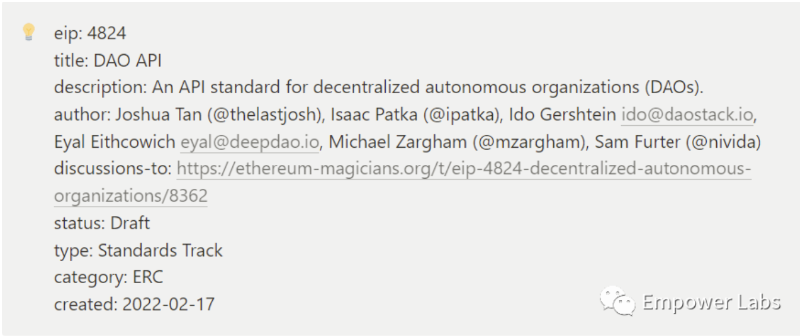
A code-based foundation also addresses the issue of DAOs not being autonomous enough. The original DAO design required organizations to operate via code-driven automated systems. However, this hasn’t been feasible thus far, forcing compromises.
Of course, Metagov’s efforts are still early-stage. If successful, DAOs could come closer to their originally envisioned form. Interoperability among DAOs would greatly improve. With a common architecture, personnel and resources could flow freely between DAOs, making communication and collaboration smoother.
Cryptopolitical Party
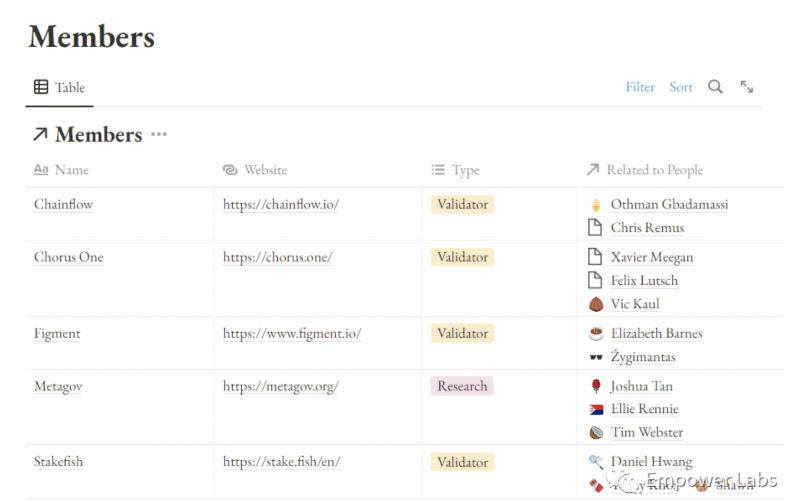
We need to bridge the gap between Web3 and the real world, bringing real-world effective structures into Web3. Political parties, proven effective in reality as consensus-building organizations driving specific goals, offer inspiration. Metagov, together with several other organizations (Stakefish, Figment, Chorus One, Chainflow, and Metagov), formed a Web3 crypto party. Unlike traditional parties, theirs consists of aligned validators and allies.
What is a cryptopolitical party? Here’s their definition:
“Like traditional parties, we share common ideologies, goals, and policies. We support certain representatives (validators) within a well-defined system (proof-of-stake governance). We coordinate actions—voting together on proposals, researching new ones, expanding community engagement. We provide technical, organizational, and financial support to representatives and active members in the community.
Unlike traditional parties, proof-of-stake blockchains demand higher economic and technical participation. Therefore, our work directly shapes economic incentives in governance and participation. We create technical standards and infrastructure for cross-chain governance. When needed, we conduct governance assessments for chains and nodes. Someday, we may evolve into a composable, interoperable, automated protocol.”
Undoubtedly, this cryptopolitical party was formed specifically to achieve these goals.
2. Tools:
To “describe, support, and expand” next-generation online community self-governance, Metagov researchers are developing a series of small tools to aid digital autonomy, such as:
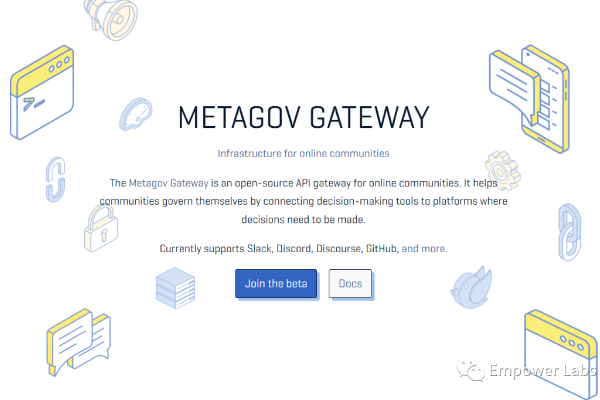
Metagov Gateway: An open-source API gateway for online communities, aiming to provide standardized governance tools and frameworks—including governance systems, decision-making processes, and workload definitions—for platforms like forums, chat tools, and blockchain-related community platforms.
DAOstar: The DAO standard defined by EIP-4824 mentioned above.
Validator Commons: The cryptopolitical party mentioned earlier.
Govbase: A database focused on online community governance, providing data for quantitative and qualitative research—covering organizations, organizational structures, case studies, documents, surveys, and more.
Agreement Engine: Developing open-source software natively built for the web to facilitate protocol creation.
Additionally, two entities manage finances and coordinate activities within Metagov:
Metagov DAO, responsible for managing the Metagov treasury; and The Metagovernance Seminar, which hosts weekly discussion events where members share research updates and coordinate future plans.
Bear markets bring turbulence. Governance tokens lose value, and many DAOs face crises. In response, should we give up or keep building? Metagov offers an answer. After reviewing Metagov’s materials, out of curiosity I searched online for academic research on DAOs—and was surprised to discover significant academic resources already dedicated to this field. This strengthened my confidence in the future of DAOs.
However, related research in the Chinese-speaking world remains limited. Let’s encourage one another—there’s vast blue ocean ahead waiting for Chinese-speaking DAO enthusiasts to explore.
Join TechFlow official community to stay tuned
Telegram:https://t.me/TechFlowDaily
X (Twitter):https://x.com/TechFlowPost
X (Twitter) EN:https://x.com/BlockFlow_News