X to Earn Research: Application Scenarios, Economic Models, Development Trends, and Challenges
TechFlow Selected TechFlow Selected
X to Earn Research: Application Scenarios, Economic Models, Development Trends, and Challenges
What is the essence of X2E? What constitutes a suitable X scenario, and what design principles should underlie the economic model E? What are the main challenges facing the development of X2E?
 Navigating Web3 tides with focused insights
Author: Mtyl, twitter@Mtyl_7th
TechFlow authorized retransmission
Introduction
In the early hours of May 27, 2022, Beijing time, StepN, a leading project in the X to Earn (X2E) space, officially announced that due to GPS data non-compliance with Chinese mainland regulations and other reasons, it would cease services for users in mainland China starting July 15. This announcement triggered sharp short-term price drops and subsequent volatility in StepN's shoe NFTs, its in-game token GST, and governance token GMT. It also reignited widespread controversy and discussion within the community about X to Earn:
What exactly is the nature of X2E? What are suitable X scenarios, and how should economic models (E) be designed? What are the main challenges facing the development of X2E? This article attempts to provide answers.
Core Insights
-
The essence of X2E is a new growth paradigm in Web3, where scenario X forms the foundation of the project, and the design of the economic model E serves X
-
Suitable X scenarios must meet two key criteria: quantifiability of behavioral outcomes and provision of achievement and enjoyment for the general public. Fitness, reading, learning, and gaming are four relatively ideal X-to-Earn use cases.
-
The aggressive early-stage growth of X2E projects is inherently unsustainable. As user payback periods lengthen, these projects inevitably undergo value regression. Only after this phase do retained and newly acquired users represent the project’s true target audience.
-
The two major challenges for X2E projects: rational economic model design and network effects post-value-regression.
1. The Essence of X2E: A Growth Paradigm Serving the Project
Generally speaking, X2E-type projects require users to purchase project NFTs as an initial investment cost, then earn economic rewards in token form by performing the "X" activities encouraged by the project team. (Readers unfamiliar with X to Earn may first refer to introductions and analyses of StepN, one of the representative projects in this category.)
From the above description, it's clear that X to Earn itself cannot be considered a dedicated web3 sector but rather a collective term for various projects adopting similar economic models. More precisely, X to Earn is not the project itself—it is a growth paradigm serving the project, a method for attracting traffic and expanding continuously in the web3 era.
Before discussing web3 growth paradigms, let’s briefly revisit the now-familiar growth model of the Web2 mobile internet era—sometimes referred to using a term familiar to some readers: “internet thinking.” As shown in the diagram below, mobile apps aggressively expand through heavy financing and user subsidies. During this spending phase, they collect data, enhance user experience, strengthen network effects, and attract more content creators and users. Companies like Didi, Meituan, and Pinduoduo survived brutal growth battles under this model, while competitors who failed to pursue similarly aggressive expansion eventually faded away.
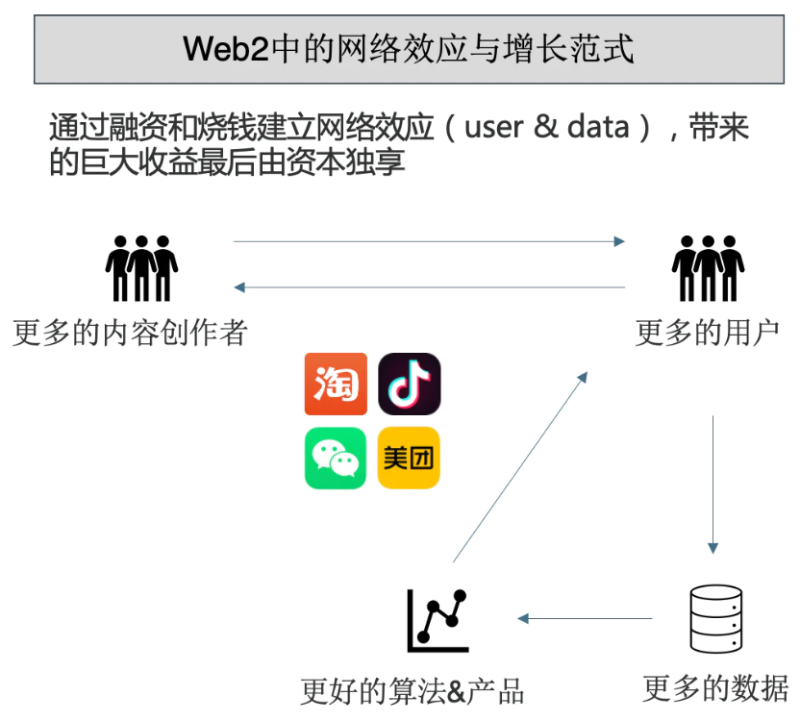
Illustration of Common Web2 Growth Paradigm - Mtyl
Web3, as the next evolution of the internet, takes growth even further: as illustrated below, most Web3 products undergo only one or two funding rounds—or none at all—before launching. Once the product reaches preliminary maturity (or sometimes even before), teams leverage community promotion and NFT/token airdrops to attract attention, seed users, and recruit contributors. As the application matures, more institutions and individual investors begin purchasing tokens and NFTs, pushing up their prices. Rising prices and user/investor advocacy generate broader interest, attracting more users and team members, improving the product, and drawing further investment… This self-reinforcing cycle is known as the “growth flywheel” of Web3, followed by many DeFi projects organized as DAOs.

Illustration of Common Web3 Growth Paradigm - Mtyl
X to Earn further iterates on this standard Web3 growth model: every user becomes simultaneously an investor in the project, significantly accelerating the speed of the “growth flywheel” and enabling faster early-stage expansion.
Why discuss X to Earn in this way? Because only when we clearly understand X to Earn as a growth paradigm can our thinking move beyond recent debates overly focused on terms like “Ponzi scheme” or “money game,” which fixate solely on “Earn,” and instead refocus on “X”: what does the project actually do? What needs does it fulfill for users? What real value does it offer?
After all, I firmly believe truly mature Web3 projects will align with users’ long-term genuine needs, and only such projects can endure market cycles and become meaningful components of the “next-generation internet” ecosystem.
2. X in X2E: Two Key Elements of an Ideal X Scenario
Broadly speaking, any input contributing to economic returns (“Earn”) qualifies as “X,” meaning X could involve capital or labor. However, when people currently discuss various X to Earn models, they typically exclude capital-intensive scenarios like “Stake to Earn”—partly because those have existed and been studied before, and partly because as capital-centric games, they naturally limit broader participation from the wider Web3 population, offering less innovation and imaginative potential.
Therefore, the “X” discussed in this article primarily focuses on labor inputs—that is, activities requiring users to spend time and effort. Even with this limitation, numerous X to Earn projects continue to emerge. Notable examples include Play to Earn, Move to Earn, Bike to Earn, Learn to Earn, Drive to Earn, Sleep to Earn, Eat to Earn, Read to Earn, Write to Earn, Code to Earn, Create to Earn, Sing to Earn, Meditate to Earn, Sex to Earn… Clearly, thanks to brainstorming by Web3 enthusiasts, nearly every aspect of daily life and work has been proposed as a potential “X” for monetization.
So which scenarios make for suitable “X,” and which don’t? After research, I conclude that a suitable X must satisfy two critical elements: quantifiability of behavior outcomes and positive societal value. Missing either makes sustained project development extremely difficult.
2.1 Key Element One: Quantifiability of Behavioral Outcomes
Since labor input X directly ties to economic rewards, if such input cannot be clearly quantified, designing a viable economic model becomes highly problematic. Even if rudimentary evaluation mechanisms are created, they often face issues of user cheating, attracting low-cost “professional gold farmers” whose actions can collapse the project’s economy. In fact, upon closer examination, this single criterion alone eliminates most proposed X to Earn ideas.
For instance, many lifestyle-oriented projects struggle with quantifying “output”:
Poppin, an Eat to Earn project, allows users to feed virtual pets by eating real food, increasing their combat power and earning tokens. The more food consumed, the faster the pet grows. But measuring actual consumption presents a major challenge. The project’s initial solution—requiring photo submissions—is clearly inadequate, as photos alone cannot verify whether food was actually eaten. Moreover, accurately detecting food quantity from images remains technically difficult.
SEXN, a Sex to Earn project, lets users earn tokens through sexual activity paired with specific NFTs, promising to satisfy “two of humanity’s most fundamental needs” simultaneously. Due to its humorous and satirical nature, the project gained traction across communities. However, studying its whitepaper reveals the team faces serious challenges in quantifying “sexual activity.” Their preliminary idea involves heart rate sensors via wearable devices, though details remain vague. Yet heart rate alone cannot reliably distinguish sex from other intense physical activities. Relying on photos or videos would raise severe privacy and pornography concerns. Without solving this quantification issue, the project may remain confined to jokes and memes.
Additionally, professional-focused projects also face significant hurdles in output quantification, often relying on peer evaluations. Given that Web3 social networks are still nascent, such attempts face immense difficulties and anti-cheating issues like mutual rating manipulation.
For example, Write to Earn incentivizes written content creation such as articles and Q&A. How can writing quality be quantified? Judging solely by word count is unwise. Better approaches rely on user interactions like shares, likes, and comments. Several projects explore this direction—for example, CrypNote, a Web3 collaborative document tool, recently launched a knowledge-base Q&A system based on Write to Earn principles, aiming toward a hybrid of Notion and Quora. Nonetheless, such projects still face a long path of experimentation and refinement in the current environment.
2.2 Key Element Two: Providing Achievement and Enjoyment for the Masses
From a product growth perspective, “to Earn” is merely a user acquisition tactic. If focus remains solely on economic model design while neglecting the intrinsic value of the X scenario, declining return-on-effort ratios will lead to mass user exodus, rendering the product unsustainable and reducing it to a pure “money game.” Additionally, delivering positive value to the public is crucial for expanding reach and converting Web2 users. After all, today’s Web3 user base remains limited; expanding into Web2 offers greater user volume and traffic, unlocking substantial growth potential.
What positive value can X deliver to users? Viewing X as a form of labor input, we find users seek one or both of the following: either enjoyment from the act itself—like addictive gameplay—or a sense of achievement derived from the activity, such as fitness, learning, or reading. Ideally, the latter evolves into the former—cultivating healthy habits.
A typical counterexample lacking this element involves activities meaningless or valueless to users, sustained purely by economic incentives. For instance, gold-farming-centric Play to Earn—games with little actual gameplay but cleverly designed economies. Following Axie Infinity’s popularity, such projects exploded over the past year. But soon it became evident that no one truly wanted to play them. Once earning expectations faltered, users rushed to exit, collapsing the economy. Over time, confidence eroded, causing faster collapses and increasingly speculative user bases. Today, purely gold-farming GameFi projects have largely disappeared from Web3 community discourse.
Another case arises when X behaviors are too niche or specialized, inherently limiting their audience and diminishing broad appeal. Take Sing to Earn: while some enjoy singing, it remains a hobby. Many accept daily 30-minute routines for exercise, language study, or reading, viewing them as beneficial habits yielding satisfaction. But asking users to sing daily for 30 minutes would likely see far fewer takers. Even reducing frequency doesn’t solve the core issue—fewer willing participants. Considering Web3’s current user scale, such projects may not suit present conditions. Still, as Web3 adoption increases, their viability may grow.
2.3 Four X Types Capable of Rapid Growth in Today’s Web3 Environment
Having thoroughly analyzed the two key elements and reviewed unsuitable X types, which scenarios satisfy both? I identify four categories: fitness, gaming, learning, and reading. Below, each is examined with concrete examples.
2.3.1 Fitness: Move to Earn, etc.
Fitness-related X activities—including walking (Walk), jogging (Jog), running (Run), or broader forms like cycling (Bike) and working out (Fit)—represent a strong balance between the two key elements: they’re easily quantifiable and create real user value by fostering exercise habits and improving mental and physical well-being. Thus, these are currently the fastest-growing and most advanced X to Earn categories.
Further analyzing Move to Earn’s value proposition, consider the real-world analogy of gym memberships: many pay for gym access hoping the sunk cost will motivate regular attendance (“I’ll lose money if I don’t go”). For some, this works; for others, it doesn’t—and those users ironically become gyms’ primary profit source. From this angle, Move to Earn performs better: users receive immediate monetary rewards after each workout, potentially profiting beyond just breaking even.
StepN, currently the most prominent and widely recognized X to Earn project, centers on running as its core labor input—further validating the strong feasibility of fitness-based X to Earn. Many users initially joined to earn money by buying shoes and running, but over time developed consistent running habits, benefiting mentally and physically, with earnings becoming secondary. Although StepN recently sparked controversy due to various incidents, this doesn’t negate the success of Move to Earn overall. Other similar projects like 5km and Step.app continue advancing steadily.
Bikerush, the leading Bike to Earn project, currently boasts nearly 100,000 Discord members. Compared to running, cycling provides comparable physical benefits while adding environmental value—being faster than walking, bikes can replace cars in many situations, promoting low-carbon transportation. While not everyone owns a bike, Bikerush indicates support for running as a substitute for slow cycling. Its strong community operations and airdrop campaigns attracted massive early engagement. With its test app launching soon, its gameplay design warrants close attention.
Fitness-focused X to Earn, or Fit to Earn, is another area I’m particularly bullish on. Regarding outcome quantification, open-source AI frameworks like Google Mediapipe now enable reliable keypoint detection directly on smartphones, making quantification feasible—using phone video + AI recognition to count squats, push-ups, dumbbell lifts, etc. As for providing achievement and enjoyment, fitness is highly suitable: accessibility is extremely high, and it helps users lose fat and build daily exercise routines. Though still in early stages—with projects like Fitcoco emerging—the potential here is undeniable.
2.3.2 Reading: Read to Earn
Read to Earn represents another direction that is both quantifiable and socially valuable: many Web3 users encounter lengthy “deep reads” online but, due to context and attention limits, often save and forget them. Read to Earn can help cultivate deep reading habits. Metrics for tracking reading are relatively straightforward—AI and interaction monitoring within reading apps can verify actual engagement, leveraging mature technologies.
Moreover, lessons from the rapid-growth phase of the popular app “Qutoutiao” offer valuable insights for Read to Earn: Qutoutiao targeted lower-tier markets with information reading, gaining fame through aggressive tactics like “read-to-earn” and “recruit-and-earn” referral programs. At its peak, it reached a Nasdaq valuation exceeding $10 billion. Despite later decline due to multiple factors, its research on user incentives and anti-cheating systems paved the way for successors. Qutoutiao’s downfall also drove many team members into Web3 Read to Earn ventures, potentially helping avoid past mistakes.
Compared to Move to Earn, Read to Earn faces an additional challenge: content diversity and sourcing. While solvable via media partnerships, trend detection algorithms, or mid-to-late-stage creator incubation, this adds complexity to initial development.
ReadON is a promising Read to Earn project worth watching, winner of The Community Choice Award at Solana Riptide Hackathon. ReadON demonstrates comprehensive and mature thinking about future product vision, anticipated challenges, and solutions—likely due to core team members’ backgrounds at Qutoutiao. Though still in development, it already has nearly 20,000 Twitter followers, warranting ongoing attention.
2.3.3 Learning: Learn to Earn
The fundamental value of Learn to Earn closely parallels Move to Earn: in real life, people enroll in training courses and engage in “knowledge payment.” Sometimes users pay for the scarcity of content, knowledge, or teaching methods. But in areas like English or programming—where learning resources are abundant—users who still pay often do so implicitly to motivate themselves (“pre-paying ensures I follow through”). Learn to Earn essentially extends and elevates this psychological mechanism.
However, compared to Move, Learn faces limitations in mass appeal. After all, demand for specific skills remains relatively low among general users. Combined with the higher concentration and willpower required, these projects grow slower than Move to Earn.
LetMeSpeak is currently the most watched Learn to Earn project, with 1 million Twitter followers. Users buy NFTs to earn through English-learning activities including vocabulary memorization, grammar exercises, and situational writing. As previously noted, the proportion of users genuinely needing English training is inherently small. Applying conversion funnel analysis, actual user numbers estimated from wallet addresses amount to only 10,000–20,000. Notably, LetMeSpeak adopts a highly conservative economic model, discouraging gold farmers. Consequently, its ratio of genuine users is exceptionally high, enabling steady progress. Economic model specifics will be further discussed in Section Three.
2.3.4 Gaming: Play to Earn
Play to Earn differs fundamentally from the three previous scenarios in nature.
Regarding the enjoyment and achievement offered to the masses, gaming falls short compared to “positive” behaviors like fitness, learning, and reading. Truly immersing oneself in games and enjoying their fun and fulfillment often demands significant time mastering mechanics—a barrier for busy users. Additionally, the subconscious belief that “gaming wastes time” lingers among many, leading to post-play emptiness or guilt. These combined factors mean gaming’s mass appeal isn’t as high as deep gamers imagine.
Yet, from the perspective of “quantifiability of labor input,” gaming excels significantly. Games are virtual worlds; once users immerse themselves, countless actions—from defeating monsters to opening treasure chests, leveling up, and exploring—are naturally quantifiable. Designing anti-cheat mechanisms in virtual environments is also considerably easier than in real life.
As a major 2021 trend, Play to Earn has already seen extensive research and analysis, so I won’t elaborate further here. However, judging by continuous high funding rounds and product updates for AAA-quality GameFi titles, interest in Play to Earn remains substantial.
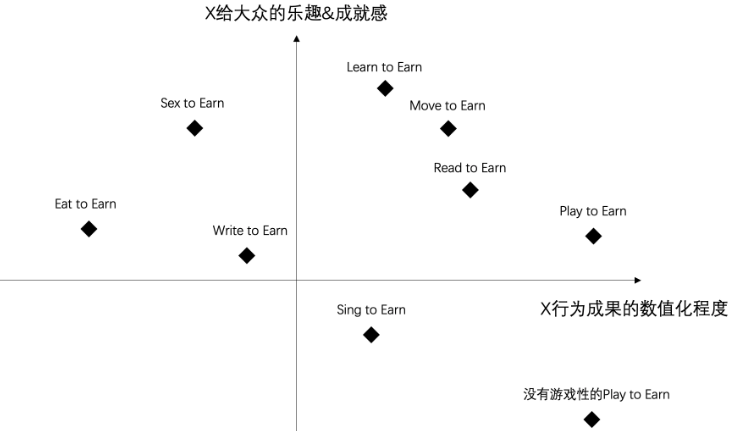
Rough Quadrant Mapping of Various X to Earn Projects - Mtyl
3. The 'E' in X2E: Aggressive Expansion Enables Better Value Regression
3.1 Typical Development Path of X2E Projects
After the prior discussion on X, revisiting E brings greater clarity: economic model design around “Earn” fundamentally serves authentic user growth for X. The chart below, created by FMResearch, illustrates the typical growth trajectory of X to Earn projects:

Lifecycle of X2E Projects - FMResearch
-
Initially, the project offers users a relatively short expected payback period, encouraging financial investment and participation in X activities.
-
Over time, this payback period inevitably lengthens; otherwise, mathematically, user numbers would need to grow exponentially (see model below), which no project can sustain indefinitely. During this phase, projects may exhibit strong characteristics of a “pay-new-with-old” money game.
-
Once the payback period extends, some users will exit, while others stay due to the project’s intrinsic value (fun & achievement), maturity, and network effects.
-
When the project reaches a stage where low or zero economic incentives suffice to attract users, the project team can initiate second-phase growth based on product maturity and network effects. At this point, alternative business models can generate revenue to offset earlier deficits and achieve real profitability.

With monthly ROI at 100%, required user growth follows an exponential trend - PAKA Labs
3.2 Growth Phase: Three Current Approaches to X2E Economic Model Design
How should economic models be specifically designed during the first growth phase of X to Earn? How can user retention be maximized? How can the balance between new and existing users be managed to prevent excessively rapid growth, avoiding overt dominance of “money game” traits over core substance? These remain unresolved challenges actively explored by X to Earn projects. A full investigation here could fill another long-form research paper.
For now, I outline three observed schools of thought in economic model design: (Note: when reading “conservative” or “aggressive” below, remember X to Earn itself is already an extremely aggressive expansion strategy.)
-
"Conservatives": Exemplified by LetMeSpeak, prioritize high user motivation from the start, aiming to acquire core users likely to stay long-term. Practically, these projects discourage pure “gold farmers”—for example, LetMeSpeak requires time investment per task and disallows stacking multiple NFTs simultaneously. This approach is stable but results in relatively lower community buzz.
-
"Balancers": Represented by StepN, aim to capitalize on the high community attention generated during the “money game” phase. Through sophisticated token and NFT loop designs, and constant adjustments to in-game mechanics like thresholds and entry barriers, they dynamically stabilize user entry costs and payback periods, prolonging the hyper-expansion phase. This approach sets low initial motivation thresholds and welcomes users initially interested only in “earning.” Pursuing this path demands deep economic understanding, allowing timely, effective, and minimalist model tuning. It also requires strong capability in converting casual users into loyal ones.
-
"Aggressives": Represented by various “meme coins” and copycat projects, characterized by absurdly high initial returns—designed solely to maximize early traffic and capital inflow. Frankly, such projects rarely have long-term prospects. Such high yields attract disproportionate numbers of pure “gold farmers” versus genuine target users. Practically, project teams often choose to “rug pull” when new entrants slow down—dumping large amounts of tokens and NFTs, crashing prices, leaving participants nearly bankrupt, turning the X to Earn project into a genuine “Ponzi scheme.”
3.3 Value Regression Phase: Post-Growth Consolidation, Not Death Spiral
After an initial phase of extreme, unsustainable expansion, X to Earn projects always undergo a fair value regression. When economic returns lose attractiveness, purely profit-driven users exit en masse. Those who remain or join afterward constitute the project’s true target audience.
Take Axie Infinity, a famous Play to Earn project: its governance token AXS has fallen from a high of 160 USD to 17.8 USD—a near 90% drop. While alarming at first glance, Axie continues to gain new users. For those genuinely interested in its gameplay, current conditions offer a favorable entry point. On another note, AXS still maintains a $1 billion market cap. Consider this: without leveraging this aggressive Web3 growth model and rising to become a top community project, would you have ever heard of Axie—given its Pokémon-like gameplay—in today’s saturated, fiercely competitive gaming market?
Some describe this value regression as a “death spiral,” a term I partially reject. “Death spiral” typically describes UST-like algorithmic stablecoins undergoing extremely rapid, near-total collapse. See my prior research on algorithmic stablecoins for reference.
3.4 After Value Regression: Network Effects and Business Models
No matter how aggressively Web2 apps burn cash, the goal is to accumulate users, build network effects, and create product moats—ultimately, these commercial ventures must profit, whether through ad monetization or fee increases. X to Earn projects in Web3 are no exception. However, the current reality is that most network-effect-driven projects in Web3 are heavily financialized, such as exchanges. For novel X scenarios, constructing such network effects and product barriers remains an open exploration.
If, after the X to Earn hype fades, a project lacks sufficient network effects and product moats, further user attrition is inevitable—why wouldn’t users simply migrate to newer projects in the same space and join a fresh “money game”? The clearest example is 5km, whose economic model closely copies StepN’s early whitepaper. If StepN’s earning potential declines, why wouldn’t users switch to 5km or similar projects offering higher returns? Indeed, this poses a severe test for every sincere X to Earn builder—an existential question they must address amid expansion efforts. In this regard, Read to Earn projects may advance faster, having Web2 analogs like “Qutoutiao” as references. After all, building network effects and product moats for content platforms is relatively clearer.
Beyond network effects, another class of monetization leverages inherent scenario traits, allowing users to reasonably accept partial investments may never break even—or view them as consumption. Classic examples include Play to Earn: hardcore players deeply immersed in games genuinely enjoy the experience. They don’t obsess over one-month vs. two-month payback periods because enjoyment comes upfront. For Move to Earn and Learn to Earn, the gym’s profit model—earning from users who buy memberships or classes but eventually quit—remains applicable: implementing automatic NFT wear-and-tear mechanics causes less disciplined users to naturally abandon “earning” and accept losses, while the project and diligent users profit from them.
Since most X to Earn projects remain in early stages, this phase currently appears mostly in roadmaps as aspirational visions. I sincerely hope mature Web3 projects develop sustainable business models, moving beyond perpetual reliance on initial “money game” growth phases.
4. Conclusion: Challenges and Outlook for X2E
The essence of X to Earn is an emerging Web3 growth paradigm. The scenario “X” is foundational and defines the project’s value; the economic model “E” enables aggressive early growth. After expansion, true value regression occurs, paving the way for sustainable, stable business models to establish the project firmly in the Web3 world.
Based on prior analysis, I believe X to Earn remains in the exploratory phase, facing two primary challenges:
-
Challenges in Rational Economic Model Design: Conservative designs struggle to generate community FOMO and broad attention; Balancer approaches resemble tightrope walking—StepN, as a pioneer, faced widespread criticism for frequent mechanism changes and centralized decisions; Aggressive models often devolve into pure “Ponzi schemes.” Achieving balanced optimization across community traffic, new users, earning yields, and conversion rates remains a formidable challenge.
-
Network Effect Challenges Post-Value-Regression: If, after the X to Earn noise subsides, a project lacks sufficient network effects and product moats, and fails to stand out against emerging rivals, further user loss and eventual demise become likely. Building network effects for non-financial projects remains a universal Web3 challenge, requiring pioneering efforts from each project.
In 2022, X to Earn projects have entered a flourishing phase. While we’ll undoubtedly see many “X to Earn”-branded Ponzi schemes, this doesn’t mean there aren’t builders striving to create a better Web3. As entrepreneurs persistently explore and innovate, I believe progressively refined answers will emerge for both economic model design and network effect construction.
The gradual maturation of X to Earn projects also represents Web3’s breakout attempt into Web2 application-layer scenarios. Should any project successfully attract massive Web2 user participation, it will become a landmark in Web3 history, remembered for generations to come.
Further Reading
Join TechFlow official community to stay tuned
Telegram:https://t.me/TechFlowDaily
X (Twitter):https://x.com/TechFlowPost
X (Twitter) EN:https://x.com/BlockFlow_News