X Pulling the Firewood from Under the Pot, the Era of Mouth-Blown Ends
TechFlow Selected TechFlow Selected
X Pulling the Firewood from Under the Pot, the Era of Mouth-Blown Ends
Other people's traffic is ultimately theirs.
 Navigating Web3 tides with focused insights
Author: Curry, TechFlow
X has banned posting-for-mining.
Nikita Bier, product lead, announced yesterday that all apps rewarding users for posting would have their API access revoked.
He kindly added: developers who got banned can contact us—we’ll help you move to Threads and Bluesky.
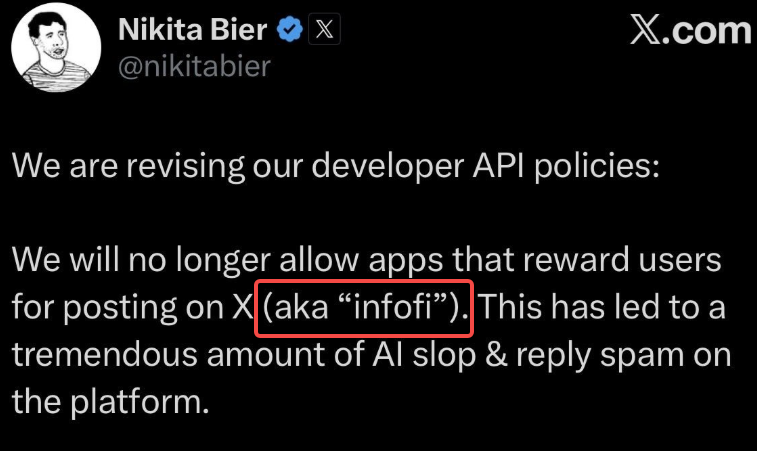
The landlord is evicting tenants—and even offering moving services.
News hit, the InfoFi sector crashed instantly. KAITO dropped 20%, Cookie down 20%, the 157,000-member Kaito Yappers community was suspended outright.
But less than an hour later, Kaito founder Yu Hu published a long post.
No apology to the community, no protest against X’s policy—just one core message:
Relocate.
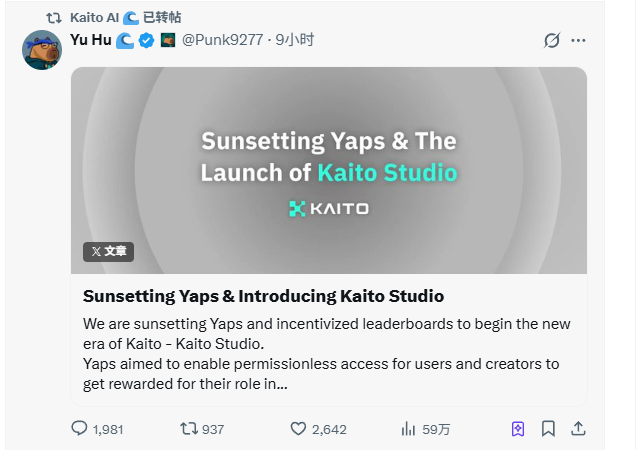
Yaps is dead. The new product is Kaito Studio—shifting to traditional marketing, direct brand-creator partnerships, no longer an open model where anyone can farm points.
No more serving Twitter. We’re moving to YouTube, TikTok. No more catering to crypto. We’re entering finance, AI, the entire creator economy—a $200 billion market.
Product? Check. Direction? Check. Data? Check. New narrative? Ready.
But this doesn’t feel like crisis response written in an hour. Feels more like they saw it coming, had the draft ready, just waiting for X to pull the trigger.
Meanwhile, on-chain signals emerged earlier.
Kaito’s multisig wallet previously distributed 24 million KAITO tokens to five addresses. One of them transferred all 5 million tokens into Binance a week ago.
Looks more like cashing out.
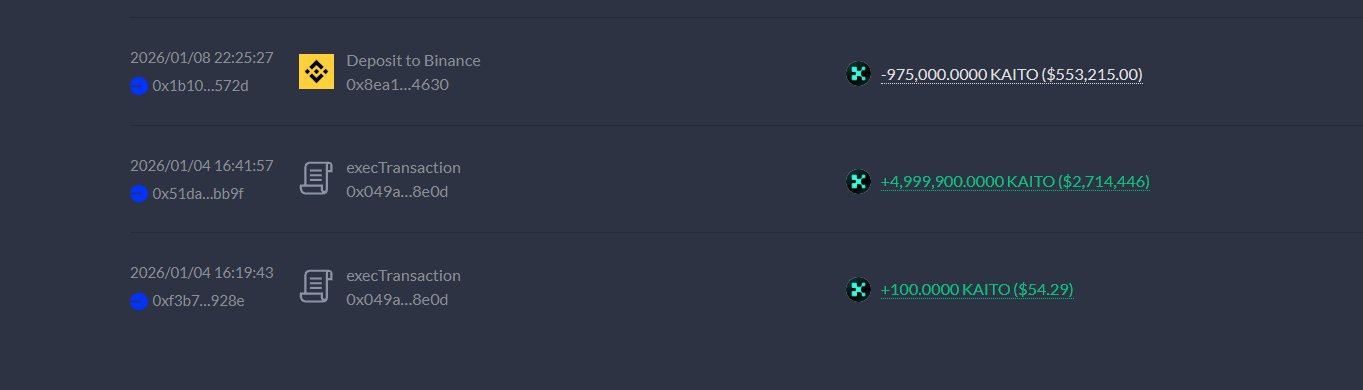
Prior coordination, pre-written statement, tokens moved to exchange—all boxes checked.
Then X announces, the long post drops immediately—perfect posture, proactive transformation, embracing change.
Yu Hu wrote in the statement: "After discussions with X, both parties agree that fully permissionless distribution systems are no longer viable."
Both parties agree.
Getting kicked out is reframed as mutual consensus. Product death sentence becomes strategic upgrade. Crypto knows this rhetoric all too well.
Project teams never say “we failed.” They say they’re exploring new possibilities, market conditions evolved, it’s a planned pivot.
Very dignified. Very PR.
Truth is, X’s ban was merely the final blow. The mouth-farming business was already dying.
Posting-for-mining sounds great—tokenize attention, fairly reward creators, decentralized information economy.
But in practice, we all know it quickly went off track.
Reward posts? Then post more. Can use AI to generate content at scale? Let AI do it. No limits on accounts? Create thousands of bots...
CryptoQuant data shows bots generated 7.75 million crypto-related tweets on X on January 9, up 1224% year-on-year.
ZachXBT raged last year, calling these InfoFi platforms the root cause of AI-generated spam. He offered a $5,000 bounty for user data to expose bot operators.
Genuine discussion drowned under endless GM, LFG, bullish spam. Humans and bots mixed together—nearly impossible to tell who’s real.
X’s Nikita Bier actually posted last week: “CT is dying from suicide, not from the algorithm.”
Crypto Twitter is killing itself, not being killed by the algorithm.
Back then, the crypto community called him arrogant, mocking him with GM memes.
In hindsight, wasn’t that a heads-up before execution?
Yu Hu admitted Kaito tried everything to fight spam—higher barriers, filters, redesigned incentives.
Didn’t work.
If you reward posting with tokens, you’re literally paying people to create noise. No matter how high the barrier, profit motive will always find a way. Human nature is what it is. As long as incentives exist, spam won’t stop.
Worse yet—the lifeline is in someone else’s hands.
What business is Kaito really in? Leveraging X’s traffic, using tokens to incentivize content creation, selling data to projects for marketing.
X is the foundation. Kaito is the house built on top.
When the foundation owner decides to reclaim control, the house collapses. No reason needed. No negotiation. Just one announcement.
Let’s be honest: InfoFi claims to build a decentralized attention economy. But the attention part was never yours. The algorithm belongs to the platform. The API belongs to the platform. The users belong to the platform.
You can put points on-chain, decentralize your token, but you can’t decentralize Twitter.
Parasites trying to overthrow their host. The host doesn’t need a revolution—just pulls the plug.
For years, Web3 startups followed this playbook: ride Web2 traffic, build Web3 momentum. Users on Twitter, data on Twitter, attention on Twitter—but tokens issued by you, profits going to you.
Sounds clever. Leverage small force to move big weight.
But others’ traffic remains theirs. Platforms tolerate you only when you’re not in their way. Once you become a nuisance, vampire-style businesses collapse overnight.
A wake-up call for every Web3 project relying on platform traffic.
If your survival depends on someone else, then every dollar you earn is just money they haven’t reclaimed yet.
Know whether you’re building a business or renting space. Renters shouldn’t act like landlords. And certainly shouldn’t believe the house is theirs.
Kaito says it’s now heading to YouTube, TikTok.
Do you really think those landlords are nicer than Musk?
Join TechFlow official community to stay tuned
Telegram:https://t.me/TechFlowDaily
X (Twitter):https://x.com/TechFlowPost
X (Twitter) EN:https://x.com/BlockFlow_News
 深潮TechFlow