The End of Stealth Advertising: X’s New Regulations and the Global Platform’s Commercial Governance Logic
TechFlow Selected TechFlow Selected
The End of Stealth Advertising: X’s New Regulations and the Global Platform’s Commercial Governance Logic
Interpreting the Ecosystem Migration and Boundaries of Power Behind X’s New Promotion Regulations
 Navigating Web3 tides with focused insights
Authors: Bbo I XHunt Operations Team, Amelia & Denise I Biteye Content Team
On March 1, 2026, X (formerly Twitter) significantly updated its “Paid Promotion Disclosure” policy. Accounts failing to comply with commercial promotion disclosure requirements will face strict penalties starting next week.
This move was initially interpreted by many as a prelude to X launching an official paid promotion platform—and even triggered collective panic across the Web3 community. However, after X officially clarified the misunderstanding surrounding cryptocurrency promotion rules, the true scope of this initiative emerged: unlike China’s mature and well-established third-party paid promotion ecosystem, X is comparatively late to the game. Its fundamental objective goes beyond merely guiding third parties to use the official X Ads system in compliance—it aims to help ordinary users clearly distinguish ads from organic content, thereby purifying the timeline experience and rebuilding a healthy content ecosystem.
For KOLs and professionals across all domains, understanding the new policy’s red lines has become an absolute prerequisite for safe monetization and sustainable operations going forward.
This article provides an in-depth analysis across the following dimensions:
- New Policy Definition and Enforcement Mechanisms: Clarifies which activities constitute paid promotions and outlines the consequences of noncompliance.
- Common Misconceptions Around Cryptocurrency Promotion: Separates fact from fiction regarding recent rumors about crypto advertising bans and clarifies actual regional restrictions.
- Global Platform Benchmarking: Compares commercialization pathways across platforms including Weibo, Xiaohongshu, and TikTok.
- Underlying AI Moderation Technology: Reveals how the platform automatically detects covert advertising and outlines mandatory labeling requirements for AI-generated content (AIGC).
I. Decoding X’s New Policy: Not Banning Ads—Rebuilding Trust
X’s latest policy update isn’t a hard landing but rather a tiered governance framework grounded in transparency principles.
1️⃣ What Constitutes an Officially Recognized “Paid Promotion”?
Per X’s official Paid Partnerships Policy, a paid promotion refers to any arrangement where a third-party brand provides compensation or incentives to a user—such as an influencer or content creator—to promote its products or services. This covers four common scenarios:
- The product or service is provided free of charge by the brand or its representative.
- The creator receives monetary payment or in-kind compensation for promoting the product or service.
- The product or service generates commission income for the creator (e.g., via affiliate links or discount codes).
- The creator maintains a formal commercial agreement with the brand (e.g., serving as a brand ambassador).
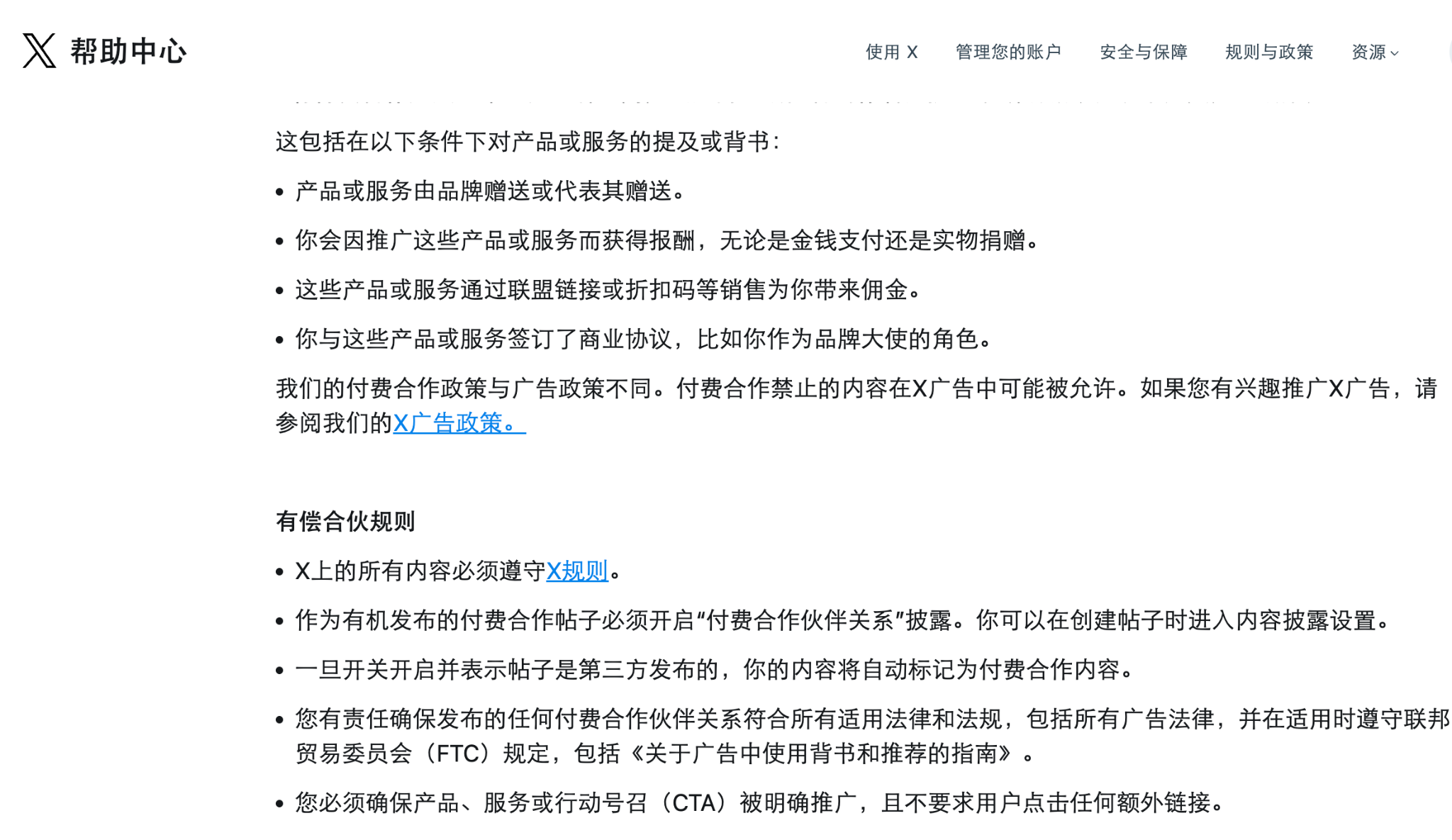
Core Disclosure Requirement: All paid promotion content posted as organic tweets must include clear, prominent language (e.g., “Ad” or “Promoted Content”) indicating its commercial nature. Additionally, the promoted product, service, or call-to-action (CTA) must be explicitly stated—users must not be required to click external links to understand what is being promoted.
2️⃣ Tiered Enforcement Options for Violations
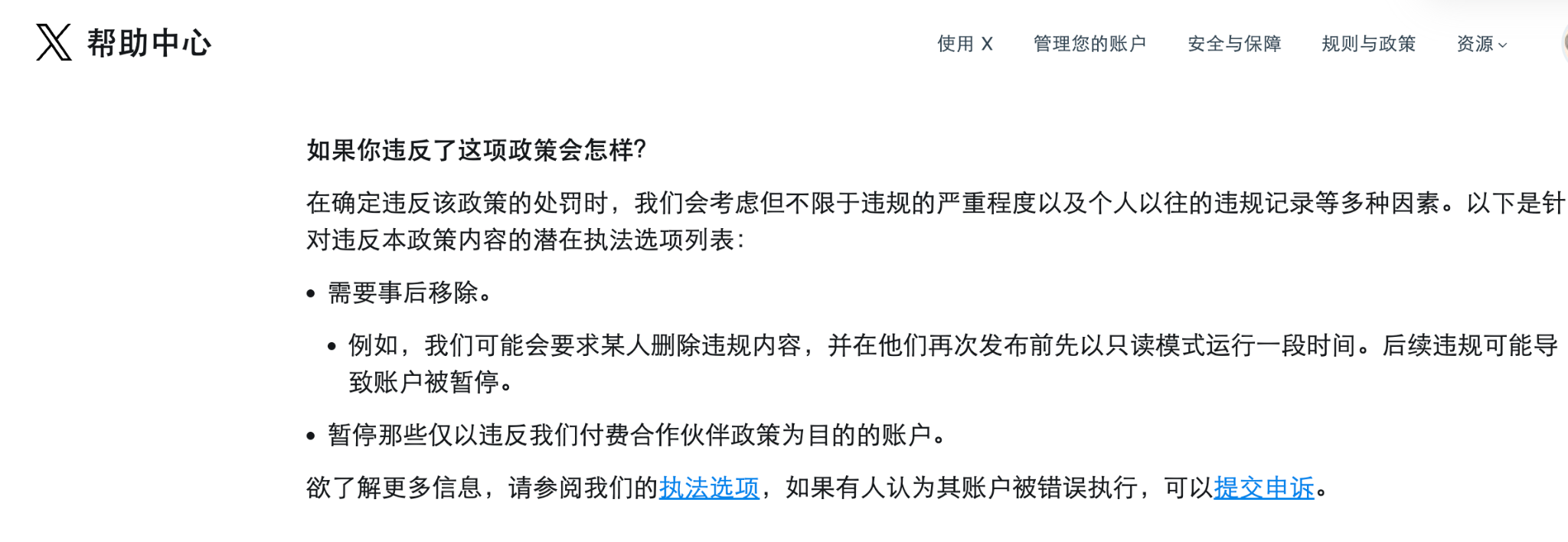
When determining penalties for violations, X considers multiple factors—including severity of violation and the user’s prior violation history—and applies a tiered enforcement approach:
- Post-Hoc Removal and Restrictions: The platform may require violators to delete noncompliant content and operate in “read-only mode” for a period before posting again.
- Suspension After Repeated Violations: Account suspension (i.e., banning) occurs only after multiple subsequent violations.
- Immediate Suspension of Malicious Accounts: Accounts created solely to violate the Paid Partnerships Policy are suspended immediately.
- In addition, users may appeal if they believe their account was mistakenly penalized.
II. The 12-Hour Panic: The Crypto Promotion Misunderstanding and Regional Compliance
Shortly after the new policy launched, X’s policy page listed “Cryptocurrency (Crypto)” as a category explicitly prohibited from paid partnerships—a development that sent shockwaves through the Web3 community. Many KOLs spent sleepless nights worrying their livelihoods were at risk.
However, this was a miscommunication. Nikita Bier, X’s Product Lead, publicly confirmed that the blanket restriction displayed on the policy page was an error. That clause had actually been updated back in June 2024—not part of the current version—and has since been urgently corrected by the platform.
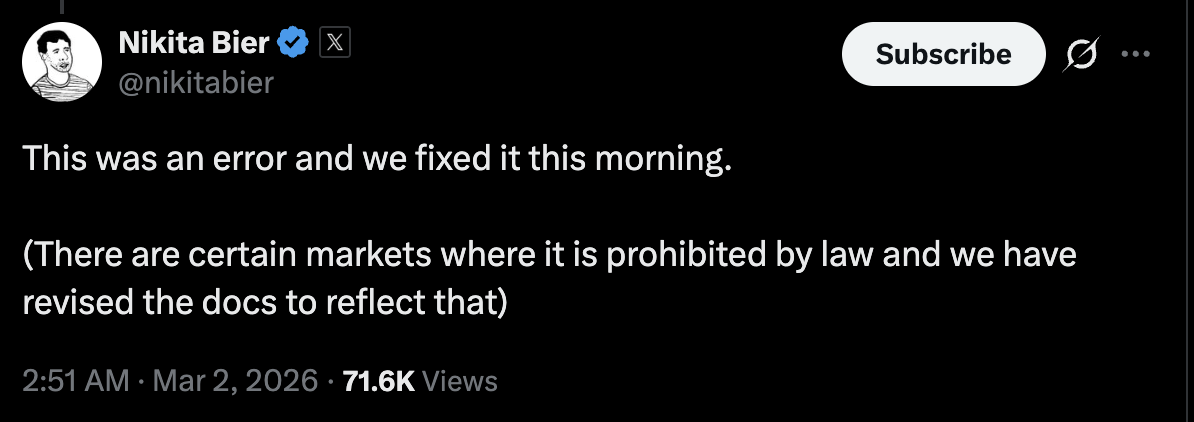
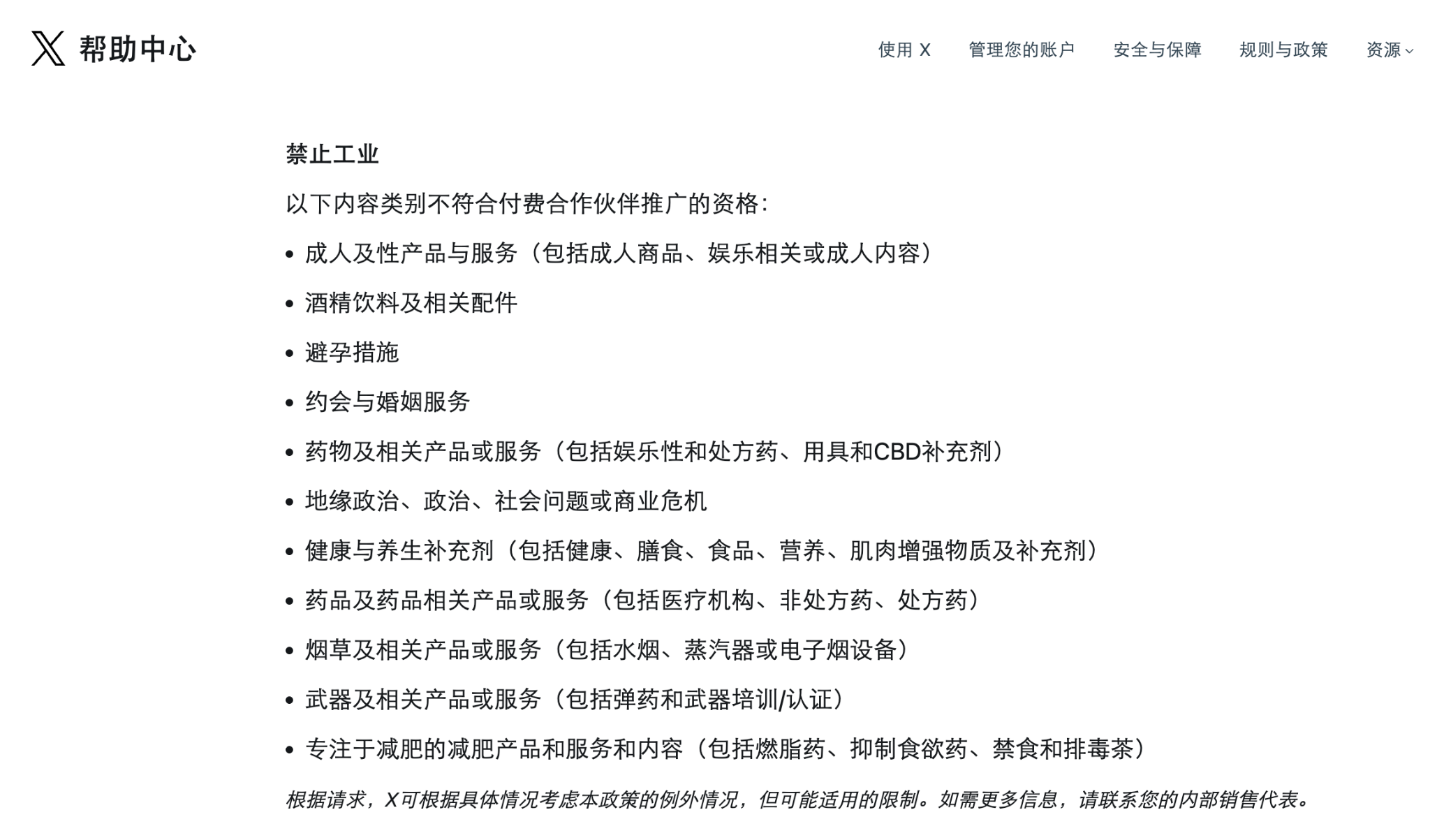
According to the latest policy update, cryptocurrencies are not globally banned—but instead subject to region-specific disclosure requirements. Specifically:
- Regional Red Lines: Currently, paid cryptocurrency promotions are prohibited in Australia, the European Union, and the United Kingdom due to local financial regulatory laws. Outside these three regions, X imposes no such prohibition elsewhere.
- Mandatory Transparent Disclosure: While promotional channels remain open in non-restricted countries, KOLs accepting campaigns there must strictly adhere to transparency standards—explicitly disclosing paid partnerships within each tweet. Previously widespread “covert promotions”—such as untagged token calls disguised as personal investment insights—now carry high risks of account suspension.
- Official X Ads Remain Available for Large Institutions: Financial projects requiring cross-regional reach or failing to meet individual KOL eligibility criteria may still submit applications through the official X Ads platform (promoted posts), obtain “pre-approval,” and run legitimate, paid campaigns.
In short, KOL marketing channels for the crypto industry remain viable—but the era of unregulated, informal promotion is over. The industry has fully entered a new phase of transparent, labeled, and compliant engagement.
III. Three Global Content Platform Commercial Governance Models
Viewed within the broader evolution of global content platforms, X’s new policy isn’t sudden—it simply fills a long-overdue gap. From a governance perspective, global platforms fall into three categories: Mandatory Official Matchmaking, Mandatory Disclosure + Optional Matchmaking, and Disclosure-Only.
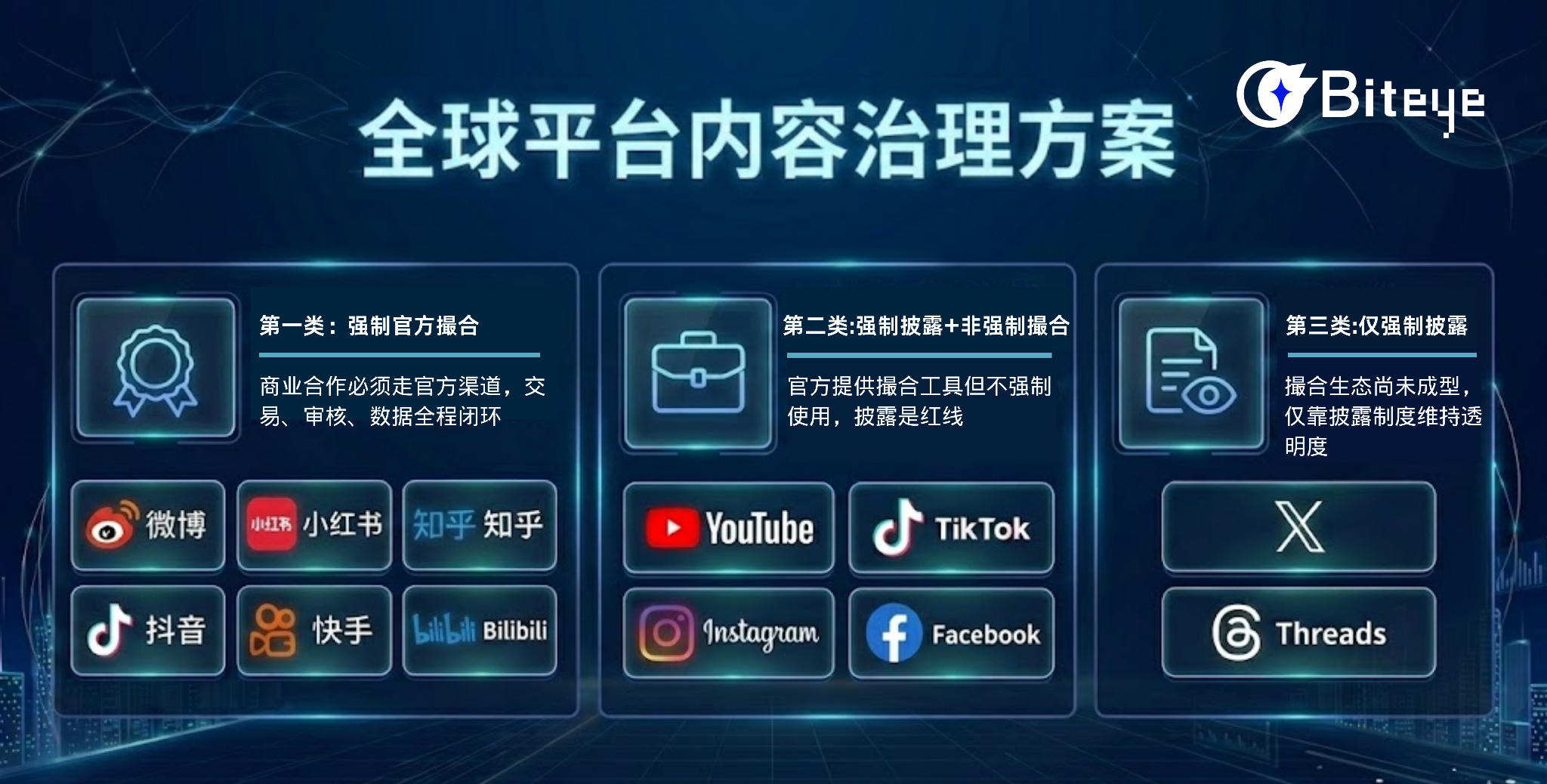
1️⃣ Mandatory Official Matchmaking — Commercial Activity Must Be Fully Closed-Loop
The core logic of this model is simple: all commercial collaborations must flow exclusively through official matchmaking channels established by the platform. Transactions, content review, and performance tracking are all managed end-to-end within the platform. Because the platform bears joint liability for commercial content, full control is non-negotiable.
Mainland China exemplifies this model.
- Weibo: Commercial ads must be published and labeled exclusively via official channels like “Weibo Tasks” or “Jubao Pan.” Strict crackdowns target spam accounts and artificial engagement boosting, enforced through a graduated penalty system: traffic throttling → point deductions → account suspension.
- Xiaohongshu: All influencer campaigns must go through the official “Pugongying Platform.” Disguised “organic recommendations” are heavily penalized—if a post fails to report and disclose its commercial relationship, it faces immediate traffic throttling; serious cases result in credit score deductions.
- Douyin (TikTok China): Maintains the most comprehensive commercial infrastructure, featuring the “Juliang Xingtou” system, integrated with a “Product Selection Plaza” and traffic-buying tools. Creators wishing to promote products or accept campaigns must link offers through the official Product Selection Center. Unreported private deals (“covert ads”) are intercepted by Douyin’s AI moderation system, which performs frame-by-frame video scanning and link analysis.
- Zhihu: Launched “Zhi+” and commercial plug-ins to embed advertising directly into the platform ecosystem. Zhihu aggressively targets soft-sell articles masquerading as rigorous technical reviews—once flagged by users or identified by the system as noncompliant ads, accounts suffer sharp drops in “Salt Value” and algorithmic weight, potentially resulting in permanent bans.
- Kuaishou: Achieves tight integration between content and commerce via the “Kuai Jiedan” platform, forming a closed-loop system spanning “content → transaction → revenue sharing.” Emphasizing authenticity rooted in its “Lao Tie Economy,” Kuaishou combats false claims and undisclosed marketing content with dual sanctions: traffic shutdowns and downgraded e-commerce permissions.
- Bilibili: Established the “Huohua Platform,” requiring UP hosts with ≥10,000 followers to register. All non-private campaigns must be contracted, reviewed, and settled through the platform. Unregistered creators cannot access ad opportunities distributed by the platform.
Summary: Mainland Chinese platforms operate under one clear principle: commercial activity must occur entirely within the platform’s ecosystem. From content creation to transactions, from discovery to purchase—the entire journey is closed-loop and fully controllable. There is virtually no boundary between content and commerce.
2️⃣ Mandatory Disclosure + Optional Matchmaking — Platform Provides the Stage, Creators Perform Freely
This model follows a “soft-closed loop” strategy: while the platform offers matchmaking tools (e.g., Creator Marketplaces), usage is not mandatory. Brands and creators may still connect externally via email or DMs. However, regardless of how collaboration is initiated, disclosure remains an absolute red line—failure to label equals violation.
- YouTube: Launched the “BrandConnect” platform, integrating end-to-end creator collaboration workflows. Its newly introduced “Open Call” feature allows brands to issue creative briefs and solicit video proposals from over 3 million creators. Simultaneously, YouTube enforces a mandatory “Includes paid promotion” declaration mechanism. Its underlying logic: long-form video audiences value credibility—labeling doesn’t kill traffic, deception does.
- TikTok: Introduced the “TikTok Creator Marketplace,” aggregating top-tier creators across verticals globally, supporting data-driven filtering, direct invitations, and commission-based payouts. Yet official matchmaking is optional—brands and creators may still connect directly via email or DMs. Regardless of channel, disclosure is mandatory: all brand-sponsored content must be published using official invitation links to ensure inclusion of the paid partnership tag; otherwise, the content is excluded from For You Page recommendations.
- Instagram: Built the “Creator Marketplace,” enabling filtering by country, content category, follower count, etc., and offering “priority DM” features to improve response rates. It also rolled out the “Paid Partnership Label,” requiring creators to clearly indicate brand collaborations at the top of every post. Instagram demonstrates that even with visible ad labels, compelling content still converts.
- Facebook: Launched both the “Brand Collabs Manager” and “Creator Marketplace” to help brands search, filter, and contact creators—providing first-party metrics (follower count, reach, engagement rate) and multi-dimensional targeting (country, age, interest tags). However, use of official tools remains optional—disclosure is the sole mandatory requirement. Facebook explicitly states: even when using the built-in Brand Collabs Manager, manual disclosure remains essential.
3️⃣ Disclosure-Only — Matchmaking Ecosystem Remains Underdeveloped
This category includes platforms that currently enforce only mandatory disclosure—with official matchmaking tools either absent or still in early exploratory stages.
- X (Twitter): The recent update mandates that all paid promotions must carry the “Paid Promotion” label; failure to do so carries suspension risk. Though Elon Musk pays some creators directly, X has yet to launch an official matchmaking system comparable to “Juliang Xingtou” or “Creator Marketplace.”
- Threads: As X’s direct competitor, Threads has adopted an extremely cautious stance toward monetization. It actively suppresses overt advertising and combats bot-like mass marketing to preserve a “clean” user experience—aiming to attract users disillusioned with X. No mature commercial matchmaking infrastructure exists yet.
💡 Key Insight: Why do Chinese platforms favor mandatory closed-loop systems, whereas overseas platforms—including TikTok—adopt only mandatory disclosure without enforcing closed loops?
- Divergent Legal Foundations: China enforces stringent entry requirements and oversight for internet advertising. Platforms bear primary legal responsibility and share joint liability for content. To minimize compliance risk, the safest path is to close-loop all commercial activity—requiring pre-publication content review. In contrast, U.S. (FTC) and EU regulations center on the “duty to inform”: as long as users are clearly notified via tags (e.g., #ad, #sponsored), platforms typically don’t intervene in private settlement terms or contract negotiations.
- Antitrust Boundaries: In Western markets, mandatory intervention risks triggering antitrust investigations or accusations of market restriction. Regulators may view such actions as monopolizing advertising, excluding third-party agencies, and limiting creator autonomy—an especially high-risk proposition in both the U.S. and EU. This explains why TikTok—a Chinese-origin platform—can offer a Creator Marketplace but cannot mandate its use.
✍️ Key Takeaway: Third-party matchmaking platforms will coexist with content platforms indefinitely—and remain indispensable.
First, Western legal frameworks prohibit platforms from achieving absolute monopoly. Second, even in China’s highly closed-loop environment, third-party intermediaries persist. For example, although Xiaohongshu and Douyin operate official Pugongying and Juliand Xingtou systems, numerous third-party analytics and matchmaking services continue thriving.
IV. AI Moderation: Intelligent Covert-Ad Detection and Mandatory AIGC Labeling
With millions of posts daily, X cannot rely on human review alone. As stated by its product lead, the team comprises just over 30 people—far too few for manual oversight. Detecting covert ads thus relies almost entirely on AI.
1️⃣ How AI Detects Covert Ads: Principles and Applications
X’s AI models identify noncompliant content primarily through cross-dimensional feature analysis:
- Natural Language Processing (NLP) Analysis: Precisely detects whether tweets contain high-frequency praise phrases, token shilling language, or suspicious soft-sell CTAs (e.g., “Buy now,” “Click to register”).
- Link and Behavioral Attribution: Automatically identifies embedded affiliate links or referral codes and assesses the commercial nature of destination domains.
- Account Relationship Graph Analysis: Evaluates abnormal interaction frequency or association patterns between an account and specific brand-aligned networks. If a tweet exhibits high confidence as a paid promotion but lacks proper labeling, the system triggers automatic penalties.
2️⃣ Mandatory Labeling for AIGC Content
Beyond covert-ad detection, X is simultaneously advancing its policies around AI-generated content. X is developing an AI-generation label—future failure to proactively tag AI-created text or images will likely constitute a platform violation.
This measure directly addresses the rampant proliferation of low-quality AI spam accounts on X. It serves not only to protect user right-to-know but also functions as a regulatory lever to compel creators to deliver authentic human insight and narrative value. Low-grade AI rewrites will be filtered out, while high-quality, niche-specific content will gain greater visibility.
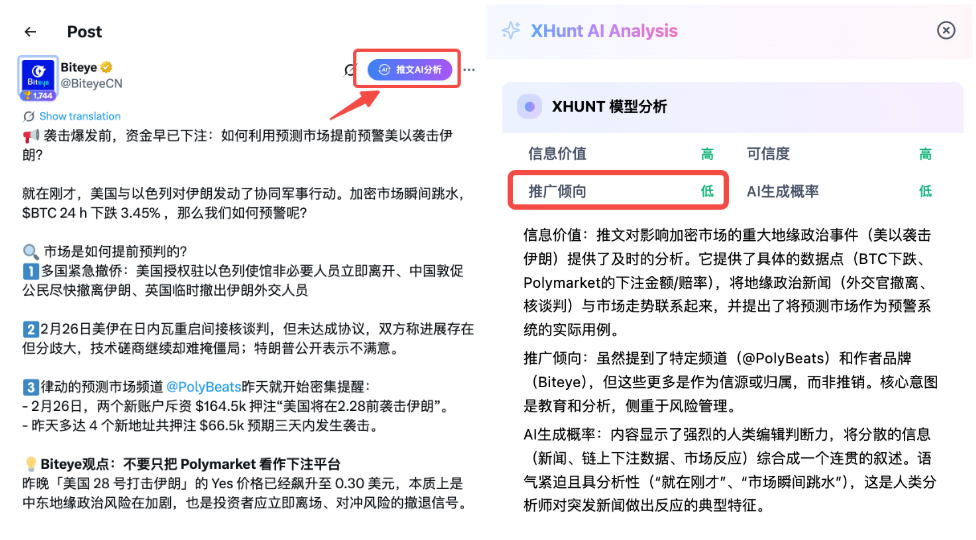
As X deploys AI-powered heavy regulation, ordinary users and operators can likewise leverage AI tools for counter-detection. Using XHunt’s “Tweet AI Analysis” feature, users can generate reports assessing the promotional intent of AI-written tweets.
Final Thoughts: Holding the Imperial Sword, Under the Sword of Damocles
Platform evolution often follows a universal trajectory: early-stage growth fueled by raw creator and user engagement; mid-stage stabilization anchored by rules and monetization; and finally, maturity marked by emerging tensions around governance authority and power boundaries.
X’s transition from chaotic growth to commercial standardization inevitably evokes memories of the great migration in 2022—when large numbers of Chinese crypto users left Weibo, disillusioned and distrustful after repeated suspensions, flocking to what appeared to be a more open public square.
Back then, Twitter felt like a vast plaza—anyone could shout two words.
Today, Twitter feels like an imperial court—large enough to suspend accounts at will, much like an emperor executing disloyal ministers on a whim.
Establishing platform rules is perfectly justified. No ecosystem can scale without structure.
Yet at all times, remember: platforms are not emperors above users. Even while holding the imperial sword, they must keep the Sword of Damocles suspended overhead.
After all, no dynasty lasts forever. Lose the people’s trust—and everything collapses.
Join TechFlow official community to stay tuned
Telegram:https://t.me/TechFlowDaily
X (Twitter):https://x.com/TechFlowPost
X (Twitter) EN:https://x.com/BlockFlow_News
 @BiteyeCN