Developed 15 Products to Test Human Nature—This “Dopamine Dealer” Has Become Musk’s Product Chief
TechFlow Selected TechFlow Selected
Developed 15 Products to Test Human Nature—This “Dopamine Dealer” Has Become Musk’s Product Chief
This is an era driven by emotions, where influence equals wealth.
 Navigating Web3 tides with focused insights
By Sleepy.txt
On June 30, 2025, X appointed a young product leader: Nikita Bier, aged 36. Before joining Elon Musk’s team, Bier had already built multiple breakout social apps—each sold to major tech giants for tens of millions of dollars.
After acquiring Twitter, Musk remained steadfast in his vision of transforming it into a “super app”—a unified platform integrating social networking, payments, investing, and banking. Yet this path is littered with failures; countless tech giants have pursued similar ambitions—and all have fallen short.
Against this backdrop, Nikita Bier’s appointment carries profound implications.
In his first six months on the job, Bier collaborated with the algorithm team to overhaul the recommendation feed, increasing the share of content from friends, mutual follows, and followers—shifting X’s content distribution logic back to the core of users’ social relationships.
Recently, Bier announced the upcoming launch of Smart Cashtags. Users will be able to mention stock or cryptocurrency tickers in their posts, and X will automatically display real-time prices, percentage changes, and related discussions. This feature transforms X from a pure social platform into a live financial information hub—eliminating the need to leave X to check stock quotes or switch between multiple apps. All information appears seamlessly within a single interface.
Then, on January 16, Bier revised X’s Developer API policy, banning InfoFi-style apps that reward users for posting—and revoking their API access outright. Simultaneously, he advanced X’s Creator Incentive Program.
These reforms may appear fragmented, but they converge on one central goal: evolving X from a social platform into a massive ecosystem where social interaction, influence, and finance are fully integrated.
The Birth of a Dopamine Dealer
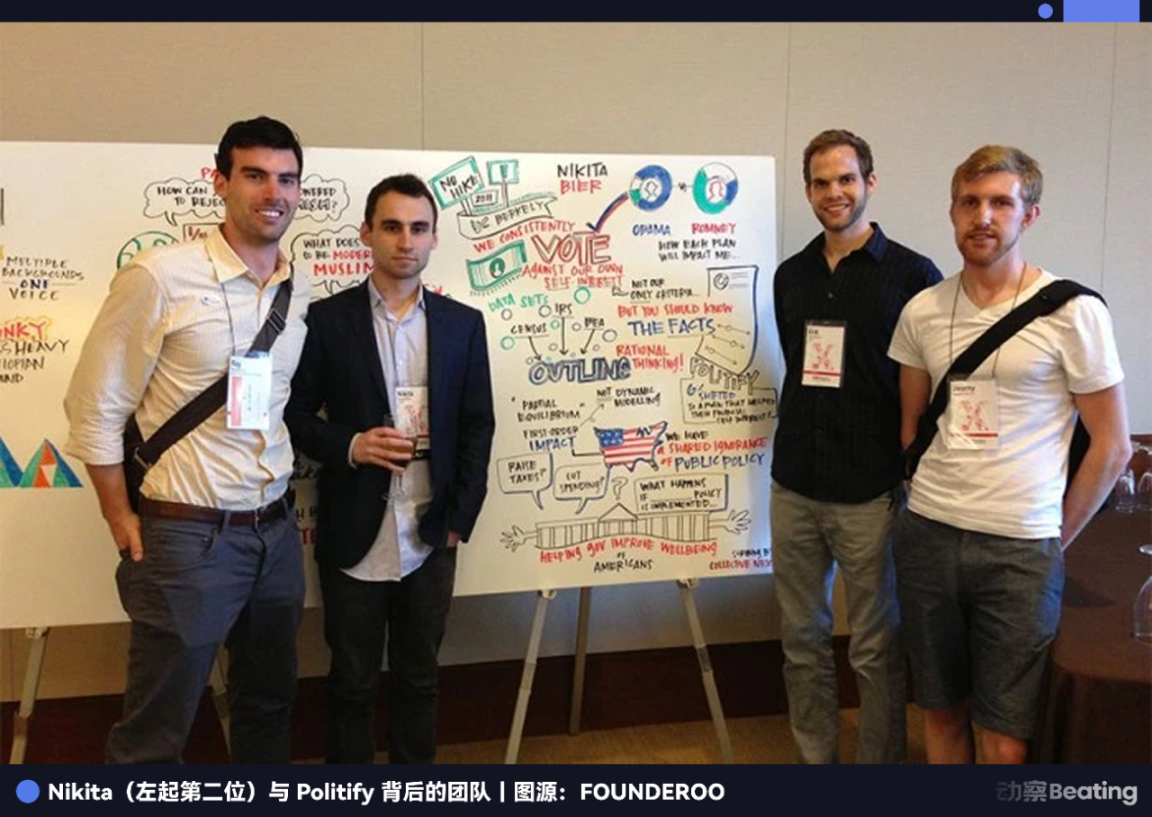
In 2012, Nikita Bier was still a student at UC Berkeley. That year, he launched Politify—a data- and logic-driven app designed to intervene in U.S. politics.
Politify’s core feature was a tax calculator: users entered income and household details, and the app computed how different candidates’ tax policies would affect them personally. Bier believed that if voters could clearly see their economic self-interest, they’d make more rational choices.
The idea exploded during the 2012 U.S. election. With zero marketing budget, Politify attracted 4 million users and briefly topped the App Store download chart. Bier then believed information asymmetry in voter decision-making was the root cause of societal problems—and his product could fix it.
Reality quickly struck him hard. Bier discovered that even after users downloaded Politify and saw how policies affected their wallets, they didn’t change their votes. A blue-collar worker earning $30,000 annually might know a candidate’s tax plan favored him—but still vote for another due to cultural identity.
That realization taught Bier that data and logic couldn’t overcome emotional resonance. So, between 2012 and 2017, he entered a frenzied phase of trial and error. According to Startup Archive, after Politify, Bier and his team launched over a dozen apps—attempting to deconstruct human behavior from every angle—yet none succeeded. Some failed to acquire users; others failed to retain them.
Yet each failure deepened Bier’s understanding of human nature. He began to see that humanity’s most primal desire isn’t rationality, knowledge, or efficiency—it’s being seen, recognized, and praised.
In 2017, they launched their 15th product: tbh (“To Be Honest”).
A fully anonymous social app, tbh let users anonymously vote on friends—for prompts like “Who’s most likely to become president?” “Who’s most likely to become a millionaire?” or “Who’s most likely to save the world?” Every question was positive. Every response was praise.
tbh attracted 5 million users in two months, peaking at 2.5 million daily active users. It started at a Georgia high school and went viral across U.S. high schools. In October 2017, Facebook acquired tbh for under $30 million.
tbh’s success marked Bier’s pivot—from trying to persuade users with data, to driving them with emotion. He stopped aiming to solve social problems—and instead weaponized human vulnerabilities to build addictive products. The earnest entrepreneur vanished, replaced by a masterful dopamine dealer.
Musk’s Choice
In October 2017, Nikita Bier joined Facebook with his team as a product manager.
Internally, Bier shared tbh’s growth playbook with Facebook colleagues. As reported by BuzzFeed News in August 2018—based on internal Facebook documents—Bier’s team detailed exactly how they leveraged Instagram’s mechanics for explosive growth.
Their strategy hinged on teenagers’ curiosity and herd mentality. Bier’s team created private Instagram accounts, followed every student at target high schools, and wrote cryptic bios like: “You’ve been invited to a mysterious new app—stay tuned!”
Students, intrigued, sent follow requests. Bier’s team waited 24 hours to collect all requests—then, at 4 p.m. (school dismissal time), made the account public and added an App Store link to its bio.
Instagram notified all students simultaneously that their follow request had been accepted. Seeing the notification, students visited the profile, clicked the link, and downloaded the app.
It was unorthodox—but revealed Bier’s uncanny grasp of human psychology. To get users to act, you don’t need to convince them—you just need to engineer an irresistible emotional trigger.
Less than a year after acquisition, Facebook shut down tbh citing “low usage.” But Bier stayed on as a product manager.
During this time, he gained deep insight into how large-scale social platforms operate—and how internal politics shape product decisions. He observed how Facebook used algorithmic recommendations to provoke controversy, deployed data analytics to predict user behavior, and engineered products to maximize dwell time.
His most important lesson? Social platforms aren’t built to connect people—they’re built to generate emotional volatility. The greater the volatility, the longer users stay—and the higher ad revenue climbs.
In 2021, Bier left Facebook to join Lightspeed Venture Partners as a Product Growth Partner. In 2022, he and his original team launched Gas—the upgraded successor to tbh—adding voting, gamification, and paid features (e.g., paying to see who praised you).
Gas attracted 10 million users in three months, generated $11 million in revenue, and briefly surpassed TikTok and Meta as the most popular app in the U.S. In January 2023, Discord acquired Gas for $50 million.
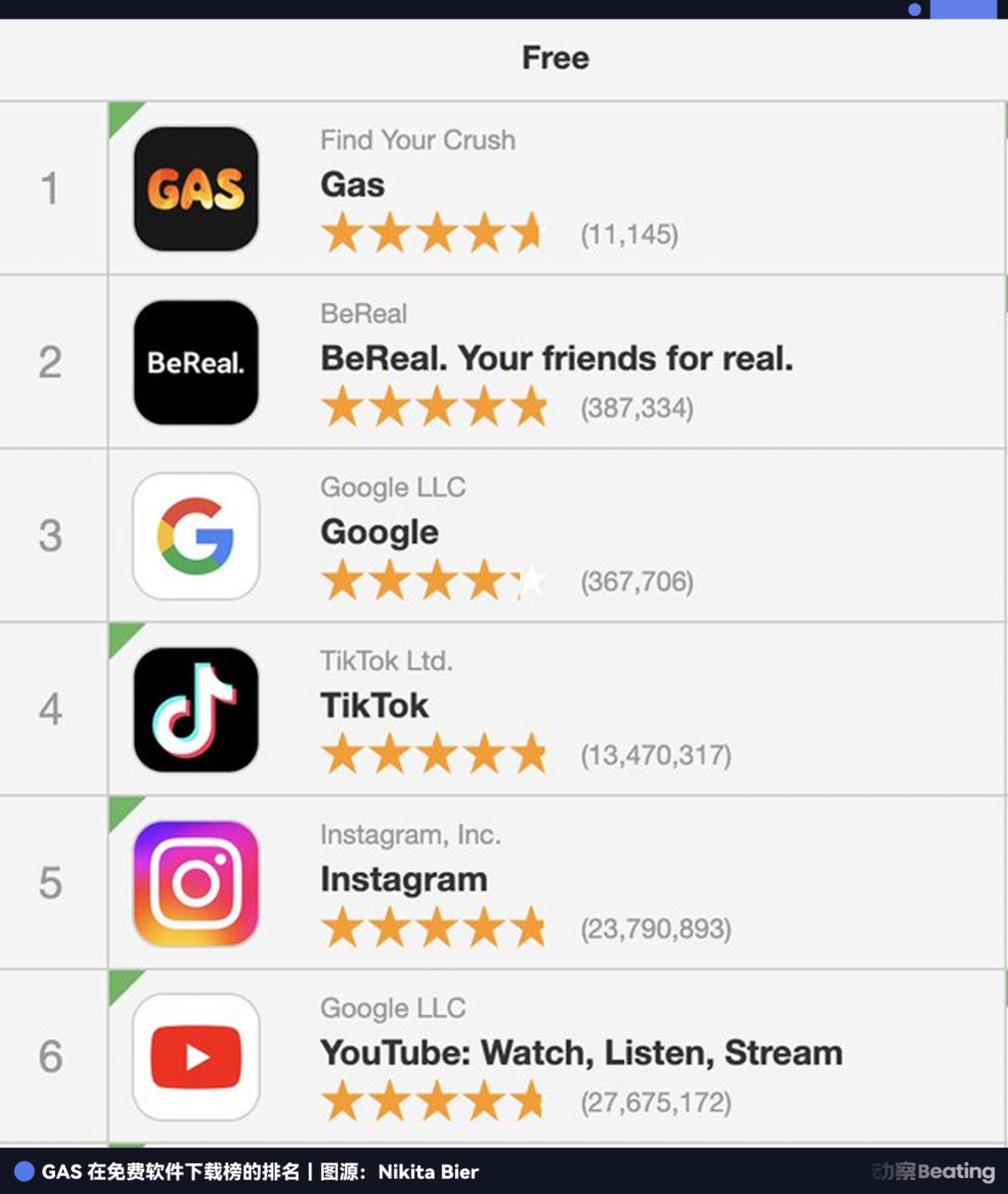
Gas’s success confirmed Bier’s key insight: the human craving for praise is monetizable. Create an environment where users desperately want to be seen and validated—and insert a paywall at the moment of peak desire—and they’ll open their wallets without hesitation.
This insight is exactly what Musk needed.
In October 2022, Musk acquired Twitter for $44 billion and rebranded it as X. His blueprint: evolve X into the ultimate closed loop—social + finance. But to turn vision into reality, Musk faced a critical challenge: How do you dissolve users’ psychological barriers so they naturally transition from scrolling feeds to trading stocks, investing, or saving—all within one platform?
At its core, this remains a question about human nature. What kind of motivation could push users past the mental hurdle of conducting financial transactions on a social platform?
Bier and Musk’s connection began with a bold cold pitch. When Musk announced the Twitter acquisition, Bier tweeted: “@elonmusk Hire me to run Twitter as VP of Product.” The tweet received no reply—but Bier didn’t give up.
Over the next three years, he posted consistently on X—sharing deep insights on product growth, user psychology, and network effects. His tweets gradually amassed massive influence, proving to Musk his profound understanding of both product and human behavior.
So, when X needed a product leader capable of fusing social and finance in June 2025, Musk turned to Bier. Upon announcing his appointment, Bier wrote: “I’ve officially posted my way to the top,” and replied to his 2022 pitch tweet: “Never give up.”
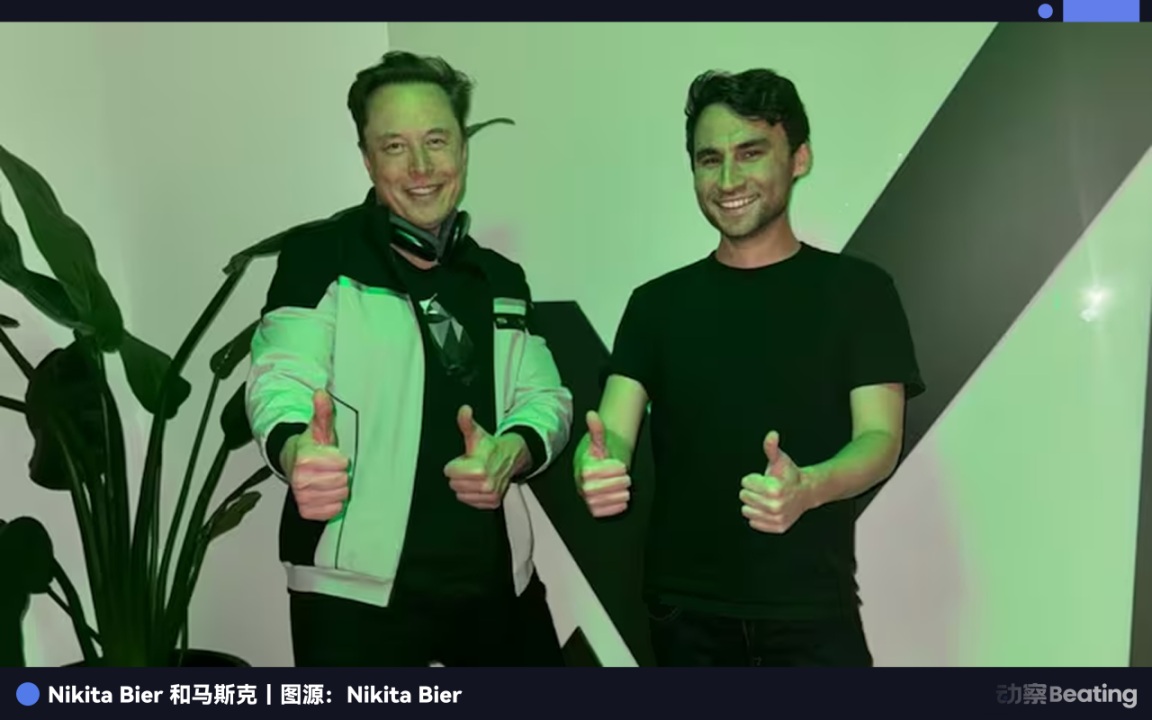
The story itself is Bier’s perfect embodiment of his core belief: “Influence is currency.”
Before joining X, Bier also served as an advisor to the Solana Foundation, leading its mobile strategy. There, he witnessed firsthand how crypto leverages social dynamics to achieve viral growth—and realized influence itself had become a priced, tradable financial asset.
Musk chose Bier because, through his first-principles lens, finance isn’t about technology—it’s about trust and emotion. You must know how to wield emotion as a lever.
And Bier is precisely that expert.
His actions at X are, fundamentally, extreme applications of emotional leverage. Take his overhaul of X’s Creator Incentive Program. Bier knows that for any platform to sustain high-quality content, it must resolve creators’ core anxieties.
So, in plain sight, he upgraded payouts—ensuring creators earn more per cycle. Behind the scenes, however, he actively manipulated algorithms to manufacture stars.
In January 2026, prominent U.S. creator Dan Koe published a long-form post on X titled “How to Fix Your Entire Life in One Day.” Within a week, it garnered 150 million views and 260,000 likes—the highest-read long-form post in X’s history.
That’s Bier’s blueprint. By catapulting a single deep article to billion-level exposure, he sent a crystal-clear signal to all creators—especially those hesitant to invest effort in X—that quality content *will* be amplified by X’s algorithm.
It’s a far more sophisticated strategy than direct monetary incentives. It cures creators’ fear of shouting into the void. Dan Koe’s case reassures them: On X, deep thinking and high-quality content *are* discoverable and scalable.
This tactic echoes the same psychological principles Bier deployed in tbh and Gas. He understood creators crave visibility and validation. By establishing a benchmark for virality, Bier precisely activated creators’ participation—drawing more premium content onto the platform and creating a virtuous cycle.
Gen Z’s Wealth Anxiety
This mastery of human psychology allows Bier to repeatedly strike the precise nerve of his target audience. In finance, his focus is a generation battered by financial anxiety.
In October 2024, BuzzFeed published “This Woman Revealed How She Coped With Financial Anxiety in Her 20s.” Its subject: 27-year-old Hayley, a front-desk clerk at an animal clinic in northern Colorado, earning $17/hour.
She’s scheduled for only 33 hours weekly. Her fixed monthly expenses: $600 rent, $400 car loan, $150 auto insurance, $50 electricity, $70 phone bill, $100 student loans, and $50 minimum credit card payment—totaling $1,420. Though she sets aside $50 per paycheck as discretionary spending, it vanishes almost instantly.
Hayley said: “Every purchase comes with guilt—I feel like that money should be saved. Until I close that financial black hole, I’ll never achieve the foundational sense of security that lets me breathe easy. Maslow’s hierarchy nailed it. I hate this society—it forces us to survive while robbing us of the space to live.”
Hayley’s story is a generation’s mirror.
According to Bank of America’s July 2025 survey, 72% of young adults altered daily habits due to rising living costs; 33% of Gen Z report severe financial stress, with over half blaming economic instability.
EY research likewise highlights finances as Gen Z’s top anxiety driver. Arta Finance’s 2024 report shows financial stress has triggered early midlife crises for 38% of Gen Z and 36% of Millennials.
This anxiety fuels X’s financial expansion.
After joining X, Bier rapidly rolled out the product adjustments described earlier. But his true ambition goes beyond making X a financial information platform—he wants X to become a full-fledged financial *trading* platform.
As reported by the Financial Times in November 2025, X is developing in-app trading and investment capabilities—letting users buy stocks and cryptocurrencies directly on X. X CEO Linda Yaccarino revealed Visa will be the inaugural partner for XMoney accounts. As of December 2025, X Payments has secured money transmission licenses in 38 U.S. states—covering roughly 75% of the U.S. population.
On X, every like, comment, and retweet expresses user emotion. Bier’s mission is to convert those emotional signals into financial ones. If a user frequently likes tweets about a particular stock, X infers interest—and serves a purchase link at the optimal moment.
If a user constantly comments on crypto-related posts, X identifies them as a potential crypto investor—and recommends relevant investment products.
This is emotion-based finance. No active search required. No complex forms. No cumbersome verification. Just capture emotional fluctuations—and deliver a frictionless transaction entry point at the peak of emotional intensity.
In an interview, Bier stated: “Consumers don’t choose products because of functional gaps—they choose them based on the emotional resonance they experience while using them.”
Likewise, X’s financialization isn’t about delivering superior financial services—it’s about capturing emotion, then converting that emotion into transactions at the exact moment it surges.
This model resonates especially powerfully with Gen Z. Per the CFA Institute’s research report: 31% of Gen Z began investing before age 18; 54% rely on social media for investment insights; 44% hold cryptocurrency—with crypto averaging 20% of their portfolios.
For this cohort, social media isn’t just an information channel—it’s where investment decisions happen. They distrust traditional financial institutions and Wall Street analysts. They trust KOLs on social media—and their own emotions and instincts. And X is precisely the amplifier for that emotion and instinct.
The Super App Curse
Yet before Musk and Bier, countless giants attempted—and failed—to build super apps.
Once the mobile industry’s dominant force, BlackBerry and its BBM messenger stood just one step away from becoming a super app. Executives ambitiously planned to layer payments and services atop messaging—building a digital empire for their era.
But reality was brutal. A cascade of strategic missteps eroded BlackBerry’s competitive position. By 2013, its market share had plummeted from 20% to under 1%—its grand imperial dream ending in total collapse.
BlackBerry’s failure wasn’t isolated. Amazon’s attempt ended similarly. In 2014, the Fire Phone launched with Jeff Bezos’s sweeping vision to merge e-commerce and social networking—only to implode rapidly. The venture cost Amazon a $170 million write-down—and stands as one of Bezos’s most conspicuous commercial failures.
Analyzing these cases reveals three core reasons super apps struggle in Western markets.
First: highly specialized user habits. Western users prefer purpose-built standalone apps. A small business owner routinely relies on Shopify for sales, QuickBooks for accounting, and Slack for collaboration. To them, “do-it-all” often means “do-it-poorly”—and super apps rarely match the professional depth of category leaders.
Second: stringent regulatory barriers and privacy red lines. At its core, a super app is a data monopoly—and privacy protection is Europe and North America’s regulatory Achilles’ heel. Consolidating massive datasets on a single platform triggers serious societal concerns—and multiplies compliance costs and breach risks exponentially.
Third: entrenched incumbent dominance. Mature markets have no vacuum. Google, Amazon, and Apple have already partitioned users’ digital lives. Any new super app faces not just functional competition—but must overcome deeply rooted brand loyalty to existing ecosystems.
So—can X succeed where predecessors failed?
X’s advantages are clear: 550 million active users; Musk’s deep pockets and political capital to navigate regulation; and, crucially, X isn’t building from scratch—it’s incrementally layering finance onto an existing foundation.
This “small-step, fast-pace” approach eliminates user friction. No new app to download. No new interface to learn. Just one extra tap in a familiar UI—and social + finance are fused.
Yet X’s challenges remain steep. American users already comfortably use Venmo for transfers and Robinhood for trading crypto and stocks. Why switch to X?
That’s Nikita Bier’s problem to solve. His answer: embed financial transactions into users’ everyday social behaviors. He doesn’t beg you to “do business” on X—he makes buying a stock or crypto as effortless as scrolling your feed. That seamless experience is X’s make-or-break factor.
But this seamlessness introduces a new dilemma. When social and finance fuse, emotional volatility translates directly into financial action. Could this amplify market irrationality? Might users make disastrous investment decisions at emotional peaks? And could this invite even heavier regulatory scrutiny?
That question has no answer yet.
Emotional Alchemy
Over the past decade, we’ve watched social media evolve—from “connecting people” to “manufacturing emotion.” We’ve seen attention economies shift—from “content is king” to “emotion is king.” We’ve witnessed wealth distribution transform—from “capital is king” to “influence is king.”
Nikita Bier’s career mirrors this evolution. He transformed from a founder trying to reshape the world with reason—into a dopamine dealer harvesting users via sentiment.
This metamorphosis reflects an era’s inevitability. In an age of information overload and attention scarcity, reason yields to emotion, logic surrenders to intuition, and long-term thinking bows to immediacy. Today, whoever engineers emotion captures attention; whoever captures attention commands influence; and whoever commands influence accrues wealth.
We now inhabit a new era—an emotion-driven era, an era where influence *is* wealth.
In this era, each of us is Nikita Bier’s product. Our likes, comments, and shares are captured by algorithms, analyzed by data models, and amplified emotionally. Our attention, our emotions, our influence—are all converted into liquidity, wealth, and power.
In this era, emotion is the most potent weapon—and the most dangerous poison.
Join TechFlow official community to stay tuned
Telegram:https://t.me/TechFlowDaily
X (Twitter):https://x.com/TechFlowPost
X (Twitter) EN:https://x.com/BlockFlow_News
 BlockBeats