








Still installing OpenClaw? This company has already built an AI-powered computer.
TechFlow Selected TechFlow Selected
Still installing OpenClaw? This company has already built an AI-powered computer.
This $20-billion-valued company has built an AI-powered computer that never shuts down.
 Navigating Web3 tides with focused insights
Author: David, TechFlow
While you’re still wrestling with installing OpenClaw on your own computer—and worrying whether it’ll run fully autonomously—a company has already built an AI-powered computer preloaded with everything you need, running 24/7 without ever shutting down.
That company is Perplexity, valued at $20 billion. Yesterday, it held a launch event in San Francisco that quickly ignited the global tech community. And its product name? Bold and simple:
Personal Computer—just “Personal Computer.”
Buy a Mac mini, install its software, connect to the internet, and you’ve got an AI computer that never sleeps. No command-line tinkering, no environment setup, no manual API key configuration.
Perplexity has already integrated 20 AI models—from Claude to Gemini to GPT—assigning each to tasks it excels at.
You just tell it what outcome you want.
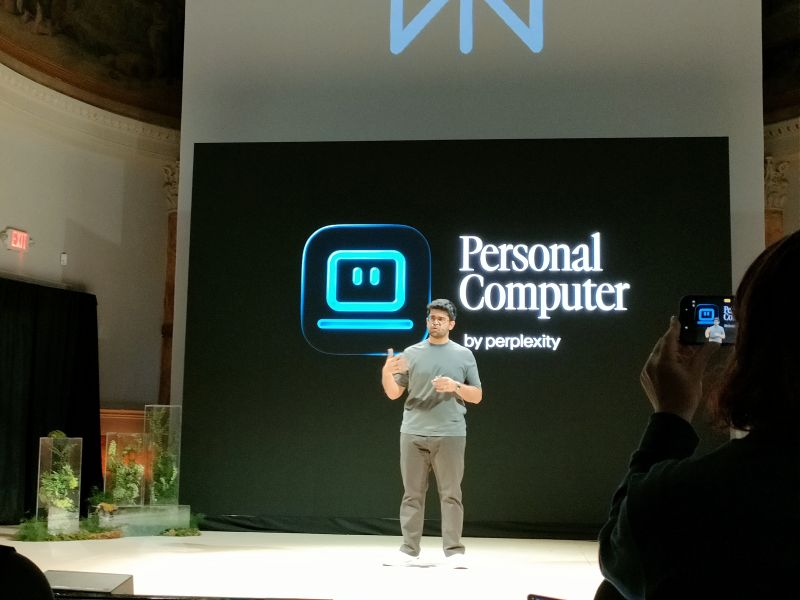
Image source: Perplexity Developer Conference — CEO demonstrating the Personal Computer
Embedding the AI Experience into the Operating System
Strictly speaking, Perplexity didn’t build a computer from scratch. What it actually did was:
embed AI directly into a Mac mini’s operating system.
You buy a Mac mini yourself, install Perplexity’s software, and connect it to the internet—and that Mac is no longer just another ordinary computer. It runs 24/7, connects to your office applications, and automatically executes tasks according to rules you define.
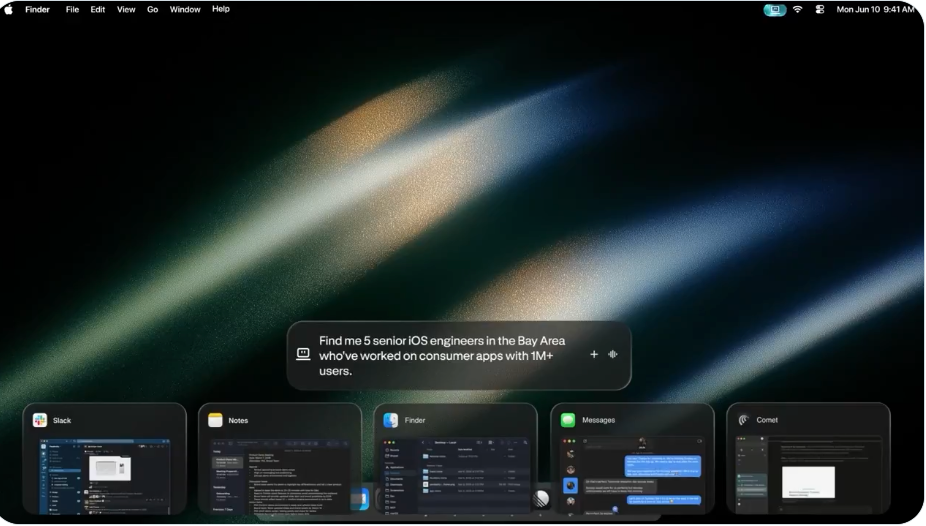
In the launch demo, someone issued a single instruction: “Screen candidates from the resume database for SwiftUI experience, and simultaneously email investors with a link to the project briefing.”
One sentence. Two tasks. Completed simultaneously. When a client sends an inquiry email, it drafts a reply in your usual tone. While you’re in a meeting, it updates sales data in the background. While you sleep, it keeps working.
I know your first reaction is: “Isn’t this exactly what OpenClaw does? What’s the difference?”
Over the past two years, there have been two main paths for ordinary users to access AI. One is cloud-based: open a browser, go to ChatGPT or Claude, type a prompt, wait for a response, then copy and use the output manually. The other is local: install tools like OpenClaw, spend hours configuring environments, and let AI operate your computer.
Both paths share one thing in common: you must actively seek out AI.
Perplexity aims for something different—you don’t need to seek out AI, because AI lives inside your computer.
It operates your files, emails, calendar, and apps directly—no need to switch to any “AI interface” to issue commands. You don’t need to know which model is running behind the scenes, how tasks are decomposed, or how much cloud compute is being used.
You only see the task completed.
No human needs to sit in front of that Mac mini. Two weeks ago, Perplexity launched a cloud-based system called “Perplexity Computer,” where 20 AI models stand ready—Claude handles reasoning, Gemini handles research, GPT handles long-form text, each with clearly defined roles.
The newly launched Personal Computer brings this entire capability onto your desktop Mac, transforming it into a self-acting machine.
“Skinning” Is Justified
Meanwhile, Aravind Srinivas, Perplexity’s CEO, said something at the launch that perfectly captures the product’s essence:
“Traditional operating systems receive instructions; AI operating systems receive goals.”
This statement explains why yesterday’s announcement swept half the tech world.
It’s not because yet another AI product launched—this year, ten new AI products emerge every week, and people are numb to them. Rather, it’s because Perplexity touched a single word—and gave it a far more compelling narrative:
Personal Computer.
Since IBM coined the term in 1981, its meaning hasn’t changed in 45 years: you buy a machine, install an OS, and launch software to get work done yourself. Now Perplexity declares: a personal computer shouldn’t be a machine you operate—it should be a machine that works for you. You’re not a user; you’re the boss.
This narrative squarely hits 2026’s hottest trend: AI Agents. OpenClaw lit the first spark in the open-source community, and everyone is betting on the same shift: AI must evolve from “answering questions” to “completing tasks.”
Perplexity itself has strong narrative credentials.
Founded in 2022, its CEO Aravind Srinivas previously worked at OpenAI, Google Brain, and DeepMind. Its original mission was simple:
You ask a question; it uses AI to search, synthesize answers, and cite sources. Think of it as an AI-powered Google—but instead of ten blue links, it delivers the answer directly.
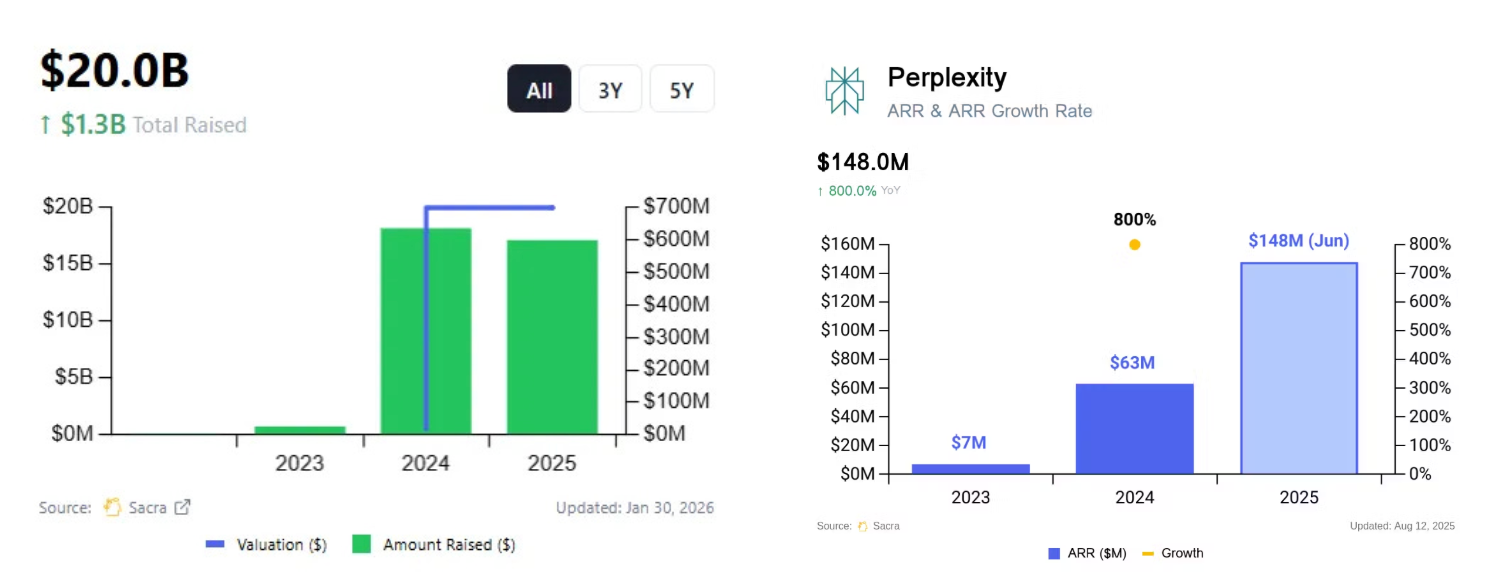
This product hit the right timing window. In under two years, its valuation soared from $500 million to $20 billion. It has raised over $1.5 billion in total funding, backed by NVIDIA, Jeff Bezos, and SoftBank. Its annualized revenue grew from $80 million at the end of 2024 to roughly $200 million today.
But Perplexity has one defining trait—and its biggest point of controversy: it doesn’t build its own large language models.
It orchestrates others’ models—Claude (Anthropic), Gemini (Google), GPT (OpenAI). Perplexity acts as the middleware layer—orchestrating these models, wrapping them in its own product interface, and selling the package to users.
The industry has a term for such companies: “skinning.”
Yet in 2026, the connotation of that word has shifted. This year’s largest AI acquisition—the $billions Meta spent on Manus—also relies on third-party models. OpenClaw, with 140,000 stars on GitHub, still runs on Claude or GPT APIs under the hood.
Nearly everyone in the AI Agent space trains no models from scratch. Everyone is “skinning.” The distinction lies in how well the skin is crafted—and how many users are willing to pay for it.
Perplexity’s skin currently sells for $200/month—the top-tier Max subscription plan.
In February, it discontinued its ad business entirely and pivoted fully to subscriptions, citing executives’ belief that ads erode user trust in search results. A “skinning” company betting entirely on product experience—not ad subsidies—to drive revenue.
Embedding this experience into the Mac mini is just step one; support for additional platforms will follow.
The Foreman’s Dilemma
“Skinning” can be justified—provided the underlying model vendors don’t enter the same arena themselves.
Anthropic launched Cowork; Google is pushing Gemini Agents; OpenAI’s Operator heads in the same direction. The very models Perplexity orchestrates are now becoming its direct competitors.
It’s like a construction foreman who borrows all his workers from other firms—only for those firms to announce: “We’re taking on projects ourselves now.”
Even thornier is the legal liability of execution.
Forbes, The New York Times, and Dow Jones have all sued Perplexity, accusing it of scraping copyright-protected content. But those cases aren’t the most serious. Last week, Amazon secured a federal court’s temporary injunction blocking Perplexity’s Comet browser from automatically shopping for users on Amazon. The court ruled that Perplexity may have violated the federal Computer Fraud and Abuse Act.
Why? Because when Comet places orders on users’ behalf, it does not disclose to Amazon that an AI—not a human—is operating the account.
Now consider that in the context of its new Personal Computer: a company the courts have deemed potentially liable for impersonating humans via AI now asks you to grant full, 24/7 access to your local files, emails, and calendar.
There’s also an under-discussed metric.
Perplexity’s U.S. website traffic rose by less than 4 million monthly visitors between February 2025 and February 2026. Meanwhile, Claude’s web-user base quadrupled during the same period. Its original differentiation—AI-powered search—is now replicable by ChatGPT, Gemini, and Claude alike.
I’m not saying Perplexity is doomed.
Building a $20 billion valuation through “skinning” is itself a remarkable feat. Yet the company is simultaneously building a search engine, a browser, an email assistant, a cloud-based AI Agent, and a local-computer operating system—each line directly competing against tech giants…
Still, perhaps the foreman’s real dilemma isn’t competition—but rather, when he’ll be acquired.
Join TechFlow official community to stay tuned
Telegram:https://t.me/TechFlowDaily
X (Twitter):https://x.com/TechFlowPost
X (Twitter) EN:https://x.com/BlockFlow_News
 深潮TechFlow


