Telegram vs X: Who Will Dominate the Super App Race in the Web3 Era?
TechFlow Selected TechFlow Selected
Telegram vs X: Who Will Dominate the Super App Race in the Web3 Era?
X focuses on public topic discussions and information dissemination, while Telegram places greater emphasis on privacy protection and security.
 Navigating Web3 tides with focused insights
Author: Leo Deng, LK Venture
Abstract: X and Telegram are globally recognized social media platforms currently exploring the race to become super apps in the Web3 era. The three key factors that will determine victory—reimagined user experience, new standards for privacy and security, and technological innovation combined with ecosystem integration—are shaping this competition. While X focuses on public discourse and information dissemination, Telegram emphasizes privacy and security. This rivalry will drive the development of the Web3 world, guiding us into a more open, decentralized, secure, and user-friendly digital age.
TL;DR
-
Exploring the potential of Web2 applications like X and Telegram in the Web3 world is not only an insight into the future development of these social platforms but also a prediction of the new landscape and order of the future Web3 world.
-
X and Telegram differ significantly in user market distribution, core functions, innovation capability, business models, openness, community culture, and Web3 exploration. Their competition and cooperation may coexist over the long term.
-
Reimagined user experience, new standards for privacy and security, technological innovation with ecosystem integration, and innovative business models are the four key factors determining whether X or Telegram will win the Web3 super app race.
-
Despite the intensifying competition between X and Telegram in the Web3 super app arena, uncertainties remain, and the final competitive landscape may unfold in unexpected ways.
The Crypto Evolution of Web2 Social Giants Could Bring a New Order to the Web3 World
Web3, representing the next generation of the internet, marks a significant shift from centralization to decentralization. Compared to Web2, Web3 emphasizes user data ownership, decentralized network structures, and transparency powered by blockchain technology. This represents not just a technological leap but also signals a transformation in online interaction and business models.
For example, the rise of decentralized finance (DeFi) and non-fungible tokens (NFTs) exemplifies the practical implementation of Web3 concepts. According to DappRadar data, DeFi's total value locked (TVL) peaked at $267 billion in 2022, while NFT market trading volume reached approximately $25 billion—highlighting the immense potential of the Web3 world.
In the Web2 era, WeChat stands as a dominant force among social applications. As of 2023, WeChat has surpassed 1.2 billion monthly active users, making it one of the most popular social apps globally. Beyond being a communication tool, WeChat integrates payments, shopping, gaming, mini-programs, and more into a multifunctional super app.
WeChat’s success lies in its comprehensive ecosystem, enabling users to perform nearly all daily tasks within a single platform. Its influence extends beyond user numbers—it has reshaped lifestyles and business models.
In this context, examining the potential of Web2 platforms like X and Telegram in the Web3 world is not merely about forecasting their future development—it is about anticipating a new structure and order for the Web3 world.
Certainly, other social platforms such as Facebook and Kakao also have vast opportunities in Web3. However, currently, X and Telegram appear to be the first Web2 social platforms poised to achieve early breakthroughs in the Web3 space.
As globally renowned social media platforms, X and Telegram each possess unique strengths and massive user bases. X is known for its broad influence and diverse user demographics, whereas Telegram is favored for its strong commitment to privacy and security. In the wave of Web3, both platforms face challenges in adapting to decentralization trends and leveraging blockchain innovations in services and business models. These factors will be crucial in determining whether they can emerge as Web3-era equivalents of WeChat.
Elon Musk has repeatedly praised China’s WeChat, stating, “In China, you can live inside WeChat—it does everything.” His vision is to build a similarly comprehensive super app, which he has named X.
To meet the specific needs of dating services, X may need to develop new algorithms and user interfaces. Becoming a "digital bank" implies introducing financial services such as payment processing, fund transfers, or even cryptocurrency transactions—requiring X to establish robust security and compliance frameworks to ensure the safety and legality of financial operations.
Meanwhile, Telegram co-founder Pavel Durov initially envisioned TON as a way to integrate cryptocurrency transactions into chats and monetize the app. In mid-September 2023, the TON Foundation officially announced a partnership with Telegram, aiming to integrate and promote the TON network ecosystem to Telegram’s 800 million active users. They aim to attract and convert 30% of Telegram’s active users—240 million—into active TON network users by 2028. The self-custody wallet TON Space has been seamlessly integrated into Telegram, enhancing user convenience and potentially attracting new users interested in cryptocurrency.
In this rapidly changing digital era, it is far easier for high-frequency scenarios to absorb low-frequency ones than vice versa. Social interaction, being an ultra-high-frequency scenario, can penetrate financial use cases much more easily than adding social features into financial platforms. The key to success lies in convenience: reducing the number of apps users need to download is a clear indicator of success.
Both X and Telegram are striving toward this goal, but their paths and strategies differ. Over time, we will see which platform better adapts to Web3 trends and ultimately emerges as a leader in this new era.
All the functionalities we’ve seen on WeChat will eventually be realized on X and Telegram. These rich ecosystems will create powerful momentum, significantly increasing user stickiness and engagement time. This logic mirrors the transition from the internet to mobile internet, and then from standalone apps to mini-programs. Even in the early stages, this shift could deliver a transformative impact on the Web3 world.
By analyzing their current status, strengths, challenges, and future possibilities, we can gain deeper insights into the development trends and business opportunities in the Web3-era social media landscape, including but not limited to the following aspects:
Massive User Base: Both X and Telegram boast extensive global user bases. This gives them the potential to onboard hundreds of millions of users into the Web3 ecosystem when transitioning. Such large-scale migration is critical to driving the adoption and acceptance of Web3.
Influence and Brand Recognition: As globally recognized social media platforms, X and Telegram wield significant brand influence. Their adoption and promotion of Web3 could profoundly shape public perception and attitudes toward Web3 technologies.
Potential for Innovation and Technological Integration: Both platforms have a history of implementing technological innovations and integrating new technologies. Their activities in the Web3 domain could lead to breakthroughs in decentralization, data security, and user experience.
Business Model Transformation: Web3 offers entirely new business models, especially around data ownership and user incentives. Explorations by X and Telegram in these areas could pioneer a new chapter in social media monetization.
Redefining Privacy and Security: As users grow increasingly concerned about privacy and data security, Telegram has already built a strong reputation in this area. The evolution of X and Telegram in the Web3 space may further strengthen social platforms’ capabilities in protecting user privacy and data.
Community and Decentralized Governance: Web3 emphasizes community power and participation. X and Telegram’s experience in building and maintaining vibrant communities may play a vital role in establishing decentralized governance models and encouraging user involvement.
Therefore, the developmental potential of X and Telegram in the Web3 world warrants close attention. Their moves could have profound implications for the entire Web3 ecosystem and even the future of the internet.
Basic Information and Competitive Analysis of X and Telegram
X and Telegram are both globally recognized social media platforms, each with a massive user base and wide market reach. Their core functions differ: X emphasizes public discussions and information sharing, while Telegram prioritizes privacy and security. Key differences include:
Features
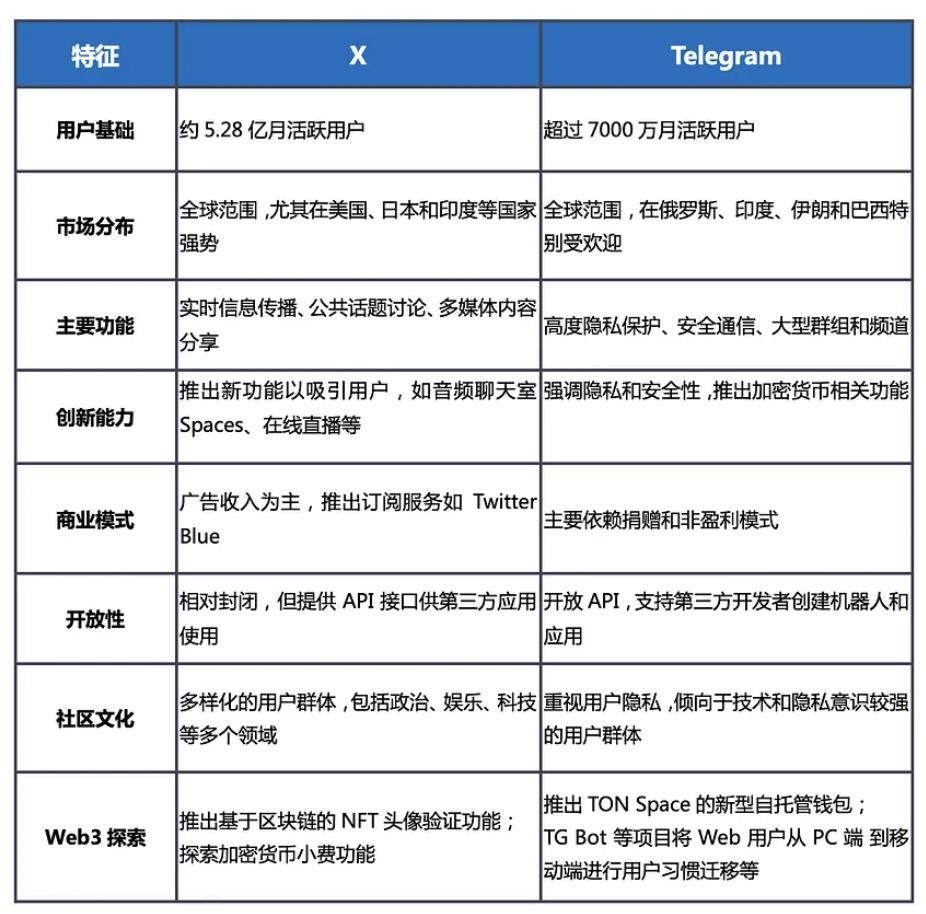
Comprehensive Comparison of X and Telegram
1. X:
User Base: As of 2023, X has approximately 528 million monthly active users. It has a global presence, with particularly large user bases in the United States, Japan, and India.
Market Distribution: X holds significant influence worldwide, especially in Western countries. It plays a key role in politics, entertainment, and news dissemination.
Core Features: X is renowned for real-time information sharing, public topic discussions, and high user interactivity. It supports multimedia content sharing, live streaming, hashtags, and more.
Web3 Milestones:
X launched blockchain-based NFT profile picture verification and explored tipping via cryptocurrency.
On October 29, 2023, Musk announced X’s vision—to evolve into a "mature" dating site and a "digital bank" by 2024.
2. Telegram
User Base: Telegram has over 70 million monthly active users. It is especially popular in Russia, India, Iran, and Brazil.
Market Distribution: Telegram has users across many countries and regions, particularly where there is high demand for online privacy and security.
Core Features: Telegram is known for its strong privacy and security. It supports end-to-end encrypted private chats, large groups and channels, and file sharing.
Web3 Milestones:
From May to July 2023, Unibot’s success—its token price increasing over 100x in three months—sparked FOMO in the market. Based on the fusion of AI and social interaction, Telegram bots now cover trading, airdrops, communities, and cross-chain functions, enriching crypto use cases and opening new innovation pathways.
In July 2023, Telegram launched its "Stories" feature, allowing users to post multimedia content via the "+" icon in the bottom-right corner. Similar to WeChat Moments, users can control visibility through filters. This fills a functional gap for Telegram as it builds a Web3 version of WeChat.
In September 2023, the TON Foundation announced an official partnership with Telegram to integrate TON’s self-custody wallet, TON Space, into Telegram. All Telegram wallet users can now access TON Space, with a global rollout expected by November.
In October 2023, the TON Foundation applied for a Guinness World Record as the “fastest blockchain,” launching performance tests on October 31 to demonstrate TON’s reliability, scalability, and speed.
Four Key Factors for Winning the Web3 Super App Race
1. Reimagined User Experience:
In the Web3 world, reimagining user experience means going beyond traditional convenience and interface appeal to deeper engagement and ownership.
X: Can leverage its vast user base and rich content to incentivize high-quality content creation and sharing via cryptocurrency rewards. For instance, rewarding trending posts or influential creators with tokens can enhance user engagement and sense of belonging.
Telegram: Can use its strong privacy and security to create a safer, more private social environment. By introducing blockchain-based identity verification and data storage, Telegram can offer users higher levels of privacy and data protection.
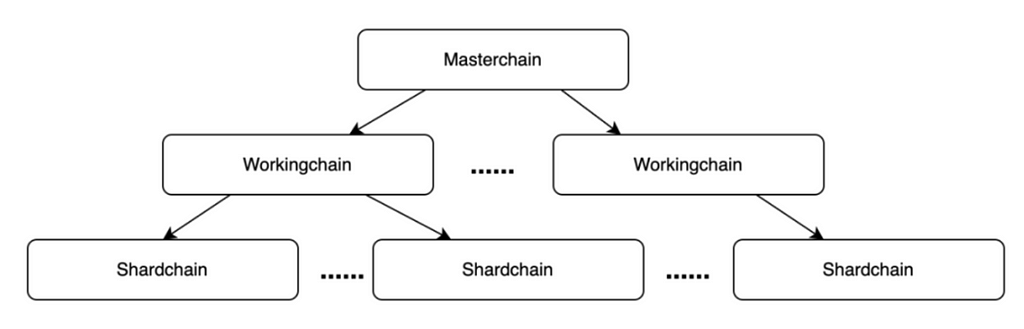
TON achieves the "infinite sharding paradigm" to support future million-level TPS, delivering a better user experience (Source: Beosin)
2. New Standards for Privacy and Security:
In the Web3 era, privacy and security will be major deciding factors for users choosing social platforms.
X: Must make greater efforts in protecting user privacy and data security. For example, adopting decentralized data storage solutions could ensure data safety and immutability.
Telegram: Already has inherent advantages in privacy and security, which it can further strengthen—such as by introducing blockchain-based decentralized identity systems for enhanced user privacy.

TON outperforms Ethereum and Bitcoin networks in fault tolerance and redundant storage
3. Technological Innovation and Ecosystem Integration:
Technological innovation and integration with broader ecosystems are essential in the Web3 world.
X: Can enrich its platform functionality and user experience through collaboration with other Web3 projects and services. For example, integrating DeFi services or NFT marketplaces would allow users to engage in financial activities or trade digital art during social interactions.
Telegram: With its openness and flexibility, has great potential for deep integration with the broader Web3 ecosystem.
According to the latest data from ton.app, the Ton ecosystem currently hosts over 550 apps, though DefiLlama lists only seven, with the top decentralized exchange (DEX) accounting for nearly half of the total value locked (TVL) at $4.87M.
Despite being a public chain with a circulating market cap of $3 billion, Ton’s TVL is only around $10 million—a disappointing figure, yet one that also presents enormous opportunity, especially for developers. There is ample time and space to explore untapped potential. The Ton team has recognized this and is actively attracting more developers through hackathons and funding initiatives.
However, Ethereum’s L2 ecosystems have already demonstrated strong network effects, with clear advantages in infrastructure maturity, application diversity, innovation, and capital scale. Market interest in new Layer 1 chains appears to be waning. If Ethereum’s L2 ecosystems achieve major breakthroughs in scalable applications, this could diminish the appeal of the TON ecosystem and affect Telegram’s Web3 development.
4. Business Model Innovation:
Social media platforms must balance user retention with exploring new revenue streams and growth vectors.
X: As of 2023, X’s financial reports show advertising remains its primary revenue source, constituting the vast majority of total income. According to 2022 financial data, X’s ad revenue reached approximately $4 billion. Additionally, X earns from data licensing and other services, contributing several hundred million dollars annually. X is actively exploring new revenue channels, including subscription services, enhanced e-commerce features, and cryptocurrency payment integration.
Telegram: Since its founding in 2013, Telegram has grown into a product with over 800 million monthly active users. However, its revenue lags far behind its user scale. Currently, aside from standard subscriptions, Telegram’s income mainly comes from limited ads. Reports indicate Telegram earned 100 billion rubles (~$104 million) in ad revenue in 2022. In contrast, Bilibili, with only a quarter of Telegram’s MAUs, generated nearly $700 million in ad revenue in 2022.
5. Impact of Commercial DNA
In the race to become Web3 super apps, the commercial DNA of X and Telegram will significantly influence their development trajectories.
X: Shares similarities with social sharing platforms like Weibo. Like Weibo—an open platform centered on information sharing and social interaction—this aligns closely with X’s original mission and direction. Weibo’s strength lies in rapid information dissemination and capturing public attention, which is also X’s core advantage.
In the Web3 era, X can build on this trait to enhance information sharing and social engagement while integrating blockchain for a more transparent, decentralized information platform. X can also learn from Weibo’s success in content creation and user engagement—such as using token incentives to encourage high-quality content.
Telegram: Built on IM tools, its commercial DNA closely resembles WeChat. WeChat, as a multifunctional social app, goes beyond messaging by integrating payments, shopping, games, and more into a full ecosystem.
Telegram can follow WeChat’s model—preserving its core messaging and privacy features while expanding into diversified services. For example, integrating Web3 elements like DeFi and NFTs could offer richer, more convenient experiences. Leveraging its strong privacy protections, Telegram could also provide a more secure and trustworthy Web3 social environment.
Overall, predicting the outcome between X and Telegram is difficult. ChatGPT offered its answer—but this is merely a reference.
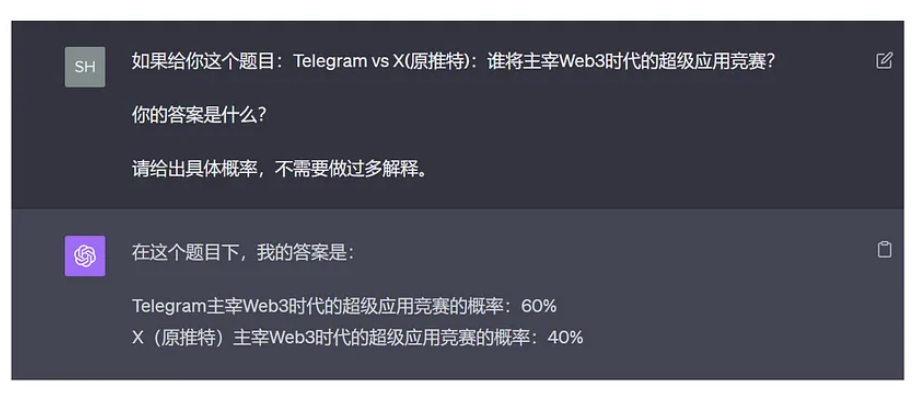
Bold Predictions on the Final Outcome of X and Telegram’s Future Competition
The competition between X and Telegram for the Web3-era WeChat crown might witness unexpected “black swan” events that drastically reshape the landscape. Let’s imagine some speculative scenarios:
Web2 Giant Acquires Telegram: If WeChat announces the acquisition of Telegram, it would dramatically alter the global social media and instant messaging landscape. Such a merger could combine technological and market resources, posing greater competitive pressure on X. Notably, in September this year, Tencent Cloud officially partnered with the TON Foundation to support Web apps and bots within Telegram—indicating quiet but strategic collaboration is already underway.
X Announces Major Web3 Partnership: If X partners with a high-performance blockchain like Solana or a leading L2, its competitiveness in Web3 could surge. Such a collaboration might involve cryptocurrency payments or integration of decentralized apps (DApps). Tip: Today, typing "Web3" in an X post automatically adds Immutable’s logo suffix (though likely still a technical bug).
Increased Government Regulation: Governments may introduce new regulations impacting social media and crypto markets. For example, if the U.S. enacts stricter rules requiring platforms to remove content labeled “fake news,” X may need to invest heavily in compliance—sparking free speech debates and potentially affecting user activity and brand image.
Geopolitical Risks: Conflicts such as the Israel-Hamas war or the Russia-Ukraine war could affect the international image and brand reputation of Telegram and X. If perceived as political tools or instruments of information warfare, their credibility among global users could suffer. Currently, Telegram’s largest user bases are in Russia, Indonesia, Malaysia, Brazil, Saudi Arabia, India, Nigeria, Egypt, and Turkey; X dominates in the U.S. and Europe.
Technological Breakthrough: A major innovation by either platform could shift the balance. Suppose Telegram develops a novel ZK-based decentralized identity system that ensures privacy while enabling efficient authentication. Such a breakthrough could attract privacy-conscious users and boost Telegram’s competitiveness.
Major Security Incident: If X or Telegram suffers a serious security breach or data leak, user trust could collapse, damaging market position—and inviting heavy fines and public backlash.
Major Partnership Announcement: Imagine X partnering with Amazon, enabling users to purchase Amazon products directly on X using cryptocurrency. This would significantly strengthen X’s position in e-commerce and payments.
Conclusion
In the race between Telegram and X (formerly Twitter) to become Web3-era super apps, reimagined user experience, new standards for privacy and security, and technological innovation with ecosystem integration may emerge as the three decisive factors. Telegram, leveraging its strengths in privacy and security and its close collaboration with the TON network, is actively exploring Web3 possibilities. Meanwhile, under Elon Musk’s leadership, X is demonstrating ambitious visions for diversified services and the concept of a digital bank. These initiatives challenge existing business models and represent explorations into the future of social media.
Yet, despite both platforms striving to define their Web3 visions, the future competitive landscape remains uncertain. We may see more players enter the race—or entirely new competitors emerge—reshaping the current dynamics.
Ultimately, the super app race between Telegram and X in the Web3 era is not just a battle of technology and business models, but a profound exploration of the future internet.
Regardless of the final outcome, this competition will drive the evolution of the Web3 world, leading us into a more open, decentralized, secure, and user-friendly digital era.
Join TechFlow official community to stay tuned
Telegram:https://t.me/TechFlowDaily
X (Twitter):https://x.com/TechFlowPost
X (Twitter) EN:https://x.com/BlockFlow_News
 LK Venture