








FaceDAO: A Web3 social app that uses Face login, launching the largest airdrop event in history
TechFlow Selected TechFlow Selected
FaceDAO: A Web3 social app that uses Face login, launching the largest airdrop event in history
FaceDAO announced to the public that it will launch the largest airdrop in history.
 Navigating Web3 tides with focused insights
By 0xmico
"What is FaceDAO?"
I first came across the name FaceDAO in a private message. It started when a reader donated to Ukraine but didn't receive an official airdrop—then suddenly, FaceDAO emerged, announcing it would airdrop 1 million $FACE tokens to every donor.
This was just the beginning. Later, FaceDAO announced it would launch the largest airdrop in history, running from March 3 at 12:00 UTC to March 18 at 12:00 UTC.
Log in to the FaceDAO app using your Web2.0 account (Facebook / Twitter), authenticate your unique face, and receive between 100,000 and 2,000,000 FACE tokens.
According to the team, in the Web2.0 era, the data you contribute becomes platform profits; in the Web3.0 era, FaceDAO will return that data value directly back to you as assets. Therefore, based on your Web2.0 account registration date, number of posts, shares, comments, likes, and other metrics, you'll receive different amounts of FACE—the more data you've contributed to Web2.0, the more $FACE you get!
In short, FaceDAO has turned Facebook-like Web2 social platforms into a DAO.
What kind of social protocol is this? Can it really impact traditional social networks? And who’s behind it?
We took a closer look at Web3 social and FaceDAO.
Starting with Information Blockades in the Russia-Ukraine War
First, we believe social applications in the Web3.0 era represent a compelling narrative.
For example, as the impact of the Russia-Ukraine war continues to grow, people have witnessed for the first time how Web2 internet giants imposed network and information sanctions on all Russians. The rights of individual internet users to speak and access information were massively blocked and censored by centralized institutions:
-
YouTube: Banned hundreds of Russian state channels;
-
Twitter: Russian citizens can no longer register new accounts;
-
Instagram: Blocked promotional activities by Russian-related individuals;
-
Facebook: Issued bans on Russian media accounts;
-
TikTok: Massively banned aggressive personal accounts and so-called media;
-
LinkedIn: Planning a full exit from the Russian market;
...
Today, the right to speak and be heard online is becoming increasingly critical—controlling话语权 in the digital world is equivalent to holding a nation and its people by the throat. This has granted internet giants unprecedented power—one often abused. At critical moments, they unilaterally impose sanctions based on their own positions.
Thus, the Web3 narrative gained widespread traction. A new generation of internet users wants autonomy over their information and digital space—not just read and write, but own.
Though not yet fully realized, the vision of Web3 is already clear—it features decentralization, the return of personal rights, immutability, and trustlessness. Web3 aims to fully empower users in the future digital world, turning data producers directly into data beneficiaries. This promising vision has attracted numerous developers and users to build this new frontier—Arweave improving foundational storage; Mask Network building a bridge to Web3; Oasis Network focusing on privacy; Poap creating a social badge system via NFTs... Everyone is working in their own way toward Web3.
FaceDAO aims to become a decentralized social application for the Web3 era.
Web3 and FaceDAO: How Does It Work?
As of January 2021, there were approximately 4.66 billion active internet users worldwide. If FaceDAO's vision for Web3 comes true, all of them could enter the Web3 world in an almost "unnoticed" way.
FaceDAO offers a "seamless" transition from Web2 to Web3—users log in with their existing Web2.0 accounts. But that’s not the real ID. The true identity in FaceDAO is your FACE.
FaceDAO aims to turn each person’s real “face” into the sole key to the digital world—by mapping your unique facial features onto the blockchain, creating an immutable, uniquely personal, and non-fungible identity.
With this identity, all your future online actions and data are instantly converted into social value, reflected directly in token form within your FaceDAO profile linked to your face.
We can understand the project’s intent: Web2.0 data resides on “accounts,” largely controlled by platforms. In Web3.0, user-owned data should reside on the individual’s “Face.”
Additionally, due to the uniqueness of facial features, FaceDAO mitigates two major risks:
-
The risk of one person creating multiple fake accounts. There’s no need to worry about spam or scientists exploiting multi-accounting for profit—blockchain ensures a strict one-to-one binding between accounts and faces;
-
The risk of platforms or hackers selling user accounts for profit. The immutability of blockchain combined with the unique link between face and real identity drastically increases the cost of theft and makes account recovery highly effective, rendering hacking unprofitable and strengthening account security.
After installing FaceDAO from the App Store and logging in with your Web2.0 account plus facial authentication, you’ll enter a world like this:
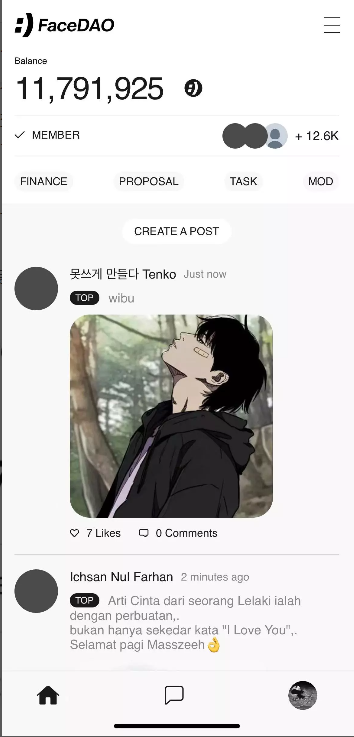
On the FaceDAO platform, similar to Web2.0 apps, users can log in, follow, like, comment, repost, or publish posts according to self-governed rules. They can also receive the same interactions from others. Currently, over 12,000 people have registered and used the platform with their real “Face.”
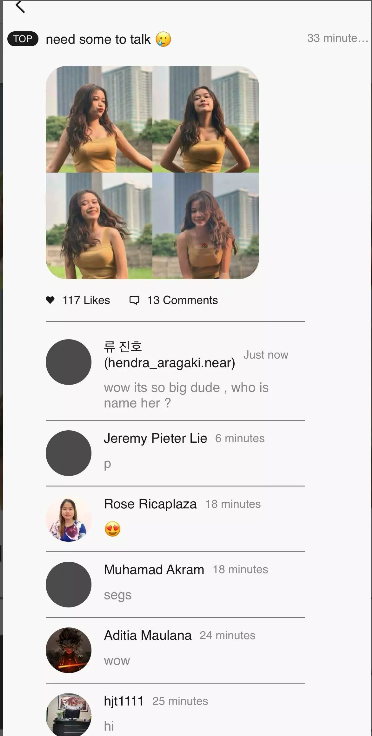
But here’s what’s different:
-
(1) Greater User Autonomy Over Data: Account deletion, network disconnection, blocking, and silencing—common practices in Web2—mean centralized entities hold more power and capture most of the profits generated by user activity. According to official statements, user data belongs to the users themselves. Sovereignty lies with the individual.
-
(2) Data Rewards: Data accumulated through social behavior is rewarded in Tokens. FaceDAO Tokens can be traded, circulated, and used for community governance.
Overall, FaceDAO aims to replace wallets and account passwords with identity as the sole credential for navigating Web3, fulfilling Web3’s core mission of returning data and value to users. It seeks to provide a complete solution—from reclaiming personal data, generating its value, upgrading, and applying it.
However, shortcomings are evident: user experience remains inadequate—a common flaw across all Web3 applications.
Users and FaceDAO: How Do You Benefit?
Simply put, FaceDAO falls under the “social mining” category—every social action such as posting, liking, being followed, etc., earns token rewards, tightly integrating economic incentives with social behavior.
The FaceDAO governance token $FACE is issued on Ethereum, with a total supply of 1 quadrillion tokens.
Of this, 90% of $FACE will be allocated to community development—rewarding active users, airdrops, paying for community tasks, providing liquidity on DEXs, and sustaining the ecosystem. The remaining 10% will fund infrastructure, servers, and engineering costs.
Unlike typical Web2 experiences like “watch X minutes to earn coins,” FaceDAO includes all positive social behaviors on its platform in its reward system—every interaction automatically earns $FACE. Additionally, FaceDAO offers several other earning mechanisms:
-
Administrator Role: Earn rewards by managing and maintaining platform order;
-
Referral Program: Earn rewards for inviting new users;
-
Task Rewards: Complete community maintenance tasks assigned by admins;
-
Passive Mining via Ad Display: Users can choose to place ads on the platform or even on their personal homepage. Ad revenue is distributed proportionally among all $FACE holders based on token ownership.
Currently, $FACE has not achieved effective value discovery and remains in the expectation phase.
The Team Behind It
Who’s behind this seemingly sudden project?
The Apple Store reveals the answer: UTU Technology.
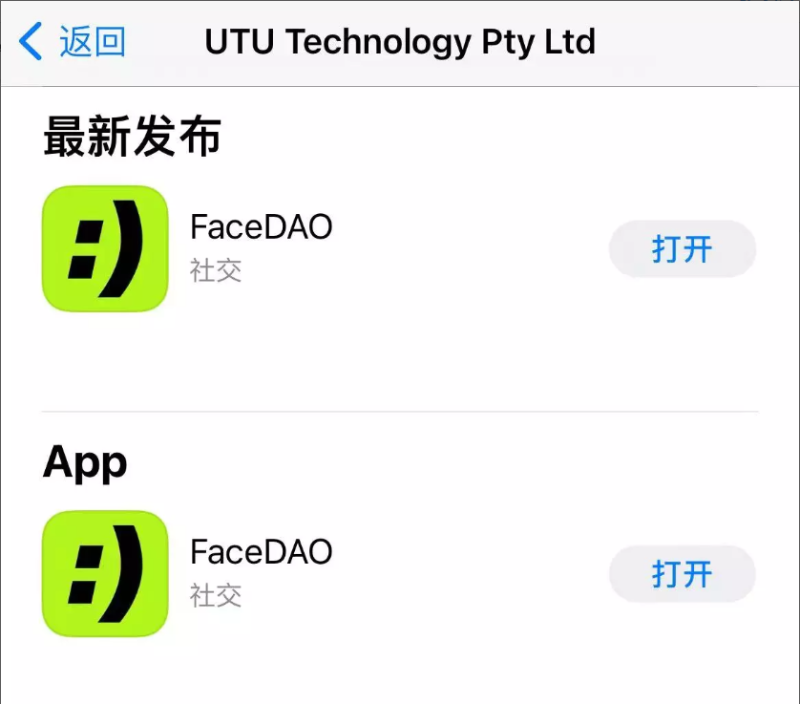
What kind of company is this?
According to Australian consulting firm RSM:
Founded in Australia in 2017, UTU was established by a team of top experts in blockchain, artificial intelligence, and IoT. Since then, the company has developed New Zealand’s most downloaded food delivery app and supply chain management and traceability systems for Australian agriculture and wine companies.
Later, the company built the world’s first DAC application for iOS and Android on EOSIO, along with other blockchain business solutions and decentralized applications. In 2020, UTU established its global headquarters in Toronto, Canada, to further expand its international operations.
UTU’s closest link to blockchain is a social app called UTU.ONE.
“UTU is a social platform exclusively for real people. At UTU, we ensure no bots and only real humans through certified biometric liveness and 3D facial verification—each person gets one account. We advocate for a genuine and trustworthy social ecosystem,” states the UTU website.
Indeed, FaceDAO follows the same philosophy. Given their track record, this appears to be a technically capable team.
Conclusion
FaceDAO launched its website and mobile app in Q1 this year. Both are now available on the App Store and Google Play for users to download and try. According to public information, in Q2, FaceDAO plans to release its V2 product, introducing more social features such as an NFT marketplace, NFT avatars, audio blogs, ad algorithms, and cross-chain protocols.
There’s always been a mismatch between Web2 and Web3: Web2 has strong product experience and large user bases but struggles to monetize; Web3 is great at “making money” but suffers from poor UX and limited users. Whoever bridges this gap will own the future of digital话语权.
FaceDAO sits in this middle ground—with both advantages and challenges. Its user experience still lags far behind mature Web2 products, and its economic model needs refinement. Yet such attempts should be encouraged—someone must keep exploring and iterating.
One step at a time, learning as we go, getting back up after falling—after all, Web3.0 is a bottom-up revolution.
Join TechFlow official community to stay tuned
Telegram:https://t.me/TechFlowDaily
X (Twitter):https://x.com/TechFlowPost
X (Twitter) EN:https://x.com/BlockFlow_News






