Will RSS3 become the information organizer for Web3?
TechFlow Selected TechFlow Selected
Will RSS3 become the information organizer for Web3?
RSS, or a similar protocol, does it still have a place in today's rising Web3?
 Navigating Web3 tides with focused insights
Author: Richard MacManus
Translation: Taotaro Kobayashi
One of the forgotten technologies of the current internet era is RSS (Really Simple Syndication), an information aggregation protocol that helped define Web2. Since the early 2000s, RSS allowed users to publish their thoughts via blogs and easily subscribe to content they cared about using RSS readers—making the web truly bidirectional (a term I prefer: read-write). However, over time, as social media platforms like Facebook and Twitter gained attention through their proprietary feeds, RSS naturally lost relevance and today sits on the shelf as yet another abandoned technology in our thoroughly social-media-saturated culture.
So here's the question: does RSS—or a similar protocol—have a place in today’s emerging Web3? In a network built on blockchain and cryptocurrency, do we still need an information feed? To explore this, I spoke with the founder of a new protocol called RSS3, which aims to be the “standard for next-generation information feeds—designed to support efficient decentralized information distribution.” Clearly, RSS3 has no technical connection to the original RSS but is conceptually inspired by its format.
The Read/Write War for the Web
Let’s first place RSS3 within the broader context, because the idea of an "information feed" has evolved dramatically over the past two decades. Facebook has long been central to this feed-centric model. Ironically,last weekFacebook announced it would remove the word “news” from “news feed.” The term “news feed” always carried a slightly odd connotation, especially today amid rampant misinformation. The early-2000s dream of blogging—where everyone could freely share their thoughts—was crushed largely by Facebook itself. Of course, it wasn’t just Facebook; the rise of social media (pioneered by Facebook) reshaped mainstream user behavior around posting and “subscribing” (later renamed “following”). In this read/write battle, social media fully captured the masses. RSS may have lost, but the war isn't over.
One reason Web3 is now gaining popularity is precisely to challenge the monopolies of Facebook, Twitter, TikTok, and other online social platforms. Web3 advocates likeMarc Andreessen argue that “decentralization and permissionless innovation” can reclaim user control from platforms like Facebook. (Notably, Andreessen straddles both sides: his venture firma16z is heavily invested across Web3, yet he also serves as adirector at Meta.)
Aggregating content in the blockchain world is no easy task, primarily due to the high degree of financialization in content platforms. Put simply: you need money to participate—not just creators, but readers too. Every interaction—commenting, liking—requires blockchain transactions, which means spending money (in the form of gas fees).
The Minds Behind RSS3 and How It Works
To understand what RSS3 is doing, I reached out to co-founder Joshua Meteora, whose partner is an anonymous tech enthusiast known on Twitter as@DIYgod, who has nearly 10K followers onGitHub. One project that made@DIYgod famous isRSSHub, an RSS discovery tool with the slogan “Everything is RSS.”
RSS3 is actively under development, with a stable version currently at v0.3.1, while discussions about v4 are ongoing on GitHub. According totweets, Joshua and@DIYgod founded a company called Natural Selection Labs to build RSS3, which secured seed funding from CoinShares Ventures, Coinbase Ventures, Dapper Labs, Arweave, and Fabric Ventures.
When I first looked into RSS3, I didn’t quite grasp its purpose: why can’t Web3 bloggers just keep using traditional RSS to aggregate their posts? But after speaking with Joshua, I realized that RSS3’s feed isn’t tied to blogs—it’s tied to a wallet address.
“TakeMirror.xyz as an example,” said Joshua, “it’s essentially a blogging platform where your account is an Ethereum wallet address and your content is stored on Arweave. So technically, a user with an Ethereum wallet doesn’t need to register separately on Mirror—they can use the platform directly. Since all articles are stored on Arweave (a peer-to-peer storage network), in theory no one owns or controls that data. And access is open. But before RSS3, it was difficult for any app to pull Mirror articles directly from Arweave without going through Mirror as a centralized intermediary. RSS3 creates a feed layer that offers broad ‘playability’—including with Mirror. Without RSS3, pulling Mirror articles would be a major challenge for decentralized applications.”
It’s important to clarify here: when Joshua refers to creating a feed, the subject is a wallet address. On Ethereum-based dApps, wallet addresses serve as user IDs. A user might have multiple wallets (which is common), so RSS3 provides a feed for each of these IDs. Any content uploaded online using the same wallet address will be represented by a single unified feed, regardless of platform.
Revery: The RSS3 Version of FriendFeed
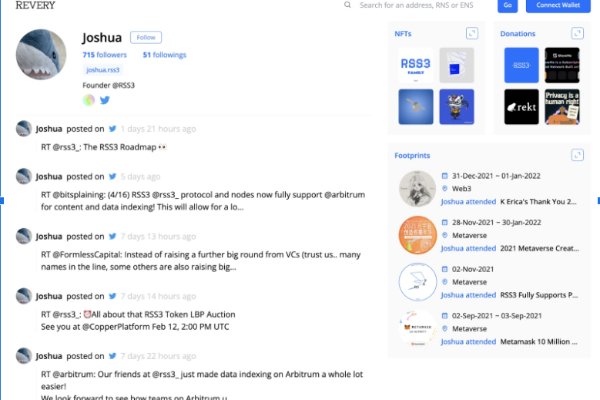
According to Joshua, several dApps are already building on RSS3. One such app, Revery, allows users to connect unlimited wallet addresses—meaning you can aggregate all your RSS3 feeds in one place. This reminded me of an old Web2 app: FriendFeed, launched in 2007, which aggregated all your social accounts into one dashboard for one-click posting. It was popular among tech enthusiasts, but quietly disappeared after Facebook acquired it in 2009.
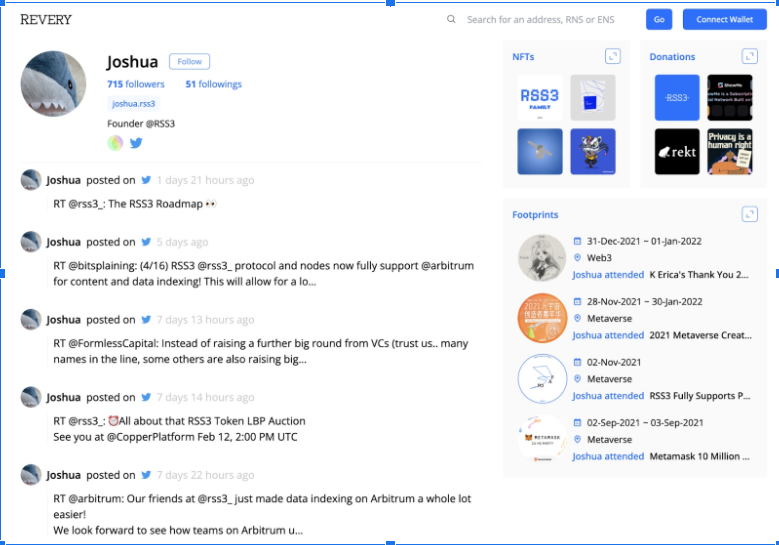
Joshua’s Revery page
Even if you’ve never used Revery or similar apps, the key takeaway is that RSS3 enables a single user’s content to be aggregated and published across platforms via a unified protocol—provided they prove ownership of the same wallet address.
Does RSS3 Have a Future?
Right now, RSS3 is still in its early stages, with the community still refining various specifications. But theoretically, building information feeds around wallet addresses rather than blogs makes sense for Web3.
A core challenge for RSS3, however, is whether using wallet addresses as online IDs can be a sustainable long-term solution. There are significant risks involved, especially for mainstream users who aren’t technically savvy. Back in 2018, I tested Peepeth, a blockchain-based “competitor” to Twitter. While using MetaMask, I made a common mistake and immediately lost access to my account. Because I lost my wallet’s private key, I could never log back in! Decentralized networks sound great in theory, but when you need customer support, you’re out of luck—because Web3 doesn’t have that!
Despite these challenges, RSS3 remains a compelling project, and I’ll continue following its progress. Integrating feed aggregation will undoubtedly enhance Web3’s overall usability, as this is currently a major pain point in the crypto and blockchain space.
Join TechFlow official community to stay tuned
Telegram:https://t.me/TechFlowDaily
X (Twitter):https://x.com/TechFlowPost
X (Twitter) EN:https://x.com/BlockFlow_News