Will the constantly evolving Quest3 be the ideal form of a Web3 advertising platform?
TechFlow Selected TechFlow Selected
Will the constantly evolving Quest3 be the ideal form of a Web3 advertising platform?
From 0 to 1, meet a better future.
 Navigating Web3 tides with focused insights
By Professor Zhou
In July this year, we introduced Quest3 in our article titled "Quest3’s Task-Based Approach: Blueprint and Ambition to Aggregate Web3 Traffic": a Web3-native advertising platform that helps projects acquire more users through task campaigns while enabling users to earn rewards.
At the time, Quest3 had just launched its beta version, with the product logic beginning to take shape. Numerous competitors were operating in similar spaces—while some offered innovative user experiences, there remained skepticism about whether Quest3 could secure a sustainable position amid fierce competition.
Now, as we approach year-end, projects across the ecosystem are preparing to deliver results.
When markets and users act as examiners, deciding which projects live or die with exacting standards, the process of building becomes even more critical:
Over the past four months, we’ve been surprised to find that Quest3 has undergone as many as 18 product iterations—averaging a new version every ten days.
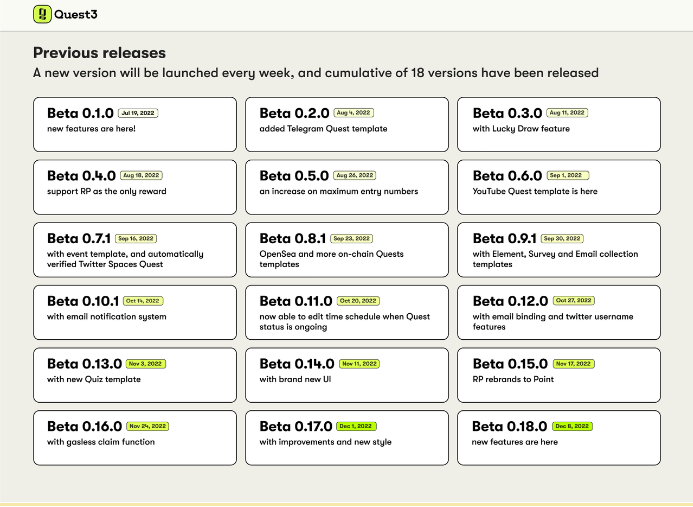
The current product form of Quest3 is vastly different from its earlier beta version.
While we jokingly refer to users “grinding tasks,” we realize the platform itself is even more deeply committed to “grinding development.” Amid admiration for its efficiency and focus, market data appears to have already validated these efforts: within those four months, Quest3 partnered with over 3,000 projects, accumulated 450,000 users, and achieved around 40,000 daily active users. Build and growth remain central themes in Web3.
Therefore, upon reevaluating Quest3, we now have more questions.
From a small-scale task platform to a success story with expanded users, use cases, and ecosystem—what exactly has Quest3 done during its journey? And why?
After continuous updates, how have platform experience, ad delivery efficiency, and user perception evolved? What might the final form of a fully mature Web3 advertising platform look like? We aim to provide answers after revisiting the platform.
Expanding Supply: Building a Cloud-Based Web3 Marketing Growth Engine
As a user, what you directly perceive on Quest3 is completing tasks and claiming rewards. In reality, the full product architecture extends far beyond this.
The types of tasks and rewards available depend heavily on Quest3’s B2B-facing features: offering easy-to-use templates and tools for creating and launching marketing campaigns tailored to project needs.
On its official page, Quest3 defines itself as a “marketing tool supporting sustained growth for Web3 projects.”

In other words, Quest3’s core product focus is growth services, helping projects continuously pursue user acquisition, retention, engagement, and other growth objectives—not merely providing basic task templates.
Will this narrative succeed? Or rather, what should an effective marketing tool or growth service look like?
Since the Web3 market remains underdeveloped without established best practices, it may be helpful to revisit the Web2 world for inspiration and proven success models.
Imagine your online store wants to run a promotion during Double 11. Preparing inventory, pricing, and staffing already consumes significant effort. If you also handle marketing activities—from designing promotional materials to executing ad campaigns—manually, it would likely be suboptimal in terms of cost and efficiency.
In such e-commerce scenarios, one-stop marketing platforms like Alibaba’s Alimama play a crucial role: from providing creative assets and activity templates to selecting target audiences and automating ad placements, they offer end-to-end solutions so merchants can manage everything through a single interface.
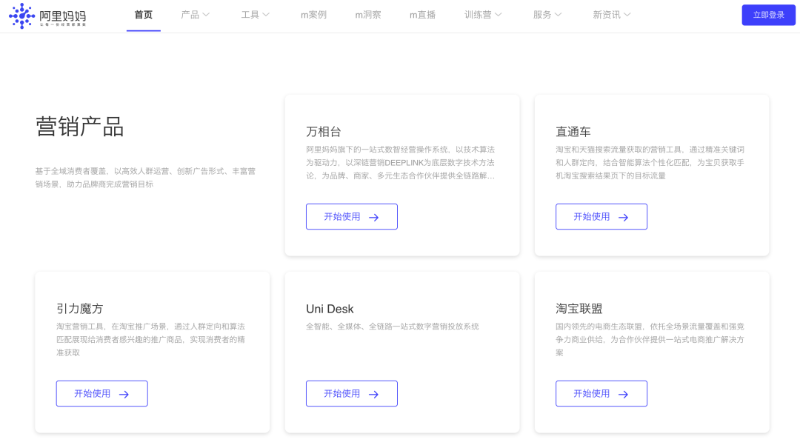
Similar platforms include Dou+ and Ocean Engine on TikTok. Leveraging massive traffic generated from video content, they offer integrated marketing services—for example, boosting video views and interactions for merchant accounts, or using recommendation algorithms to expose accounts and products to interested users.
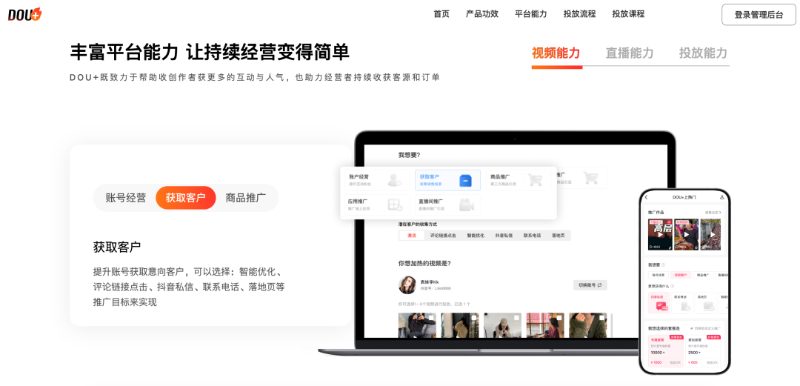
Abroad, similar success stories have long existed.
HubSpot, founded in 2006, grew its revenue from zero to $100 million over eight years before going public. Its product targets all-in-one automated marketing solutions—helping SMEs with SEO, website design and development, social media marketing, content creation, ad design, PR, and sales support.
Capital markets have also recognized HubSpot’s performance, with its stock price and valuation rising steadily alongside business growth.

Globally, these successful marketing tools share a common core: offering SaaS-based services covering the entire marketing funnel, providing entrepreneurs and businesses with one-stop solutions.
The clear path seen in Web2 holds immense potential when applied to Web3. And Quest3 is actively exploring this direction.
Specifically, Quest3 is transforming into a “growth-as-a-service” marketing platform for Web3 by upgrading its capabilities. Through rapid version iterations and feature enhancements, it enables Web3 projects to go live instantly—simply by selecting options and clicking—to launch customized marketing campaigns without needing to build their own marketing infrastructure.
For a platform like Quest3, sufficient supply is key.
Supply here refers both to attracting more projects onto the platform to offer diverse tasks (drawing in more users), and expanding the variety of available task templates. To address “how to attract more participants,” Quest3 adopts a free and permissionless model: any individual or organization can log in and publish tasks, regardless of size. As the Web3 market exhibits long-tail characteristics, valuable information, events, or platforms naturally draw participation.
Inside the Quest3 platform, however, new entrants inevitably ask: how many suitable marketing templates does your platform actually offer? Can it quickly support all my marketing scenarios?
The answer, of course, is the more, comprehensive, and richer—the better.
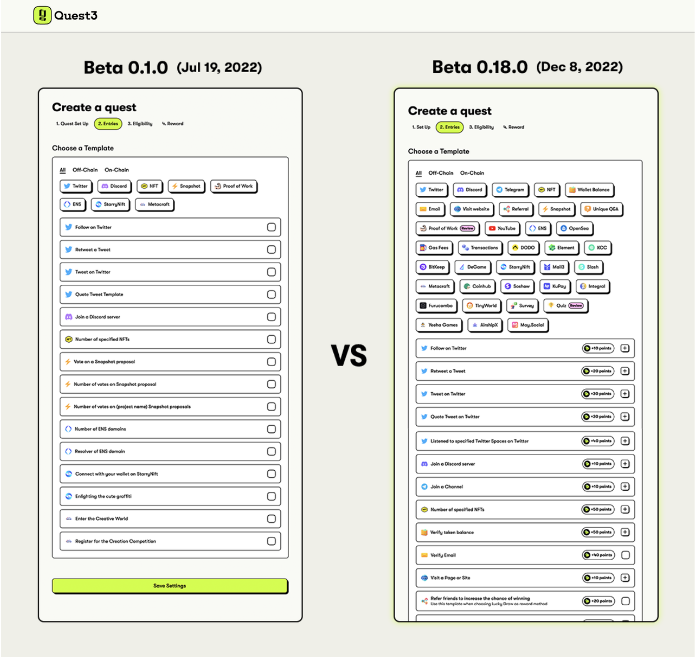
From analyzing multiple B2B product iterations, it's evident that Quest3 has invested significantly in “expanding supply.” In the early beta version, although tasks were categorized into on-chain and off-chain types, the number and coverage of use cases were limited (left image): only about 10 scenarios supported, such as following on Twitter, joining Discord, retweeting, etc.
If a project wanted to create tasks via other channels, the lack of pre-built templates made campaign deployment difficult. After several rounds of iteration, Quest3 now supports nearly 40 distinct task scenarios (right image). A closer look reveals these are well-organized and categorized, covering almost every conceivable marketing scenario and template.
On-chain tasks can broadly fall into two categories:
Interaction-based: e.g., participating in transactions on a blockchain, performing swaps on DeFi protocols;
Status-based: e.g., holding a certain amount of tokens or NFTs, wallet balance reaching a threshold, etc.
Off-chain tasks increasingly cover social media, marketing tools, and proof-of-work scenarios:
Social Media: Following or retweeting on Twitter, Discord, or Telegram; watching a YouTube video and leaving a comment;
Marketing Tools: Completing surveys, forms, or quizzes distributed by projects;
Proof-of-Work: Submitting evidence for personalized tasks, such as uploading proof of completing a specific action...
Additionally, the platform offers custom task creation to meet non-standard marketing needs.
Clearly, these preset templates weren't built overnight. Across multiple Quest3 product iterations, various templates were gradually added and refined until reaching today’s comprehensive form. Post-updates, B2B users enjoy greater ease: most common and mainstream marketing channels and task scenarios can now be found with simple clicks and selections.
This resembles the difference between dining out versus cooking at home: at a restaurant, you simply order from a menu while others handle sourcing, preparation, and cooking; cooking yourself requires managing every step.
Yet, convenience inevitably leaves gaps. For unique or specialized marketing scenarios, standard templates may still fall short. Updated versions of Quest3 demonstrate enhanced customization capabilities, making dedicated solutions possible.
In earlier versions, nearly all task templates were generic and universal. Now, post-iteration, you see highly customized tasks tailored to specific projects and chains. Take DODO tasks as an example (image below): holding vDODO tokens or placing limit orders are deeply customized based on DODO’s business model—only feasible for DeFi projects with ve-token governance.
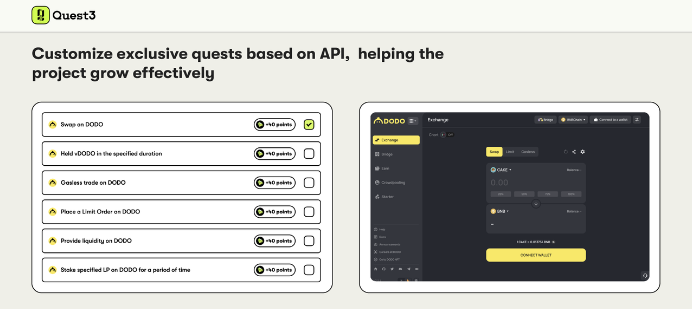
Thus, given adequate resources, Quest3 can collaborate deeply with projects to identify distinctive usage patterns within their business logic and design corresponding tasks and trigger conditions accordingly.
This bespoke capability serves as a key selling point to attract more projects—and a potential revenue stream. Supporting both general-purpose and “private-label” customization widens the path forward.
Beyond “one-time setup” and “tailored solutions,” updated versions of Quest3 include additional highlights that are both efficient and practical. For event marketing, newly abstracted templates better reflect real-world marketing demands:
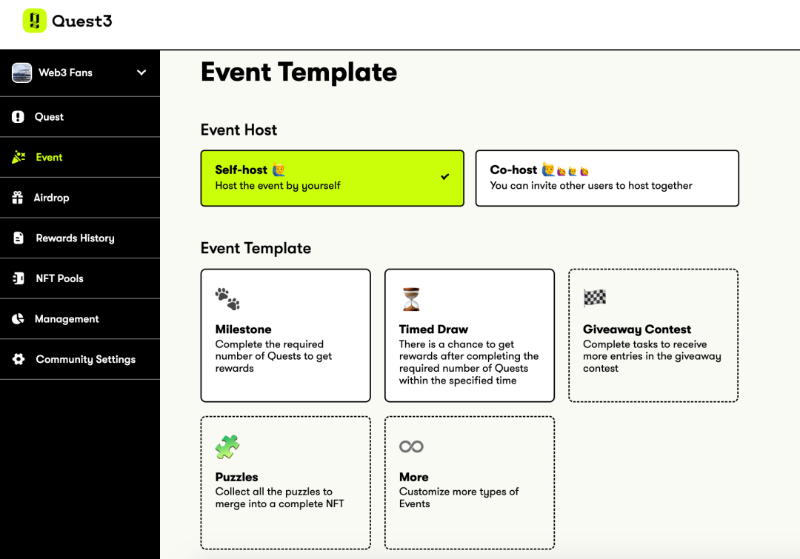
You can either host an event independently or co-host with multiple parties—an essential tool for joint marketing campaigns among interconnected projects. Co-hosted events often involve several related projects, each wanting users to complete specific tasks, yet desiring those tasks to converge under a unified theme.
To serve this need, Quest3 provides two event templates: Milestone and Timed Draw:
Milestone: A progressive collection of multiple tasks. Participants receive incremental rewards upon completing certain milestones—a powerful tool for maintaining user continuity and habit formation;
Timed Draw: Time-bound tasks where participants who complete a set number of tasks within a timeframe have a chance to win rewards. Ideal for time-limited, lottery-style campaigns, helping generate marketing scarcity and urgency.
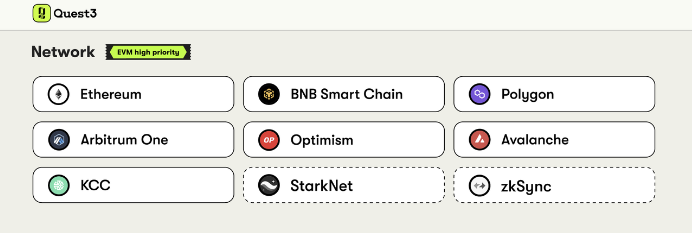
Both templates include customization options, allowing deeper collaboration between projects and Quest3 to design more distinctive event mechanics. Additionally, in terms of ecosystem coverage, Quest3 collaborates with BSC, Polygon, and ETH. On BSC, it even launched gas-free task participation campaigns, added Kucoin Chain, and integrated two major L2s—Arbitrum and Optimism—with Starknet integration planned. By completing marketing infrastructure ahead of the L2 boom, future L2 projects will find task design significantly easier.
For more advanced, larger-scale projects with strong frontend design capabilities, Quest3 offers “task-as-a-service” functionality—providing APIs and SDKs so relevant features can be embedded directly into the project’s app, eliminating the need to visit Quest3’s website for task deployment.
Summarizing the above B2B product evolution: “one-time setup” expands breadth by offering comprehensive templates accessible to more projects; “tailored solutions” deepen depth by enabling project-specific collaborations. Together, they broaden the scope of one-stop marketing solutions, delivering value through improved efficiency and attracting more partnerships.
Traffic Accumulation: Creating “Account Opening” Scenarios for Outer-Circle Users
With abundant marketing task templates and solid user experience, Quest3 has accumulated considerable traffic within the task-completion niche. Projects launch campaigns, and users naturally flock to complete them driven by profit motives.
However, standalone Web3 SaaS tools lack deep moats.
The reason lies in Web3’s early stage: lacking clear rules, user traffic sources are fragmented. Tool efficacy alone cannot concentrate traffic. Platforms offering both SaaS services and user acquisition capabilities deliver true value.
This reflects clients’ hunger for traffic: when projects urgently need users, using platforms like Quest3 isn’t just about finding convenient tools—it’s also about hoping the platform can bring in new traffic.
When traffic becomes paramount, examining users reveals: Web3 users exhibit stronger “sheep farming” tendencies. Their primary motivation for using tools like Quest3 remains short-term profit—either controlling multiple identities at scale or exiting immediately after completing temporary tasks.
It’s hard to expect such traffic to truly settle on the platform, generating sustained, authentic, habitual usage.
While most similar marketing platforms fiercely compete for this existing user base, Quest3 seems to have turned its gaze toward incremental markets—traditional Web2 users and contexts may ultimately determine the fate of Web3 marketing platforms. Recalling last year’s popularity of Axie and other blockchain games, many users from Southeast Asian countries previously unfamiliar with Web3 contributed high engagement.
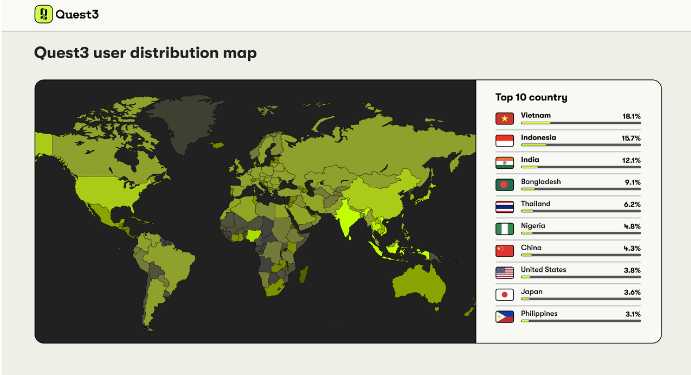
Why? Amid pandemic and economic downturn, earning income through blockchain gaming became a sufficiently valuable use case. The key takeaway: we must create more compelling scenarios to encourage outer-circle users to “open accounts” (wallets). Especially for potential users in Southeast Asia, Africa, and Latin America, frequent, low-value reward opportunities align better with their interests and habits.
Can platforms like Quest3 create more valuable scenarios for these outer-circle users? The answer is yes.
Currently, task-based marketing represents just one Web3 marketing scenario. From the user perspective, this is Quest-to-Earn. Familiar blockchain games represent Play-to-Earn.
For a traffic-attracting platform like Quest3, it clearly has the potential to become an “X-to-Earn” aggregator: any user participation model that leads to rewards can be hosted on this platform.
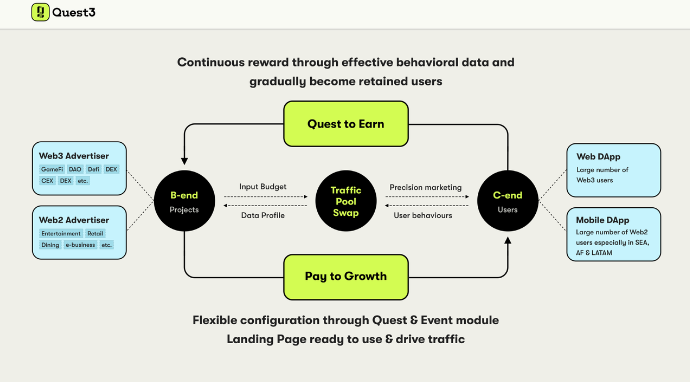
This opens possibilities for Quest3 to partner with local merchants in different regions. Merchants can design reward conditions based on business goals and local user behavior, guiding users to complete actions and claim rewards. During this process, users may organically create wallets, while Quest3 accumulates more traffic. Moreover, aggregating X-to-Earn models creates more real-world applicable scenarios.
Take Shopback, a popular cashback platform in Southeast Asia: it primarily drives purchases by redirecting users to partner sites, then returns a portion of spending as cashback, encouraging repeat buying. In conversations with TechFlow, the Quest3 team shared aspirations to go beyond current task marketing—leveraging X-to-Earn aggregation to expand into payment, cashback, consumer credit, and other financial-integrated services in emerging markets across Asia, Africa, and Latin America.
When users’ off-chain data (e.g., spending behavior) links to wallet addresses, the resulting value and possibilities far exceed simple task grinding. From pure task marketing to becoming an X-to-Earn aggregator, Quest3’s strategy to penetrate Web2 markets and grow incremental users is clear.
Execution-wise, team members revealed that Quest3’s mobile app officially launched in December this year. To cultivate new user habits and lower barriers, initiatives like waiving gas fees for new users’ first 10 tasks have been introduced.
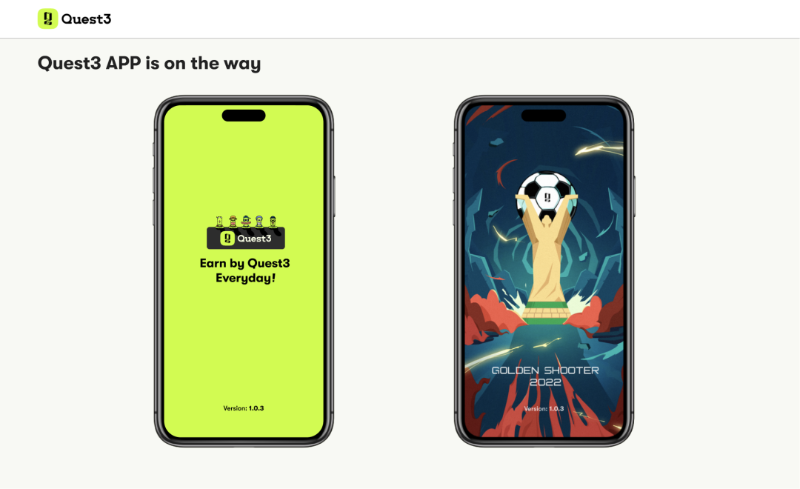
Long-term growth depends on current accumulation and optimization. Currently web-based, Quest3 has, across dozens of iterations, increasingly prioritized user perception and experience—laying groundwork for future expansion.
In earlier versions (left), the homepage’s recommended tasks section was small and lacked intuitive information. Post-update (right), the module is larger with richer visual design. Visual elements help users quickly associate task types (NFT vs. FT) and rewards (e.g., whitelist access, badges in the right image). All visual changes serve improved experience.
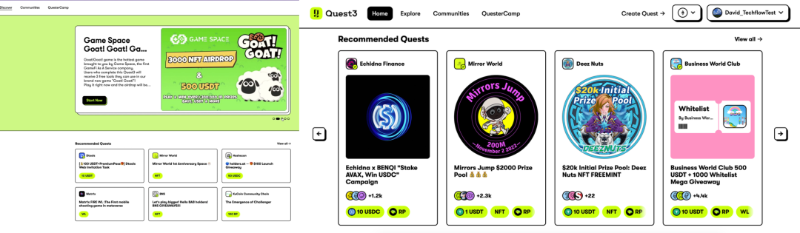
The “recommendation” feature primarily targets users entering the homepage casually, browsing without specific intent. Conversely, for goal-oriented users who know exactly which project’s tasks they want, visiting the “Explore” page presents a clearer visual layout:
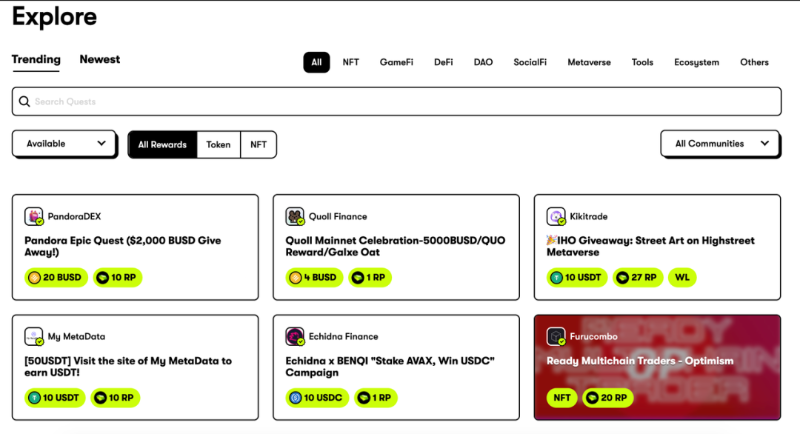
When information categorization and accuracy take priority, Quest3 offers more detailed category filters and search boxes, facilitating proactive task discovery. Continuous refinement of UI and experience has grown Quest3’s DAU to 40,000. Looking ahead, satisfying genuine needs and delivering excellent UX will be key to retaining incremental Web2 users accustomed to mature internet products.
Quest3’s near-term goal is to reach over 100,000 DAU by Q2 next year. Combining the earlier-discussed user scenario strategy, a viable path emerges:
Targeting Asia, Africa, and Latin America, initially attract and educate users via X-to-Earn reward models. Once a critical user base is reached, leverage local habits and economic conditions to introduce Z-generation-focused payment and cashback services, monetizing further through financial lending.
On the user side, a clear path—"Earn → Pay → Loan"—is emerging, potentially becoming Quest3’s breakthrough vector.
Scenario Demonstration: World Cup Marketing Campaign Capability Showcase
After analyzing Quest3’s B2B and C2C product designs, you may still wonder whether it’s fully prepared for broader future scenarios and users. Perhaps its recent high-profile marketing campaign offers an answer.

With the kickoff of the FIFA World Cup, Quest3 launched a large-scale prediction contest sponsored and co-hosted by multiple projects. Users can predict group winners, knockout-stage victors, and the champion, while completing additional tasks from sponsoring projects, competing for a total prize pool of $20,000.
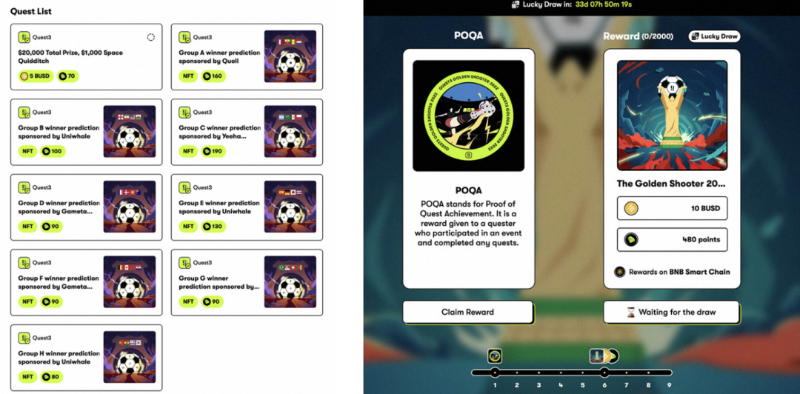
Setting up such an event requires only three steps:
First, define relationships between main and sub-tasks—for example, completing partial sub-tasks automatically contributes to overall progress;
Second, integrate pre-built external event templates, such as national flags and groupings from the World Cup;
Finally, select task types aligned with marketing goals, such as following social media, visiting websites, or inviting friends.
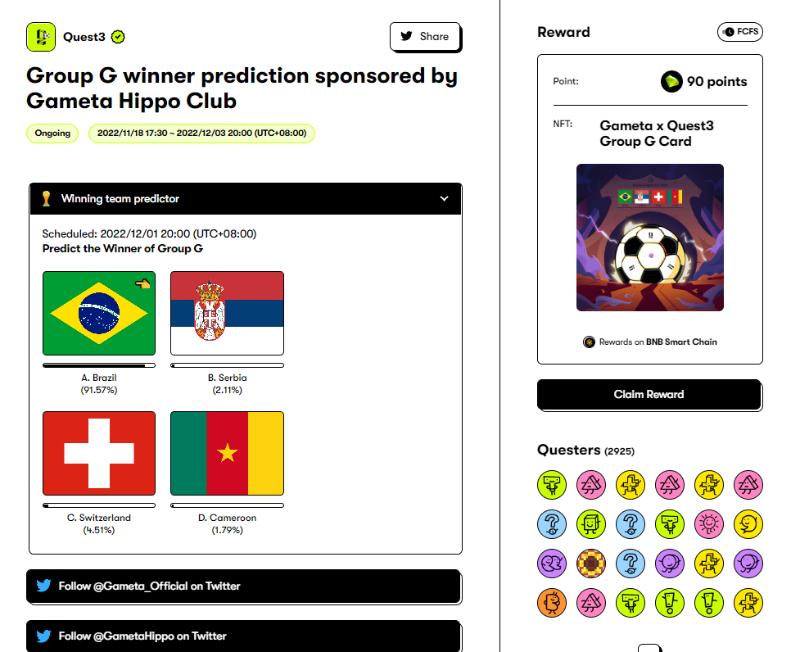
Thus, Quest3’s World Cup campaign serves as a comprehensive capability showcase—a model unit demonstrating “task-as-a-service” and providing confidence and experience for supporting future scenarios. When brands or projects wish to leverage external events (like the World Cup) for marketing, they no longer need to do everything manually. Using Quest3’s mature templates and capabilities, they can quickly launch related campaigns.
From 0 to 1: Meeting a Better Future
Reviewing Quest3’s update history, we noticed all 18 versions begin with “0.” In software development conventions, versions starting with “1” denote stable releases—meaning Quest3 hasn’t yet reached the team’s envisioned “1.” So we begin to wonder: what will Quest3’s “1” ultimately look like?
Perhaps the word “Quest” itself hints at an aspiration. Inspired by gaming, players seek NPCs marked with exclamation points, accepting quests in pursuit of treasure and achievement.

These quests serve as bridges, helping players gradually familiarize themselves with game worlds in a relaxed, enjoyable way. When Quest3 aims to similarly bridge users into Web3, its current task platform is clearly not the final form. Changes in messaging and product features alike reveal Quest3’s ambition to support broader scenarios and reach wider user bases.
From single-function tool to multi-scenario marketing service, the future holds vast potential. Without accumulating small steps, one cannot travel a thousand miles. It continues refining itself, becoming richer and more complete. Meanwhile, the entire industry must advance together.
Perhaps in the Web3 world, many products may appear stuck at version “0” for a long time—but that doesn’t mean stagnation. Through subtle, incremental improvements, momentum builds, eventually converging toward the “1” everyone anticipates.
Join TechFlow official community to stay tuned
Telegram:https://t.me/TechFlowDaily
X (Twitter):https://x.com/TechFlowPost
X (Twitter) EN:https://x.com/BlockFlow_News
 CryptoDada