RSS3: Redefining Data Distribution and Ownership in Web3.0
TechFlow Selected TechFlow Selected
RSS3: Redefining Data Distribution and Ownership in Web3.0
We refer to an internet without social media manipulation, profit extraction, and data monopolies as Web3.0.
 Navigating Web3 tides with focused insights
Author: Walter Huang @HashGlobal
RSS3 is a next-generation data distribution protocol derived from the RSS protocol and integrated with blockchain technology, characterized by flexibility, efficiency, scalability, and decentralization.
The RSS protocol was originally developed by early developers as an open-source, simple, and free protocol to facilitate tracking website updates and capturing content.
The ability of the RSS protocol to retrieve information without accessing the original site significantly impacted the traffic acquisition strategies of Web2 internet giants. Additionally, the fact that RSS feeds do not display source-site advertisements severely undermined the advertising revenue of these Web2 companies. As a result, Web2 tech giants abandoned the RSS protocol and built closed social relationship networks based on their own traffic systems and business models.
Most underlying decentralized protocols from Web1 face higher difficulty in achieving consensus compared to centralized, closed products, and without consensus or incentive mechanisms, it's hard to build ecosystems and applications. With the emergence of blockchain technology, a new opportunity arises for foundational decentralized internet protocols like RSS to establish economic models and viable business models.
As data breaches, privacy violations, public opinion manipulation, algorithmic abuse, profit extraction, and data monopolies become increasingly prevalent and concerning in the Web2 era, we begin to reminisce about pure, simple, free, and open Web1 underlying protocols such as RSS—the true "original intent" of the internet. It is precisely against this backdrop and vision that RSS3 emerges.
Decentralized information flows can generally be divided into four layers: Creation, Storage, Distribution, and Rendering. RSS3 focuses primarily on decentralized information distribution while also providing corresponding storage solutions and rendering modules.
The RSS3 protocol allows users to generate an RSS3 file based on their Ethereum address and link social platforms such as Twitter and Jike to this file. The file synchronizes in real time the user’s assets (digital assets, posts, etc.) and activities (transactions, likes, reposts, etc.) across other platforms, storing this information within the RSS3 decentralized network, ultimately ensuring that user data belongs to the user and is no longer "held hostage" by centralized platforms.
With user permission, developers building applications on the RSS3 ecosystem can filter and present different types of information according to application needs and access content published by users across various platforms via distinct API endpoints. This enables the development of decentralized alternatives such as a decentralized Instagram, decentralized Twitter, or decentralized WeChat based on RSS3.
RSS3 operates its own blockchain system, with the network mainly composed of service node groups and global indexers. Service node groups consist of multiple service nodes responsible for the day-to-day operations of the RSS3 network. Global indexers are made up of several relay nodes tasked with ensuring network security, governance, and performance management.
Applications within the RSS3 ecosystem and the RSS3 network itself will provide us with a free, decentralized environment for data creation, storage, and distribution—fundamentally resolving issues caused by Web2 internet giants such as data leaks, privacy threats, opinion manipulation, algorithmic abuse, profit extraction, and data monopolies.
We refer to an internet free from social media manipulation, profit extraction, and data monopolies as Web3.0; and to an information society that remembers the original purpose of the internet and aligns with user needs as the Web3.0 era. RSS3 is a crucial piece in realizing Web3.0—a fundamental tool and protocol essential for entering the Web3.0 era.
I. RSS Protocol: From Prosperity to Decline
To understand RSS3, we must first look at the RSS protocol.
In the Web1 era, information was primarily generated and disseminated through web portals, with users retrieving information by visiting websites. To make it easier for users to track updates and capture content, early developers created the open-source, simple, and free RSS protocol. RSS stands for “Really Simple Syndication,” a format for syndicating content, typically delivered via email, enabling websites to distribute content. Users no longer needed to log into websites to check for updates—they could receive timely notifications directly. When new content appeared on a website, RSS immediately recorded the title, author, content, and source in an RSS file using XML markup language and triggered content distribution. Email users would then receive instant push notifications. To date, the RSS protocol has evolved to version 2.0 and remains in use across many websites—it is what we now recognize as website subscription functionality.
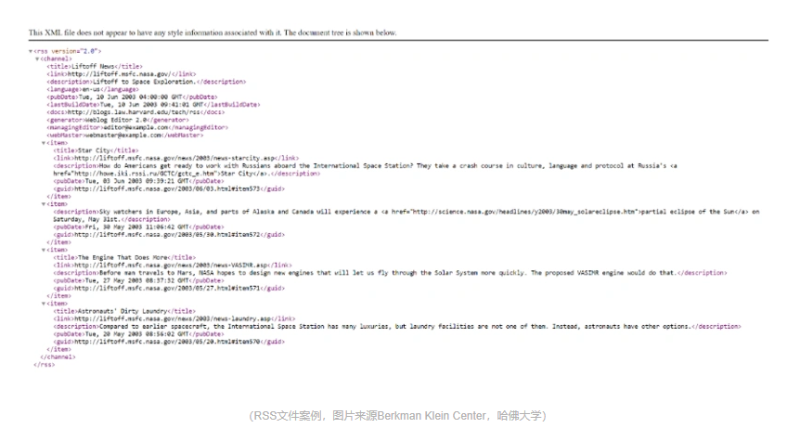
Because it met user needs, the RSS protocol was once widely popular, with numerous RSS readers emerging. In the Web2 era dominated by centralized internet giants, RSS allowed information retrieval without visiting the source site, offering strong timeliness and high reading efficiency. This convenient user experience seriously threatened the traffic acquisition models of Web2 giants. Moreover, the absence of ads in RSS feeds greatly appealed to users but dealt a heavy blow to the ad revenues of these giants. As the internet gradually shifted toward centralization and commercialization, tech giants established internal, closed content distribution systems and social graphs—what we see today in platforms like WeChat, Facebook, and Twitter. Furthermore, reaching consensus around decentralized open protocols is inherently more difficult than with centralized closed products, and prior to the widespread adoption of blockchain technology, there were no effective incentive mechanisms to support ecosystem and product development for decentralized protocols. Thus, under the control of internet giants in the Web2 era, the RSS protocol was pushed to the margins.
However, as recurring issues in the Web2 era—data breaches, privacy risks, opinion manipulation, algorithmic abuse, profit extraction, and data monopolies—draw increasing attention, we find ourselves longing for the pure, simple, free, and open foundational protocols of Web1 like RSS—the very "original intent" of the internet. Against this background and driven by this vision, RSS3 quietly emerged.
II. RSS3: A Lightning-Fast Return
RSS3 combines blockchain technology with the RSS protocol to build a flexible, efficient, and scalable decentralized information distribution protocol.
Like most Web1 foundational protocols, RSS lacked an incentive mechanism, making it difficult to develop sustainable business models or economic ecosystems. The advent of blockchain and cryptocurrencies perfectly addresses this gap, enabling foundational protocols to incentivize contributors of decentralized network resources, reward ecosystem developers, and ultimately align the interests of the network, users, developers, maintainers, and resource providers—all working together cooperatively.
Decentralized data flows can broadly be categorized into four layers: Creation, Storage, Distribution, and Rendering. RSS3 focuses primarily on decentralized data distribution while also providing corresponding storage solutions and rendering modules.
When users interact with applications in the RSS3 ecosystem (you can try at https://rss3.co/), the application helps them create an RSS3 File within the RSS3 decentralized network. This file is established via an Ethereum address. Users can add multiple public keys from decentralized networks or accounts from centralized systems into the RSS3 File, build friend relationships within RSS3, and thereby create their own personalized content aggregation feed and social graph.
As shown in the image below, in my RSS3 File, I have added my Ethereum address, Twitter, and Jike account. My friends within the RSS3 ecosystem will receive timely updates about my content when using RSS3-based applications.

For application developers, they can filter and display information based on app-specific features and retrieve my content posted across different platforms via various APIs. Developers can leverage RSS3 to build decentralized versions of Instagram, Twitter, WeChat, and more.
III. RSS3 Network Architecture and Vision
RSS3 will build a blockchain network operated in a DAO structure. The network primarily consists of Serving Nodes and Relay Nodes:
lServing Nodes: Multiple serving nodes are randomly grouped into subgroups (Subgroups), primarily responsible for storing, managing, and syncing users’ RSS3 Files, as well as handling content push operations within the network. These serve as the basic operational units of the RSS3 network.
lRelay Nodes: Multiple relay nodes, together with the network’s archival storage module, form the Global Indexers (GIs), responsible for managing serving node subgroups, routing data requests from RSS3 ecosystem applications, and maintaining network performance. They act as the governance and performance management units of the RSS3 network.
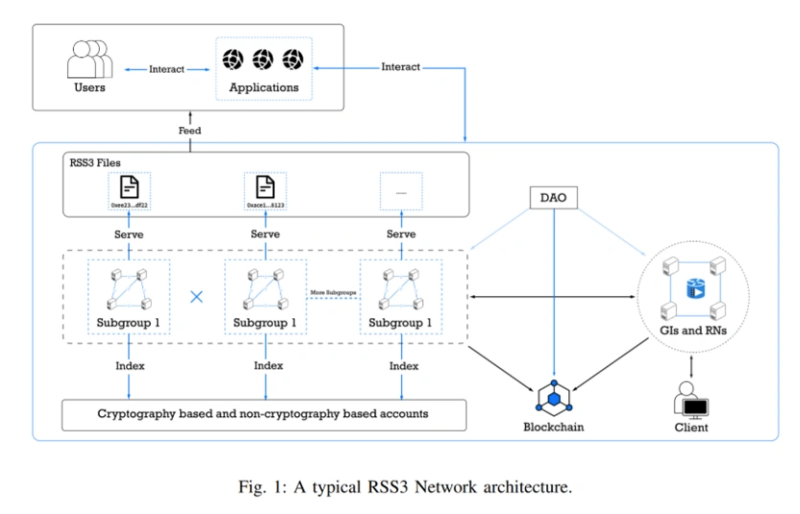
Global Indexers (GIs) and Serving Node Subgroups (Subgroups) will be elected by the network. Matters including elections of GIs and Subgroups, maximum number of nodes, penalties for malicious behavior, node incentive mechanisms, module upgrades, and treasury management will all be decided through voting by RSS3 token holders. For further design and technical details, please refer to the RSS3 Whitepaper: https://rss3.io/#/whitepaper
Within the RSS3 ecosystem, user content feeds and RSS3 Files are dynamically stored and managed by randomly assigned serving node groups, eliminating dependency on any single node. When the RSS3 network achieves sufficient decentralization, user data will truly belong to users. Users won't need to worry about losing content or social graphs due to bans on centralized platforms like Twitter or Jike. Applications built on RSS3 cannot control user data, allowing users to seamlessly migrate from a decentralized Twitter to a decentralized Facebook without losing social data or relationships—freeing them from being "held hostage" by social platforms.
Ultimately, applications in the RSS3 ecosystem and the RSS3 network will provide a free, decentralized environment for data creation, storage, and distribution—fundamentally solving the problems of data leaks, privacy violations, opinion manipulation, algorithm abuse, profit extraction, and data monopolies caused by Web2 internet giants. We call this ideal Web3.0: a product that returns data ownership to users; an internet free from social manipulation, profit extraction, and data monopolies; an information society that stays true to the internet’s original mission and serves user needs. RSS3 is a vital piece in realizing this vision—an essential foundational tool and protocol to help us enter the Web3.0 era.
Join TechFlow official community to stay tuned
Telegram:https://t.me/TechFlowDaily
X (Twitter):https://x.com/TechFlowPost
X (Twitter) EN:https://x.com/BlockFlow_News