









Data Investigation: Coinbase's Listing Curse
TechFlow Selected TechFlow Selected
Data Investigation: Coinbase's Listing Curse
If tokens, especially VC-backed ones, consistently underperform compared to Bitcoin/Ethereum after listing on Coinbase, it suggests to me that insiders are waiting for a major dollar-based exchange listing to sell—meaning venture capitalists profit at the expense of retail investors.
 Navigating Web3 tides with focused insights
By Fais Khan
Translated by 0xBread TechFlow
Marc Andreessen has been a bit hard to reach lately.
Is he worried that things are about to be exposed?
Jack Dorsey has been aggressively exposing how VCs profit from山寨coins despite claiming to promote "decentralization." That got me thinking: Marc Andreessen actually holds a seat on Coinbase’s board. Meanwhile, Coinbase is publicly listing his tokens. Isn't this a conflict of interest?

I started wondering what the long-term performance of these tokens really looks like—especially compared to Bitcoin and Ethereum—benchmarks that are difficult to access and calculate.
If tokens, especially VC-backed ones, consistently underperform Bitcoin/Ethereum after being listed on Coinbase, it suggests to me that insiders are waiting for a large, USD-based exchange listing so they can sell—VCs profiting at the expense of retail investors. These insiders include firms like a16z, and incredibly, Coinbase’s own venture arm, which also has stakes in projects listed on Coinbase. Other exchanges like Kraken, FTX, and Gemini are similarly active in venture investing and maintain their own portfolios.
Why does this matter beyond just academic economics? First, Coinbase is like the New York Stock Exchange of crypto—being listed there is a big deal, typically bringing huge profits to all involved. But unlike the NYSE or Nasdaq, Coinbase can use its own process to list any asset it chooses.
Second, the returns for a16z and Coinbase themselves are particularly interesting because a16z is considered one of the top players in the field, and there's a potential conflict of interest. Is the game rigged?
Third, Coinbase changed its strategy last year—from cautious to listing as many assets as possible. This gives them and their users more trading pairs.
So I dove into the data, and what I found shocked me: most tokens perform poorly, returns worsen over time, and VC-backed tokens perform worst of all.
But I discovered something else—over the past few years, Coinbase has announced which tokens they’re considering for listing. I analyzed those—and found they performed even better than already-listed tokens, while VC-backed tokens did not show the same outperformance.
Let’s dig deeper.
Coinbase Effect or Coinbase Curse?
For years, getting listed on Coinbase has been the holy grail of crypto—equivalent to an IPO on Wall Street. Like initial public offerings, listings appear to bring “momentum”—crypto research firm Messari documented in a report that, on average, a Coinbase listing leads to a 91% gain within five days.
But I believe that analysis has two flaws:
1. It uses an extremely short timeframe. If, like me, you believe most token returns come from illiquidity rather than fundamental value, then the sudden influx of buyers post-listing creates a temporary spike, but eventually turns negative as insider lockups expire.
What does illiquidity mean? Essentially, large supplies are often fixed or “locked” in DeFi protocols with incentives not to sell. Project developers and investors hold large token allocations, but supply is gradually released over time.
2. Showing returns on an absolute basis is meaningless. If you're a hedge fund, you must beat benchmarks. The benchmark for any crypto should be Bitcoin (BTC) and/or Ethereum (ETH). To me, Ethereum makes sense because most of these “web3” tokens are built on Ethereum’s vision, not Bitcoin’s.
For example, the above Coindesk article cites Filecoin’s “sixfold” return. But investors who chose to buy Filecoin instead of Bitcoin on its December 10 Coinbase listing day actually underperformed significantly, dropping sharply in the first month (yellow line).
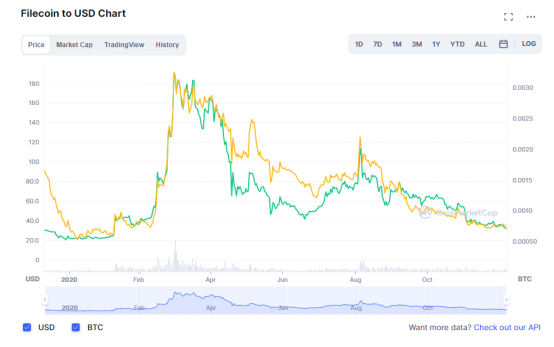
Note: Yellow line shows performance vs Bitcoin, green line shows USD.
Most of the gains cited were due to Bitcoin rising, while Filecoin actually severely underperformed Bitcoin during that period—by 55%!
At this point, I’m not alone. Most experienced crypto traders evaluate prices against BTC or ETH, not USD.
How do Coinbase listings fare overall? I gathered 128 listings from Coinbase (excluding stablecoins and pegged coins), broken down by year.
Note: In most cases, I used the official Coinbase Pro listing date from Coinbase announcements. Trading for most coins typically begins within two days and usually starts on the same day.
To me, the results largely confirm my argument. Coinbase and VCs may loudly tout dollar-denominated returns to suggest crypto allows retail investors (“the community”) to participate in network growth. But reality shows most returns happen very early after listing—2021 coins did well, but everything from 2020 and earlier performed poorly!! What does this mean? Even 2021 returns fall below the 91% pop rate cited by Messari, suggesting they all lost value after the pump.
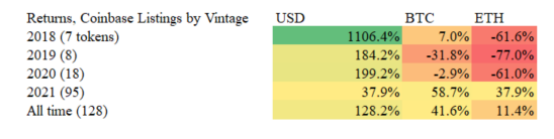
Once a token has been on Coinbase for a year, it appears to significantly underperform both Bitcoin and Ethereum.
I also looked at tokens where pre-listing one-year returns were available (68 out of 128), to show they weren’t underperforming since inception:
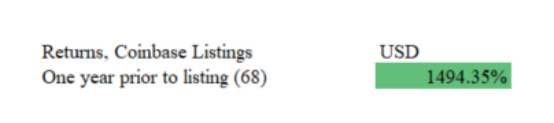
If we split last year’s listings, we still see the same pattern:
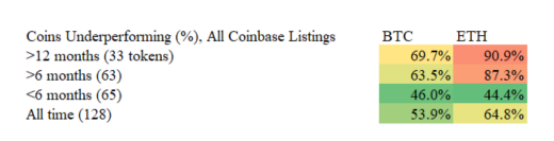
Coins from the last six months (65 coins) performed better than the first half. If you remove just two coins (Polygon and Solana) from the 63 coins older than six months, Coinbase’s returns turn negative (–10.5% vs BTC, –55.0% vs ETH).
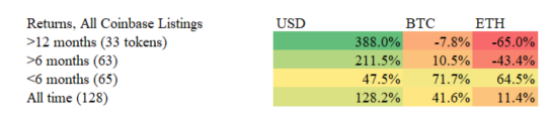
In terms of hit rate, 91% of all listed tokens underperformed Ethereum over a year post-listing, and 70% underperformed Bitcoin. These numbers get worse the further back you go.
Hunger for Liquidity
Of course, would filtering for a16z’s picks on Coinbase yield better results? Quite the opposite…
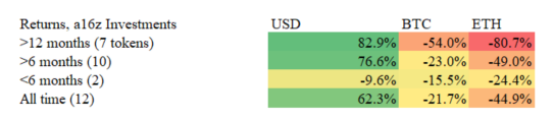
a16z’s returns are far worse than Coinbase’s overall listings! This smells like insider dealing to me. Given a16z’s access, these should be the best tokens—but instead, 100% of coins over 12 months old and 90% over 6 months old underperform Ethereum:
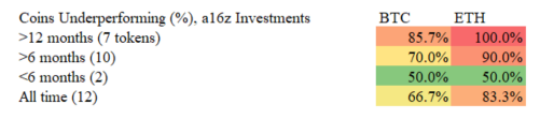
“It’s a hit-driven business,” Marc Andreessen might counter. But:
1) Retail investors don’t build diversified portfolios like VCs
2) This is a public offering, so returns should resemble stocks where average returns are positive
3) VC “hits” should deliver “100x” returns to offset dozens of failures, but in a16z’s portfolio, only one (Solana) doubled in BTC terms.
Back in 2018, when I used to trade digital currencies for fun, checking market caps backed by big-name investors like Andreessen Horowitz was the best way to avoid “rug pulls”—when coins suddenly collapse. I’d say it worked well.
Yet when I tried deploying a similar strategy on Coinbase in 2021, I kept losing money. Now I think I know why.
I also examined Coinbase Ventures’ investments. They seem to do better—though older tokens perform equally poorly. Coinbase’s portfolio is younger, and its strong performance is entirely driven by two tokens: Polygon and Wrapped Luna. Without these two, the average return across Coinbase Ventures’ other 15 coins is –6.0% in BTC and –42.6% in ETH.
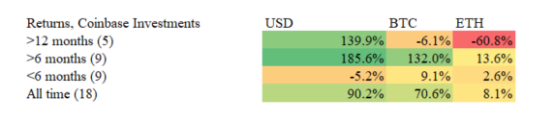
My favorite angle is looking at when Coinbase and a16z invest together. These seem like darlings of the industry (DeFi darlings?), but actually perform worst of all groups! (If you’re curious, the five are Uniswap, Celo, Keep Network, Rally, and Compound).
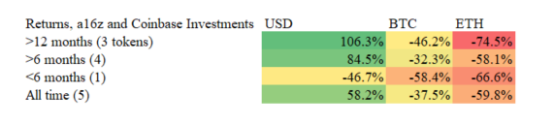
There are solid reasons for U.S.-based VC investors to sell on Coinbase: (1) You don’t want to be double-taxed, leading to (2) You’re a U.S. entity and can’t open accounts on Binance or other exchanges that list these coins first (3) Hosting and trading on Coinbase is safer, since elsewhere you might need hardware wallets, manage cross-exchange trades, etc.
I also investigated why Coinbase’s investments might outperform. One thing I noticed is that Coinbase lists its own investments but at smaller market caps (see below). For 7 out of 18 Coinbase-backed tokens, I checked whether Coinbase or Binance (an exchange often more aggressive on regulation) listed first—and in 5 out of 7 cases, Coinbase came first—more than average. One wonders if Coinbase knows that a Binance listing would hurt their profits by siphoning off returns!
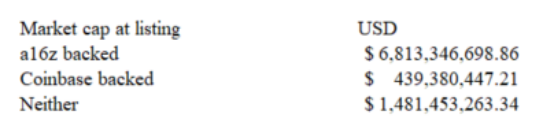
(If you wonder whether a16z’s low returns can be explained by larger listing market caps, the answer is no—their figures appear larger only because Internet Computer debuted at ~$52B; otherwise, they align closely with others.)
Pudding Proof
These numbers alone don’t prove anything, Coinbase or a16z spokespersons will say. Newer cryptos perform better because they have superior technology! And these fading returns apply to all exchanges, not just Coinbase. Now shut up before we sue you.
But luckily, we have what economists call a “natural experiment.” Until 2020, Coinbase would announce tokens they were considering for listing. Some got the green light (included in my analysis above), some didn’t.
How did the unlisted tokens perform? Many of them exploded. On both USD and BTC bases, unlisted coins consistently outperformed listed ones, slightly lagging ETH (consistent with my view that ETH is the best benchmark).
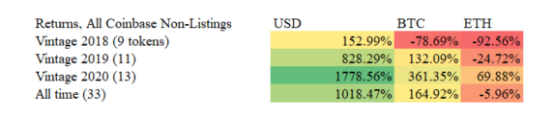
Crucially, returns worsened over time—even worse than Coinbase-listed coins. I think this is due to several factors: (1) Coinbase’s selection criteria may exclude the worst junk coins (2) Longer unlisted periods mean more time for degradation.
If we look only at 2020, we get a fairly even comparison (17 Coinbase listings vs 13 unlisted), and the return difference is almost astronomical. It’s not a winner’s product—4 unlisted tokens were positive vs ETH, while only 1 of the 17 actually listed was!

This negative effect seems so strong that in 2019 and 2020, choosing what Coinbase didn’t list gave you a significantly higher chance of beating BTC or ETH—in 2020, five times higher odds vs ETH (94% of Coinbase 2020 coins underperformed, versus 69% of rejected ones). This strongly suggests that the availability of dollar liquidity seems to outweigh Coinbase’s “halo effect”... or people are dumping.
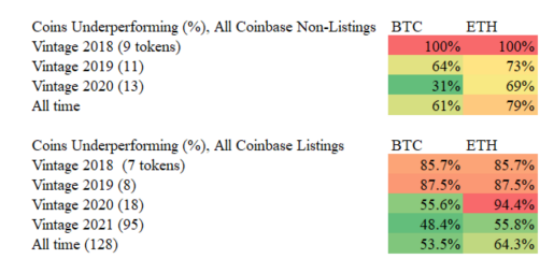
My conclusion: The “Coinbase Effect” is overstated: enabling people to sell coins for dollars seems to do more harm than good. If anything, there appears to be a Coinbase curse.
This feels like strong support for my two arguments: (1) Most tokens rise due to illiquidity, not value (since both listed and unlisted degrade over time) (2) Liquidity on Coinbase causes these tokens to underperform, possibly due to insider trading.
Insider trading? You haven’t said anything about that part…
Lockup
We’ve looked at a16z tokens and found they underperform BTC, ETH, and Coinbase’s average listing.
What about unlisted a16z tokens? The sample size is much smaller—only four coins—but the result is striking:

Returns for unlisted a16z tokens actually outperformed Bitcoin, while listed ones didn’t come close. Arweave received investment from both a16z and Coinbase Ventures but was never listed—and has so far performed strongest, up tenfold since Coinbase said it was “evaluating” a listing!
Starting from the “DeFi Summer” of 2020, we can basically tell our story with three coins:

All three coins experienced the same “macro” environment. Never-listed coins performed best; listed non-VC coins did better; listed VC-backed tokens performed worst.
What does this mean?
My first reaction was that I wouldn’t buy anything listed on Coinbase, especially after the initial listing hype fades, and to stop trusting VC-backed tokens. Turns out, I haven’t lost all my trading skills…
The logical implication is to only buy BTC and ETH, though these returns also decline year by year (including last year), albeit with far lower risk than smaller coins. Overall, they seem to outperform buying “web3” tokens.
I think this also matters for major debates in crypto:
1) Contrary to the “Balaji” argument. Balaji likes to repeatedly emphasize that the core value proposition of “web3” is helping the “little guy”: letting users participate in value creation (e.g., owning a piece of a project). Yet the vast majority of users buy on Coinbase and thus underperform Bitcoin.
2) Supports the “Jack” argument. Jack argues that most tokens are owned by VCs, and they’re destroying Bitcoin by siphoning liquidity from deflationary assets using the “web3” narrative. Jack is somewhat of a Bitcoin maximalist, so this is self-serving, but so far, it looks like he might be onto something.
Other thoughts: Coinbase may also be sacrificing its brand here. They may need new assets to encourage trading, but others suggest the shift away from caution could be Balaji’s influence—given his thesis on “helping” investors, that makes sense, but he may be misreading the data. Also, Balaji once worked at a16z and Coinbase—so no one can truly know his motives!
Finally—do I think either company is doing something wrong? Actually, I don’t—they may not have even looked at these numbers themselves. They’re just the most visible, as data from other investors and exchanges is hard to obtain. But they’re by far the most influential. As Uncle Ben said, with great power…
Rather, I see this as a symptom of how broken crypto incentives are—VCs and private investors who used to wait ten years for liquidity can now get it in one. The last time this happened was 1999, and we know how that ended. It’s a recipe for flipping and rapidly passing risks to the public.
Some objections to my analysis:
1) You’re a nobody.No, I’m long BTC, ETH, and NEAR, hedged recent volatility with BITO at $26 on March 22.
2) You’re a Bitcoin maxi.No, I worked for Joe Lubin and ConsenSys for three years.
3) You didn’t look at other exchanges.Given Coinbase’s dominant “popularity” in exchange listings so far, I expect liquidity decay to be strongest there. I also think the a16z-Coinbase nexus is the best studied, as both rank among the most influential. I also doubt a16z has accounts at Kraken or Gemini given their vested interests at Coinbase, so I wouldn’t expect relationships there. I’m interested in analyzing Binance, so that might be future work.
4) These aren’t bad returns.Last year’s listings (mostly 2021) had decent returns, all positive in USD. Fair enough, but I’d argue if these coins only rose because Bitcoin went up, what happens when Bitcoin has a bad year? If you’re just underperforming Bitcoin, what’s the point of Coinbase?
5) You did this during a bear market, so it looks worse.No—I ran the raw data in December (BTC ~$50K) before writing this, and all the same trends held.
Solutions I propose (hello, Gary Gensler)
My first question is: should this even be legal? Nasdaq and NYSE have venture funds, but their investments must be approved by the SEC for public listing! No regulator checks each Coinbase listing. Sure, maybe they have processes and act in good faith, but would you trust any old company’s financial statements if no one audits them?
Think of it this way: Google invests in Goldman Sachs (here, Messari), then Goldman publishes research reports on Google’s work, then Google conducts an IPO of its own investments. No one has to disclose what they’re buying or selling. Do you think you’ll get good information from such misaligned incentives?
Here are some solutions I believe are necessary to better protect investors and correct these bad incentives:
1. Fund disclosures. Hedge funds and mutual funds are subject to 13F and 13D regulations: under 13F, they must disclose holdings quarterly; under 13D, whenever they acquire over 5% of a public company. I believe VCs and other crypto investors should do the same for crypto. Want to sell to the public? Follow public market rules. Otherwise, it’s unfair to the moms and dads clicking Coinbase’s billionth YouTube ad.
Some will say 13F and 13D don’t help much and probably don’t assist small investors who don’t read filings. But I say this would allow professional investors to assess tokens from investors who enable fast exits, allowing reputation to be earned or lost.
2. Fix accredited investor rules—but not just by deregulating. Populists say “eliminate accredited investor rules! They block people from participating in economic growth!” I say absolutely. But do you know that public companies (you know, “permissionless” investments) are also subject to regulations and disclosure rules? These advocates want to deregulate VCs (necessary) without also imposing public market rules (also necessary). That means S-1 style public filings. S-1s typically disclose relationships between investors and directors, risks, and crucially, management and major investor ownership.
I believe world-class figures like Balaji and Ryan Selkis will say this idea “kills” innovation: contrary to popular belief, I don’t think companies stay private longer due to heavy rules (though they are burdensome), but because public markets have become more tolerant of losses, meaning you can go public at ever-larger loss scales. If you can avoid dilution and get a bigger exit, why wouldn’t you as a founder or investor?
3. Close the utility and governance token loophole. The SEC accidentally created a massive loophole when stating Ethereum isn’t a security because its coin has utility.
Suppose you run a deli and decide to sell sandwich coupons online (utility!). If people online seem willing to buy them, why not issue a billion sandwich coupons? Of course, your little deli won’t sell a billion sandwiches in the next ten thousand years, but that’s not your problem.
Most DeFi coins use a “governance token” model, where one token equals one vote. This falls into a very similar gray area of “how many votes?”
Take Celo as an example: “Between 2018 and 2020, Celo raised over $46.5 million by selling around 120 million CELO tokens.” Since then, it stated the total supply would never exceed one billion, with only 6% (60 million) circulating at launch. Later, it listed on Coinbase on September 3 (with investments from Coinbase and a16z), with ~12% circulating. Over the following 15 months, circulation increased to 37% today!
The coin’s value lies in its ability to “vote to create stablecoins,” so of course we need a billion.
If utility/governance tokens remain an open loophole, issuing companies need to provide a fair estimate of how many tokens users actually need in disclosures—so investors can hold them accountable.
See how performance flattened after the release plan accelerated significantly in April 2021 (1.2% monthly):
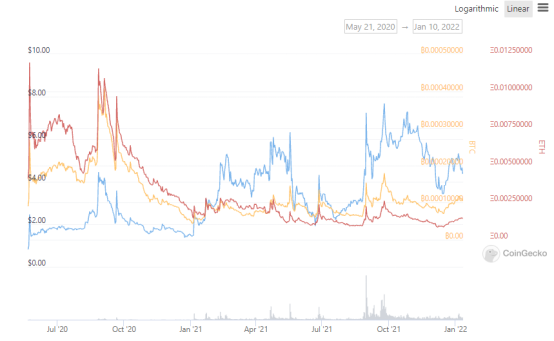
4. Stricter (non-)listing rules. Coinbase currently has no rules on minimum market cap, minimum number of shareholders, or minimum daily trading volume. This means shitcoins can drop, keep dropping, and drop again. The NYSE and Nasdaq have many such rules, which is why they’re respected globally. These also include rules on how much stock management teams can control. If crypto exchanges had to repeatedly delist tokens due to lack of liquidity or price drops, it would damage their reputation—motivating them to demand quality.
Conclusion
In Urdu, we call a sycophant a chamcha, a “spoon”—because it serves your needs. At the end of the day, I’m just someone on Substack—but unfortunately, I think the state of crypto investing today is that all the “research” you get comes from someone’s chamcha.
I don’t know whether Balaji or Jack will be proven right in ten years, but all this supports what I call Charlie Lee’s (Litecoin’s creator) argument: demand for deflationary assets like Bitcoin could be huge, but the biggest problem is anyone can create another similar cryptocurrency, so it’s not truly deflationary.
What will returns for Coinbase’s 2021 coins look like next year? I bet the same pattern continues—prices pump and slowly fade, returning less than Bitcoin. At the very least, I hope Coinbase users eventually see this—just like you would with an ETF or mutual fund. Over time, Coinbase is offering increasingly risky assets, and that’s the truth.
At best, investors and exchanges are people who want to reshape finance but underestimate its complexity. As Matt Levine says, much of crypto is just repeating the mistakes of financial history. At worst, wealthy insiders collude with friends to exploit bubbles, helping each other buy $100 million mansions. It’s time for big players and regulators to act, ensuring everyone operates under the same standards and data. Until then, buyer beware.
Notes:
1. In 8 cases, unlisted tokens had no trading activity before Coinbase’s evaluation. In those cases, I used the earliest market data available on Coingecko. Interestingly, of the 8 tokens not traded anywhere before being evaluated for listing, 5 received investment from a16z or Coinbase!
2. I used a16z and Coinbase Ventures’ own investment lists, but in one case (Livepeer), I found an external source indicating Coinbase invested, though it wasn’t recorded on their website (they may have exited the position).
3. For comparing market caps of Coinbase-supported vs unsupported tokens, I couldn’t find listing market caps for: Braintrust, Clover Finance, Jasmy, Kyber Network, Loom Network, Moss Carbon Credit, Voyager Token, Wrapped LUNA, Orchid-protocol.
References:
1. All my data analysis and source data can be viewed here
2. Coinbase provides all new listings on its blog
3. Coinbase lists its investments on its website
4. a16z has two portfolio lists: crypto and all.
5. Messari also has Coinbase and a16z portfolios, but I cross-referenced for accuracy.
6. All prices from Coingecko.com. Returns based on January 9, 2022.
Join TechFlow official community to stay tuned
Telegram:https://t.me/TechFlowDaily
X (Twitter):https://x.com/TechFlowPost
X (Twitter) EN:https://x.com/BlockFlow_News






