








Former hedge fund manager: 7 cryptocurrencies with market caps under $1 billion will perform well in 2022
TechFlow Selected TechFlow Selected
Former hedge fund manager: 7 cryptocurrencies with market caps under $1 billion will perform well in 2022
Moonriver is an Ethereum-compatible smart contract parachain on Kusama. Kusama is a $2.4 billion cryptocurrency that serves as a public pre-production environment for Polkadot.
 Navigating Web3 tides with focused insights
By Mark Hake
Translated by Alex, TechFlow
I want to write an article about seven cryptocurrencies with market capitalizations under $1 billion that have the potential to perform well in 2022. The idea is that as investors "discover" these new blockchains and their related use cases, these seven cryptocurrencies could rise 5 to 10 times during the year.
One point to clarify here is that there's no guarantee any of these seven cryptocurrencies will surge significantly. However, I will try to highlight unique features of each one that could potentially drive such growth.
Another interesting fact is that Coinmarketcap.com ranks all cryptocurrencies by market value. As of December 31, the 95th-ranked cryptocurrency was slightly below $1 billion. Therefore, all these cryptocurrencies have market caps close to rank 95 or higher.
Here are the top seven cryptocurrencies with market capitalizations under $1 billion:
1. Moonriver (MOVR-USD)
Market Cap: $510.4 million
Moonriver is an Ethereum-compatible smart contract parachain on Kusama. Kusama is a $2.4 billion cryptocurrency that serves as a public pre-production environment for Polkadot.
Before Polkadot launched its own parachain auctions and began leasing space on its mainnet, Kusama’s parachain auctions were seen as a “canary” network. The Kusama parachain auctions raised 2.4 million KSM (Kusama’s native token), contributed by over 49,000 unique addresses. This includes Moonriver, which is also part of the Moonbeam network ecosystem.
Their website explains how the system works:
"Moonriver is Moonbeam's companion network providing a permanently incentivized canary network. New code is first deployed to Moonriver, where it can be tested and verified under real economic conditions. Once proven, the same code is then deployed to Moonbeam on Polkadot."
It describes itself as a "community-led sister parachain" on Kusama. Now that Polkadot's parachains are also live, Moonriver is expected to eventually appear on Polkadot as well. Once migrated, MOVR cryptocurrency is anticipated to surge.
2. OriginTrail (TRAC-USD)
Market Cap: $456.3 million
OriginTrail is known as the world's first decentralized knowledge graph. Its purpose is to integrate humanity's most important assets and leverage its decentralized network to make them discoverable and verifiable.
According to the OriginTrail website, its network enables the world’s data assets to be structured, linked, persistent, and understandable. It calls this the Decentralized Knowledge Graph (DKG). A knowledge graph is exactly what it sounds like—a physical map of interconnected descriptions of entities.
OriginTrail combines blockchain and knowledge graphs. It operates based on Metcalfe’s Law, which states that the value of a telecommunications network is proportional to the square of the number of users in the system.
Therefore, as the number of users grows within the decentralized network, the value of knowledge within the network increases exponentially.
From an investment perspective, if the OriginTrail network takes off, the value of its cryptocurrency TRAC could also grow exponentially.
3. My Neighbor Alice (ALICE-USD)
Market Cap: $391.3 million

My Neighbor Alice is a multiplayer metaverse game. It allows anyone to purchase and own virtual islands using ALICE tokens. If it gains traction, the ALICE token is expected to rise accordingly.
One of the best places to understand what's happening in this exciting metaverse is its Medium site. For example, this article updates ALICE enthusiasts on events during November via the My Neighbor Alice platform.
Recently, for instance, ALICE has been distributing free Alice Seeds NFTs (non-fungible tokens) on the Binance network.
Expect to see the ALICE token take off next year due to its cool name, giveaways, and rising game popularity.
4. Dusk Network (DUSK-USD)
Market Cap: $365.5 million
Dusk Network is a financial platform. It brands itself as a “privacy network for financial applications.” The network aims to enable businesses to tokenize financial instruments (such as debt securities) and automate costly processes.
Instead of proof-of-work, Dusk Network uses a novel transaction validation system to approve financial instrument transactions. It’s called Proof-of-Blind-Bid. The goal is to finalize transactions within 15 seconds after initiation.
More importantly, it allows smart contracts to be processed privately—using distributed ledger technology (DLT), i.e., blockchain technology—but keeping details confidential between parties. Most blockchain technologies operate on the principle that everyone knows everyone else's business. Dusk Network’s DLT transactions are processed quickly on the blockchain while protecting user privacy.
This fills a much-needed niche in commercial transactions. If the network takes off, DUSK cryptocurrency is expected to rise significantly in the coming years. In fact, one analyst predicted that over time, the value of its ecosystem could exceed $100 billion.
5. MetisDAO (METIS-USD)
Market Cap: $327.8 million
Metis aims to make building DApps (decentralized applications) and DACs (decentralized autonomous companies) on its platform extremely easy. It wants to help newcomers complete this process very quickly—within minutes. It refers to itself as a “Layer 2” protocol because it's built on top of other underlying blockchains, primarily Ethereum (CCC:).
Most of its announcements and news are published on Medium.com, where it describes new staking features and metaverse blockchain capabilities. The ability for users to stake their METIS cryptocurrency began in late November. This should help the cryptocurrency perform well next year, as the supply of its crypto tokens is tied to staking contracts.
6. Qredo (QRDO-USD)
Market Cap: $237 million
Qredo is a London-based blockchain network specializing in cryptography research. According to its website, it was built by veteran cryptographers, cybersecurity leads, and blockchain technologists. Thus, it aims to achieve fast transaction speeds on a highly secure foundation.
After raising $2.9 million in angel funding (now called pre-seed) in Q1 2019, Qredo completed an $11 million seed round in Q1 2021. In Q1 2021, it launched blockchain software support, enabling conversions using Tether and USD Coin on Qredo.
More recently in Q3 2021, Qredo raised an additional $16 million through a private sale to strategic investors. One of its core and unique features is the ability to secure financial transactions with Tier-1 banking security. It also enables complex trading strategies such as accessing “cross-chain” liquidity pools, trading collateralized derivatives, and executing cross-chain atomic swaps.
The Qredo blockchain has already gone live in November 2020. It focuses on institutional investors and their advanced trading requirements. As its network and blockchain gain trust, the Qredo token is expected to take off.
7. Aleph.im (ALEPH-USD)
Market Cap: $86.3 million
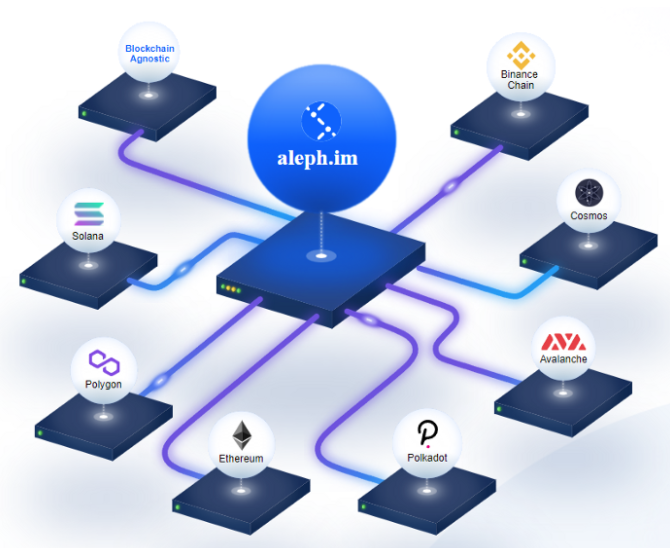
This is a relatively small decentralized finance (DeFi) application and blockchain network expected to take off this year as its staking and DeFi applications grow in popularity. The company claims its core focus is the “decentralization” of the internet. It achieves this by enabling Web2 and Web3 applications to remove centralized components from their stacks and transition toward fully decentralized architectures.
From a practical standpoint, Aleph.im has many use cases. These include document authentication, smart contracts, real-time DApps (decentralized applications), censorship-resistant social applications, and Know-Your-Customer (KYC) metadata analysis.
One of its unique aspects is its compatibility across numerous blockchain networks, including ETH, Polkadot, Solana, Polygon, and others.
Finally, here’s something I find particularly interesting. Aleph.im is actually a company, not a blockchain token. Yet you can buy it on cryptocurrency platforms as if it were a blockchain token. In effect, you’re purchasing a piece of the company.
It's still unclear whether this means you're buying a token, shares, LP rights, or some other form of decentralized participation in the company’s value economics. This could also be high-risk, as you may not actually own anything (so buyers beware). I suspect this will become clearer over time, especially if the company conducts airdrops of relevant tokens or securities.
All views expressed in this article are the author’s personal investment opinions, not investment advice.
TechFlow is a community-driven deep content platform dedicated to delivering valuable information and thoughtful perspectives.
Community:
WeChat Official Account: TechFlow
Telegram: https://t.me/TechFlowPost
Twitter: TechFlowPost
Join WeChat group: Add assistant WeChat ID TechFlow01
Join TechFlow official community to stay tuned
Telegram:https://t.me/TechFlowDaily
X (Twitter):https://x.com/TechFlowPost
X (Twitter) EN:https://x.com/BlockFlow_News






