For everyone, for all: Harmony ecosystem overview
TechFlow Selected TechFlow Selected
For everyone, for all: Harmony ecosystem overview
Harmony has several unique features designed to address challenges faced by other blockchain protocols. The platform features a deep sharding system, consensus protocol, distributed random generation (DRG), and cross-chain interoperability.
 Navigating Web3 tides with focused insights
Written by Alexander, with partial content from Kadeem Clarke
What is Harmony?
Harmony is a high-performance public blockchain project based on state sharding and Proof-of-Stake (PoS). Its sharding architecture consists of one beacon chain and multiple shard chains. The beacon chain provides services including decentralized random number generation, validation of shard chain headers, and staking acceptance for validator nodes.
The project aims to build a next-generation blockchain network—based on sharding architecture—to achieve high scalability, security, and low energy consumption.
Historical Background
Stephen Tse founded Harmony in 2018, and the protocol officially launched in 2019. Stephen Tse is an experienced cryptographic protocol engineer whose goal was to provide global DeFi users with a decentralized, open, and trustless blockchain platform. Tse co-founded the project with 20 other members who have extensive experience in machine learning, software development, artificial intelligence, blockchain technology, and virtual reality.
The team held regular meetups in San Francisco, and over time, the project began attracting interest from multiple investors. In its 2019 funding round, Harmony raised over $18 million. Since launch, its online and offline communities have continuously grown, attracting new users.
Technology
Harmony features several unique capabilities designed to address challenges faced by other blockchain protocols. These include deep sharding systems, consensus mechanisms, distributed random generation (DRG), and cross-chain interoperability.
Sharding
Sharding refers to the process of dividing a blockchain network into smaller partitions (called shards) to improve overall network throughput. Sharding was introduced to solve Ethereum’s scalability issues. While many blockchain protocols have attempted to address this problem, most solutions have proven ineffective.
Harmony addresses common sharding challenges, with dynamic sharding enabling 2-second transaction finality on this blockchain. Transaction fees on the platform are up to 100 times lower than those of other blockchains. Shard 0, Shard 1, Shard 2, and Shard 3 each support 250 validators.
FBFT Consensus
Fast Byzantine Fault Tolerance (FBFT) simplifies communication processes on the platform. In this model, validator selection is determined by the amount of tokens held. This design eliminates the need for vote broadcasting, as increased token holdings automatically increase the chance of being selected as a validator. FBFT uses a simple multi-signature design and process.
Distributed Random Generation (DRG)
Distributed Random Generation (DRG) is a randomness-based sharding mechanism that assigns network nodes to shards using verifiable random numbers.
Cross-Shard Communication
Cross-shard communication is a technical feature that reduces complexity and volume when running communication protocols on the platform. Kademlia is the distributed hash table and routing protocol relied upon by the system. This concept enhances intra-shard communication by allowing nodes within a shard to receive and send information internally via shard IDs, eliminating the need to broadcast messages across other shards.
Ethereum Integration
High fees on the Ethereum network have led many developers to abandon plans for dApp development within its ecosystem. Ethereum's growth is slowing as users turn to alternative platforms with significantly lower gas fees.
Ethereum’s limited scalability makes it difficult to support the creation and deployment of decentralized applications. Harmony’s unique features aim to overcome the challenges faced by the Ethereum network. Harmony’s scalable, sharding-based next-generation protocol mitigates Ethereum’s limitations. It offers an energy-efficient and secure platform that operates alongside the Ethereum network while still supporting decentralized applications.
Harmony Token (ONE)
The name "one" originates from the platform’s vision “For One and For All” and serves as Harmony’s native token. ONE governs various activities on the platform, including:
1) Voting on on-chain governance proposals.
2) Paying gas, transaction, and storage fees.
3) Staking required for PoS consensus, where validators earn block rewards and transaction fees.
Token incentives reward various participants involved in network development and governance, such as investors, validators, stakeholders, developers, and community members.
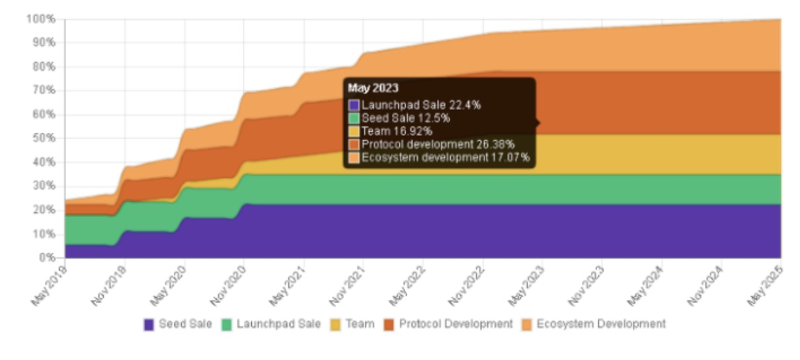
ONE Token Issuance Schedule
Validators can easily join the protocol by staking at least $10,000 worth of ONE tokens. Validators then receive rewards proportional to their staked $ONE holdings. Those who double-sign to manipulate the system will be penalized through slashing of a significant portion of their stake and ultimately removed from the network.
A key differentiator between Harmony and other Layer 1 blockchains is that all $ONE tokens earned from transaction fees are burned. Zero token inflation results from high network usage. This deflationary mechanism—through issuance and burning driven by growing network activity—ultimately increases the intrinsic value of the $ONE token.
Current staking rates ensure delegators receive approximately 10% returns after fee deductions. This yield falls within the mid-range compared to competing L1s. Around 42% of $ONE tokens are currently staked—a figure influenced by declining returns and predictable inflation rates as network usage increases.
Harmony Foundation
Recently, Harmony launched a $300 million ecosystem fund to support startups building on various protocols and decentralized applications. As Stephen Tse stated, Harmony was specifically built to make it easy for developers building on it to connect seamlessly with other blockchains. The goal is to enable smooth and affordable interoperability between chains.
The official website outlines how this fund will be deployed over the coming years. The target is to roll out $180 million by Q3 2022, allocated as follows:
1) $50 million to fund 100 DAOs
2) $30 million to fund 1,000 bounties
3) $30 million for 10 partnerships
4) $10 million for 10 hackathons
Harmony’s Ecosystem Projects

Harmony hosts a rich ecosystem; below are highlights of select projects:
Horizen Bridge
Harmony was among the first projects to develop a cross-chain bridge. Initially, the Harmony token ONE was issued on Binance Chain (BEP2), later bridged to Ethereum (ERC20). After mainnet completion, native mainnet tokens were issued, followed by BEP20 tokens once BSC integration was finalized. Currently, the primary token is the mainnet version, with the official Horizen Bridge serving as the main cross-chain solution.
Horizen Bridge is an official cross-chain bridge where smart contracts lock users’ original assets and mint new assets on Harmony for distribution.
Horizen Bridge imposes no restrictions on bridged assets, enabling any Ethereum or BSC asset to be transferred to Harmony—meaning any ERC20 or BEP20 token can be bridged to Harmony as an HRC20 token. Conversely, any HRC20 token can also be bridged back to Ethereum or Binance Smart Chain.
This design ensures universality but requires caution regarding whether bridged assets are officially supported. Assets from different sources may generate two distinct versions post-bridge. For example, BUSD: the officially preferred version is the ERC20 BUSD bridged to Harmony, whereas BEP20 BUSD becomes bscBUSD after bridging.
Even identical assets may produce two variants after bridging. Users should verify the target chain’s contract address during bridging. For instance, 1SUSHI on Harmony becomes 11SUSHI when bridged to BSC—not the standard SUSHI used on BSC. If 11SUSHI is bridged back to Harmony without specifying the correct 1SUSHI contract address, the default result would be bsc11SUSHI, which cannot be used natively on Harmony.
In terms of cost, bridging assets to Harmony is inexpensive—for example, converting ERC20 tokens into HRC20 tokens costs only about 1–2 times the standard ERC20 transfer fee. However, bridging HRC20 tokens back to Ethereum incurs significantly higher costs.
Anyswap
Anyswap is one of the most universal cross-chain bridges, currently supporting over 500 projects across 19 chains. Harmony partnered with Anyswap to bring native BTC onto the Harmony network. Today, anyBTC can already be used for liquidity mining on Viperswap.
Assets from Polygon can also be bridged to Harmony via Anyswap, helping Harmony build a multi-chain future.
Beefy Finance
Beefy Finance is a multi-chain yield optimizer with total value locked (TVL) exceeding $900 million across five chains: BSC, Polygon, Fantom, Heco, and Avalanche. Beefy Finance recently deployed on Harmony, but due to limited ONE token incentives, TVL remains at just $900,000.
Beefy Finance relies on liquidity from other DEXs, staking LP tokens for yield farming. Currently, Beefy Finance offers slightly higher APR than SushiSwap, funded by ONE token rewards from Harmony. Supported trading pairs match those on SushiSwap.
Some SushiSwap LP tokens have migrated to Beefy Finance for staking, but this does not reduce SushiSwap’s TVL since liquidity remains on SushiSwap. This actually helps boost SushiSwap’s mining yields and may explain why Harmony has reduced ONE incentives on SushiSwap.
ViperSwap
Among DEXs on Harmony excluding SushiSwap, ViperSwap has the highest TVL at $11.07 million, primarily consisting of liquidity pairs involving ONE or VIPER paired with other major assets. The much-promoted anyBTC by Harmony debuted first on ViperSwap, where mining rewards users with VIPER tokens. Although APR appears in the hundreds of percent, 95% of rewards are locked and will only begin unlocking after December 25, 2021.
MochiSwap
A DEX forked largely from PancakeSwap, MochiSwap currently has a TVL of $1.63 million, with individual trading pair liquidity typically around tens of thousands of dollars—insufficient to meet robust trading demand. Additionally, the community created ONEmoon, a token similar to HTMOON, where each transaction distributes part of the tokens to existing holders, adds irreversible liquidity, funds the community treasury, and burns a portion.
OpenSwap
Another DEX, OpenSwap reports a TVL of $1.28 million, mostly from single-sided oSWAP token staking. Due to excessive capital inflow, the oSWAP single-token pool offers only a 3.6% APR.
aVinci Gallery
An NFT platform on Harmony, aVinci Gallery has seen 3,575 artists mint 30,721 NFTs, with a total of 44,467 items sold (including duplicates), generating sales worth 9.57 million ONE tokens—approximately $1.66 million.
DeFi Kingdoms
DeFi Kingdoms is a play-to-earn (P2E) game built on the Harmony Protocol blockchain. Designed from a DeFi perspective, it functions not only as a game but also as a DEX, liquidity pools, and a marketplace powered by rare NFTs.
According to DappRadar data from November 29, DeFi Kingdoms ranked second among all blockchain gaming Dapps in weekly transaction volume, reaching $219 million.
References:
https://medium.com/momentum6/for-one-and-for-all-harmony-ecosystem-overview-d974e8e2d6f2
Join TechFlow official community to stay tuned
Telegram:https://t.me/TechFlowDaily
X (Twitter):https://x.com/TechFlowPost
X (Twitter) EN:https://x.com/BlockFlow_News