








Burger Burger Exposed: What's the Logic Behind Making Money?
TechFlow Selected TechFlow Selected
Burger Burger Exposed: What's the Logic Behind Making Money?
Burger is the Sushi on Binance Smart Chain, starting the matryoshka journey
 Navigating Web3 tides with focused insights
Burger is a decentralized token swap platform built on the Binance Smart Chain.
Providing liquidity for pairs like BNB/Burger and BNB/BUSD earns you Burger rewards. In plain terms: locking up BNB, Burger, or BUSD generates more Burger tokens. However, there are risks involved—impermanent loss, for example. If prices drop, you might end up with lots of Burger tokens but less BUSD (a USD-pegged stablecoin).
The total supply of Burger increases through mining—it appears unlimited, but in reality, it's quite hard to mine. Based on firsthand testing, providing about 1% of the liquidity for the BNB/BUSD pair yields roughly 400 Burger tokens in 12 hours. The current total supply is around 3 million.
The project launched at 4 PM on Friday, September 10. Due to Binance Wallet maintenance, actual mining didn’t start until Saturday morning, September 12. Only two people tested it on Friday. Around 800 participated on Saturday, and 1,200 on Sunday.
Verified data shows only 1.2 million Burger were minted by early Saturday morning. By Sunday afternoon, the total reached 3 million. Approximately 2,000 users took part, and participation is accelerating.
Issues and Timeline of Burger
First, someone drained all BEP20 (Binance Smart Chain) BNB from the wallet, causing wallet maintenance (allegedly—exact details remain unclear). As a result, no one could deposit funds early Saturday morning. Real operations effectively began Saturday morning.
Second, many retail investors followed the “mine-sell-withdraw” strategy and accidentally drained BurgerSwap’s BUSD reserves, causing the Burger price to crash—from 3.6 USD down to as low as $0.90. At that moment, He Yi appeared across various chat groups asking what happened and clarified that the project wasn't run by Binance and that audits were done internally by the team. Within an hour, large amounts of BUSD were deposited back into the system, stabilizing the price, which briefly rebounded to $2. Later, due to panic selling by retail users continuing to “mine-sell-withdraw,” the price fluctuated between $1.20 and $1.60.
After enduring sell pressure throughout Saturday daytime, prices surged overnight to $3.50 while most retail users slept. The bad news? The Saturday BUSD shortage scared off many inexperienced investors.
Highlights of the Project
The product experience is quite user-friendly—thanks to lessons learned from earlier projects.
Although not an official Binance project, He Yi actively helped resolve issues in community groups, likely because this was the first major application on the Binance Smart Chain.
Price stability has been decent. If you mined via the BNB/BUSD pool, you haven’t lost money so far. On Saturday morning, daily returns from mining Burger were as high as 30%.
Current daily returns are around 3%, excluding additional gains from BNB rising over 10%. Even calculating Burger at $2 per token (the conservative estimate used during initial mining), actual profits are substantial—especially now that Burger trades at $3.50, making early miners’ earnings even higher.
Voting requires locking tokens. While displayed as ~60+ hours, when block times are fast, unlocking can happen overnight.
The team actively adjusts UI and features. When users complained—e.g., about lacking visibility into pool sizes and staking ratios—the feature was added late Saturday night after some website crashes. Given the speed of implementation, one might suspect Binance product managers tipped them off, with Chinese developers coding furiously behind the scenes.
The Profit Logic
Can Burger get listed on Binance?
This is a project personally promoted on social media by He Yi and several Binance business and marketing staff.
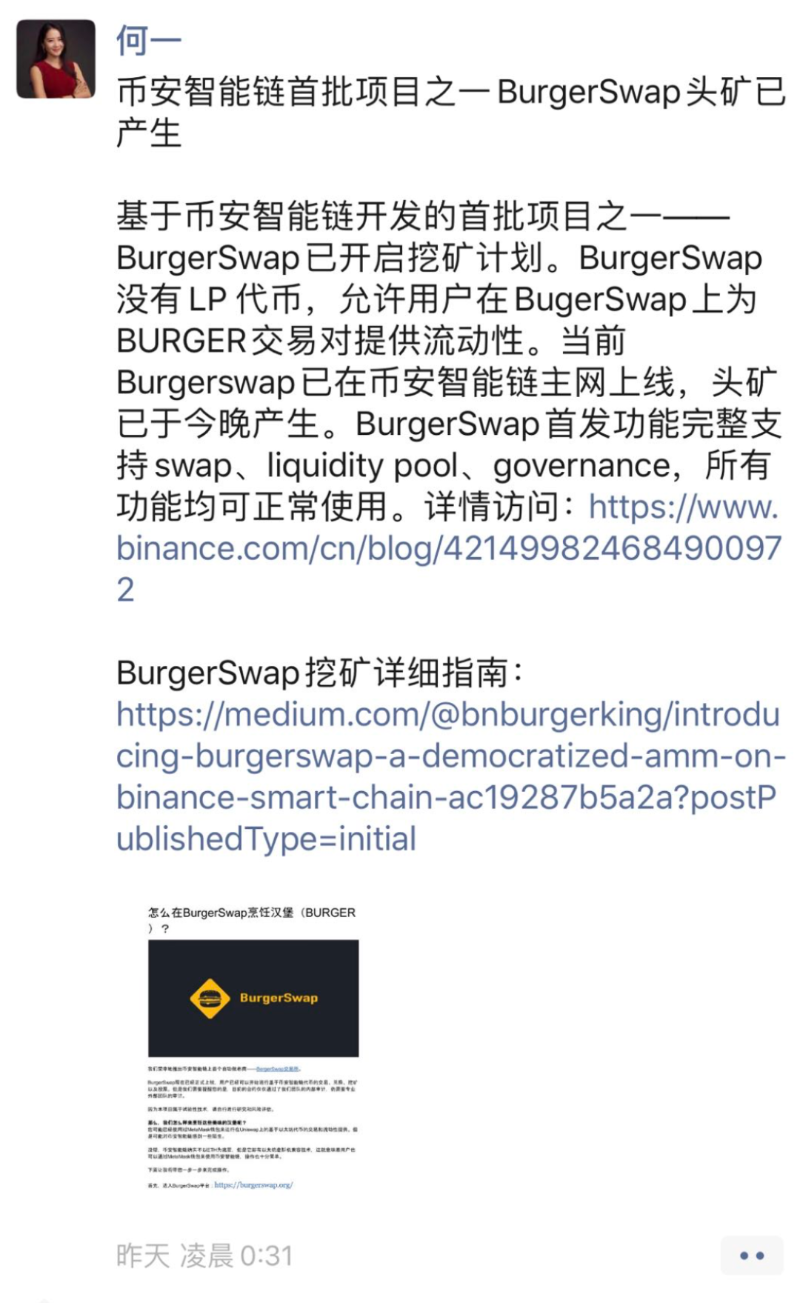
He Yi said, “We’ll look at its performance after some time, possibly in the first batch.” Her original wording was grammatically flawed, so we’re quoting it verbatim. Interpret that however you wish. So—will it get listed? Seems plausible. What good would listing do? If you don’t know, go ask someone else.
Burger is essentially Sushi on the Binance Smart Chain—the beginning of a copycat cycle. Binance has already announced five upcoming similar projects. Mining with Burger will likely offer better yields—just as Sushi did initially.
When I checked, Sushi was priced at $1. After the copycat wave started, it jumped to $10...
Burger still holds promise, especially since it hasn’t been listed on any major centralized exchange yet. Those who don’t understand wallet-based mining will become bagholders later on.
Currently, around 2,000 addresses are mining Burger, compared to 20,000 for Sushi. That suggests we're only about 1/10th into the race—with plenty of opportunity ahead! Isn’t being in the top third already pretty good? After all, real activity only began two days ago.
Finally, Burger carries significant risk. This is not investment advice. Readers assume full responsibility for their decisions, and we disclaim any liability for potential losses.
Join TechFlow official community to stay tuned
Telegram:https://t.me/TechFlowDaily
X (Twitter):https://x.com/TechFlowPost
X (Twitter) EN:https://x.com/BlockFlow_News






