









Decoding the ETC Blockchain Transaction Halt: Analysis and Incident Reconstruction
TechFlow Selected TechFlow Selected
Decoding the ETC Blockchain Transaction Halt: Analysis and Incident Reconstruction
For the transactions themselves, the impact of this incident is minimal, as there were very few transactions in these blocks. Moreover, the unmined transactions outside these blocks will eventually be resubmitted.
 Navigating Web3 tides with focused insights
Background:
On July 31 Beijing time, Multi-geth released version 1.9.18, announcing the end of support for Ethereum Classic. The main reason was that Ethereum Classic violated the principle of immutability and "code is law" during its Phoenix hard fork, causing fallback functions in some smart contracts to fail.
Multi-geth itself is a distributed development toolkit supporting multiple blockchains under the Ethereum protocol. Its decision to discontinue support for Ethereum Classic means numerous alternative chains may emerge, and all Ethereum Classic nodes will have to independently decide which chain becomes the main chain based on different criteria. Some nodes might choose the longest chain as the main chain, others might opt for the chain with the highest cumulative difficulty, while still others may mine on the chain currently requiring the most work.
Event Timeline:
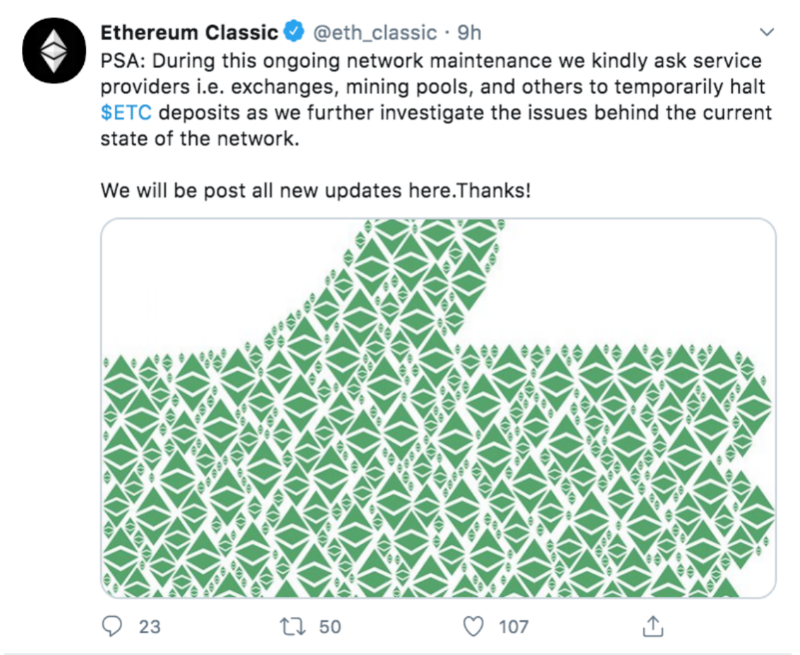
Yesterday, Ethereum Classic (ETC) announced via its official Twitter account that network maintenance was underway, urging service providers including exchanges and mining pools to suspend ETC deposits to further investigate network issues.
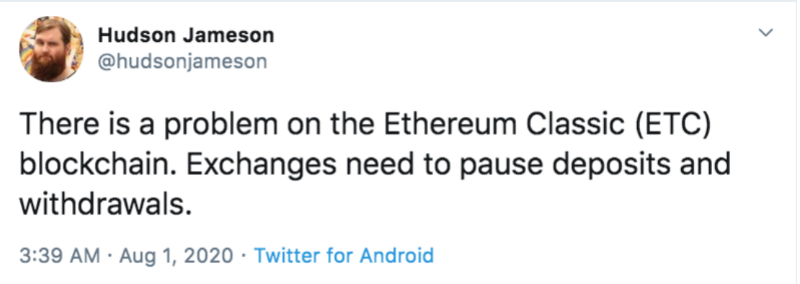
Previously, Hudson Jameson, community manager at the Ethereum Foundation, stated on Twitter that the Ethereum Classic blockchain had encountered problems and recommended exchanges suspend deposits and withdrawals. He also advised miners to cooperate by mining on the same chain and abandoning minority chains until the issue was resolved.
On August 2 Beijing time, Ethereum Classic Labs officially announced on Medium that the ETC network had completed blockchain reorganization and confirmed the issue had been resolved.
Due to an unidentifiable error, OpenEthereum / Parity and Open-ETC ceased normal operations. This error caused temporary and minority chain splits. Going forward, any Ethereum Classic node running OpenEthereum or Open-ETC could potentially mine on an incorrect chain.
Problem Analysis and Event Reconstruction:
The sequence of events unfolded as follows:
1. A malicious miner (ETC address: 0x75d1e5477f1fdaad6e0e3d433ab69b08c482f14e) mined approximately 3,000 blocks.
2. The 2Miners mining pool temporarily went offline for maintenance due to Multi-geth ending support for Ethereum Classic.
3. During this maintenance period, no new blocks were generated by the 2Miners pool. After completing maintenance and reconnecting, about 3,000 blocks were simultaneously inserted into the 2Miners system.
4. Since all Parity or OpenEthereum nodes on Ethereum Classic could not process these 3,693 blocks originating from Core-Geth nodes, a chain split occurred: miners on Parity or OpenEthereum nodes continued mining on the original main chain, whereas miners on Core-Geth nodes began mining on the new chain containing the inserted ~3,000 blocks.
5. According to Proof-of-Work (PoW) consensus rules, the computational work on the new chain gradually surpassed that of the original main chain. Consequently, some miners operating Parity nodes on the original main chain followed the rule of “mining on the chain with more accumulated work” and switched to mining on the new chain.
6. Ultimately, at block height 10,904,146, a total of 3,693 blocks were added to the blockchain through reorganization (reorg). Reorganization is a blockchain feature commonly used for rollback operations.
Was This an Attack?
Whether this constitutes an attack depends primarily on how these ~3,000 blocks were generated. Was it accidental—such as due to a network disconnection during which blocks were mined—or was it intentional?
Based on the current official statement citing an “unknown error,” we cannot yet fully determine the true nature of this incident.
Impact:
In terms of transactions themselves, the impact of this event was minimal because there were very few transactions within these blocks. Additionally, transactions outside these blocks that weren't mined would eventually be resubmitted.
However, regarding the blockchain itself, this incident may have lasting implications. It occurred less than a day after Multi-geth ended support for Ethereum Classic. While this case appears relatively straightforward, if skilled actors were to repeatedly exploit the same method in an organized manner, their intent—to deliberately cause repeated forks—would remain unclear. Moreover, using such methods, malicious attackers could potentially launch a 51% attack to take control of the blockchain, conduct double-spending attacks, or erase existing transactions on the chain.
References:
https://coinfomania.com/the-ethereum-classic-blockchain-etc-51-attack/
https://hashdeploy.com/?p=38898
https://hackmd.io/@cUBb4hAvQciAEPoU2yfrzQ/Skd4X6MZw
https://twitter.com/pool2miners/status/1289475794230587394?s=21
https://github.com/multi-geth/multi-geth/releases/tag/v1.9.18
https://cointelegraph.com/news/ethereum-classic-blockchain-splits-due-to-reorg-by-a-single-miner
Join TechFlow official community to stay tuned
Telegram:https://t.me/TechFlowDaily
X (Twitter):https://x.com/TechFlowPost
X (Twitter) EN:https://x.com/BlockFlow_News






