








Bitcoin surges, gold hits record high—what's behind the scenes?
TechFlow Selected TechFlow Selected
Bitcoin surges, gold hits record high—what's behind the scenes?
Is the Bitcoin bull market here?
 Navigating Web3 tides with focused insights
After much anticipation, Bitcoin has finally reached $11,000, while at the same time precious metals such as gold and silver have also broken historical highs.
"Gold" and "Bitcoin bull market" have successively topped Weibo's trending topics, with popular comments asking: Has the Bitcoin bull market really arrived? Is gold still worth buying?
Yes, it has been one year since Bitcoin last broke above $11,000.
During this year, although Bitcoin experienced a plunge below $4,000 on "March 12," it mostly fluctuated between $9,000 and $10,000 for most of the time, even being jokingly referred to as a "stablecoin."
What exactly caused Bitcoin to soar past $11,000 like an arrow piercing through the clouds? What pushed gold to its highest level in nine years? Peeling back the layers, this article analyzes four key logics behind the surge in Bitcoin and gold:
Is Bitcoin’s definition as currency by a U.S. federal court a reason for the rally?
The wealth effect from DeFi drove Ethereum higher, which in turn stimulated Bitcoin’s price;
Bitcoin benefits from Federal Reserve monetary easing and a weakening U.S. dollar;
Economic stagflation is emerging—asset prices rise while the real economy stagnates.
Has Bitcoin Become American Money?
Recently, a U.S. federal court stated that under Washington state law, Bitcoin is defined as money.
Chief Judge Beryl A. Howell of Washington, D.C., said: "Currency typically means a medium of exchange, a method of payment, or a store of value—and Bitcoin is precisely such a thing."
Some argue this represents official recognition—Bitcoin receiving its legal “ID card”—thus driving up prices.
However, in fact, in most U.S. states, Bitcoin has already been recognized as money (Money) under state laws, requiring financial licenses for related transactions.
"It's not new at all." Cai Kailong, founder of Anrong Global Capital, wrote that the judge in Washington, D.C. merely reiterated what is already common knowledge in the U.S. digital currency industry—that Bitcoin qualifies as money under state law.
This reaffirmation was made in connection with criminal charges against Larry Dean Harmon, operator of an underground Bitcoin trading platform.
Under U.S. federal law, operating a money-related business requires proper licensing. Harmon was accused of running an unlicensed money transfer service and engaging in money laundering. He reportedly argued that Bitcoin is not "money" and his platform does not constitute a "money transmitting business" under U.S. code—an argument that was ultimately rejected.
Many see this ruling as bullish for Bitcoin, but in reality, it could be bearish—indicating continued high-pressure regulation of Bitcoin in the United States.
The U.S. federal court classified Bitcoin as Money, not Currency. Although both are translated as "currency" or "money," Money has a broader meaning, whereas Currency usually refers specifically to circulating legal tender like the U.S. dollar.
Cai Kailong explained that at the federal level, the Federal Reserve holds the greatest authority in defining digital currencies—and the Fed has clearly stated that digital currencies are not real money.
In summary, Bitcoin is money—but not circulating currency.
Thus, the idea that Bitcoin has obtained an official ID is merely wishful thinking by some. This round of Bitcoin’s rise has little to do with recent regulatory developments.
The Wealth Effect from DeFi
What is the real reason behind Bitcoin’s surge?
In the view of industry veterans, the current Bitcoin rally is driven primarily by the wealth effect generated by DeFi tokens.
William, chief researcher at OKEx Research, noted that within the cryptocurrency market, the DeFi narrative has been the main driver of this rally—led by ETH and lifting the entire crypto market including BTC.
DeFi stands for Decentralized Finance. The "liquidity mining" trend led by projects like Compound triggered explosive growth in DeFi tokens, drawing investors with stories of 10x and 100x returns.
Over the past four months, the total value locked (TVL) in DeFi has quadrupled—from $1 billion to $4 billion.
Currently, most DeFi applications are built on the Ethereum blockchain, meaning ETH serves as the entry ticket to DeFi. Most users must lock up Ether to participate in DeFi investments.
According to DeFi Pulse, the amount of ETH locked across DeFi protocols increased by 60% over the past six weeks.
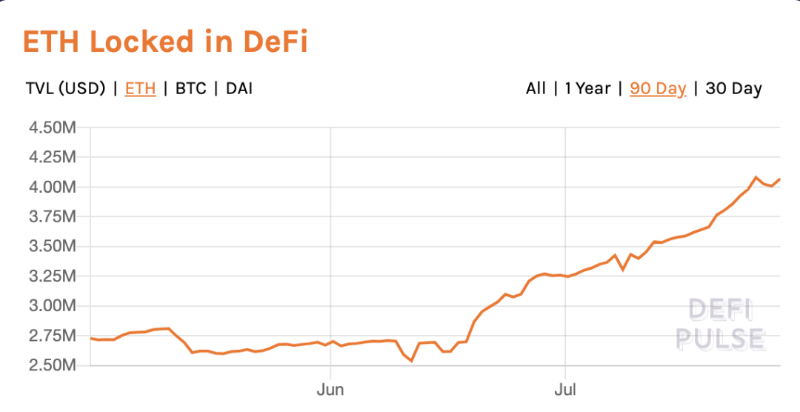
Another non-negligible factor is anticipation around ETH 2.0. Recently, Ethereum co-founder Vitalik Buterin revealed progress toward implementing Phase 1 of ETH 2.0.
In the past week alone, Ethereum surged 35%, while Bitcoin rose 18.7%—with most gains concentrated in the last three days.

To summarize using crypto-market logic: DeFi and ETH 2.0 boosted ETH, which in turn fueled Bitcoin’s rally.
However, according to CoinMarketCap data, Bitcoin dominates 63% of the entire cryptocurrency market, while Ethereum accounts for only 11%. Bitcoin’s market cap is roughly six times that of Ethereum.
“If rising prices alone attract capital without bringing in new participants, then the argument that Ethereum drove Bitcoin’s rally doesn’t hold water.” Some industry insiders have voiced skepticism.
“Orange Book” argues that DeFi remains a niche area, primarily attracting entrepreneurs within the DeFi space and existing DApp traders. High operational and cognitive barriers make it difficult to draw in mainstream users.
Bitcoin’s surge may have been sparked by DeFi—but the true catalyst likely lies beyond the crypto bubble, where capital flows reach into the tens of billions of dollars.
Safe Haven! The U.S. Dollar Enters a Weak Cycle
Beyond Bitcoin, gold, silver, U.S. stocks—all asset prices are rising, hitting new highs.
On July 27, after nine years, international gold prices broke past $1,940, reaching a new historical high. Silver prices also surged sharply, rising over 7% on Monday to close at $24.50 per ounce—the highest in nearly seven years.
The only loser among these assets is their pricing mechanism—the U.S. dollar.
In trader Mike’s view, the weakening U.S. dollar cycle is the true trigger behind rising asset prices.
Before July 28, the U.S. Dollar Index fell for nine consecutive days. After breaking below the 95 threshold, it briefly dropped to 93.47, reaching a two-year low.
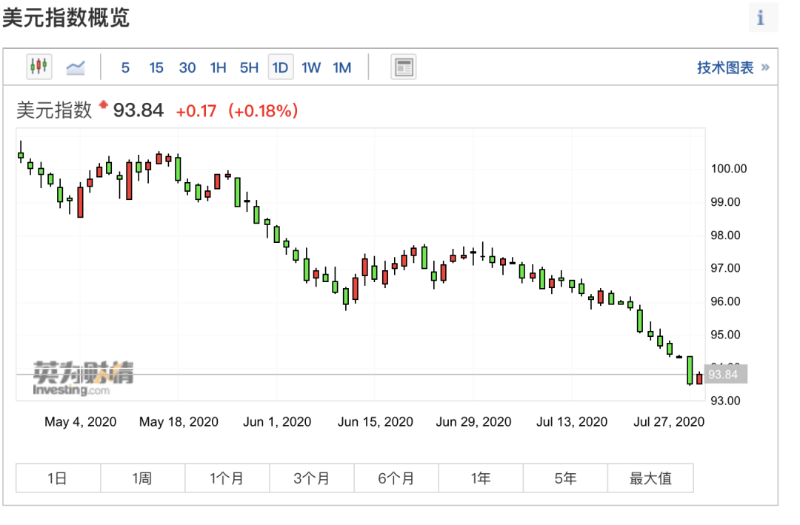
As the dollar falls, gold and Bitcoin rise—driven by growing risk-averse sentiment. Key reasons include:
Worsening global pandemic, with resurgence in U.S. cases;
Deteriorating China-U.S. relations;
Accelerating deglobalization;
U.S. elections increasing uncertainty.
By July 28, cumulative confirmed cases in the U.S. exceeded 4.37 million, with deaths reaching 150,000—adding more than 2,600 cases per hour, the highest in the world.
Undoubtedly, worsening pandemic conditions will drag down the U.S. economy. Investors expect slower recovery compared to other countries, prompting continued dollar selling.
“The dollar is on shaky ground,” said Mazen Issa, senior FX strategist at TD Securities in New York. “Right now, the mindset of dollar weakness is deeply entrenched.”
Beyond external factors, the dollar’s biggest threat comes from within: soaring government debt and continuous monetary easing by the Fed, pushing the dollar into danger and fueling gold’s rally.
History doesn't repeat itself, but it often rhymes!
From December 2008 to June 2011, the Federal Reserve purchased $2.3 trillion in Treasury bonds and kept borrowing costs near zero to support economic growth, helping gold reach a record high of $1,921.17 in September 2011.
Current U.S. federal debt is nearing $26.5 trillion. As the top buyer and "bailout" agent of U.S. debt, the Fed has launched unlimited quantitative easing, printing money at full speed to support bond-buying programs.
Recently, the Fed’s balance sheet slightly contracted—but this signals side effects are appearing, indicating ample liquidity in the market. Yet due to prior massive monetary expansion, worsening pandemic, and prolonged economic slump, funds must seek higher-yielding global investments to avoid depreciation.
Gold has become the preferred safe-haven asset in the eyes of financial institutions.
Jim Reid, top strategist at Deutsche Bank, pointed out that throughout monetary history, fiat currencies have been fleeting, while gold remains the ultimate hedge.
Reid concludes that gold is absolutely a monetary hedge. More importantly, regardless of future monetary systems, gold serves as a transitional asset.
Besides gold, Bitcoin—often called "digital gold"—has also benefited from Fed easing and dollar weakness, and due to its smaller market cap, it's easier to push upward.
"The general public struggles to understand Bitcoin as a new investment vehicle, so it has long been promoted as having safe-haven properties similar to gold, attracting capital inflows and contributing to price increases," William said.
Danger! Signs of Stagflation Emerge
With nearly all asset prices surging, some see golden opportunities for financial freedom. Others see danger: ongoing pandemic, economic stagnation, and even recession.
Why are asset prices continuing to climb? Is this sustainable?
This recalls America’s 1970s dilemma—stagflation!
Stag
Join TechFlow official community to stay tuned
Telegram:https://t.me/TechFlowDaily
X (Twitter):https://x.com/TechFlowPost
X (Twitter) EN:https://x.com/BlockFlow_News






