Dark Forest Under Quantum Computers: A Survival Guide for Bitcoin Users, L1 Projects, and On-Chain Life
TechFlow Selected TechFlow Selected
Dark Forest Under Quantum Computers: A Survival Guide for Bitcoin Users, L1 Projects, and On-Chain Life
Quantum computers are quietly on the rise, and once mature, will launch a fatal attack on Bitcoin and the entire blockchain ecosystem.
 Navigating Web3 tides with focused insights
Author: Chain Revelation
Introduction: Bitcoin's "Dark Forest" Crisis
In the world of blockchain, each node is like a star in the universe—separate yet interconnected, collectively building a decentralized financial system. As the pioneer of this network, Bitcoin relies on powerful cryptographic algorithms to safeguard its security. However, this security framework is not invincible. A technology from the future—quantum computers—is quietly rising. Like the Trisolaran fleet in *The Three-Body Problem*, it possesses the ability for "dimensional reduction attack." Once mature, it will launch a fatal assault on Bitcoin and the entire blockchain ecosystem.
So, if quantum computers crack Bitcoin in the near future, what should we do? Is there still a chance to fight back in this on-chain survival war within the "Dark Forest"?

Chapter One: Bitcoin Will Face a Quantum "Dimensional Reduction Attack"
The most terrifying weapon in *The Three-Body Problem* is not a laser cannon, but "dimensional reduction attack"—a higher-dimensional civilization doesn't fight on the same level; instead, it flattens three-dimensional space into two dimensions. All your defenses, all your fortresses, instantly collapse into a sheet of paper. The mathematical "impossibility" that Bitcoin depends on becomes "easy" in the face of quantum computing.

IBM Quantum System One in Ehningen, Germany. Source: Wikipedia
1.1 Bitcoin’s “Technical Barrier” vs. Quantum Computer’s “Swordholder” Weapon
Bitcoin: 1980s Encryption Standard
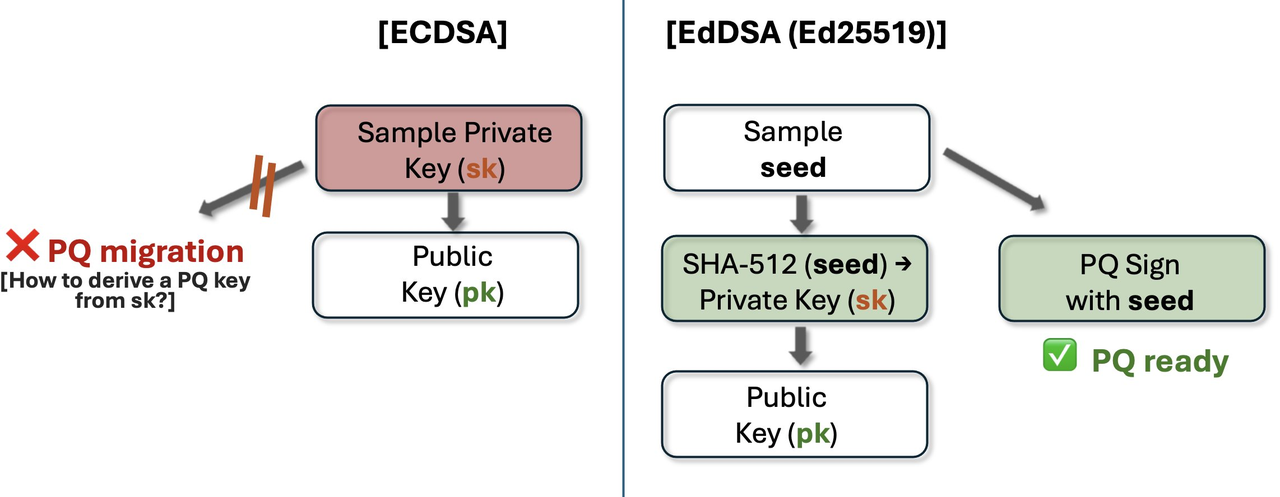
Bitcoin's core security relies on the ECDSA algorithm, a cryptographic standard first proposed in 1985. In this system, every user has a key pair: the private key is the user’s “mind,” known only to themselves; the public key serves as a public “identity,” used to verify transaction legitimacy.
Due to one-way mathematical functions, generating a public key from a private key is easy, but deriving the private key from the public key is nearly impossible under traditional computing power. Since Bitcoin uses 256-bit keys, even with the most powerful classical computers performing brute-force attacks, it would take longer than the age of the universe. It is precisely this mathematical “impossibility” that protects Bitcoin’s network security.
Quantum Computers: The “Swordholder” Technology That Breaks Encryption
Quantum computers are a new type of computing device fundamentally different from classical computers. They leverage quantum phenomena such as superposition and entanglement to perform calculations, achieving theoretically exponential increases in computational power for certain problems.
The emergence of quantum computers changes the rules—through Shor’s algorithm, a sufficiently powerful quantum computer could theoretically derive a private key directly from a public key within a reasonable timeframe. This is akin to the Trisolarans’ “Swordholder” probe, effortlessly piercing through humanity’s strongest defenses. Its attack features include:
-
Stealthiness: After obtaining the private key, attackers can legitimately sign forged transactions, and the entire network will perceive them as normal operations by asset owners. Just like the monitoring by Sophons in *The Three-Body Problem*, it happens completely silently.
-
Selectivity: Wallets whose public keys have already been exposed are most vulnerable, especially addresses used in early Bitcoin transactions. Kapil Dhiman, CEO of Quranium, warns: “Satoshi’s coins will become prime targets. If those coins are moved, confidence in Bitcoin will collapse completely before the system itself fails.”
-
"Steal now, decrypt later": Attackers can copy publicly available data from the blockchain today and wait until quantum computing matures to decrypt it. Even after networks upgrade to more secure algorithms, old addresses, long-dormant wallets, and certain smart contract patterns may remain vulnerable.
1.2 Trust Crisis and Timeline: Over One Million Bitcoins Held by Satoshi
The UK National Cyber Security Centre advises organizations to define their migration path toward quantum-safe cryptography by 2028 and complete the transition around 2035. For blockchain systems designed to last decades, preparation must begin now.
Some early estimates suggest quantum computers might become effective around 2030. This means time is running short for the blockchain industry.
In such a quantum attack scenario, the blockchain itself continues to operate normally—blocks keep being mined, ledgers remain intact—but ownership of assets quietly shifts. This situation is more terrifying than technical failure because it destroys trust in the entire system.
Once over one million bitcoins belonging to Satoshi start moving, markets will panic. Even if the blockchain remains technically secure, prices could plummet, triggering cascading effects across traditional financial markets that have widely adopted cryptocurrencies.
If Bitcoin cannot solve its quantum vulnerability within the next year, gold will permanently outperform Bitcoin. This was stated last month by the founder of Carpriole, a quantitative Bitcoin and digital asset fund, on X.
Part Two: Layer1’s "Wallfacer" Plan
*The Three-Body Problem* features a brilliant concept: when humans discover an alien civilization monitors Earth via "Sophons," all defense plans are preemptively exposed. What then? The United Nations proposes the "Wallfacer Project"—selecting several "Wallfacers" and granting them authority to mobilize global resources, preparing in secret for the coming invasion.

Facing the impending dimensional reduction attack from quantum computing, the blockchain world likewise needs "Wallfacers." The U.S. National Institute of Standards and Technology (NIST) plays this role. From 2022 to 2024, NIST selected and initiated standardization of the first set of post-quantum cryptographic algorithms. These new algorithms resemble interstellar weapons developed in *The Three-Body Problem*: although they come with trade-offs such as larger signature sizes and increased complexity, they offer practical solutions for blockchain systems to resist quantum attacks.
Faced with the same threat, different L1 blockchains have chosen distinct survival strategies.
2.1 Strategy One: Multi-Path Exploration (Wallfacer Experiment)
In *The Three-Body Problem*, Wallfacers can experiment in multiple directions without explaining themselves—because no one knows which path will succeed. Some mainstream blockchain projects adopt a similar approach: simultaneously testing various technical solutions to find the optimal one through practice.
Ethereum: Comprehensive Technical Exploration
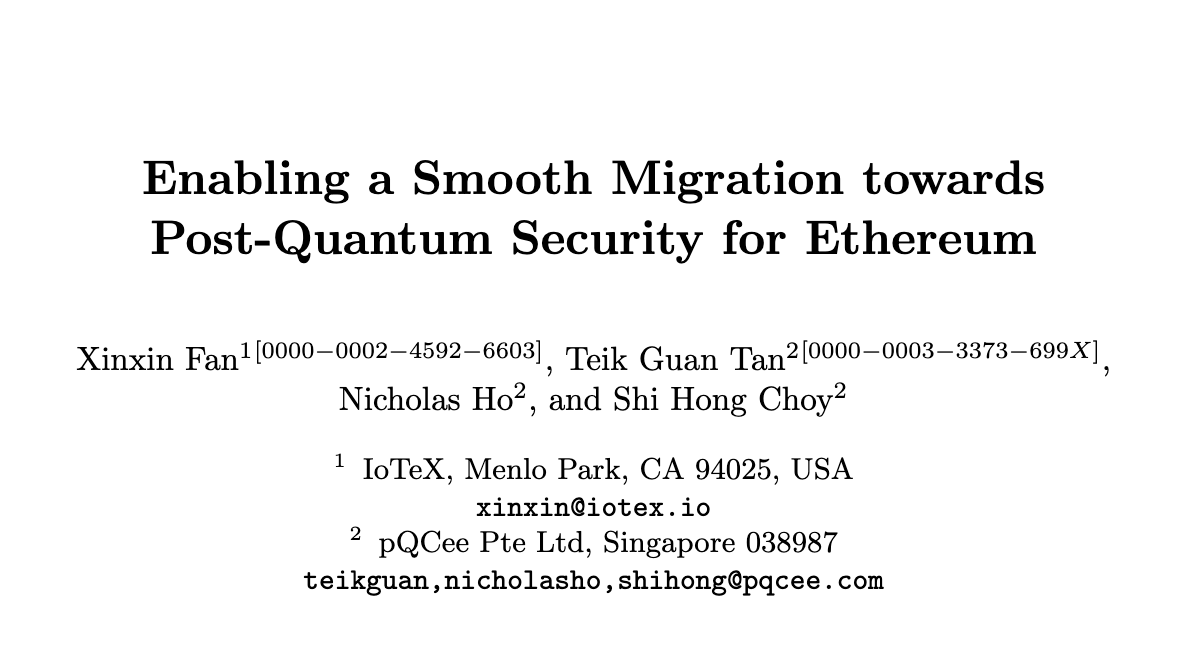
The Ethereum research team is developing a post-quantum migration checklist, including new transaction types, rollup experiments, and zero-knowledge-based wrappers. Rather than betting on a single solution, they advance in multiple directions to identify the most viable and efficient path.
Source:pqcee.github.io
Solana: Optional Quantum-Safe Vaults
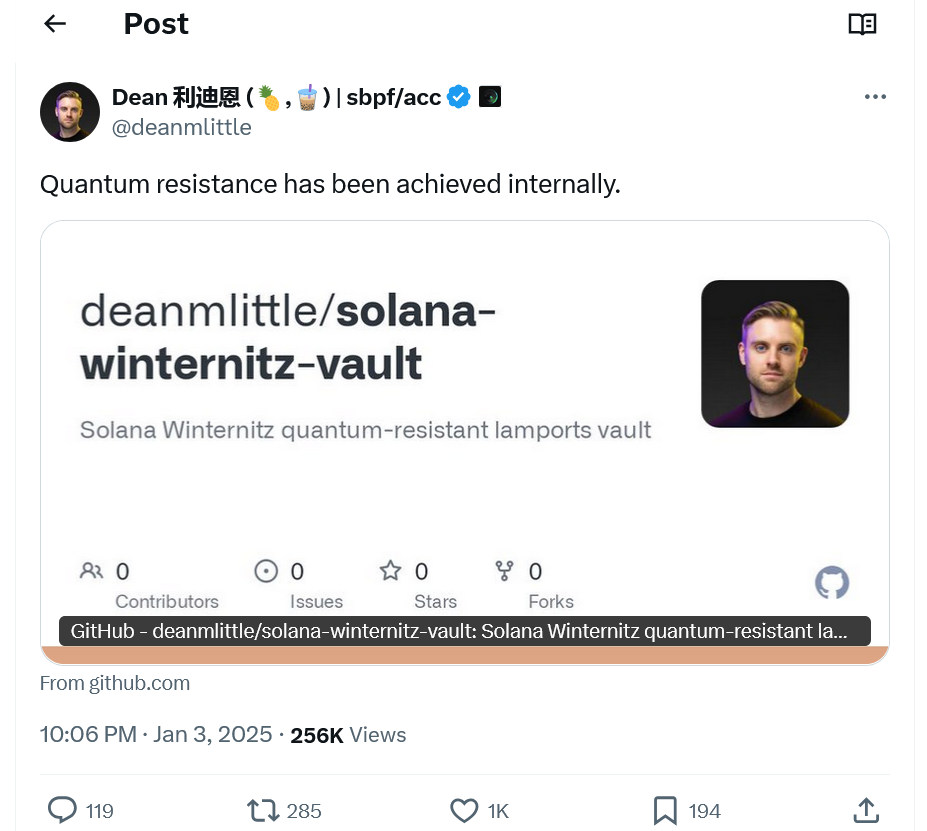
Solana has introduced optional quantum-resistant vaults. Specifically, the "Solana Winternitz Vault" solution implements a complex hash-based signature system that generates new keys with each transaction.
Source: @deanmlittle
Sui: Gradual Upgrade Path
Sui’s research team released a dedicated quantum-safe upgrade roadmap, proposing a non-disruptive hard fork path in collaboration with academic partners. This is a gradual strategy aimed at minimizing impact on existing users.
Source: @kostascrypto
The core of this strategy is "choice": rather than forcing universal upgrades, it offers multiple options, allowing the market and users to decide.
2.2 Strategy Two: Retrofitting the Old World (Mars Base Plan)
The "Mars Base Plan" in *The Three-Body Problem* does not involve rebuilding from scratch but constructing shelters behind gas giants—the old world continues while new defenses are gradually built. Some blockchain projects follow a similar strategy: adding quantum-safe layers atop existing systems, enabling coexistence and gradual migration.
Algorand: Reinforcing Critical Nodes
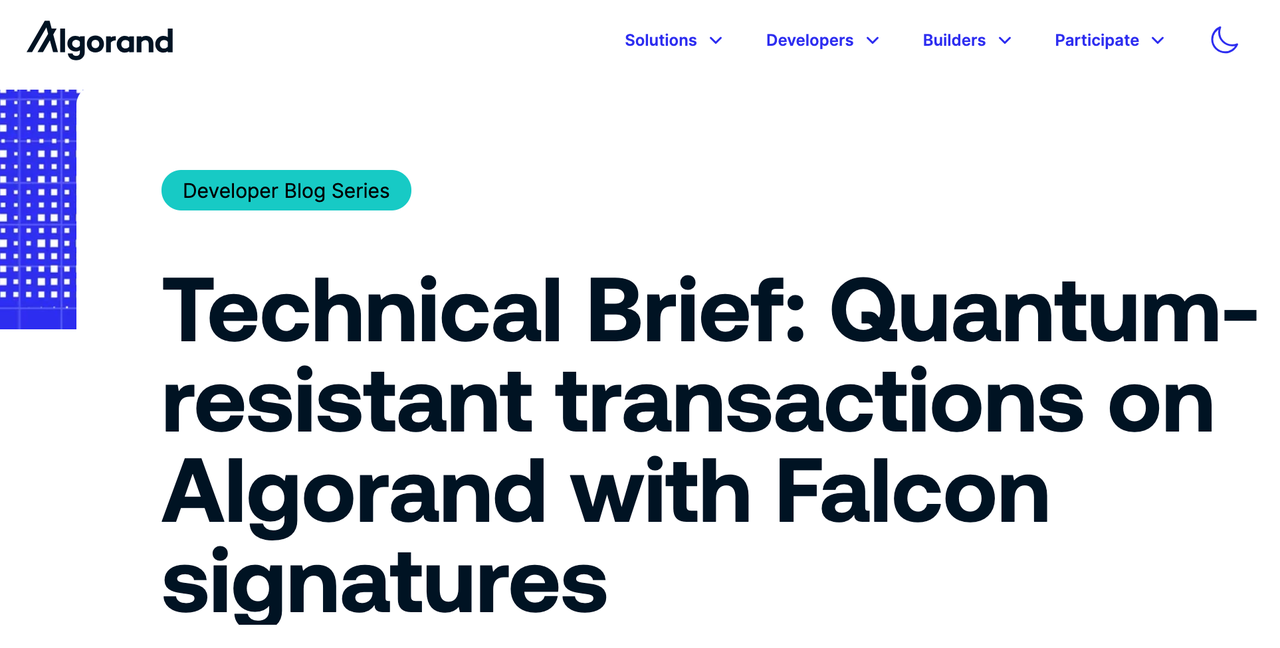
Algorand is a typical example of post-quantum technology applied in production environments. In 2022, it introduced "State Proofs" using FALCON, a lattice-based signature scheme standardized by NIST. These proofs validate Algorand’s ledger state every few hundred blocks, providing quantum-safe verification services for other chains. Recently, Algorand also demonstrated full post-quantum transactions on mainnet, showcasing logical signatures based on Falcon.
Source: Algorand
Cardano: Long-Term Dual-Track Planning
Although Cardano currently still uses Ed25519 signatures, its team views quantum readiness as a long-term competitive advantage. Founder Charles Hoskinson outlined a plan combining independent proof chains, Mithril certificates, and NIST-compliant post-quantum signatures.
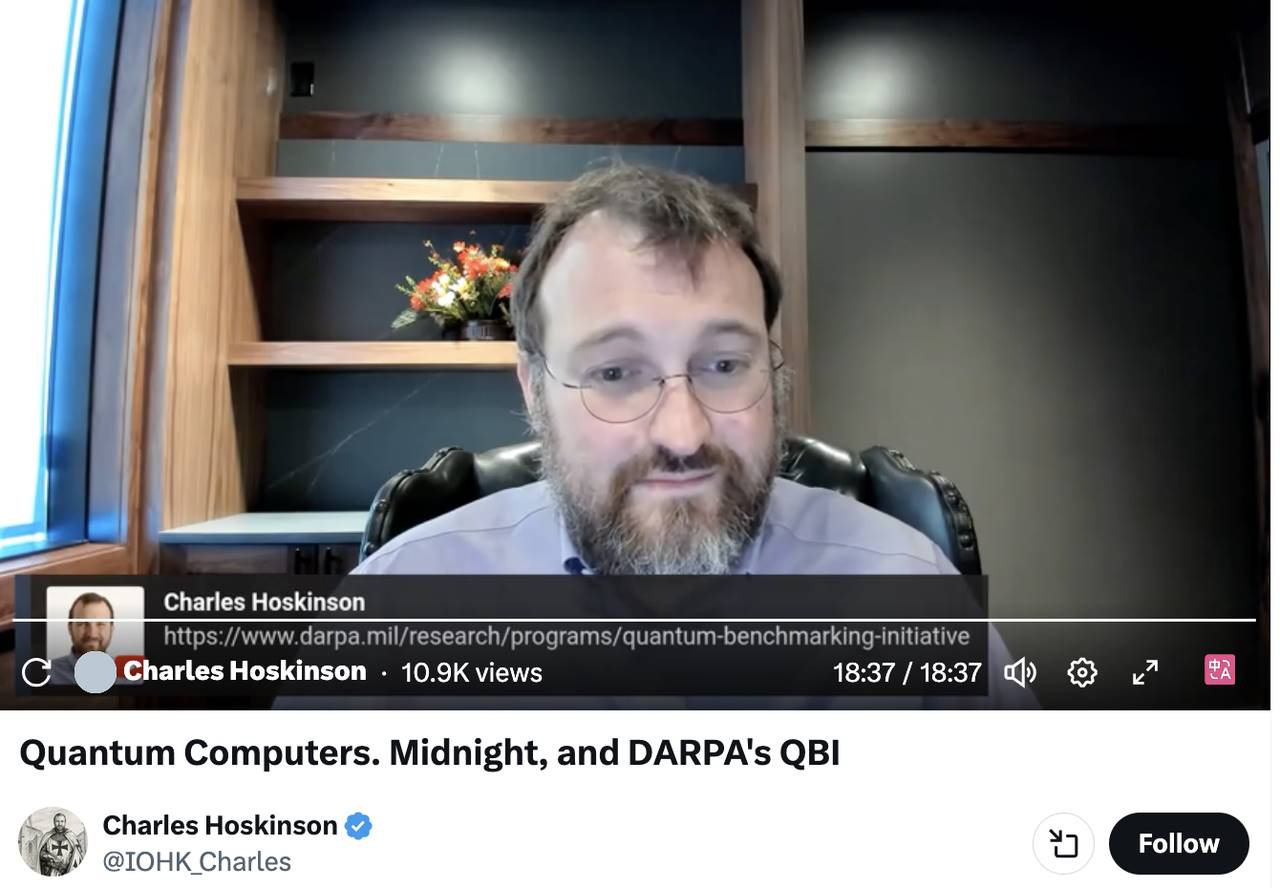
Source: @IOHK_Charles
2.3 Strategy Three: Building a New World (Star Ring City)
Toward the end of *The Three-Body Problem*, humanity stops trying to defend Earth and instead builds entirely new civilizations in space—free of historical baggage, compromise, and designed from the first brick for the new environment. Some new blockchain projects have chosen this path: building fully quantum-resistant systems from scratch.
-
Naoris Protocol: Mentioned in a filing submitted to the U.S. Securities and Exchange Commission, focused on post-quantum infrastructure.
-
Quranium: Uses NIST-approved stateless hash-based digital signature algorithm (SPHINCS+), designed at the protocol level for the quantum era.
-
Quantum Resistant Ledger (QRL): Launched in 2018, built on hash-based XMSS signatures, one of the earliest quantum-resistant blockchains.
These projects don’t need to worry about backward compatibility, migrating legacy users, or balancing performance against security. They establish colonies directly in the "new universe," awaiting the arrival of the quantum age.
Part Three: The Dark Forest Law—Everyone Must Choose

3.1 Individual User Response Strategies
Avoid long-term dormancy: Regularly check and update wallets to avoid becoming a prime target for quantum attacks.
Prepare for key upgrades: In the coming years, expect new account types, hybrid signature options, and wallet prompts encouraging users to upgrade keys for high-value assets.
Focus on cryptographic agility: Choose ecosystems capable of adding and rotating cryptographic primitives without disruptive hard forks.
3.2 Investor Due Diligence
Transparency in roadmaps: Does the project have a clearly documented post-quantum roadmap?
Actual implementation: Are there prototypes or working features, or is it just marketing?
Timeline planning: Has the project started preparing for quantum threats expected in the 2030s?
Conclusion: Granting Time for On-Chain Evolution
In *The Three-Body Problem*, the "Swordholder" alone decides humanity’s fate, but the blockchain world has no such figure. Each project explores its own path. Which solution will work? No one knows. Yet this is the resilience of decentralization—no single point of failure, no single answer.
The threat of quantum computing is not an endpoint, but a beginning. Blockchain may not preserve all of its past, but as long as its core principles endure—decentralization, censorship resistance, trustlessness—civilization will continue.
Grant time to civilization, grant time to on-chain evolution—only the prepared civilizations will enter the next dimension.
Join TechFlow official community to stay tuned
Telegram:https://t.me/TechFlowDaily
X (Twitter):https://x.com/TechFlowPost
X (Twitter) EN:https://x.com/BlockFlow_News