Multicoin Capital: Why are we bullish on Ethena in the long term?
TechFlow Selected TechFlow Selected
Multicoin Capital: Why are we bullish on Ethena in the long term?
Stablecoins represent the largest potential market in the crypto space, and yield is the final challenge.
 Navigating Web3 tides with focused insights
Author: Vishal Kankani, Multicoin Capital
Translation: AididiaoJP, Foresight News
Our Multicoin liquidity fund has invested in ENA, the native token of the Ethena protocol. The Ethena protocol is the leading issuer of synthetic dollar USDe.
In our article "The Endgame for Stablecoins," we articulated that stablecoins represent the largest potential market in crypto, and yield is the final challenge. While we were correct in identifying "yield-bearing stablecoins" as a key direction, we underestimated the scale of the synthetic dollar market.
We divide the stablecoin category into two parts:
-
Yield-sharing
-
No yield-sharing
Yield-sharing stablecoins can be further divided into two categories:
-
Fully backed 1:1 by government-supported treasury assets
-
Synthetic dollars
Synthetic dollars are not fully backed by government-supported treasury assets; instead, they aim to generate yield and create stability by executing neutral trading strategies in financial markets.
Ethena is a decentralized protocol and the operator of the largest synthetic dollar, USDe.
Ethena aims to provide a stable alternative to traditional stablecoins like USDC and USDT, whose reserves earn roughly the short-term U.S. Treasury yield. In contrast, USDe's reserves generate yield through one of the largest and most mature strategies in traditional finance: basis trading.
The basis trade in U.S. Treasury futures alone represents a market worth hundreds of billions, if not trillions, of dollars. Today, only qualified investors and institutional buyers with the necessary infrastructure have access to large-scale basis trading. Cryptography is rebuilding the financial system from scratch, tokenizing opportunities so everyone can access them.
We've been conceptualizing a synthetic dollar built on basis trading for years. As early as 2021, we published an article outlining this opportunity and announced our investment in UXD Protocol, the first token fully backed by basis trades.
While UXD Protocol was ahead of its time, we believe Guy Young, founder and CEO of Ethena Labs, has exceptionally well executed this vision. Today, Ethena has become the largest synthetic dollar, growing circulation to $15 billion within two years of launch, later pulling back to around $8 billion after the market purge on October 10. It is now the third-largest digital dollar overall, behind only USDC and USDT.
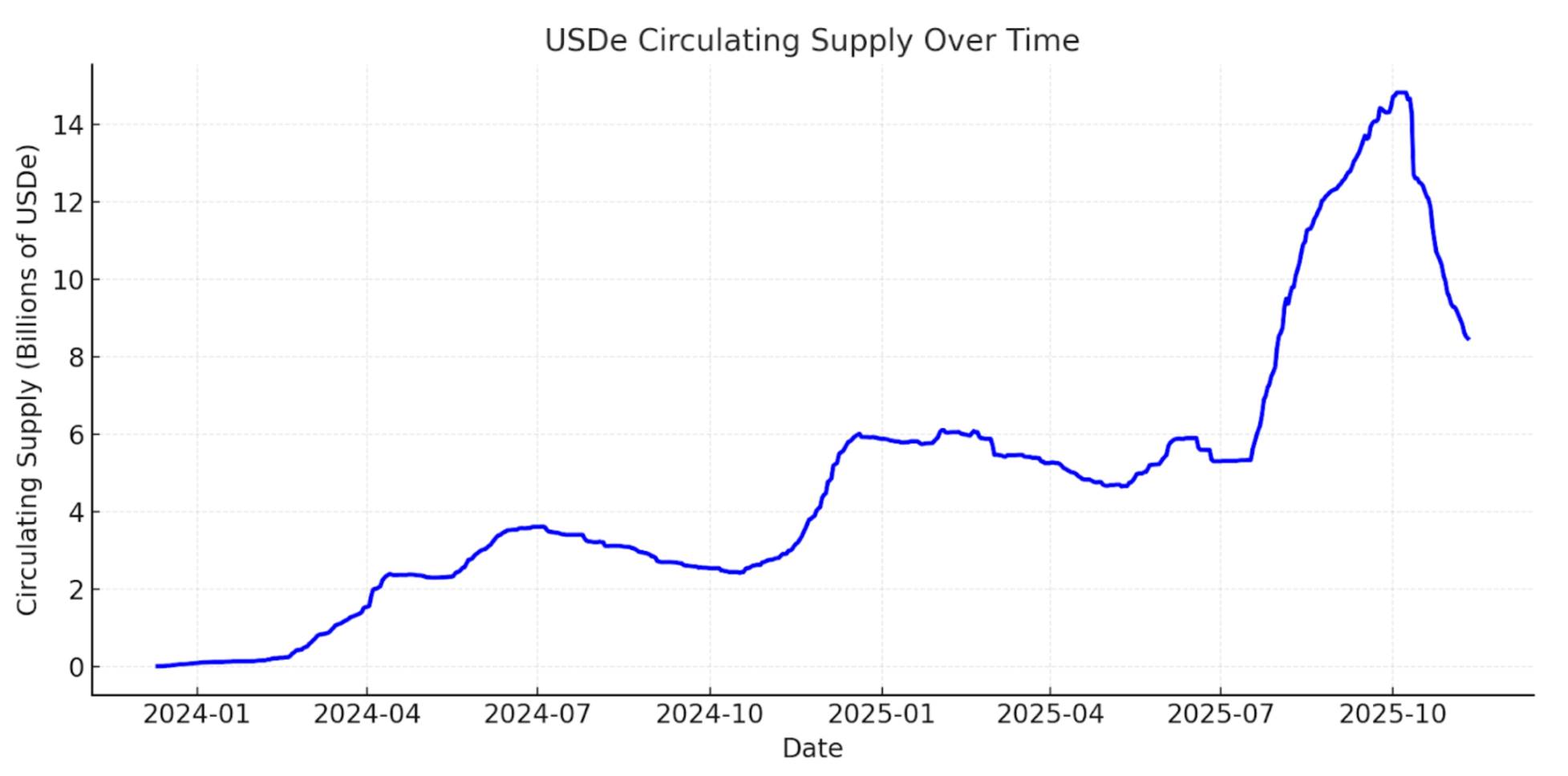
USDe Circulating Supply Over Time - DefiLlama
Structural Tailwinds for Synthetic Dollars
Ethena sits at the intersection of three powerful trends reshaping modern finance: stablecoins, perpetuals, and tokenization.
Stablecoins
There are currently over $300 billion in circulating stablecoins, and this number is expected to grow into the trillions over the next decade. For nearly ten years, USDT and USDC have dominated the stablecoin market, together accounting for more than 80% of total supply. Neither directly shares yield with holders, but we believe that over time, sharing yield with users will become the norm rather than the exception.
We believe stablecoins compete and differentiate along three key vectors: distribution, liquidity, and yield.
Tether has built exceptional liquidity and a global distribution network for USDT. It serves as the primary quote asset in crypto trading and is the most widely used method for emerging markets to access digital dollars.
Circle focuses on gaining distribution by sharing economic benefits with partners like Coinbase—a strategy effective for growth but which puts pressure on Circle’s margins. As crypto adoption accelerates, we expect more companies with strong distribution networks in finance and technology to issue their own stablecoins, further commoditizing treasury-backed stablecoins.
For new entrants in the digital dollar space, the primary way to stand out has historically been offering higher yields. In recent years, momentum has grown around the narrative of yield-bearing stablecoins. However, treasury-backed stablecoins have failed to offer sufficient yield to drive meaningful adoption within crypto. This is because the opportunity cost of crypto-native capital has historically been higher than U.S. Treasury yields.
Among new entrants, Ethena is the only project that has achieved meaningful distribution and liquidity, largely due to offering higher yields. Based on price changes of sUSDe since launch, we estimate its annualized yield slightly above 10%—more than double that of treasury-backed stablecoins. It achieves this by leveraging basis trading, a strategy that monetizes market demand for leverage. Since launch, the protocol has generated nearly $600 million in revenue, with over $450 million generated in the past twelve months alone.
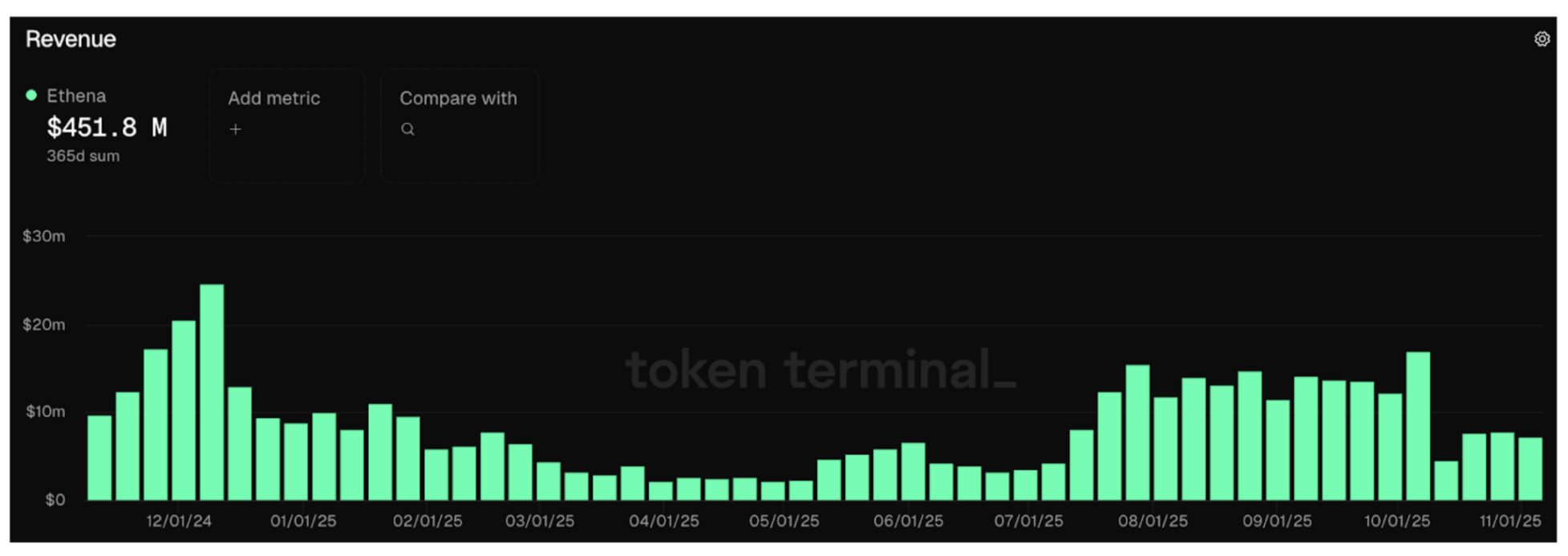
Ethena Token Terminal
We believe the true test of a synthetic dollar's adoption is whether it is accepted as collateral by major exchanges. Ethena has excelled at integrating USDe as core collateral on major centralized exchanges like Binance and Bybit, a key driver of its rapid growth.
Another unique aspect of Ethena’s strategy is its slight negative correlation with the federal funds rate. Unlike treasury-backed stablecoins, Ethena is expected to benefit when interest rates decline, as lower rates stimulate economic activity, increase demand for leverage, lead to higher funding rates, and strengthen the basis trades underpinning Ethena’s yield. We saw a version of this in 2021, when the spread between funding rates and Treasury yields widened to over 10%.
To be sure, as crypto integrates further with traditional financial markets, more capital will flow into the same basis trades, narrowing the spread between basis trading returns and the federal funds rate—but this convergence will take years.
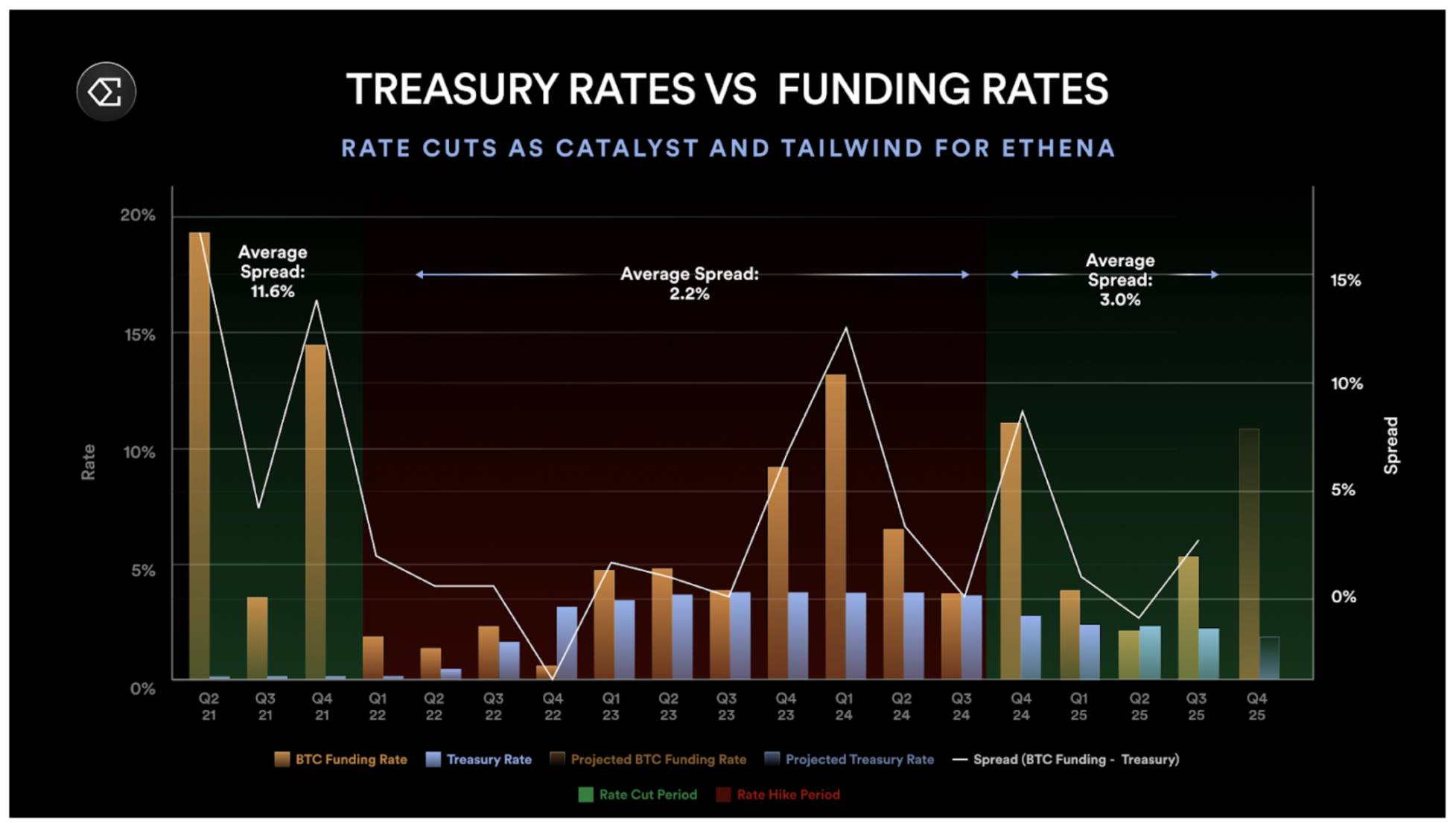
Treasury Yield vs Funding Rate
Finally, JPMorgan predicts that yield-bearing stablecoins could capture up to 50% of the stablecoin market in the coming years. With the total stablecoin market expected to soar into the trillions, we believe Ethena is well-positioned to be a major player in this shift.
Perpetualization
Perpetual futures have achieved strong product-market fit in crypto. In the approximately $4 trillion crypto asset class, perpetual contracts see over $100 billion in daily trading volume and more than $100 billion in open interest across CEXs and DEXs. They provide investors with an elegant way to gain leveraged exposure to underlying asset price movements. We believe over time, more asset classes will adopt perpetual contracts—what we call “perpetualization.”
A common question about Ethena is the size of its potential market, given that its strategy is limited by the open interest in perpetual markets. We agree this is a reasonable constraint in the short term, but believe it underestimates the medium- to long-term opportunity.
Perpetual Contracts on Tokenized Equities
The global stock market is worth about $100 trillion—nearly 25 times the size of the entire crypto market. The U.S. stock market alone is worth about $60 trillion. Like in crypto, participants in the stock market have strong demand for leverage. This is evident in the explosive growth of 0DTE options, primarily traded by retail investors and accounting for over 50% of SPX option volume. Retail clearly wants leveraged exposure to underlying assets—an appetite that can be directly met by perpetual contracts on tokenized equities.
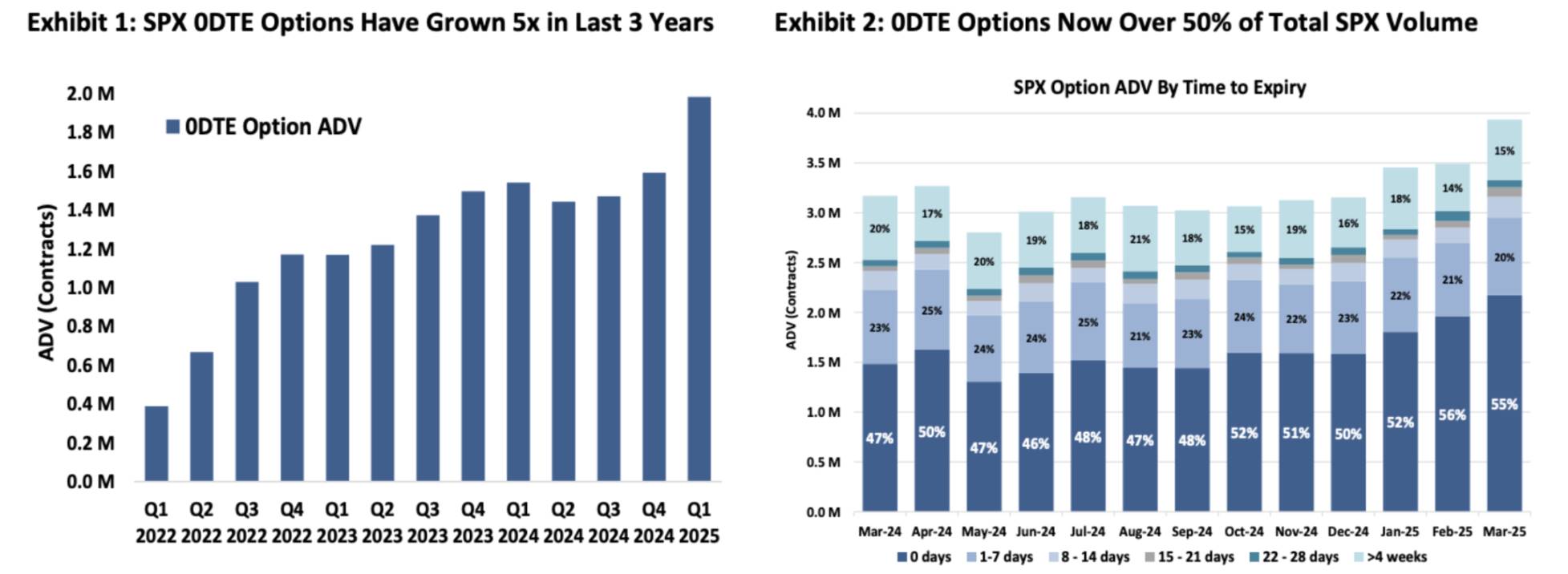
SPX ODTE Options
For most investors, perpetual contracts are easier to understand than options. A product offering 5x exposure to an underlying is far simpler than understanding Theta, Vega, and Delta in options, which require deep knowledge of pricing models. We don’t expect perpetuals to replace the 0DTE options market, but they may capture significant share.
Translator’s note: Theta, Vega, and Delta measure how option prices fluctuate with different factors. Delta measures sensitivity to underlying price changes; Vega measures sensitivity to volatility.
As equities become tokenized, perpetual contracts on stocks unlock a vastly larger opportunity for Ethena. We believe this positions Ethena as a valuable source of liquidity for bootstrapping new markets—benefiting both CEXs and DEXs, and allowing internal capture by building a DEX for stock perpetuals under the Ethena brand. Given the stock market’s size relative to crypto, these developments could expand basis trading capacity by several orders of magnitude.
Net New Distribution from FinTech Companies Integrating Decentralized Perpetual Exchanges
When we first published our paper on a decentralized digital dollar backed by basis trading, decentralized derivatives exchanges were still in early stages—illiquid and not ready for mainstream use. Since then, stablecoins have gone mainstream, and low-cost, high-throughput chains have been battle-tested. Today, platforms like Hyperliquid facilitate around $40 billion in daily decentralized perpetual volume, with $15 billion in open interest.
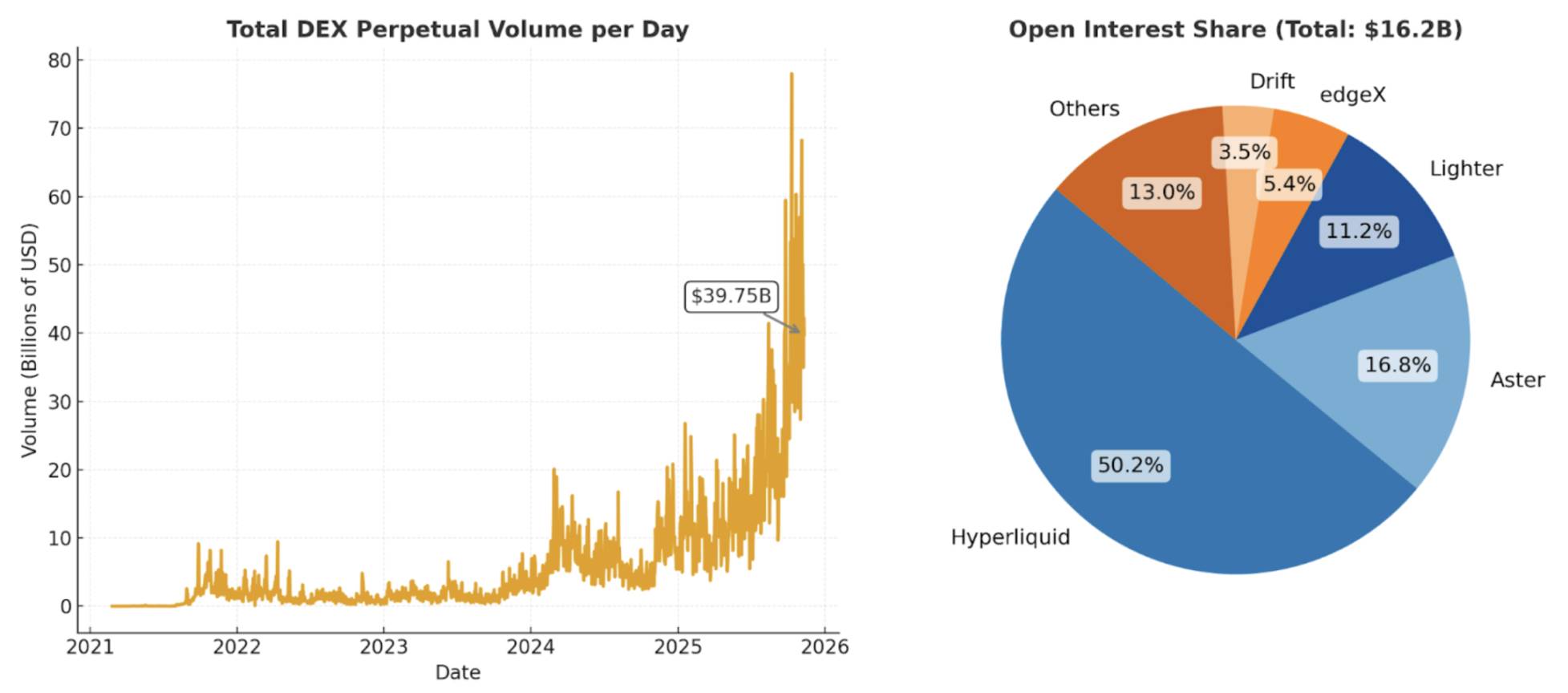
Daily DEX Perpetual Trading Volume
As crypto regulation becomes more favorable, fintech companies worldwide should increasingly embrace crypto. Leading players like Robinhood and Coinbase have already evolved into “full-service exchanges.” Many have already integrated DeFi middleware to support spot trading of long-tail assets not listed on their platforms.
Today, most non-crypto-native users have access to only a limited set of crypto assets, and only in spot form. We believe this group represents massive untapped demand for leverage. As decentralized perpetual exchanges go mainstream, it’s natural to expect fintech companies to integrate these products directly.
For example, Phantom recently integrated with decentralized perpetual exchange Hyperliquid, allowing users to trade perpetuals directly from their Phantom wallet. This integration added approximately $30 million in annualized revenue. If you’re a fintech founder seeing this, it’s hard not to want to follow suit. For instance, Robinhood recently announced its investment in decentralized perpetual exchange Lighter.
We believe as fintech companies adopt crypto perpetuals, they will create a new distribution channel for these products, driving higher volumes and open interest, thereby expanding the capacity and scalability of the basis trades supporting Ethena.
Tokenization
Crypto’s superpower lies in enabling anyone to seamlessly issue and trade tokens. Tokens can represent anything of value—from stablecoins and L1 assets to meme coins and even tokenized strategies.
In traditional finance, the closest equivalent to tokenization is ETFs. Today, there are more ETFs in the U.S. than individual publicly listed stocks. ETFs package complex strategies into a single, tradable ticker that investors can easily buy, sell, or hold—without worrying about execution or rebalancing. All complexity is handled by the ETF issuer behind the scenes. Unsurprisingly, BlackRock, the world’s largest ETF issuer, appears fully committed to tokenization.
Tokenization goes beyond ETFs, enabling faster, cheaper, and easier ownership and trading of assets at any scale, while improving distribution and capital efficiency. Anyone with internet access can instantly buy, sell, send, or receive tokens—and even stake them as collateral to unlock additional liquidity. We envision a future where fintech companies worldwide become primary distributors of tokenized strategies, bringing institutional-grade products directly to global consumers.
Ethena began by tokenizing basis trading, but nothing prevents it from diversifying its yield sources over time. In fact, it’s already doing so today. When basis trades offer low or negative returns, Ethena can shift part of its collateral into another product within its ecosystem, USDtb (a stablecoin backed by BlackRock’s tokenized treasury fund BUIDL), to maintain stability and optimize yield.
Why Invest in ENA?
While we’ve outlined bullish reasons for Ethena’s long-term market potential, it’s also important to understand more about the team and protocol characteristics—especially regarding risk management, value capture, and future growth opportunities.
Team
"I quit my job days after Luna collapsed to build Ethena, and assembled the team months after the FTX incident," said Ethena founder Guy Young.
In our experience, Guy has proven to be one of the sharpest and most strategic thinkers in DeFi, bringing his investing experience from Cerberus Capital to a crypto market undergoing rapid financialization.
Guy’s success is supported by a lean and experienced operational team of about 25 people. Among Ethena team members: Ethena’s CTO Alex Nimmo was one of BitMEX’s earliest employees and helped build and scale perpetual futures into the most important financial instrument in crypto. Ethena’s COO Elliot Parker previously worked at Paradigm Markets and Deribit; his connections with market makers and exchanges contributed to Ethena’s successful integrations with these counterparties today.
The results speak for themselves. Ethena became the largest synthetic dollar in less than two years. During this time, the team moved quickly—integrating with top centralized exchanges and establishing hedging channels that most projects take years to develop. USDe is now accepted as collateral on major venues like Binance and Bybit. Many of these exchanges are also Ethena investors, demonstrating clear strategic alignment between the protocol and key players in the global crypto market.
Risk Management
My partners Spencer and Kyle wrote an article in 2021 titled “DeFi Protocols Don’t Capture Value, DAOs Manage Risk.” The core argument is simple: DeFi protocols that don’t manage risk and attempt to charge fees will be forked, and there will always be a free version. Meanwhile, protocols that inherently manage risk must charge fees, or no one will support the system.
Ethena best embodies this principle. The protocol has demonstrated strong risk management, successfully navigating two major stress events this year—each enhancing its credibility, resilience, and brand trust within the crypto ecosystem.
Bybit Hack: The Largest Crypto Hack to Date
The $1.4 billion hot wallet hack at Bybit on February 21, 2025, served as a real-world stress test for Ethena’s exchange counterparty model. The event triggered a massive withdrawal wave from Bybit, yet Ethena’s strategy remained unaffected.
Because hedging positions and collateral were diversified across multiple venues and protected via external custodianship, Ethena operated normally throughout the incident. Importantly, no Ethena collateral was lost, and there was no disruption to minting or redemption flows due to the Bybit event.
October 10 Sell-off: The Largest Single-Day Liquidation Event in Crypto History
On October 10, 2025, the crypto market experienced an extreme deleveraging event, with around $20 billion in positions liquidated within hours as open interest on major CEXs and DEXs collapsed. During the cascade, due to Binance’s oracle design, USDe briefly traded as low as ~$0.65 on Binance, drawing criticism. However, USDe remained close to par on more liquid on-chain venues like Curve (see chart below), and redemptions continued functioning normally—indicating a venue-specific mispricing, not systemic depegging. Guy’s post on X is excellent reading for understanding the October 10 event.
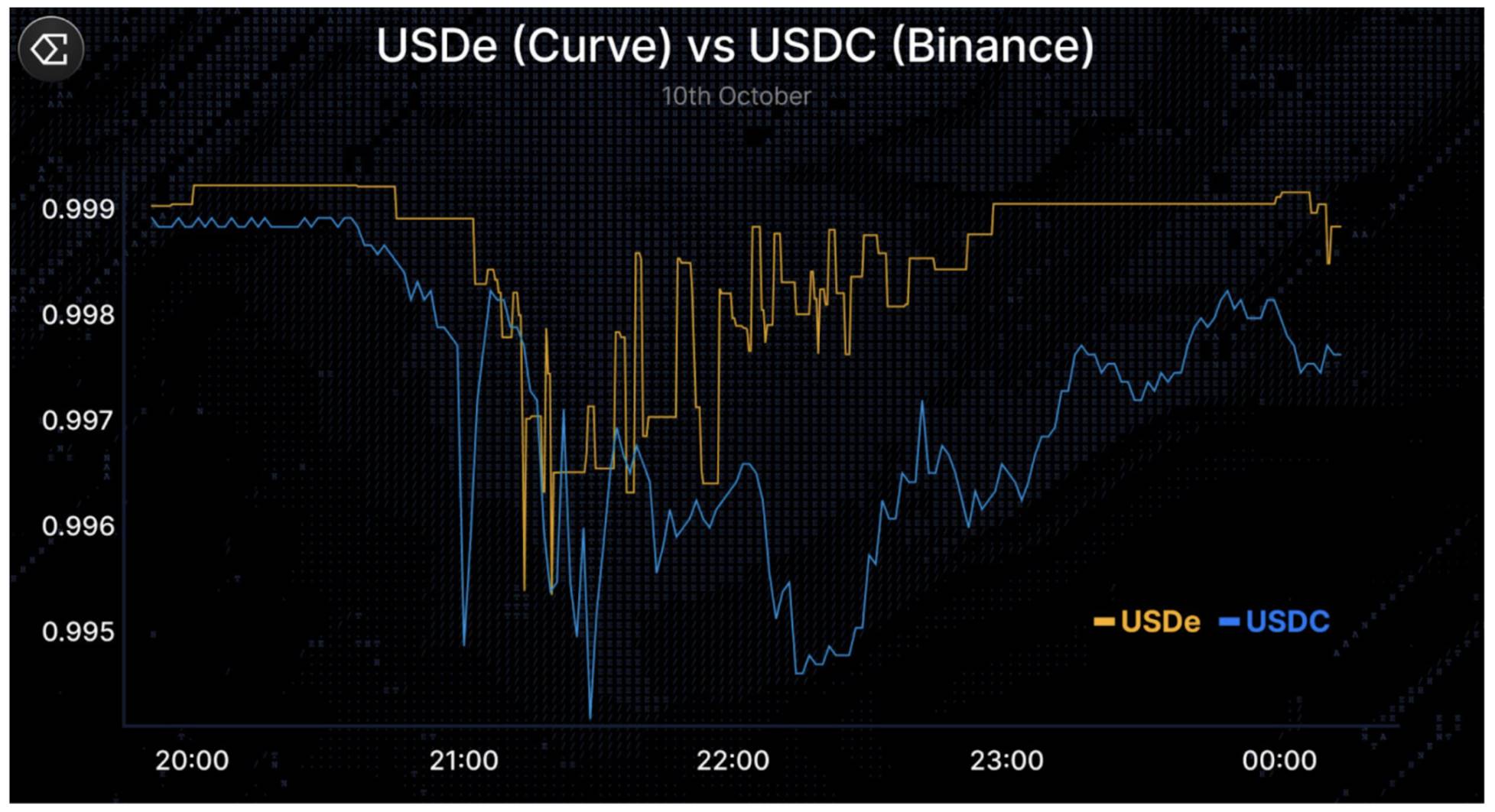
USDe (Curve) vs USDC (Binance)
In both incidents, the Ethena team communicated transparently and no user funds were lost. Meanwhile, the protocol continued operating normally, processing nine-figure redemptions within hours—all verifiable on-chain. Moments like these test any protocol’s risk discipline. Successfully managing such large-scale stress events builds trust, credibility, and brand value—creating a strong moat for DeFi protocols like Ethena.
To be clear, it’s reasonable to expect Ethena will face more stress tests in the coming years. We’re not suggesting risks don’t exist or are fully mitigated, but rather emphasizing Ethena’s strong performance and resilience during some of the most significant market stress events in recent memory.
Value Capture
We believe Ethena can sustain higher fee rates than stablecoins like USDC. Unlike USDC, Ethena actively manages market risk, typically shares higher yields with users, and may exhibit negative correlation with interest rates in the medium term—all strengthening its ability to capture and retain long-term value.
While the ENA token currently functions primarily as a governance token, we believe there is a clear path for it to begin accruing value. Ethena generated approximately $450 million in revenue over the past year, none of which has been passed to ENA token holders.
A fee switch proposal introduced in November 2024 outlined several milestones that need to be met before value can flow to ENA holders. All conditions were satisfied prior to the October 10 crash. Currently, the only metric below target is USDe’s circulating supply, which we expect to exceed $10 billion before fee switch activation. The risk committee and community are currently reviewing implementation details for the fee switch.
We assess that these developments will likely be favorably received by public markets, as they strengthen Ethena’s governance alignment, long-term holder base, and reduce selling pressure on the token.
Long-Term Growth Potential
On its own, Ethena is already one of the highest-revenue protocols in crypto.
Ethena is leveraging its leadership position to launch a series of new product lines built upon its core strengths in stablecoin issuance and expertise in crypto perpetual exchanges. These include:
-
Ethena Whitelabel: A stablecoin-as-a-service product where Ethena builds stablecoins for the largest chains and applications. Ethena has already launched Ethena Whitelabel in collaboration with megaETH, Jupiter, Sui, and others via SUIG.
-
HyENA and Ethereal: Two third-party perpetual DEXs built on USDe collateral, driving USDe utility while funneling trading fee revenue back into the Ethena ecosystem. Both are built by external parties but directly return value to Ethena.
These potential product lines could further solidify Ethena’s leadership in the synthetic dollar space.
All net new product lines built atop Ethena should entitle it to the resulting economic benefits, coexisting alongside its already strong revenue figures.
Why We Are Long-Term Bullish on Ethena
Ethena has carved out a unique niche in the broader stablecoin market—long dominated by Tether and Circle—emerging as the clear market leader in the synthetic dollar category.
With the surge in stablecoins, tokenization of traditional assets, and rise of perpetual DEXs, we believe Ethena is uniquely positioned to capture these tailwinds, transforming global demand for leverage into attractive, accessible yield for its users and fintech companies worldwide.
The protocol’s strong risk management culture has been tested in real-world stress scenarios and has consistently delivered, helping Ethena build deep trust and credibility among users and partners.
In the long run, Ethena can leverage its scale, brand, and infrastructure to expand into other products, diversify revenue, and enhance resilience against market shocks.
As the fastest-growing synthetic dollar in the fastest-growing category of yield-bearing stablecoins, Ethena is well-positioned to incubate new business lines, adding further growth potential to its already highly profitable businesses in crypto’s most lucrative sectors—exchanges and on/off ramps—while simultaneously growing USDe supply.
The opportunity ahead is enormous, and as long-term holders of ENA, we are excited.
Join TechFlow official community to stay tuned
Telegram:https://t.me/TechFlowDaily
X (Twitter):https://x.com/TechFlowPost
X (Twitter) EN:https://x.com/BlockFlow_News
 Multicoin Capital