

From 0 to $12.4 billion in a blitz: How did Ethena build the fastest-growing "money printer" in history?
TechFlow Selected TechFlow Selected
From 0 to $12.4 billion in a blitz: How did Ethena build the fastest-growing "money printer" in history?
Ethena shows no signs of slowing down.
 Navigating Web3 tides with focused insights
Written by: thetokendispatch
Translated by: Baicai Blockchain
A crypto protocol launched just 18 months ago, USDe, has already reached a circulating market cap of $12.4 billion, setting the fastest growth record in the history of digital dollars. By comparison, USDT didn't reach $12 billion until mid-2020 (after years of gradual growth), and USDC only surpassed $10 billion in March 2021. Ethena's USDe appears to have completed a high-speed sprint in the financial赛道.
How did they achieve this speed? What risks lie beneath? Is this model sustainable, or is it just another Terra (Luna) waiting to collapse?
The World’s Largest Carry Trade
Ethena has found a way to turn the crypto market’s endless appetite for leverage into a money-making machine. Simply put: hold crypto assets while simultaneously hedging with an equivalent short position in the futures market, profiting from the spread. This creates a stable synthetic dollar while also earning yield from crypto’s most reliable “money printer.”
How exactly does it work?
When someone wants to mint USDe, they must deposit crypto assets like Ethereum (ETH) or Bitcoin. But instead of simply holding these volatile assets, Ethena immediately opens an equivalent short position on perpetual futures exchanges.
-
If ETH rises by $100, the spot holding gains $100, but the short position loses $100.
-
If ETH drops by $500, the spot holding loses $500, but the short position gains $500.
The result? The dollar value remains stable regardless of price movements. This is known as a "delta neutral" strategy—no large profits or losses from price volatility.
So where do the 12–20% returns come from? Three sources:
-
Staking yield: Ethena stakes deposited ETH to earn approximately 3–4% annual staking rewards.
-
Funding rates: They collect funding fees through their short positions. In the crypto perpetual futures market, traders pay funding every 8 hours to maintain positions. When bullish sentiment dominates (about 85% of the time), longs pay shorts. Ethena always takes the short side, collecting these fees. In 2024, Bitcoin’s average funding rate was 11%, and Ethereum’s was 12.6%—real cash flow.
-
Reserve asset yields: Ethena holds cash equivalents and treasury products such as loyalty rewards from USDC or BlackRock’s BUIDL fund, generating additional returns.
In 2024, these sources delivered an average 19% annualized yield to sUSDe holders. Over recent years, crypto funding rates have averaged 8–11%, combined with staking and other income, making USDe’s returns compelling enough to sleep well at night. Isn’t this what we’ve all been chasing?
Image source: ethena.fi
Four Tokens Powering the Ethena Ecosystem
The Ethena ecosystem is supported by four distinct tokens, each serving different functions:
USDe: A synthetic dollar designed to maintain a stable value of $1 through delta-neutral hedging. It does not generate yield unless staked, and only whitelisted participants can mint or redeem it.
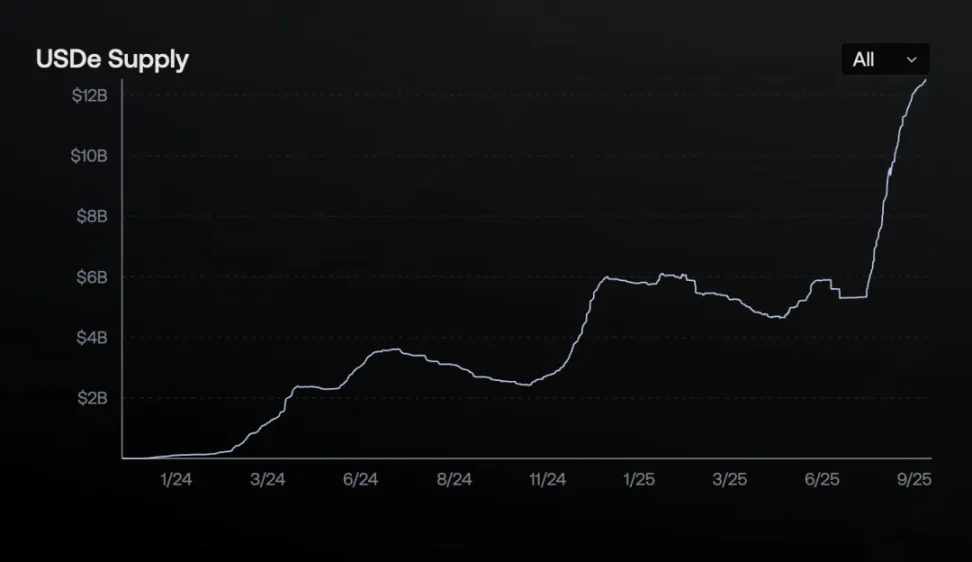
Image source: ethena.fi/
sUSDe: A yield-bearing token received after staking USDe, held in an ERC-4626 vault. All protocol revenues are distributed to sUSDe holders, whose value grows with regular deposits of earnings. Users can unstake after a cooldown period to reclaim USDe.
ENA: The governance token, allowing holders to vote on key protocol matters such as acceptable collateral assets and risk parameters. ENA will also support future security models within the ecosystem.
sENA: The staked version of ENA. Future “fee switch” mechanisms will allocate part of the protocol revenue to sENA holders. Currently, sENA receives ecosystem allocations, such as the proposed 15% token distribution via Ethereal.
But there’s a major caveat: this entire system relies on sustained bullish market sentiment, where longs willingly pay funding fees. If market sentiment reverses and funding rates turn negative, Ethena would have to pay fees instead of collecting them. This is a critical risk—we’ll explore it further shortly.
2025: Ethena’s Breakout Year
Several forces have driven USDe to become the fastest-growing digital dollar in history:
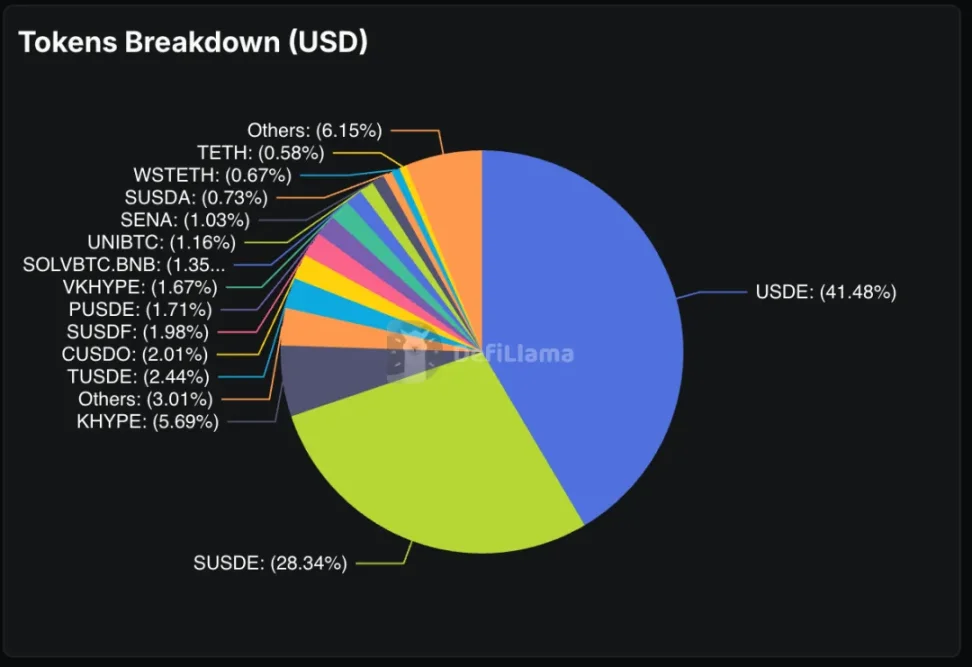
Explosion in perpetual markets: In August 2025, open interest in major altcoins reached $47 billion, while Bitcoin hit $81 billion. Increased volume means more funding fee opportunities, which Ethena capitalizes on.
Source: defillama.com
Financial engineering frenzy: Users discovered they could stake USDe to get sUSDe (yield-bearing token), tokenize sUSDe on Pendle (a yield derivatives platform), then use those tokens as collateral on Aave (a lending protocol) to borrow more USDe—and repeat the cycle. This recursive yield loop allows sophisticated players to amplify exposure to USDe yields. Result? 70% of Pendle’s deposits are Ethena-related assets, and $6.6 billion worth of Ethena assets sit on Aave. This “leverage on leverage” chase for double-digit returns is in full swing.
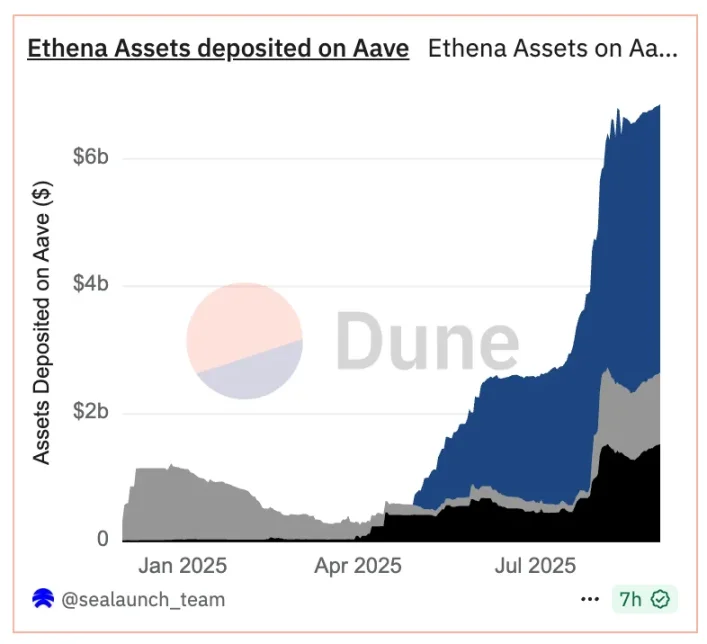
Image source: dune
SPAC boost: A SPAC named StablecoinX plans to raise $360 million specifically to accumulate ENA tokens, creating a “permanent capital” buyer that reduces selling pressure and supports decentralized governance.
Ethereal perpetual DEX: Ethereal, built specifically for USDe, attracted $1 billion in total value locked (TVL) even before mainnet launch. Users deposit USDe to earn points toward future token airdrops, creating massive demand for USDe.
Convergence Chain: Ethena’s permissioned L2 chain developed with Securitize uses USDe as its native gas token, attracting traditional financial institutions through KYC-compliant infrastructure, creating structural demand.
Fed rate cut expectations: Markets anticipate two rate cuts by end of 2025, with an 80% chance of a September cut. Rate cuts typically boost risk appetite, driving up funding rates. USDe’s yield is negatively correlated with the federal funds rate—rate cuts could significantly increase Ethena’s income.
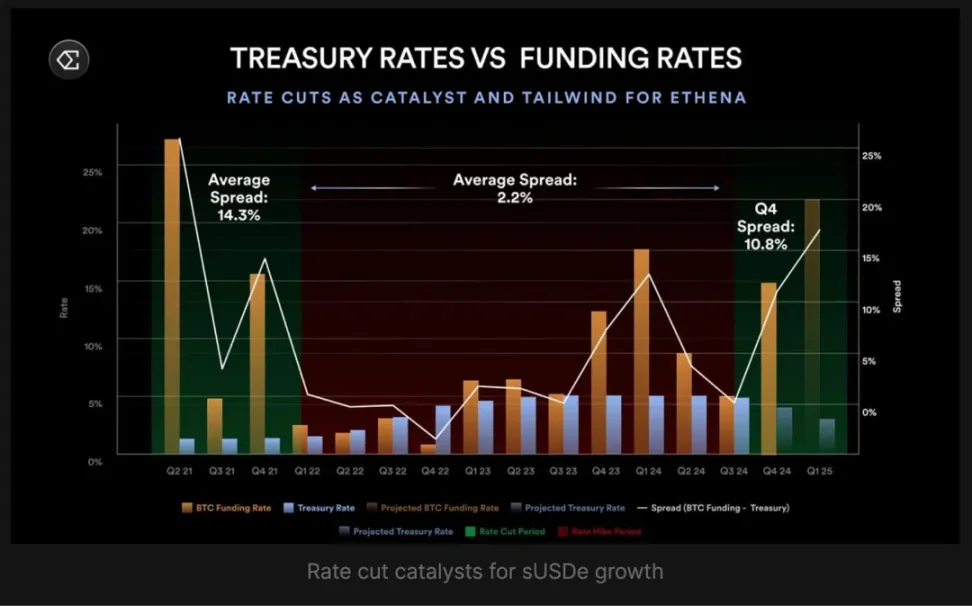
Image source: mirror.xyz
Fee switch proposal: Ethena’s governance passed a five-point framework to distribute revenue to ENA holders. Four criteria have already been met: USDe supply exceeding $6 billion (now $12.4 billion), protocol revenue over $250 million (already exceeded $500 million), integration with Binance/OKX (completed), and sufficient reserve fund. The only unmet condition is that sUSDe yield must exceed sUSDtb yield by at least 5%, a crucial safeguard for the protocol and sENA holders.
Ethena has also formed partnerships with traditional finance players and crypto exchanges, making USDe available across platforms from Coinbase to Telegram wallets.
Institutional Frenzy
Unlike early stablecoins that relied solely on crypto-native use cases, USDe has captured the attention of traditional financial institutions. Coinbase’s institutional clients now have direct access to USDe, CoinList offers a 12% APY USDe earning product, and major custodians like Copper and Cobo manage Ethena’s reserve assets.
This institutional adoption mirrors USDC and USDT—but compressed into months rather than years. Traditional stablecoins took years to build institutional relationships and compliance frameworks, while Ethena achieved similar traction in just months, thanks to a mature regulatory environment and the allure of high yields.
Institutional adoption brings credibility, credibility attracts more capital, more capital enables greater funding fee capture, supporting higher yields, which attract even more institutions. It’s a self-reinforcing flywheel that keeps accelerating—as long as the underlying mechanics remain intact.
However, it’s important to note that USDe’s rapid growth stands on the shoulders of USDT and USDC, who paved the way by proving stablecoins’ utility, safety, and legitimacy.
Leverage Squared
The high concentration of USDe on Pendle and Aave introduces “single point of failure” risks. If Ethena’s model falters, it won’t just affect USDe holders—it could ripple through the entire DeFi ecosystem dependent on Ethena liquidity. Pendle’s 70% business and significant deposits on Aave are tied to Ethena. If USDe fails, it may trigger a liquidity crisis across DeFi—not just a stablecoin depeg.
Even more concerning is user behavior. Recursive borrowing loops on Aave and Pendle amplify returns—and risks. Users stake USDe to get sUSDe, tokenize sUSDe on Pendle to obtain PT tokens, then use PT tokens as collateral on Aave to borrow more USDe, repeating the cycle. This leveraged recursion echoes the CDO-squared structures of the 2008 financial crisis—using one financial product to collateralize borrowing of the same product, creating recursive leverage that’s hard to unwind quickly.
If funding rates stay negative for extended periods, USDe may face redemption pressure, leveraged positions could trigger margin calls, and protocols relying on USDe TVL might experience massive outflows—the unwinding process potentially faster than any single protocol can handle.
Where Are the Risks?
Every high-yield strategy eventually faces a question: what happens when it stops working? For Ethena, several potential risks exist:
-
Persistent negative funding rates: If bearish sentiment prevails, Ethena would pay funding fees instead of collecting them. Their $60 million reserve fund provides a buffer, but it’s not infinite.
-
Exchange counterparty risk: While Ethena uses OTC custody for spot assets, it still depends on major exchanges to maintain short positions. If an exchange goes bankrupt or gets hacked, Ethena may need to rapidly migrate positions, temporarily breaking delta-neutral hedging.
-
Liquidation risk in leverage loops: If USDe yields suddenly drop, recursive borrowing positions may become unprofitable, triggering a wave of deleveraging and selling pressure on USDe.
-
Regulatory pressure: European regulators have already forced Ethena to move from Germany to the British Virgin Islands. As yield-bearing stablecoins draw more scrutiny, stricter compliance requirements or restrictions may follow.
The Stablecoin War
Ethena marks a fundamental shift in stablecoin competition. Historically, battles were fought over stability, adoption, and regulatory compliance. USDC and USDT competed on transparency and regulation, while algorithmic stablecoins emphasized decentralization.
USDe changes the game with yield. It’s the first major stablecoin to offer double-digit returns to holders while maintaining a dollar peg. This puts pressure on traditional stablecoin issuers who pocket treasury yields without sharing them with users.
The market is responding. USDe now holds over 4% of the stablecoin market share, behind only USDC (25%) and USDT (58%). More importantly, USDe is growing much faster: over the past 12 months, USDT grew 39.5%, USDC grew 87%, while USDe grew over 200%.
If this trend continues, the stablecoin market could undergo a fundamental reshaping. Users may shift from non-yielding stablecoins to yield-bearing alternatives, forcing traditional issuers to either share yields or watch their market share erode.
Summary
Despite risks, Ethena shows no signs of slowing down. The protocol has just approved BNB as a collateral asset, with XRP and HYPE also meeting inclusion thresholds. This expands their market beyond ETH and Bitcoin to a broader range of assets.
The ultimate test is whether Ethena can maintain its yield advantage while managing systemic risks. If successful, they will create the first scalable, sustainable yield-bearing dollar in crypto history. If not, we’ll witness another cautionary tale of chasing high returns.
Regardless, USDe’s achievement of reaching $12 billion in just 18 months proves that when innovation meets market demand, financial products can expand at unimaginable speed.
Join TechFlow official community to stay tuned
Telegram:https://t.me/TechFlowDaily
X (Twitter):https://x.com/TechFlowPost
X (Twitter) EN:https://x.com/BlockFlow_News















