Ethena Treasury Strategy: The Rise of the Third Empire of Stablecoins
TechFlow Selected TechFlow Selected
Ethena Treasury Strategy: The Rise of the Third Empire of Stablecoins
8% of DAI, 12% of sUSDe.
 Navigating Web3 tides with focused insights
Author: Zuoye
In August 2023, Spark, a lending protocol within the MakerDAO ecosystem, offered an 8% annual yield on $DAI. Soon after, SBF gradually entered the market, accumulating 230,000 $stETH, at one point accounting for over 15% of Spark’s total deposits, forcing MakerDAO to urgently propose reducing the rate to 5%.
MakerDAO originally intended to “subsidize” $DAI adoption, but nearly turned it into SBF’s solo yield farm.
In July 2025, Ethena mastered the "crypto-stock-bond" treasury strategy, rapidly pushing $sUSDe's APY to around 12%, causing $ENA to surge 20% in a single day.
Originating from BTC-native treasury strategies and narrowly missing $SBET/$BMNR, this approach ultimately landed on USDe.
Ethena once again leveraged capital markets to successfully create a two-way flywheel for $ENA and $USDe across both on-chain and stock-like markets.
Double-Token System Battle Royale
USDT created stablecoins, USDC captured user compliance mindshare, USDe hunts capital.
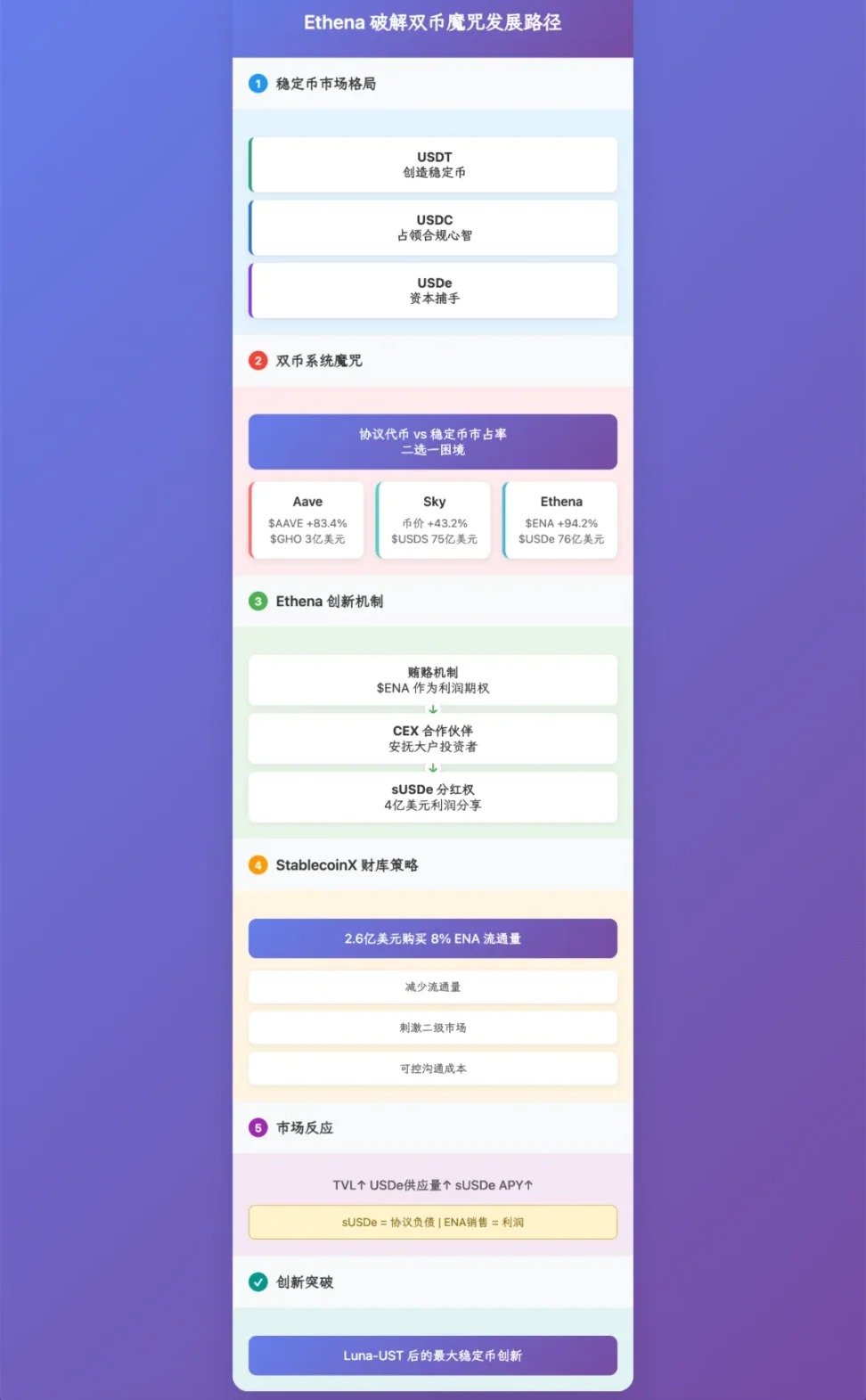
Image caption: Ethena's path to capitalization, Image source: @zuoyeweb3
When the $ENA treasury strategy launched, I initially thought it was merely imitating current Strategy trends. However, upon closer review, Ethena is actually attempting to break the "double-token" system curse.
The curse forces on-chain stablecoin issuers to choose between protocol token price and stablecoin market share:
-
Aave chose to empower $AAVE, whose price rose 83.4% over three months, but $GHO issuance remained at only $300 million
-
Sky, evolved from MakerDAO, saw its token rise 43.2% over three months, with $USDS issuance reaching $7.5 billion
-
Ethena’s token ENA rose 94.2% over three months, with $USDe issuance hitting $7.6 billion
Adding the collapsed Luna-UST dual-token system reveals how incredibly difficult maintaining balance between the two is—primarily because protocol revenue is limited. Directing revenue toward market share destabilizes token prices, and vice versa.
Across the entire stablecoin market, this creates a barrier to entry established by USDT. As the inventor of the stablecoin category, USDT naturally faces no such dilemma. Circle must share profits with partners, but still won’t distribute to USDC holders.
Ethena uses a bribe mechanism, sharing ENA as profit "options" with CEX partners, temporarily appeasing whales, investors, and exchanges, while prioritizing dividend rights for USDe holders.
According to A1 Research estimates, since inception, Ethena has shared approximately $400 million in profits with USDe holders via sUSDe, breaking through the entry barriers set by USDT/USDC.
Ethena not only surpassed Sky in stablecoin market share (excluding residual DAI), but also outperformed Aave in primary token project performance—this was no accident.
While ENA’s price increase benefited from its Upbit listing, Ethena is fundamentally reshaping how value flows within double-token systems by introducing stock-style treasury strategies.
Returning to the earlier question: beyond protecting USDe’s market share, ENA’s dividend rights still need fulfillment. Ethena’s solution was to mimic treasury strategies by launching StablecoinX—but with modifications.
-
BTC treasury strategy: take Strategy as an example, betting on long-term BTC price appreciation; holding 600,000 BTC acts as fuel during rallies and becomes hell during downturns;
-
ETH treasury strategy: take Bitmine (BMNR) as an example, betting on eventually acquiring 5% of circulating supply to become the new whale, following stock-market players like SBF and Yi Lihua, profiting from volatility;
-
BNB/SOL/HYPE treasury strategies involve project foundations or single entities pumping prices to boost their own tokens—these are the most bandwagon-oriented, as these assets haven't achieved BTC/ETH-level market value.
ENA’s treasury StablecoinX differs from all the above. On the surface, it involves ENA’s on-chain entity investing and fundraising, spending $260 million to buy 8% of ENA’s circulating supply—essentially self-dealing to stimulate price growth.
The market responded positively: Ethena TVL, USDe supply, and sUSDe APY all rose accordingly. But note: sUSDe is本质上 a protocol liability, while ENA sales revenue constitutes actual profit.
StablecoinX reduces ENA circulation, boosting secondary market sales growth. The coordination cost is manageable—Ethena simply negotiates with investors Pantera, Dragonfly, and Wintermute.
Dragonfly led Ethena’s seed round, and Wintermute also participated—making this less new investment and more like accounting reclassification.
Ethena is playing the capital markets game, successfully escaping the double-token system death trap—likely the biggest stablecoin innovation since Luna-UST.
Real Adoption Hasn’t Happened Yet
When artificial prosperity collapses, deeply rooted weaknesses will be exposed.
ENA’s new upward trend is now one source of project revenue, driving growth in USDe/sUSDe holdings. At least now, USDe has a chance to become a truly application-driven stablecoin.
ENA’s treasury strategy mimics BNB/SOL/HYPE—boosting yields to drive stablecoin adoption, capturing volatility gains while high-controlled supply via negotiation mechanisms reduces downward selling pressure.
Capital maneuvers can only push token prices. After stabilizing the USDe-ENA growth flywheel, long-term sustainability still requires real-world USDe usage to cover market-making costs.
Image caption: Ethena’s ecosystem expansion, Image source: @Jonasoeth
On this front, Ethena consistently walks both off-chain and on-chain paths:
-
On-chain: Ethena maintains long-term collaboration with Pendle to revitalize on-chain interest rate markets, gradually partners with Hyperliquid, and internally supports Ethreal as a Perp DEX alternative
-
Off-chain: collaborates with Securitize, BlackRock’s partner, to launch the Converge EVM chain targeting institutional adoption; post Genius Act, expands compliant stablecoin USDtb issuance with Anchorage Digital
Additionally, Anchorage Digital and Galaxy Digital are currently hot institutions—arguably the third wave of market makers after Jump Trading/Alameda Research, with the second wave being DWF/Wintermute and others—a topic for future discussion.
Beyond its on-chain and off-chain capital plays, Ethena’s real-world adoption remains lackluster.
Compared to USDT and USDC, USDe/USDtb have barely scratched the surface in cross-border payments, tokenized funds, and DEX/CEX pricing. Their only notable achievement remains cooperation with TON; DeFi protocol partnerships struggle to achieve mass adoption.
If Ethena’s goal is purely on-chain DeFi, it has already succeeded. But if aiming for off-chain institutional adoption and retail use, it has only taken the first step of a long march.
Moreover, ENA’s hidden risks are emerging—its fee switch is coming. Recall that Ethena currently only shares revenue with USDe holders. The fee switch protocol would require ENA holders, via sENA, to share in earnings.
Ethena stabilized CEX relationships via ENA to secure USDe’s survival space, and used treasury strategies to protect major ENA holders and investor interests. But what must come cannot be avoided—once ENA starts sharing protocol revenue, ENA itself will become Ethena’s liability rather than income.
Only when ENA truly becomes something like USDT/USDC can it enter a genuine self-sustaining cycle. For now, it’s still maneuvering under pressure that never truly disappears.
Conclusion
Ethena’s capital playbook offers inspiration to more stablecoin and YBS (yield-bearing stablecoin) projects—even Genius Act-compliant payment stablecoins aren’t precluded from earning yield via RWA tokenization.
Following Ethena, Resolv also announced activation of its fee switch protocol, though it won’t yet distribute profits to token holders. Ultimately, revenue sharing requires actual protocol revenue.
Uniswap has long cautiously approached its fee switch, aiming to maximize protocol revenue between LPs and UNI holders—while most current YBS/stablecoin projects still lack sustainable revenue generation.
Capital stimulation is a pacemaker; real adoption is the blood-producing protein.
Join TechFlow official community to stay tuned
Telegram:https://t.me/TechFlowDaily
X (Twitter):https://x.com/TechFlowPost
X (Twitter) EN:https://x.com/BlockFlow_News
 @zuoyeweb3