"Trillion" Liquidity: Pre-IPO Equity Tokenization Opens New Exit Channels for PE/VC
TechFlow Selected TechFlow Selected
"Trillion" Liquidity: Pre-IPO Equity Tokenization Opens New Exit Channels for PE/VC
This study suggests that the evolution of future markets is not a simple replacement of models, but rather a process of integration and transformation.
 Navigating Web3 tides with focused insights
Authors: Lacie Zhang (X:@Laaaaacieee), Owen Chen (X:@xizhe_chan)
Executive Summary
Private company equity is a trillion-dollar segment in global asset allocation, yet it has long been constrained by the structural challenges of "high participation barriers" and "narrow exit channels," ultimately leading to severe liquidity issues for private equity (PE) and venture capital (VC) firms. Equity tokenization, as a key application within the real-world assets (RWA) wave, offers a new pathway to resolve this systemic problem. This report aims to deeply explore the current market landscape, core models, critical bottlenecks, and future trends of private company equity tokenization, assessing its potential to empower PE/VC exits.
Key findings:
(1) The market exhibits a stark contrast between "trillion-dollar potential" and "millions in reality." Despite unicorn valuations exceeding $5 trillion, the current market cap of tradable equity tokens is only in the tens of millions of dollars—indicating an extremely early stage with high concentration among top-tier companies.
(2) Three dominant models have emerged: Native Collaborative (compliant but limited deployment, e.g., Securitize), Synthetic Mirror (pure derivatives, e.g., Ventuals), and SPV Indirect Holding (e.g., PreStocks, Jarsy).
(3) The SPV model, as the first to validate market demand, demonstrates high flexibility. Although the market faces challenges in regulatory compliance, liquidity depth, and IPO transition alignment, these very constraints are driving evolution toward more mature structures.
This study concludes that future market evolution will not be a simple model replacement, but rather a process of integration and transformation. The core driver will be a shift in private companies' (issuers') attitudes—where, as Web3 becomes increasingly mainstream, enterprises begin proactively viewing tokenization (STO) as a novel, efficient financing and market capitalization management tool, shifting the market from one-way exploration to two-way collaboration. Moreover, the true blue ocean for tokenization lies not in super-unicorns, but in the broader long-tail of mature private companies seeking exit paths, whose scalable breakout will depend on the maturity of native RWA liquidity infrastructure.
Keywords: Private Company Equity, Real World Assets, Tokenization, PE/VC Exit, SPV
01 Introduction
Equity in private companies, especially fast-growing unicorns, represents a significant asset class in the global economy. ① However, investment opportunities and substantial gains from such high-value assets have historically been accessible primarily to professional institutions like private equity (PE) and venture capital (VC), limiting participation to select institutional and high-net-worth individuals, while excluding ordinary investors. Recently, the rise of blockchain technology has made equity tokenization feasible—issuing digital tokens on a blockchain to represent equity stakes—and could potentially reshape the rules of traditional private markets. Tokenization is seen as a bridge connecting traditional finance (TradFi) and decentralized finance (DeFi), and is a crucial component of the real-world assets (RWA) on-chain movement.
This trend is driven by immense market potential. According to Boston Consulting Group (BCG), the on-chain RWA market could reach $16 trillion by 2030. [1] Citigroup also notes that private market tokenization could surge 80-fold this decade, nearing $4 trillion. [2] These large forecasts reflect high industry expectations for tokenization. On one hand, private companies (such as billion-dollar unicorns) hold enormous value; on the other, blockchain-based tokenization is expected to break down current private market barriers, enabling greater efficiency and broader participation.
This article will delve into the background and current state of private company equity tokenization, analyze traditional market pain points, tokenization solutions and advantages, review major global platform cases, technological support, regulatory policies, and existing challenges, and finally offer outlooks on future trends, helping readers understand the financial innovation wave led by this popular field.
(① The focus of this article is not limited to the tokenization of private equity funds managed by traditional PE firms, but analyzes the core value of tokenizing "primary equity" in high-valued private companies (unicorns) from the perspective of the 'issuing company'—that is, including but not limited to the tokenization of private equity.)
02 Private Company Equity Market: A New Blue Ocean for Tokenization
Private company equity—especially in pre-IPO unicorns—is one of the largest yet most illiquid isolated islands in global asset allocation. It is precisely the vast discrepancy between scale and efficiency that makes it the most promising blue ocean within the RWA tokenization wave.
2.1 Trillion-Dollar Fortress: The Value Landscape of Private Company Equity
1. Asset Scope: Which Entities Does Private Company Equity Cover?
Broadly defined, private company equity refers to shares of any company not publicly listed on a stock exchange. This is an extremely large and heterogeneous asset class, spanning from early-stage startups to large, mature private groups. Its holders include not only professional private equity (PE) and venture capital (VC) funds, but also extensive founder teams, employees holding employee stock ownership plans (ESOP) or restricted stock units (RSU), and early angel investors.
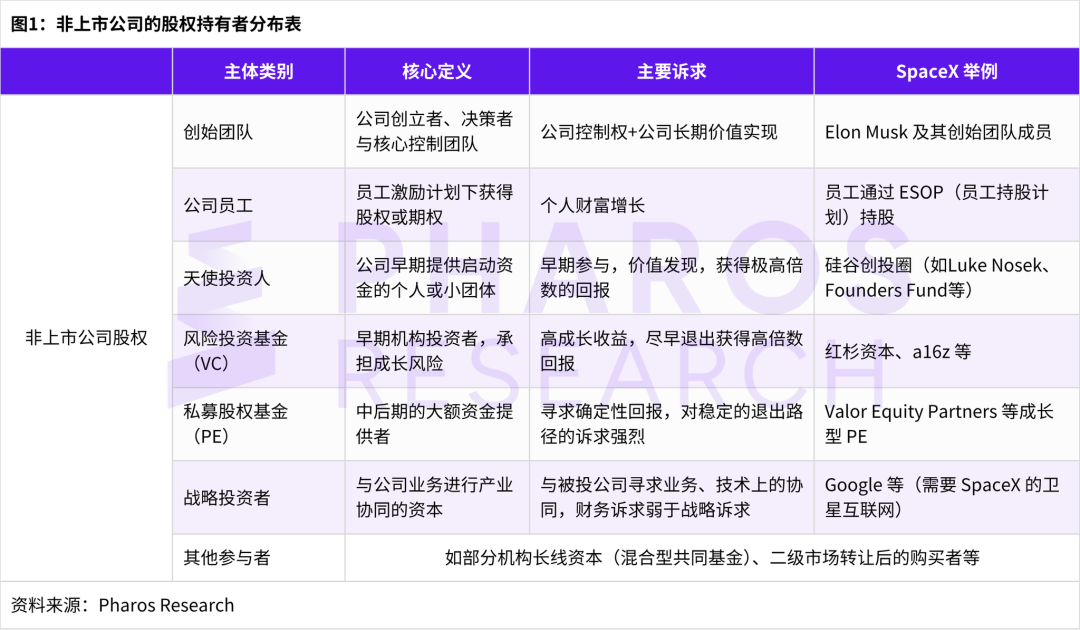
As shown in the table above, aside from strategic investors and founding teams, the majority of private equity holders have strong demands to monetize their stakes and achieve certain returns. Among them, private equity funds (PE) and early investors (such as angel investors, VC) face particularly urgent exit needs. Additionally, employees holding equity incentives often seek to cash out their options when leaving a company, driven by practical motivations to "secure gains." However, under traditional pathways, secondary market trading of private equity is far from smooth except through rare channels like company buybacks, resulting in widespread structural difficulties around exit challenges and poor liquidity.
2. Scale Estimation: The Magnitude of the Trillion-Dollar "Fortress"
First, it must be clarified that there is currently no unified official data on the total size of global private company equity. This stems mainly from the inherent subjectivity and non-public nature of private market valuations. Nevertheless, we can still use key public data to estimate the scale of this market.

① Dry Powder: Refers to uninvested reserve capital held by funds.
② Unicorn: A company founded within 10 years with a valuation over $1 billion.
Based on the data above, we can estimate the massive scale of this "fortress" from two dimensions:
First, from the perspective of assets under management (AUM), global private equity (PE) and venture capital (VC) funds—the primary institutional allocators to private equity—manage a staggering $8.9 trillion ($5.8T + $3.1T). While this includes some dry powder, the figure itself reflects the substantial capital institutions have reserved for such asset classes.
Second, from the asset's own valuation standpoint, the combined market value of just global "unicorns" (private companies valued above $1 billion) has already reached the trillion-dollar level. As shown in Table 2, Hurun Research reports this at $5.6 trillion. [3] Different sources yield slightly different figures—for example, CB Insights estimates that as of July 2025, the cumulative valuation of 1,289 global unicorns exceeds $4.8 trillion—but all confirm the massive scale. [4]
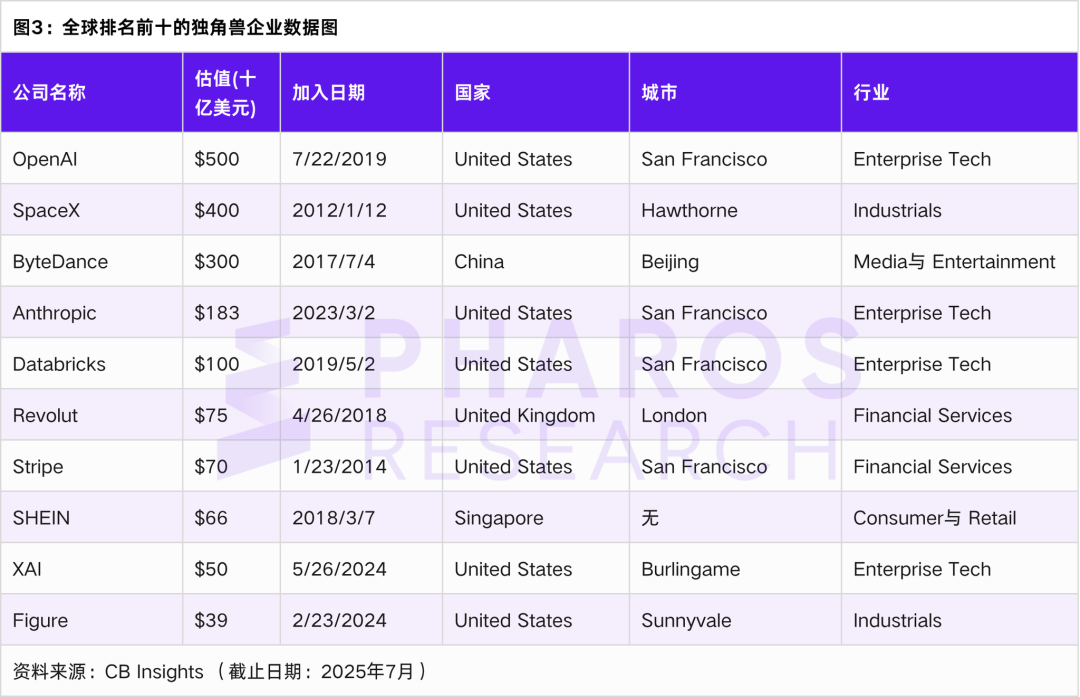
Figure 1 lists CB Insights’ ranking of the top ten globally valued unicorns, with OpenAI (valued over $500 billion), SpaceX (valued at $400 billion), and ByteDance (valued at $300 billion) leading the pack.
It should be emphasized that whether $4.8 trillion or $5.6 trillion, this represents only the tip of the pyramid—thousands of top-tier companies. The vast value of tens of thousands of non-unicorn mature private and growth-stage companies worldwide remains uncounted.
In summary, the actual total value of the global private equity market is a fortress far exceeding several trillion dollars. This surprisingly large yet highly illiquid asset sea undoubtedly provides fertile ground for tokenization.
2.2 The "Fortress" Dilemma: Participation and Exit Challenges for High-Value Assets
The private company equity market holds trillions of dollars in value, but this potential remains largely untapped under traditional models. Due to the lack of effective value transfer channels, the market has instead become a "fortress"—its vast value tightly constrained by structural issues of "difficult exit" and "difficult access." It is precisely this huge friction between high value and low efficiency that constitutes the fundamental market driver for private company equity tokenization.
"Difficult access" arises from high entry barriers. Unlike public markets, investment opportunities in private company equity are strictly confined to a small circle of "accredited investors" or institutional investors across nearly all jurisdictions. Minimum investments ranging from hundreds of thousands to millions of dollars, along with stringent net worth requirements, create a high wall, excluding the vast majority of ordinary investors from participating in these high-growth dividends. This not only entrenches inequality of opportunity but fundamentally limits the market’s capital supply and breadth.
"Difficult exit" results from severely limited liquidity outlets. For holders inside the "fortress"—whether early angel investors, VC/PE funds, or employee teams holding equity incentives—their exit paths are narrow and prolonged. Traditionally, exit heavily depends on two terminal events: initial public offering (IPO) or merger & acquisition (M&A). However, the trend of unicorns delaying IPOs has made decade-long lock-up periods the norm, leaving massive wealth trapped in paper form. Beyond IPOs, private secondary market transfers are a slow, high-friction bottleneck: they rely heavily on offline intermediaries, involve opaque processes, burdensome legal due diligence, high transaction costs, and lengthy settlement cycles.
It is this dual dilemma of "can’t get in" and "can’t get out" that collectively forms the fortress-like structure of the private company equity market, locking trillions of dollars in value. This sharp contradiction between high value and low efficiency creates the most urgent and imaginative application scenario for tokenization technology.
2.3 Mechanism Restructuring: Core Advantages of Tokenization in Empowering Private Company Equity
Faced with the fortress dilemma analyzed above, tokenization does not merely offer a patchwork solution—it systematically restructures the entire value chain of private company equity. Its core function goes beyond passively reducing friction in "access" and "exit"; it actively introduces new market mechanisms and valuation paradigms.
First, the primary advantage of tokenization is creating continuous secondary market liquidity, thereby breaking the fortress deadlock. This manifests in two ways:
• For external investors: Tokenization drastically lowers investment thresholds by finely dividing high-value equity, dismantling the previous "difficult access" barrier and opening participation to a broader base of compliant investors. This differs fundamentally from the tokenization of already-listed stocks (e.g., U.S. equities): while stock tokenization mostly improves trading convenience (e.g., 7x24 trading), private company equity tokenization achieves a paradigm shift under compliance—it enables compliant retail investors to access high-growth investment vehicles for the first time—allowing ordinary people to easily purchase OpenAI equity.
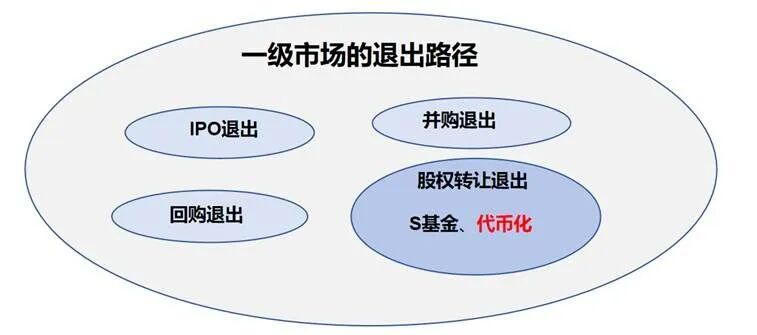
• For internal shareholders: It opens a new exit path. Beyond traditional IPO, company buyback, M&A, or inefficient secondary market transfers, shareholders (like employees or early investors) can now transfer their shares via compliant tokenization platforms and "on-chain," gaining liquidity in a 7x24 on-chain market—providing PE and VC investors with an alternative to IPO and M&A exits, reaching a wider pool of retail investors.
Figure 4: Summary of Primary Market Exit Paths
Source: Pharos Research
Second, tokenization enables continuous price discovery, empowering active market capitalization management. Traditional private equity valuation relies on infrequent private funding rounds—occurring every few months or years—resulting in discrete, lagging, and opaque pricing. Continuous secondary market trading brought by tokenization provides private company equity with near-public-market high-frequency price signals for the first time. This continuous price discovery mechanism transforms valuation from a "black box," allowing companies and primary investors to fairly price subsequent financings and conduct more rational, proactive "market cap management," significantly narrowing the valuation gap between primary and secondary markets.
Finally, tokenization opens new financing channels, reshaping corporate capital strategies. Tokenization is not just a tool for circulating existing assets; it can also serve as a new channel for raising incremental capital. High-growth companies (like unicorns) can collaborate with specialized Web3 projects or tokenization platforms to bypass the lengthy timelines and high underwriting costs of traditional IPOs, directly conducting security token offerings (STOs) to a global base of qualified digital investors. This "digital listing" model revolutionizes fundraising channels, enabling access to a larger, more diverse global capital pool. Emerging platforms like Opening Bell are already actively exploring such collaborations with private companies, pioneering this frontier fundraising path.
03 Current State of Private Company Equity Tokenization
3.1 Overview of Market Size and Underlying Assets
Precisely measuring the overall market size of private company equity tokenization remains challenging. On one hand, some platforms (like Robinhood) do not disclose full market cap data for their tokenized equities; on the other, synthetic contract-based products like Ventuals only have "open interest," not a so-called "equity token market cap." Therefore, this section primarily provides a macro-level estimation by reviewing partial key product market caps available from public sources (e.g., CoinGecko). 
① CURZ tokens trade on tZERO (an ATS platform), which does not publicly disclose total market cap. Data in the table is estimated via "latest available price × total shares outstanding." Also, this product is not freely tradable on DEXs or CEXs in the traditional sense, but circulates within an Alternative Trading System (ATS).
② MGL tokens issued by Archax were part of the UK Financial Conduct Authority (FCA) Digital Securities Sandbox launched in July 2023. The asset was issued on the Hedera chain by Montis Group, with Archax providing custody. It qualifies as tokenized equity but has not yet entered public circulation.
③ Jarsy-issued tokens also include listed stocks (e.g., NVIDIA, Tesla), though their TVL is generally low. Tokens with market caps below $100,000 are excluded from statistics.
Based on this incomplete statistical table, the private company equity tokenization market remains in an extremely early stage, with an estimated total market cap between $100 million and $200 million. After excluding Securitize and Archax, the market size is expected to be in the tens of millions—making it a particularly niche market. [1] CURZ from Securitize and MGL from Archax are excluded because the former trades on the alternative trading system (ATS) tZERO, and the latter is a UK regulatory sandbox product, neither possessing liquidity in the traditional crypto-native sense.
From a market structure perspective, share distribution is highly concentrated among top-tier compliant issuances. Just CURZ issued by Securitize and MGL issued by Archax (a regulatory sandbox project) together account for over 60% of the total market volume.
Regarding underlying assets (excluding special projects from Securitize and Archax), current tokenized assets show high convergence, focusing on top-tier U.S. high-tech unicorns, especially in the AI sector. OpenAI, SpaceX, and xAI have become the most sought-after assets. This reflects that project initiators, during the early market cultivation phase, tend to prioritize the most well-known companies capable of attracting investor interest. In contrast, although some project teams have indicated ongoing discussions with equity holders of Chinese-background unicorns (like ByteDance, Xiaohongshu), no actual projects have materialized yet.
3.2 Three Mainstream Models of Private Company Equity Tokenization
Currently, the market has evolved three distinct implementation models for private company equity tokenization, differing fundamentally in compliance foundation, asset attributes, and investor rights—with the third—SPV Indirect Holding—being the current mainstream.
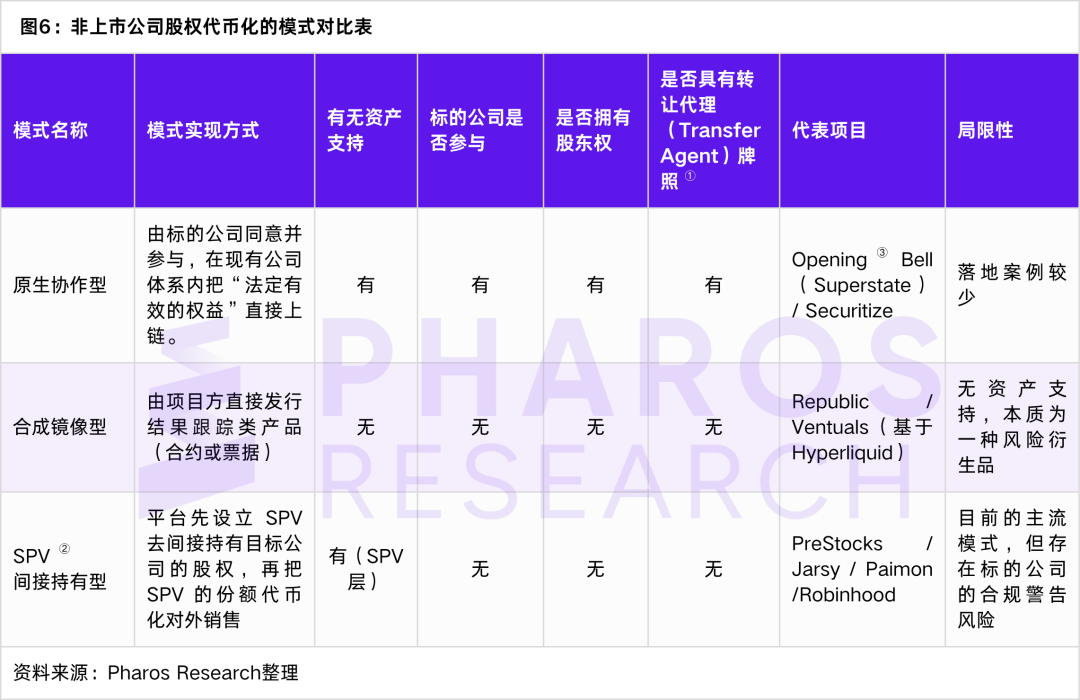
① Transfer Agent license refers to registration with the SEC as a transfer agent authorized to maintain, manage, and modify shareholder registers. It marks the compliance starting point for equity tokenization in the U.S. Full SEC securities issuance and operation compliance also requires Broker-Dealer and Alternative Trading System licenses.
② SPV (Special Purpose Vehicle) is a common financial term meaning a legally segregated entity created for a specific transaction (or asset holding), primarily for risk isolation—in simple terms, a "shell company."
③ Although Opening Bell adopts a method involving cooperation with issuing companies to tokenize equity, its current implemented cases are all publicly listed companies. Cooperation with private companies remains at the announcement stage without actual deployment.
1. Native Collaborative Model
In this model, the target company (i.e., the private entity) personally authorizes and deeply participates in directly registering and issuing "legally binding equity" on the blockchain. Here, the on-chain token is the equity itself, with legal standing fully equivalent to the off-chain shareholder register (specific rights executed per charter and jurisdictional law).
Thus, token holders are officially registered "shareholders" of the target company, typically enjoying full voting rights, dividend rights, and information access rights. Issuance platforms must hold key financial licenses, such as the SEC-approved "Transfer Agent" license, to legally manage and update shareholder registers. Representatives of this path include Opening Bell (advocating for "on-chain" statutory shares) and Securitize (whose model is more commonly used for compliant fund tokenization, holding a full suite of licenses including Transfer Agent, Broker-Dealer, and Alternative Trading System).
However, real-world implementations of this model remain limited. Securitize has only a handful of cases, and Opening Bell’s current deployments are exclusively with listed companies, with cooperation with private companies still at the promotional stage.
2. Synthetic Mirror Model
This model usually proceeds without permission from the target company, unilaterally initiated by third-party project teams. What is issued is not equity, but synthetic derivatives mimicking the economic returns of the target equity—such as "contingent value notes" or on-chain perpetual contracts.
Investors purchasing these tokens do not acquire real shares, are not registered as shareholders, and naturally lack voting or dividend rights. Their profits or losses depend entirely on contractual settlements with the issuer. Thus, this model carries significant counterparty risk, price tracking errors, and serious regulatory uncertainty. Examples include Republic (with mirror note-style tokens) and Ventuals (company valuation perpetuals based on Hyperliquid).
3. SPV Indirect Holding Model
This model is currently the mainstream approach for private company equity tokenization—a common workaround structure. The tokenization platform first establishes a "special purpose vehicle" (SPV), which acquires and holds real equity in the target company via the traditional private secondary market. Then, the platform tokenizes and sells the "interest shares" or "beneficial certificates" of the SPV—not the target company’s equity itself.
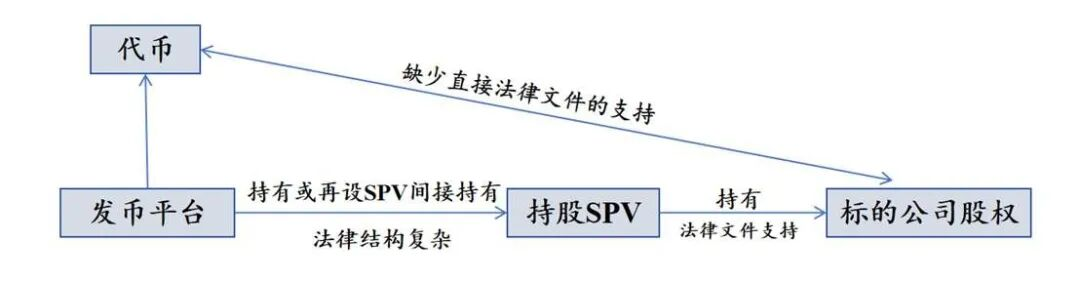
Figure 7: SPV Indirect Holding Issuer Architecture
Source: Pharos Research
Under this structure, investors hold contractual economic beneficiary rights to the SPV, not registered shareholder rights to the target company, and thus typically do not enjoy voting rights over the operating entity. This model amounts to issuing tokens backed by SPV holdings, with legal documentation supporting the SPV’s ownership of target equity, while the tokenization of SPV shares attempts to bypass direct approval from the target company.
This model involves operational opacity and risks of compliance warnings from the target company. Issuers (project teams) often establish complex offshore SPV structures to pursue "regulatory arbitrage." Transparency tends to be one-sided: investors usually only see proof from the SPV’s "asset side"—that the SPV indeed holds the target company’s equity (via asset proofs and custody documents); however, regarding the SPV’s "liability side"—the project team’s operations, financial health, and details of token issuance—transparency is often lacking, resembling a "black box." Meanwhile (as discussed later), such operations have already received legal warnings from some target companies (e.g., OpenAI). Representatives include PreStocks, Jarsy, Paimon Finance, and Robinhood.
3.3 Implementation and Compliance Pathways for Private Company Equity Tokenization
The three models discussed above (Native Collaborative, Synthetic Mirror, SPV Indirect Holding) differ in legal frameworks, investor rights, and risk exposures. This section delves into their specific implementation methods and compliance pathways.
1. Synthetic Mirror Model: Simulating Equity via Derivatives
Synthetic mirror tokens are essentially financial derivatives. Their value is not pegged to real equity, but tracks the valuation performance of the target company through mechanisms similar to "contracts for difference" (CFDs). Implementation typically involves "indexing" the valuation and dividing it into tradable contract units, then matching trades via on-chain protocols.
For instance, Republic’s Mirror Token is legally classified as a tokenized contingent payment note—a debt instrument issued by the platform, with value anchored to unicorn valuations. Ventuals takes a more direct approach, launching valuation perpetuals (Perps) on Hyperliquid, representing pure contract-based derivatives.
On the compliance front, because such tokens do not grant shareholder rights, their pathways diverge. Projects like Ventuals adopt a purely Web3 "regulatory avoidance" path, with dependent protocols like Hyperliquid explicitly excluding U.S. investors. Republic, however, shows a different compliance philosophy: its platform has broad operations, high compliance standards, and holds a "Broker-Dealer" license. Its Mirror Tokens (debt notes) are treated as securities under U.S. securities law and clearly indicate whether specific products are open to U.S. investors.
2. Native Collaborative Model: Legally Compliant On-Chain Real Equity
In the native collaborative space, explorers are primarily Securitize and Opening Bell. Opening Bell is a sub-project launched by Superstate, advocating for "issuer-collaborated real equity on-chain." Currently, its implementations (e.g., Galaxy Digital and Exodus) involve target companies actively tokenizing their equity using the Opening Bell platform.
However, it must be noted that Opening Bell’s current cases are all publicly listed companies, not the private companies central to this article. Its cooperation with private companies remains at the promotional stage, with no actual projects deployed. Thus, for analyzing private company equity tokenization, Securitize’s path offers more relevant reference.
• Securitize, founded in 2017, is an infrastructure service provider focused on RWA tokenization. Its core business model involves transforming traditional financial assets—like company equity and fund shares—into compliant digital securities that can be issued, managed, and traded on blockchains, providing end-to-end services from primary issuance to secondary trading.
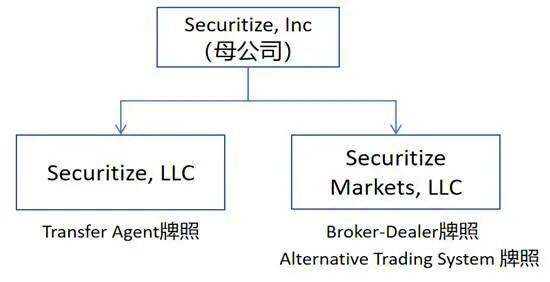
• To achieve this closed-loop operation, Securitize operates under the regulatory framework of the U.S. SEC and FINRA, holding through subsidiaries three key licenses: Transfer Agent (TA), Broker-Dealer (B-D), and Alternative Trading System (ATS), forming a complete compliance profile.
Figure 8: Securitize’s Compliance License Structure
Source: Securitize official website
Securitize’s practice offers two directions for private companies: one represented by Exodus, pointing to a tokenized IPO path; the other represented by Curzio Research, indicating a long-term private market circulation path.
Path One: From ATS to NYSE—Exodus’s Tokenized IPO Approach: The collaboration between U.S. crypto wallet company Exodus and Securitize stands as a benchmark case demonstrating the full lifecycle of private equity tokenization. As of November 1, 2025, the project’s token market cap reached $230 million, accounting for over 30% of the entire tokenized stock market. Its successful listing on a public exchange clearly illustrates the evolving liquidity pathways of tokenized equity across development stages.
(1) Project Timeline: The collaboration between U.S. crypto wallet company Exodus and Securitize is a landmark case showcasing the complete lifecycle of private company equity tokenization. As of October 2025, the project’s token market cap stood at $230 million, making it a significant part of the tokenized stock market. Its successful journey to a public exchange clearly demonstrates the evolving liquidity mechanisms of tokenized equity across development phases.
• Exodus began tokenization in 2021 as a private company, partnering with Securitize to mint its Class A common equity as "equity tokens" on the Algorand chain using its DS protocol. Throughout, Securitize served as the core transfer agent (TA), responsible for all token creation, maintenance, and destruction.
• The project then achieved several key milestones: progressing from initial peer-to-peer transfers between whitelisted wallets, to compliant trading on Securitize Markets and tZERO (both ATS platforms); finally, in December 2024, Exodus successfully listed on the New York Stock Exchange (NYSE American) under the ticker EXOD, with its tokenized equity becoming publicly traded securities. Post-listing, to expand asset reach, Exodus announced in 2025 a partnership with Superstate’s Opening Bell platform to extend stock tokens to Solana and Ethereum networks, while Securitize retained its core transfer agent role.
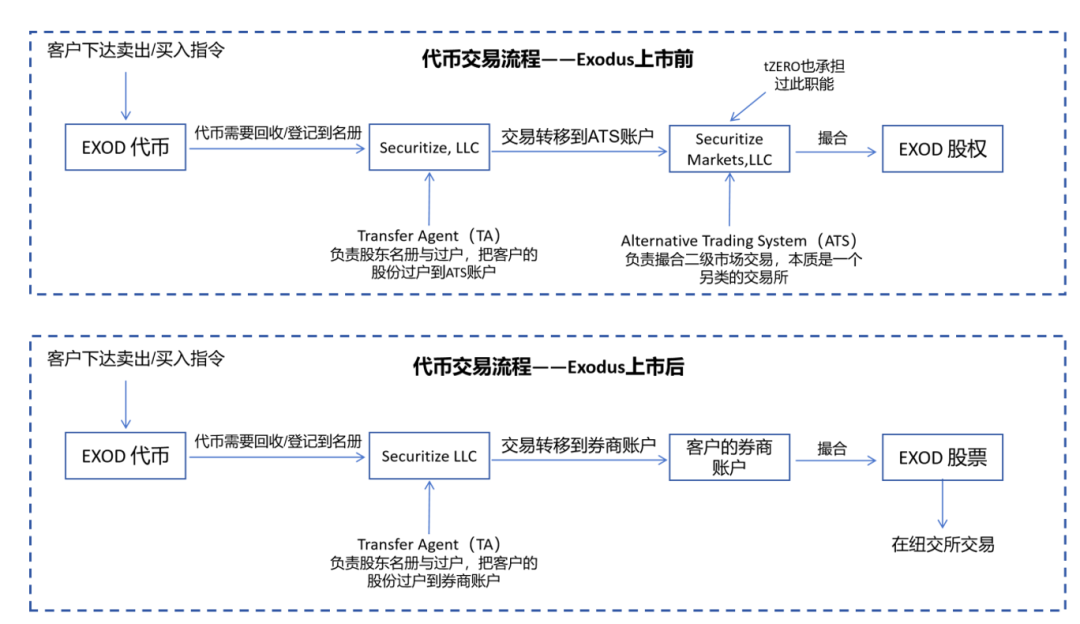
(2) Liquidity Mechanisms at Different Stages of the Exodus Product: Depending on the asset’s stage, the liquidity mechanisms for Exodus stock tokens fall into three main categories:
• Pre-IPO (2021–2024): Circulation via ATS Platforms: Before public listing, the primary liquidity channel was licensed Alternative Trading Systems (ATS). The standard process involved investors depositing their tokens with the transfer agent (Securitize) to update the shareholder register, followed by the agent transferring corresponding holdings to ATS brokers (e.g., tZERO Markets or Securitize Markets). Finally, investors submitted trading instructions via the respective ATS platform, where systems matched and settled trades.
• Post-IPO (Dec 2024–present): Conversion to Public Market Stocks: After successfully listing on NYSE American, the tokens gained access to public markets. The standard process involved investors submitting their tokens to transfer agent Securitize, who assisted in converting the tokens into traditional registered shares (street name holdings) in the investor’s brokerage account. Once converted, investors could trade normally on public markets under the stock code "EXOD" via their broker.
Figure 9: Exodus Token Trading Flow Before and After IPO
Source: Paramita Venture
• Foundational Path: Compliant OTC Transfers: As a persistently available underlying method, tokenized EXOD shares also support compliant over-the-counter (OTC) or peer-to-peer (P2P) transfers. The core prerequisite is that both parties’ wallet addresses must be whitelisted by transfer agent Securitize. Price and payment terms are negotiated offline, followed by on-chain token transfer execution. Notably, during the transitional period between delisting from ATS and formal listing on NYSE, this compliant OTC path was the sole available liquidity mechanism.
Path Two: Long-Term Private Market Circulation—Curzio Research’s ATS Norm: While Exodus’s IPO path depicts the ideal blueprint, for the vast majority of private companies, circulation within ATS platforms may not be a transitional phase toward IPO but their permanent, long-term existence. The case of U.S. investment research firm Curzio Research profoundly reflects this common reality.
• The company tokenized its equity into CURZ tokens via Securitize and continues trading them on tZERO’s ATS platform among accredited investors. The core value of this model lies in offering a compliant, continuous, albeit limited-liquidity secondary market for private companies unable or unwilling to go public, solving critical exit problems for early shareholders.
• Its market cap trajectory (as shown in Figure 6) also confirms the characteristics of ATS-based private circulation: after issuance in 2022, the CURZ token market cap experienced a prolonged decline, hitting bottom in early 2024. Since then, its market cap has entered a high-volatility range, exhibiting typical features of a "thin market" with scarce liquidity and inefficient price discovery—starkly contrasting the high liquidity of public markets like NYSE.
Figure 10: Curzio Research Token Market Cap Trend (Traded on ATS Platform)
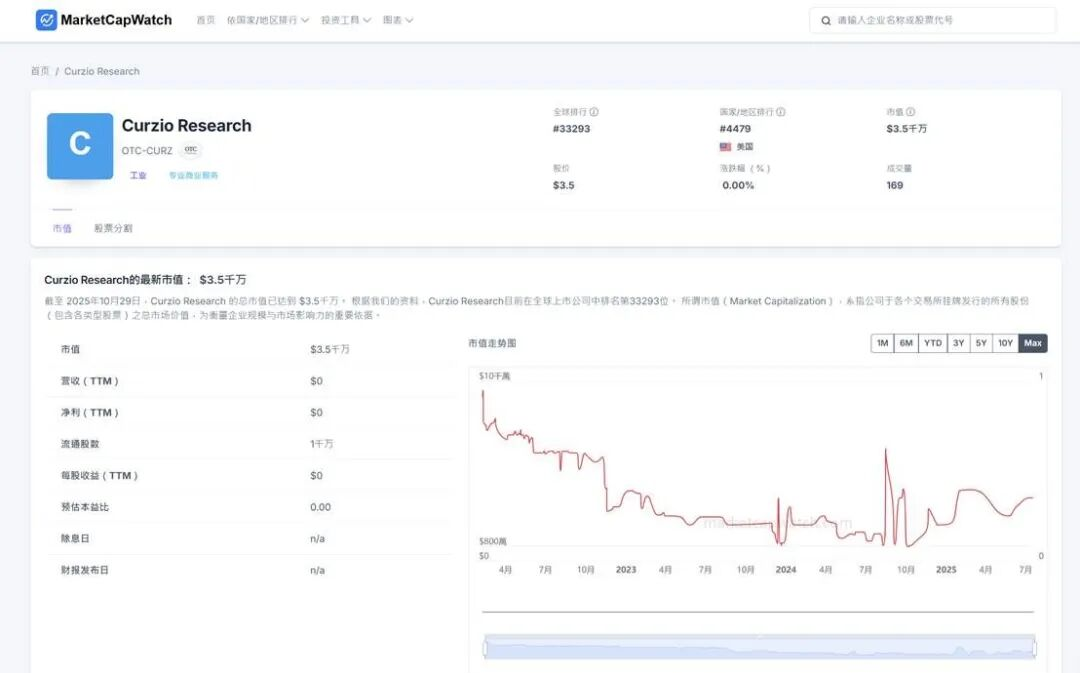
Data Source: MarketCapWatch
3. SPV Indirect Holding Model: The Mainstream "Regulatory Arbitrage" Path
The SPV indirect holding model is currently the dominant practice in private company equity tokenization. Its core architecture involves the issuance platform setting up an (often offshore) Special Purpose Vehicle (SPV), which holds the target company’s equity via the private secondary market, followed by the platform tokenizing the SPV’s beneficial certificates.
In terms of asset acquisition, the SPV obtains target equity through two main paths:
• First, leveraging the issuer’s core resources in traditional PE/VC sectors to directly acquire shares from private equity or venture capital funds holding the target company’s equity. In this structure, the holding SPV typically acts as a new LP (limited partner) in the fund, holding indirectly.
• Second, purchasing via private equity secondary market platforms (e.g., EquityZen, Forge Global, Hiive). While more standardized, this path may incur additional legal structuring costs and compliance risks.
Figure 11: SPV Indirect Holding Token Issuance Structure
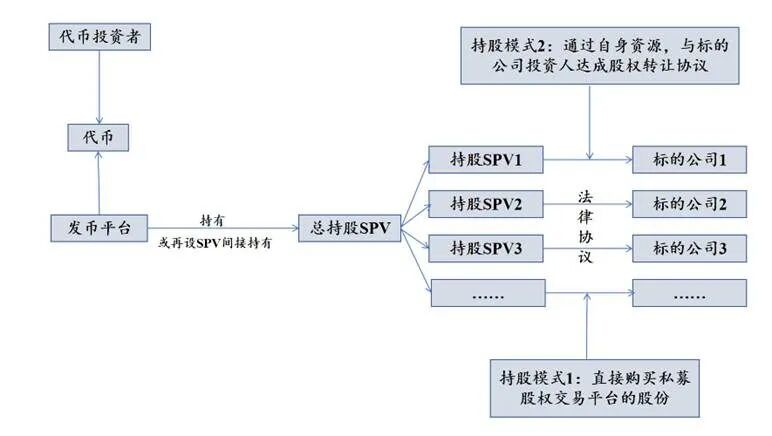
Data Source: Pharos Research
The key to this model is circumventing transfer restrictions in the target company’s shareholder agreement. Because the SPV’s acquired stake is usually small, and transactions (e.g., Path One) may be viewed as internal LP share transfers within the investor fund, disclosure to the target company is often unnecessary. This grants platforms temporary legal leeway to bypass the target company’s consent.
However, operations under this model are often opaque. Platforms use complex offshore SPVs to provide only one-sided transparency: investors can verify the SPV’s asset holdings (target equity), while the project team’s financial health and operational details remain in a "black box." This opacity is also evident in issuance models, which commonly fall into two categories:
• "Buy First, Issue Later" Model: The project team (and its subsidiary SPV) uses its own funds to first purchase the target company’s equity, then tokenizes the SPV-held shares and sells them to the public to recoup capital. This model is relatively stable, with assets secured upfront.
• "Issue First, Buy Later" Model: The project team first issues tokens to raise funds, then promises to use the proceeds to purchase the target company’s equity. This model carries higher risk—project teams may face insufficient fundraising, volatility in asset prices, or even failure to acquire the asset, creating significant uncertainty for investors.
Of course, this operational opacity is relative. Compared to completely unbacked "synthetic mirror" derivatives, the SPV model at least provides tangible equity backing, giving it relatively higher asset stability.
Yet the real concern isn't internal operational risk, but the external legal and compliance challenges posed by its "regulatory arbitrage" structure. Because private tokenization actions have drawn public opposition from some target companies (e.g., OpenAI), SPV holdings under this "regulatory arbitrage" model often face dual constraints from regulatory scrutiny (from governments) and corporate legal action (from target companies). The following sections will elaborate on this.
04 Reflection and Outlook
4.1 Proceed with Caution: Core Bottlenecks in Private Company Equity Tokenization
Despite its potential to reshape trillion-dollar markets, private company equity tokenization remains in its earliest stages and faces four critical unresolved bottlenecks.
1. Compliance Challenges: Dual Pressure from Government Regulation and Corporate Legal Action
Compliance is the foremost and most complex bottleneck facing private company equity tokenization today. Unlike tokenizing listed stocks, tokenizing private company equity must contend not only with securities regulation from bodies like the SEC, but also legal risks from the target companies themselves.
Particularly for the SPV indirect holding model, its essence is attempting regulatory arbitrage by circumventing transfer restriction clauses (Transfer Restrictions) in target company shareholder agreements. Recently, companies like OpenAI and Stripe have issued public warnings (as shown in Figures 8 and 9), stating clearly that SPVs behind such tokens violate transfer agreements, token holders will not be recognized as company shareholders, and such SPVs may face sanctions from the company.
Figure 12: OpenAI’s Announcement Warning Against Tokenized Equity
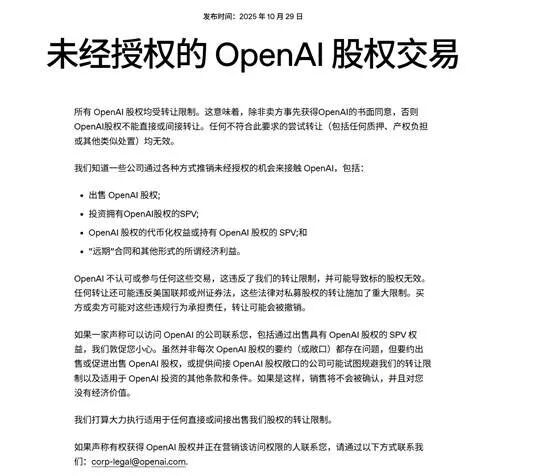
Source: OpenAI official website
Figure 13: Stripe’s Announcement Warning Against Tokenized Equity
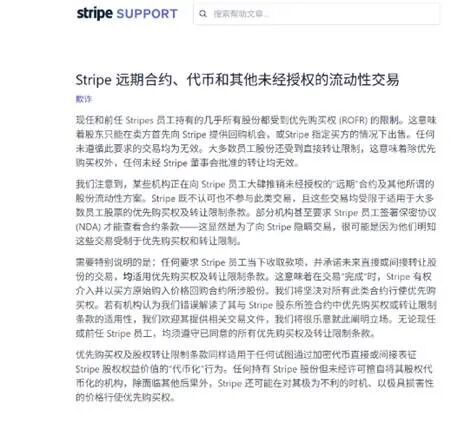
Source: Stripe official website
This risk has rapidly become reality. For example, Robinhood (which established an entity in Lithuania) launched OpenAI tokens in June 2025, received a public warning from OpenAI in July (as shown in Figure 10), and was subsequently investigated by Lithuanian regulators within a week. This dual pressure from government regulation and corporate legal action constitutes the biggest current compliance uncertainty.
Figure 14: X Post That Led to Robinhood’s Investigation
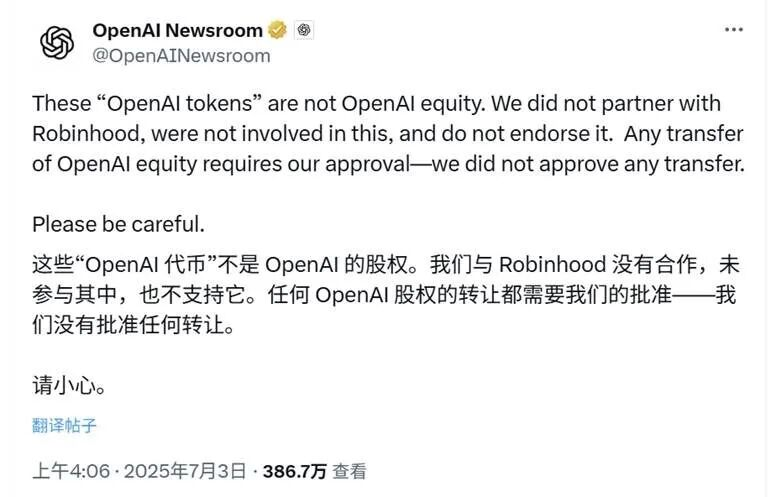
Source: OpenAI’s official X account
Nevertheless, it should be noted that there are certain mitigating mechanisms for such dual-pressure risks.
• On one hand, the complex SPV legal structures built by project teams objectively exploit legal gray areas in "transfer restriction" clauses. While target companies publicly oppose, it remains uncertain whether they can legally block such indirect transfers—and given the high time and cost of litigation, it's unclear if they have strong motivation to pursue legal action.
• On the other hand, only a minority of target companies (e.g., OpenAI, Stripe) have publicly expressed strong opposition, while many other top-tier firms (e.g., Musk’s SpaceX) adopt a "no comment" strategy, which the market interprets as tacit acceptance.
• More importantly, as crypto assets gain increasing acceptance in mainstream finance, corporate attitudes toward tokenization are dynamically evolving (e.g., some firms have begun adopting DAT treasury strategies). Therefore, companies currently opposed may eventually seek collaboration—this dramatic shift is possible. We assess that the core future evolution in this field hinges on whether the "SPV indirect holding" model can integrate with the "native collaborative" model, with the key turning point being the penetration of crypto assets into traditional finance and tech enterprises.
2. Unclear Price Discovery: Lack of Fair Value Anchoring
The pricing mechanism for tokenized equity also has significant flaws. Private company equity lacks continuous public market quotes, so its valuation anchor (e.g., last funding round) is infrequent, lagging, and opaque. When such non-standard assets are tokenized and placed in a 7x24 market, the effectiveness of their price discovery mechanism is severely tested.
For investors, it is difficult to judge the reasonableness of token prices—are they anchored to outdated funding valuations, or speculative premiums driven by market sentiment? This causes secondary market token prices to be more susceptible to market mood, leading to large swings and significant deviations from true primary market valuations. When target companies (or their sectors) experience extreme market fluctuations, this pricing mechanism lacking a solid value anchor may fail, and its potential risk transmission mechanism remains unclear.
3. Liquidity Challenges: Constraints from Market Depth and Scale
Although one core goal of tokenization is to unlock liquidity, current market performance shows this goal is far from achieved. As previously stated (Table 3), the market cap of freely tradable equity tokens (excluding Securitize, Archax) is extremely low, mostly in the millions of dollars, with trading scattered across DEXs (decentralized exchanges).
This combination of small market cap and fragmented trading leads to severe deficiencies in liquidity depth. Markets exhibit classic thin market characteristics: widened bid-ask spreads, and even moderately sized orders easily cause significant price slippage. This fragile market structure makes token prices highly vulnerable to shocks and large swings, failing to effectively accommodate large-scale exits by traditional shareholders and significantly increasing trading costs and risks for ordinary investors.
4. Poor IPO Transition: Endgame Risks for the SPV Model
When a tokenized private company (e.g., OpenAI) eventually pursues an IPO, the current SPV model faces major transition challenges. As warned by OpenAI and others, indirect holding via SPV may violate "transfer restriction" clauses, creating legal obstacles for the SPV controlled by the token issuer to register and convert its holdings into publicly tradable shares during IPO. If the SPV’s shareholder status is not recognized, its tokens cannot be converted into publicly tradable stocks, preventing value realization through public market sales, and possibly excluding it from future shareholder rights (e.g., dividends, rights issues).
To date, the only successful transition from a private company token to a public company stock is the Exodus case via Securitize. Even this compliant path wasn’t frictionless. During the nearly one-year transition when Exodus delisted from ATS platforms preparing for its NYSE American listing, tokenized equity trading almost completely halted (only compliant OTC remained), causing market liquidity to stall.
Moreover, once asset nature shifts from pre-IPO equity to public market stock, the complexity of compliance, clearing, settlement, and transfer agency increases dramatically. Most SPV-issuing project teams (mostly Web3 teams) generally lack the professional licenses (e.g., Broker-Dealer, Transfer Agent) and operational experience needed for post-IPO compliant securities. This operational gap adds new uncertainties about whether assets can smoothly transition to public markets, leaving the value realization path of the SPV model unclear at this critical endgame stage.
Naturally, facing this "endgame" challenge, some SPV model project teams are actively building compliance capabilities for listed stock tokenization (e.g., considering acquiring licensed securities brokers), while others propose alternative exit paths: after the target company’s IPO, the SPV (as an original shareholder) immediately liquidates all its stock upon lock-up expiration and distributes the fiat proceeds as "dividends" to all token holders. This path theoretically sidesteps the "token-to-stock" compliance hurdle, but its execution effectiveness, timing of liquidation, and project team credibility risks remain untested by market and time.
4.2 Outlook: Three Trends in Private Company Equity Tokenization
Despite the numerous bottlenecks above, private company equity tokenization—as one of the most imaginative fields in the RWA space—cannot overlook its potential to reshape traditional financial structures. We believe that after the current phase of "wild growth," the market will evolve along three key trends:
1. Evolution of Drivers: From "One-Way Arbitrage" to "Two-Way Integration"
The legal friction between the SPV model and target companies (e.g., OpenAI) clearly reveals the friction and limitations of bypassing issuers. Such actions directly breach core clauses in shareholder agreements regarding transfer restrictions, triggering legal risks and public resistance from companies (e.g., Stripe, OpenAI).
However, the real breakthrough driving the market forward may not come solely from external regulatory pressure, but from a shift in the target companies’ (private companies’) own attitudes—from passive defenders to active participants. As Web3 and crypto assets enter the view of Wall Street and traditional finance, tech companies’ understanding of tokenization is maturing rapidly. They are beginning to reassess the advantages of tokenization (e.g., STO) as an efficient, global capital strategy compared to traditional IPOs, including:
(1) Lower issuance costs;
(2) Access to a broader global pool of compliant capital;
(3) Gaining continuous price discovery and market cap management capabilities before IPO.
Therefore, the future mainstream path may not be a simple replacement of "SPV arbitrage" by "native collaboration," but rather a fusion and transformation. The divergence (OpenAI’s resistance vs. SpaceX’s silence) and dynamic evolution (e.g., some firms adopting DAT treasury strategies) in corporate attitudes make it highly possible that some currently opposed companies will dramatically seek active collaboration—much like countless celebrities and politicians have done with BTC.
We assess that the core future direction lies in integrating the "SPV indirect holding" and "native collaborative" models—whether the SPV model, with its flexibility and market sensitivity, can gradually gain issuer recognition and transform "regulatory arbitrage" into "issuer-led" compliant collaboration.
2. Infrastructure Evolution: From DEX Speculation to Deepening Native RWA Liquidity
The liquidity challenges of thin markets on current DEXs won’t be solved by retreating to traditional non-native systems like ATS. As crypto-tradable assets, their future lies in building and deepening genuine "on-chain native liquidity."
The next phase will focus on infrastructure development, including:
(1) Widespread multi-chain and L2 deployment, bringing assets to new ecosystems like Solana and Base with massive user and capital bases;
(2) Emergence of dedicated RWA protocols, and DEXs built on them specifically offering order books, market-making, and clearing services for security tokens (not memecoins);
(3) Project teams building proprietary exchanges or dedicated liquidity layers to manage their token’s secondary market in a more centralized, efficient manner (under compliance), ensuring stable depth.
3. Evolution of Underlying Assets: From Super Unicorns to Long-Tail Private Companies
The current market is highly concentrated on star unicorns like OpenAI and SpaceX, largely for marketing purposes to capture attention. However, these top-tier firms are often well-funded with robust legal mechanisms, and their shareholder agreements pose the strictest legal challenges and resistance to SPV-based tokenization. In contrast, mid-to-late stage, non-top-tier unicorns—and even certain mature private companies—may have stronger incentives for proactive collaboration.
Based on this, another vast blue ocean for tokenization may lie in serving tens of thousands of mature private companies seeking exit paths beyond IPO. As demonstrated by the Curzio Research case, these long-tail value companies may have no immediate IPO plans, but their employees and early investors face pressing liquidity needs. When these companies actively seek partnerships with native liquidity platforms, the private company equity tokenization market will truly shift from marketing-driven to utility-driven, entering a phase of scalable explosion and unlocking its real market potential.
05 Conclusion
Private company equity tokenization aims to solve the problem of the world’s largest yet most illiquid multi-trillion-dollar asset "fortress." Through analysis of market size, core pain points, mechanism advantages, mainstream models, and future challenges, this report draws the following conclusions:
First, the market shows a stark contrast between "trillion-dollar potential" and "millions in reality," remaining in an extremely early stage. On one hand, private company equity represented by unicorns is a multi-trillion-dollar "fortress" plagued by "difficult access" (high barriers prevent investor entry) and "difficult exit" (long lock-ups prevent PE/VC and other holders from exiting). On the other hand, starkly contrasting this huge potential, the current freely tradable token market cap (after excluding sandbox and ATS projects) is only in the tens of millions. This indicates the market is still in its earliest infancy, with core functions like price discovery and liquidity release far from realized.
Second, current models show diversified exploration paths. The market has split into three models: Native Collaborative (e.g., Securitize) represents the ideal compliant path but has long deployment cycles and few cases; Synthetic Mirror (e.g., Ventuals) is purely Web3 derivatives; while SPV Indirect Holding (e.g., PreStocks, Jarsy) is the current primary practice, flexibly exploring the market first but needing improvement in issuer communication and IPO final-stage alignment.
Third, the core of future market evolution is "integration and transformation," not simple "replacement." The SPV model, as a flexible pioneer validating market demand, faces current challenges in regulatory compliance, IPO final-stage alignment, and insufficient liquidity—challenges that are pushing it toward more mature models. The future core driver will be a shift in private companies’ (issuers’) own attitudes—that as Web3 becomes increasingly mainstream, real-world enterprises begin proactively viewing tokenization (STO) as a new, efficient financing and market cap management tool. This cognitive maturity will shift the SPV model from one-way market exploration to compliant collaboration with "issuer participation."
Fourth, the blue ocean of long-tail private companies and the deployment of native infrastructure are keys to scalable explosion. The true blue ocean for tokenization extends beyond super-unicorns to the broader long-tail of mature private companies seeking exit paths (as shown by the Curzio Research case). When these utility-driven issuers combine with tailor-made "native RWA liquidity infrastructure" (e.g., dedicated RWA protocols, L2 deployment), the private company equity tokenization market will truly move from a "marketing-driven" prelude to a "utility-driven" phase of scalable explosion.
In conclusion, private company equity tokenization is at a critical juncture transitioning from spontaneous market exploration toward "ecosystem-compliant collaboration." This sector is undoubtedly one of the most worthy long-term focuses in the RWA and broader crypto finance space. Its ultimate form remains to be determined by time and market forces, but once this door opens, it may herald the dawn of an entirely new financial paradigm.
References
[1] Kumar, S., Suresh, R., Kronfellner, B., Kaul, A., & Liu, D. (2022, September 12). Relevance of on-chain asset tokenization in “crypto winter”. Boston Consulting Group & ADDX.
[2] Citi Global Perspectives & Solutions. (2023, March 30). Money, Tokens, and Games: Blockchain’s Next Billion Users and Trillions in Value. Citigroup.
[3] Hurun Research Institute. (July 2025). Press Release: Global Unicorn Index 2025
[4] CB Insights. (July 2025). The Complete List of Unicorn Companies. CB Insights official database
Join TechFlow official community to stay tuned
Telegram:https://t.me/TechFlowDaily
X (Twitter):https://x.com/TechFlowPost
X (Twitter) EN:https://x.com/BlockFlow_News