5 promising new projects in the robotics sector worth watching
TechFlow Selected TechFlow Selected
5 promising new projects in the robotics sector worth watching
Blockchain encryption empowers robots with autonomous interaction, enabling new economic models.
 Navigating Web3 tides with focused insights
Author: Schizoxbt, Castle Labs
Translation: TechFlow
This week, we're skipping the market overview update and instead introducing you to a field we believe will be one of the year's hottest topics: robotics.
Introduction
In the early 2000s, a scholar named Ray Kurzweil made an interesting observation. He noticed that the pace of technological advancement was accelerating, with each new invention yielding exponential returns over time. For example, the discovery of fire led to metallurgy, which enabled machine development, which in turn facilitated the creation of computers, and computers drove advances in more sophisticated chip technologies and artificial intelligence, and so on.
The creation of new technologies accelerates along this path, forming a feedback loop that enables humanity to continuously explore new frontiers. We acquire better tools, which accelerate research speed, and faster research allows us to produce even better tools, thus speeding up the next cycle.
This brings us to where we are today.
In a short period of time, it feels as though we've stepped into a future where artificial intelligence is rapidly advancing, self-driving cars are becoming reality, cryptocurrencies circulate widely as internet money, and now robotics is beginning to emerge.
A robot-driven new era is expected to bring labor prosperity, with humanoid robots capable of performing various general-purpose tasks. Robots don't need rest, take vacations, or incur high labor costs—making them far more cost-effective than humans.
Businesses are gradually realizing they can deploy entire warehouses full of robots at a cost far lower than human labor. This represents a massive breakthrough for enterprises.
Where do cryptocurrencies fit into all this? Cryptocurrencies can integrate with robotics across three distinct layers: financial, coordination, and infrastructure. The following sections will dive deep into the robotics tech stack and highlight some intriguing projects at the intersection of crypto and robotics.
Understanding the Three Layers of the Robotics Tech Stack
Here’s how cryptocurrencies integrate into the robotics tech stack:
-
Financial Layer
-
Cryptocurrency introduces a new financial rail for robots, enabling trustless and programmable income and payments.
-
Robots can possess cryptocurrency wallets, allowing them to receive and send micropayments not feasible with traditional payment methods. This becomes especially important in a future where billions of robots autonomously interact, as blockchain technology can support interactions at this scale.
-
Decentralized autonomous organizations (DAOs) can also raise funds through tokenization, partially funding ownership of robots or robot fleets, opening up new investment/ownership pathways for investors.
-
Coordination Layer
-
The key to efficiently operating robot networks lies in coordination—task allocation, work verification, incentive alignment, etc.
-
Smart contracts can serve as coordination logic, with all task assignments, payments, and confirmations executed and verified on-chain.
-
Governance mechanisms can also be used for fleet upgrades, deployment zones, pricing, and other decisions, voted on by token holders or automatically enforced.
-
Infrastructure Layer
-
Robots require shared infrastructure to operate, including positioning systems, maps, communication networks, identity systems, and computing power. If robots are to play significant roles in society, they’ll need maps to navigate human-designed environments, real-time location awareness, and the ability to communicate or identify other robots. Cryptocurrency offers an open/decentralized approach to building these capabilities instead of relying on centralized infrastructure like Google Cloud or AWS.
-
Robots need precise positioning, and Real-Time Kinematic (RTK) technology provides centimeter-level accuracy via GPS. This level of precision is crucial for autonomous movement and navigation.
-
To prove identity, each robot can have a cryptographic wallet to demonstrate authenticity, sign telemetry data, verify proof-of-work, and build on-chain reputation.
Now that we’ve covered how cryptocurrency integrates with robotics, let’s examine how these technologies function in practice and highlight some notable crypto x robotics projects.
peaq - @peaq
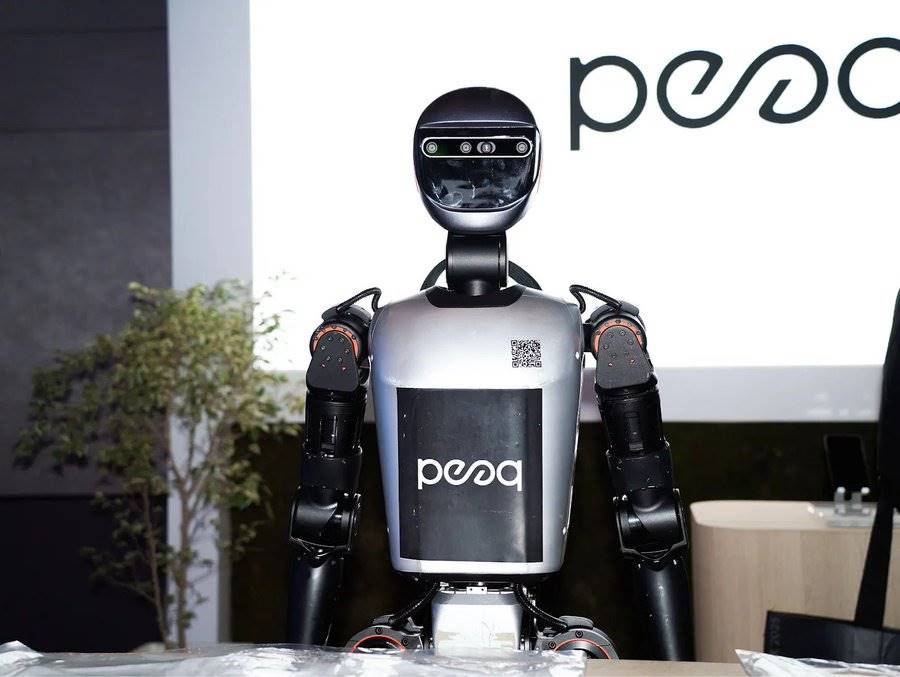
Many may already be familiar with peaq, but in the crypto space, it currently holds the largest market cap among robotics-related tokens, making it hard to ignore.
peaq is an L1 built as a backbone for the machine economy, treating machines, robots, and devices as first-class citizens. This means any type of machine—land, air, sea, or space—can have applications built for it on peaq.
Machines want to build apps on peaq because these apps can transform them into autonomous economies capable of earning money, coordinating actions, and self-upgrading, while developers gain access to the entire machine economy.
These machines thus become native participants on-chain. peaq already has over 3 million machines connected, and that number continues to grow.

In recent months, peaq has announced the following achievements:
-
Robotics SDK: Enables developers to easily connect machines to the blockchain and grant robots autonomous identities, allowing them to pay, receive payments, and verify data.
-
The world’s first tokenizedrobot farm: Supplying vegetables to local communities.
-
The first robot withautonomous identity.
Additionally, peaq offers various plug-and-play modules, allowing teams to avoid rebuilding core infrastructure from scratch. This is a critical advantage, positioning peaq as a Robotics Infrastructure-as-a-Service provider. It’s a game-changer for developers who can skip infrastructure setup and go straight to product launch.
As peaq positions itself as the financial, coordination, and identity layer for machines, it has strong potential to become a leader in this space.
These layers are essential components at the intersection of crypto and robotics, bringing financial economies to all machines and enabling scalable growth with demand—without having to rebuild these systems from the ground up. If robots grow as predicted, millions of autonomous robots could engage in large-scale buying, selling, and interaction.
Currently, $PEAQ has a market cap of approximately $125 million and trades around $0.09. As more projects adopt peaq's SDK and leverage its machine economy, peaq is well-positioned to further advance the crypto x robotics ecosystem.
Auki - @AukiNetwork
Robots need to interact with and navigate the human-built world—a process requiring extensive spatial processing. They must be able to turn corners, cross sidewalks, know when to use crosswalks, and handle many other tasks we often take for granted.
Auki has developed a technology called posemesh, which they describe as “a decentralized machine perception network and collaborative spatial computing protocol designed to allow digital devices to securely and privately exchange spatial data and computational resources, forming a shared understanding of the physical world.”
Ideally, this technology could help transform the physical world into a searchable, browsable, and navigable environment, supporting robots in developing spatial awareness. Auki is essentially building a decentralized nervous system for machines.
Through posemesh, devices can request and contribute sensor data, computing power, storage, and other services. With such a diverse range of possible applications, layers, and datasets, Auki enables different machine profiles to both contribute value to and extract value from the network.
Currently, $AUKI has a market cap of about $78 million and trades around $0.02. Recently, Auki mentioned exclusive partnership talks with one of China’s largest robotics companies and potential integration of its AR navigation tech into airlines—both serving as major catalysts for future growth!
Geodnet - @geodnet_

We previously mentioned RTK in this report, but let’s dive deeper: RTK stands for Real-Time Kinematic positioning—an advanced technique built atop standard GPS/GNSS that delivers centimeter-level accuracy, a foundational infrastructure requirement for robots, drones, autonomous vehicles, and spatial intelligence networks.
This infrastructure enables machines to reliably navigate, map, and coordinate within the physical world. Without RTK, their positional errors could span several meters, making autonomous movement, precise task execution, and on-chain data validation nearly impossible.
Typically, RTK requires a GNSS (Global Navigation Satellite System) base station and a rover.
The rover is the robot or drone receiving GNSS signals, estimating its position, and using correction data from nearby base stations to achieve real-time centimeter-level accuracy.
Geodnet is a decentralized RTK network that incentivizes base station operators through its native token. It’s recognized as the largest RTK correction service provider and has gained notable attention even in mainstream GNSS circles.
Currently, $GEOD has a market cap of approximately $42 million and trades around $0.13. Just days ago, they announced pre-orders for handheld GNSS RTK receivers—a potential catalyst for future growth.
CodecFlow - @codecopenflow

CodecFlow is a Solana-based project aiming to become the execution layer for robots and AI agents. Essentially, their goal is to give AI agents physical presence and action capabilities—not just thinking or communicating. This opens up numerous possibilities, as current AI agents lack the ability to perform physical tasks at scale in the real world.
To achieve this, CodecFlow employs Vision-Language-Action (VLA) models.
These models enable agents to:
-
Capture environmental information via cameras or screens;
-
Use AI models to understand dynamics within the environment;
-
Take actions through software or physical actuators.
CodecFlow's tech stack consists of two core components: Fabric and Operator Kit (OPTR).
-
Fabric: Acts like an intelligent router for computing power, serving as a unified orchestration layer that intelligently schedules workloads across cloud providers and routes them to the cheapest available GPUs or compute resources. This allows developers to assign robotic agent tasks to the most cost-effective cloud options without being locked into expensive ones.
-
Operator Kit: A developer toolkit for programming these agents. It enables creators to build agents that can perceive, make decisions, and act reliably—standardizing workflows and enhancing agent robustness and scalability.
Currently, $CODEC has a market cap of about $13 million and trades around $0.018. With the August release of the Operator Toolkit and integration with peaq's MachineDex, CodecFlow has strengthened its narrative within the robotics space.
Silencio - @silencionetwork

Sound is a sensory input rich with environmental information—car horns, sirens, even a baby crying.
For humans, understanding everyday sounds takes years of learning and experience, and equipping robots with this ability isn’t easy. For instance, autonomous delivery robots need to recognize auditory cues like emergency sirens.
Silencio is building this auditory layer, allowing anyone with a smartphone or sensor to become a node in its network. With enough collected sound data, robots can gain necessary environmental awareness and audio recognition capabilities.
Silencio already covers over 180 countries, with daily active nodes, more than 1,300 years of accumulated sound data, and over 1 million contributors uploading data to the network.
Currently, $SLC has a market cap of approximately $6 million and trades around $0.0002. In a September keynote, Silencio demonstrated the importance of sound data for the future of robotics. If they continue expanding this competitive moat, their growth potential is enormous.
Is This the End or Just the Beginning?
While this may conclude our report, the age of robotics is far from over—and certainly not the end of the crypto x robotics space. This remains an emerging field, and as time progresses, the world will continue moving toward these industries.
Currently, the market cap of robotics-related stocks is about $112 billion, while the crypto x robotics sector sits at roughly $404 million. This indicates ample room for growth ahead.
There are many more projects worth discussing and many ways to interpret the potential of robotics. It’s a broad and rapidly expanding topic, likely to grow exponentially over time—as Kurzweil predicted.
Soon, we may grow accustomed to humanoid robots helping with household chores at home, just as we now accept seeing self-driving cars on roads.
The future will only get stranger.
As the industry continues evolving, this article is not a complete summary. If we missed any projects or if you have insights on others worth watching, please let us know.
Join TechFlow official community to stay tuned
Telegram:https://t.me/TechFlowDaily
X (Twitter):https://x.com/TechFlowPost
X (Twitter) EN:https://x.com/BlockFlow_News
 @castle_labs