Huang Renxun's latest interview transcript: AI robots expected to achieve mass production and application within five years
TechFlow Selected TechFlow Selected
Huang Renxun's latest interview transcript: AI robots expected to achieve mass production and application within five years
"AI competition is an infinite game, and the ultimate winner is not the country that invents the technology, but the one that can apply it at scale and with high efficiency."
 Navigating Web3 tides with focused insights
On May 3, NVIDIA CEO Jensen Huang was interviewed at the The Hill & Valley Forum, where he discussed the core concept of "AI factories," explained the development stages of "physical AI," and explored the global landscape of the AI race, as well as how AI and digital twins empower advanced manufacturing.
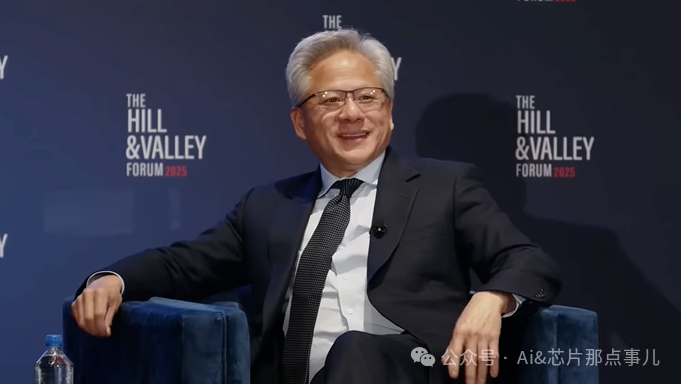
Huang stated that the AI race is an infinite game, and the ultimate winners will not be the countries that invented the technology, but those capable of applying it at scale and with high efficiency. He also predicted that AI-powered robots, due to their constrained operating environments, will achieve mass production and widespread adoption within five years—faster than autonomous vehicles.
Below is a transcript of the dialogue:
01 AI Factories Will Reshape Every Industry by Mass-Producing "Intelligent Tokens"
Host: You've positioned AI as a new industrial revolution, placing AI factories at its core. Can you explain what an AI factory is, and why understanding it is crucial in the 21st-century economy? Moreover, do you consider this a paradigm shift in modern computing? In the future, will every physical factory producing tangible goods have a corresponding AI factory?
Jensen Huang:
We've had many discussions about AI over the past few years. It has multiple dimensions, and viewing it from the following perspectives can be helpful. First, AI is undoubtedly a new technology. It's built differently from previous software, enabling it to perform tasks that traditional software could not. Therefore, it's an extraordinary technology: full of potential, requiring efforts to ensure safety, and bringing many exciting changes. That's the technological level.
The second layer is relatively new. In past tech industries, software was produced by humans typing code. Now, a new industry has emerged where machines produce software. This requires large supercomputers powered by electricity to generate tokens. These tokens can be reconfigured into various forms—numbers, text, proteins, images, video, 3D structures—we call this intelligence. This kind of machine is fundamentally different from past machines. I call it an AI factory because it focuses on one thing: continuously producing tokens every day.
The higher level is infrastructure. Precisely for this reason, we increasingly recognize that AI is highly likely to trigger a profound industrial revolution. This new technology will not only give rise to the new industry I just mentioned—the AI factory, which produces intelligence—but will also completely transform all other industries. These tokens will be applied in healthcare, education, financial services, engineering. We already use AI daily for software programming and supply chain management. AI is about to enter more fields like manufacturing. Viewing AI from these three layers, its transformative power and impact are comparable to electricity in the past—it will revolutionize every industry. Thus, this is a genuine industrial revolution.
Regarding the future of AI factories, I believe it's absolutely correct. Today, any company manufacturing mechanical products—for example, a lawn mower manufacturer or heavy equipment makers like Caterpillar—whose products currently rely mainly on human operation—will in the future achieve autonomy, high autonomy, semi-autonomy, or assisted operation. Once autonomous, they will be software-defined. Then, companies must produce the tokens (i.e., software) that drive these devices (such as tractors). In the future, every product manufacturing company will have, in addition to its physical factory, another factory dedicated to producing the AI that powers its products. Looking at the automotive industry makes this clear: today’s car companies primarily manufacture cars, but within ten years, all car companies will undoubtedly also produce the tokens running inside their vehicles.
02 Physical AI with Reasoning Capabilities Is Crucial for Real-World Industries Like Manufacturing
Host: Over the past year, you've discussed the concept of physical AI. For policymakers thinking about America's future, could you explain what physical AI is, and how we should view it?
Jensen Huang:
Let's look back. Modern AI truly entered the public eye about 12 to 14 years ago, with the advent of AlexNet and major breakthroughs in computer vision around 2012. From a broader perspective, computer vision at that time was essentially perception—perceiving the world, whether images, sound, vibration, temperature, or any form of information. Today, we've developed AI models that understand the meaning of various information and exhibit intelligent behavior. Thus, the first wave of AI was perceptual AI. About five years ago, people began discussing the second wave: generative AI. The essence of generative AI is that AI models not only understand meaning but can also transform information—for instance, translating English into French, or turning text descriptions into images—generating images from prompts. Generative AI is essentially a universal translator that understands human language. That's the second wave.
The current wave is that AI has both understanding and generation capabilities. However, true intelligence also requires solving unknown problems and identifying entirely new situations. We do this through reasoning: using learned rules, patterns, and principles to break down problems step by step, finding solutions even for novel challenges. This is one of the core abilities of intelligence, marking our entry into the era of reasoning AI. Reasoning AI generates digital robots—we call them AI agents—which possess autonomy. These AIs can understand tasks, autonomously learn to read, use calculators, browsers, spreadsheets, and ultimately complete assigned jobs—like accessing SAP to handle supply chain operations or connecting to Workday to manage HR. These agent-based AIs are essentially digital labor robots. In the future, our generation of CEOs will manage both biological and digital workforces, with traditional HR departments handling the former, while IT departments evolve into "HR centers" for agent-based AI. This is where we are today.
The next wave will benefit the largest industries globally. It requires AI to understand fundamental concepts like physical laws, friction, inertia, and causality. For example, when an object is knocked over, it falls; a bottle on a table won’t pass through it. These commonsense physical reasoning skills, which even children and pets possess, most AI lacks. If a ball rolls off a kitchen counter and disappears, AI might think it's gone forever, but a dog knows it's on the other side. Dogs understand object permanence—they know the ball hasn't entered another metaverse—and will go around to retrieve it.
Robots need to learn similarly: to get from one side of a table to the other, they can't go straight through—they must reason out a path around it. This kind of physical reasoning is physical AI. Embedding physical AI into a physical entity called a "robot" gives us robotics. This is critically important now because factories are being heavily built across the U.S. We want to build these facilities using the latest technologies. Therefore, we hope the new generation of factories built over the next decade will be highly roboticized, helping us address the severe global labor shortage.
03 The AI Race Is an Infinite Game; Winners Are Nations That Apply Technology at Scale and Efficiently
Host: Many believe we're in a global AI race. What actions should the U.S. government take to win this race and master the most advanced AI technology?
Jensen Huang:
First, to participate and win, you must understand the game itself: know your resources, assets you have and lack, strengths and weaknesses. Recognize that AI is foundational. Revisiting the three layers I mentioned earlier, we must ensure understanding of the rules at each level. This game isn't limited to 60 minutes—it's an infinite game. Most people aren't good at infinite games. Nvidia has been around for 33 years, going through the PC revolution, internet revolution, mobile revolution, and now embracing the AI revolution. To sustain growth in a constantly changing environment, you must know how to play the game. Understanding the rules and knowing your assets is critical.
At the technology level, the key is understanding knowledge capital. Know that half of the world's AI researchers come from China—we must acknowledge this significant factor and incorporate it into our strategy. Second is the AI factory, whose efficient operation depends on energy because it essentially converts electricity into digital tokens. Just as the last industrial revolution used energy to turn atoms into steel, cars, buildings; earlier, hydropower drove generators to produce electricity. Now, electricity goes in, tokens come out. Therefore, energy is key at the next level.
The higher level is gradually emerging, and we must deeply understand: the ultimate winners of the last industrial revolution were not the countries that invented the technologies, but those that best applied them. The U.S. far surpassed others in applying steel and energy. Therefore, at this infrastructure level, the core is application—not fearing the technology, actively embracing it, retraining the workforce for new technologies, and encouraging broad adoption. Viewing AI through this lens and framework reveals unique challenges, opportunities, and rules at each level.
04 AI Factories Will Create Demand for Numerous New Skilled Technical Jobs
Host: Regarding labor, media often emphasizes narratives that AI may cause massive job displacement and unemployment. Could you share your outlook on how AI will affect the job market? More specifically, what new job categories do you foresee emerging—ones we haven't even imagined yet?
Jensen Huang:
New jobs will be created, some will disappear, and every job will change. People easily swing between extremes, but I always believe breaking down problems and thinking from first principles is beneficial. In the framework I described earlier, at the foundational level—you're deeply involved in venture capital and aware of AI dynamics—AI is precisely what has revived San Francisco. Almost everyone left San Francisco; now it's thriving again, entirely thanks to AI. AI creates new jobs fundamentally because it's a new way of developing software. AI changes every technical layer. Previously, manually written software ran on CPUs; now, machine-learning-generated software runs on GPUs. Thus, every layer—tools, compilers, methodologies, data collection and management, using AI to set safety guardrails, using AI for training, using AI to secure AI itself—all these technologies keep emerging and create massive employment opportunities.
A higher layer holds enormous opportunity. As I mentioned, we'll build new factories that input electricity and output tokens. Take a 1-gigawatt factory, for example—we expect clusters of AI factories reaching 7 to 10 gigawatts in the future. A 1-gigawatt factory involves investment up to $60 billion. Currently, a 100-megawatt factory is already quite common. This $60 billion investment equals Boeing's annual revenue. Financing such factories creates many jobs. Constructing sites and building shells drives construction employment—carpenters, steelworkers, masons—all essential talents. A $60 billion factory is extremely large-scale. It will require mechanical engineers, electrical engineers, plumbers, and later specialists in low-voltage systems, IT, and networking, followed by operational teams. The entire construction cycle takes about three years. This will spawn numerous new skilled technical roles. In past computing industry transitions, the main bottleneck for company growth was the shortage of software engineers.
At this new level of AI factories, the most critical talent will be skilled technicians—people with specialized crafts. I think this is excellent. Our nation must recognize that skilled craftsmanship is a respected and vital job, indispensable for national development. Therefore, we should encourage cultivating such talent. Electricians, plumbers, carpenters, steelworkers—all fields need abundant such personnel.
At a higher level, we can discuss how AI agents will change the work of doctors, financial professionals, or customer service staff. In our company, for example, every software engineer now has an AI assistant as a pilot program. The result is astonishing growth in newly generated code. Our productivity has surged, allowing us to hire more people because AI enables us to create more market-demanded products, increasing revenue and hiring capacity. Therefore, I believe higher-level applications should embrace AI early. Remember, it's not AI that will take your job, nor will AI destroy your company—it's companies and individuals who skillfully use AI. This is worth reflecting on and accepting.
05 AI and Digital Twin Technologies Are Core to Advanced Manufacturing
Host: Recently, there's been intense discussion about manufacturing reshoring. Many AI experts have discussed the concept of digital twins and how adopting this technology in manufacturing plants can genuinely aid the revival of domestic manufacturing. Meanwhile, Apple's CEO recently noted that one major bottleneck for bringing iPhone manufacturing back home is the lack of high-quality, high-precision robotic arm technology. So overall, AI does seem to be a key enabling technology for advancing manufacturing and industrial reshoring. What's your outlook on this?
Jensen Huang:
First, the core of manufacturing is not low-cost labor. Today's advanced manufacturing means the entire factory is software-driven. The whole factory functions like a giant robot, coordinating the operation of numerous internal robots. While these advanced factories have many employees, they are essentially technology-led. I believe the first point—in our industry (just taking my own industry as an example)—achieving end-to-end manufacturing from chips to AI supercomputers on U.S. soil is an excellent opportunity. I welcome the government actively encouraging and supporting industry efforts to bring manufacturing back home. This is high-quality, high-tech work, and doing it domestically is a great opportunity for the nation. I'm passionate about this, we're strong advocates of this trend, and we're glad global partners support it. That's one.
Second, if we don't excel in manufacturing, we’ll miss a massive industry whose future will be driven by energy availability. Which country wouldn't want to join this new AI industry? Why wouldn't they want to produce AI? Why avoid the most advanced manufacturing? It's essentially manufacturing. Its final output is digital, just as the last industrial revolution’s output was electronic—back then, most people couldn't grasp how generators could create electricity. Today we call them Nvidia AI supercomputers. But at the time, generators produced invisible electricity—intangible, unseen, yet real electrons. Now, it's a new form of "electrons"—digits. Therefore, we certainly want to engage in this new industry, and to do so, we must have domestic manufacturing.
Given the technical intensity of manufacturing, we should first build in digital twin environments, then operate in virtual reality environments. Nvidia designs the world’s most complex systems. Our R&D investment per product generation is about $20 billion, possibly higher now, but that $20 billion is only for producing one chip series. We design everything entirely within digital twins of these chips. Months before actual manufacturing, they already exist as digital models. When the chip launches, I know it will be perfect because we’ve thoroughly simulated, emulated, and rigorously tested it. Digital factories should be the same. Especially large factories should fully create their digital twins, using AI to build and operate them—achieving virtual integration, digitally integrating these grand structures completely, then operating, optimizing, and planning fully digital outputs. In the future, every factory, every car, every building, every city, and even I hope every person, will have a digital twin. The concept of digital twins is thus becoming real, all thanks to artificial intelligence.
06 AI Robots Expected to Achieve Mass Production and Application Within Five Years
Host: When do you expect AI-powered robots to become ubiquitous in our daily lives?
Jensen Huang:
First, autonomous vehicles are a type of robot. It took us about 10 years to reach the current stage. Waymo is now operating in many cities nationwide with excellent performance. Seeing Waymo cars driving in cities like San Francisco is encouraging. That took about 10 years. Robots will take less time. Because we can constrain robots’ operating environments. So robots don’t need to be as universally capable as cars. Once a car enters San Francisco, it must adapt to every street and road condition. But for robots, we can impose more constraints. From prototype development, functional refinement to mass production, it will take about five years. We already have powerful robots today. Therefore, in about five years, we’ll see robots rolling off factory lines in large numbers. Companies that currently make cars will in the future be very skilled at making robots. They just need to improve in software and AI, and the relevant technologies are already widely available.
Join TechFlow official community to stay tuned
Telegram:https://t.me/TechFlowDaily
X (Twitter):https://x.com/TechFlowPost
X (Twitter) EN:https://x.com/BlockFlow_News