Zhihui Jun and robots, inseparable from bicycles
TechFlow Selected TechFlow Selected
Zhihui Jun and robots, inseparable from bicycles
Performed in an almost magical way, but everyone is more curious about how it was achieved.
 Navigating Web3 tides with focused insights
Author: Lafeng de Geek
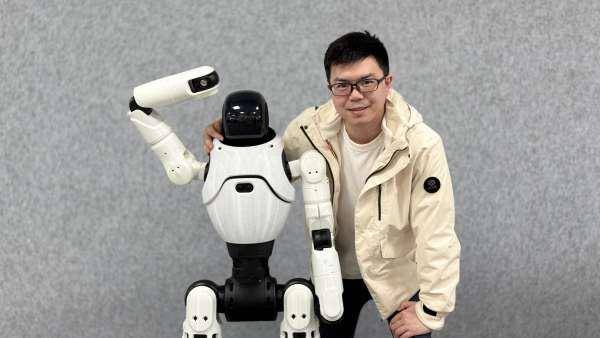
In June 2021, Zhihui Jun released a video on Bilibili showcasing a "self-driving bicycle," which quickly went viral and later earned him the title of "Huawei Genius Youth."
Four years later, now an entrepreneur, he has once again captured public attention with a “bicycle.” This time, however, there’s a “human” on it.
On March 11, 2025, after revealing its robotic foundation model GO-1, Agibot unveiled its latest product: the Lingxi X2 robot. As expected, in the demo video Lingxi X2 not only dances the “Ke Mu San” (a popular Chinese dance), but also uses its dexterous hands to "sew grapes." Of course, there's also Zhihui Jun’s signature bicycle act—Lingxi X2 riding a bike reaffirms that the bicycle remains his true "soul artifact."
Lingxi X2 doesn't just excel in movement—it even has its own “personality,” playfully teasing humans or acting cute for attention.
Can Agibot’s Lingxi X2 truly enter ordinary households? Could it become a lovable pet or companion?
Motion and Stillness Combined: Exceptional Mobility
Another bicycle stunt!
After keeping fans waiting for two years, Zhihui Jun—the once-celebrated “wild Iron Man” known for his self-balancing bike project—first introduced the ViLLA architecture and large model GO-1 on March 10. Then, the next day, he delivered another showstopper: this time, his Lingxi X2 robot took the spotlight, skillfully riding a bicycle with autonomous balance, precise pedal control, and body-leaning during turns to prevent falls—all executed with remarkable smoothness:

Lingxi X2 riding a bicycle|Image Source: Agibot
This performance is made possible by Lingxi X2’s 28-degree-of-freedom design, achieved without any parallel-linkage structures. Parallel mechanisms typically require complex transmission systems and multi-joint coordinated control, whereas Lingxi X2 adopts a purely serial configuration, avoiding common mechanical interference issues found in parallel designs and significantly reducing system complexity.
Such freedom of motion would be wasted if not used for dancing. Sure enough, it performs the viral “Ke Mu San” dance:
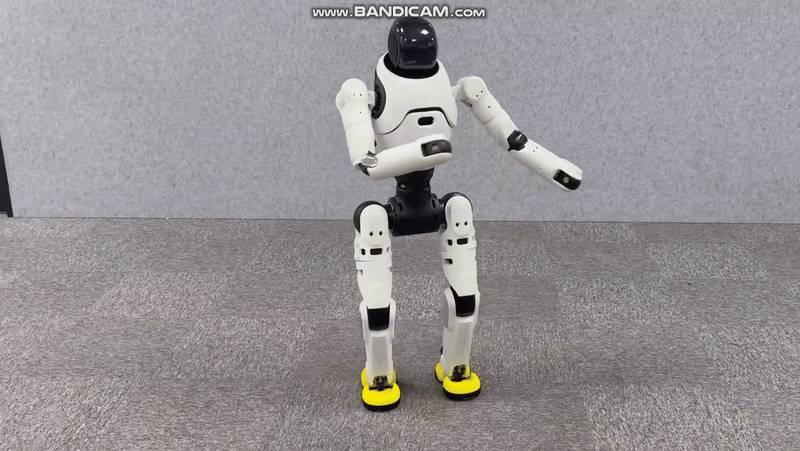
Lingxi X2 busts a move|Image Source: Agibot
The serial structure reduces coupling between joints, lowering failure risks and enhancing overall motion stability. Combined with deep reinforcement learning and imitation algorithms, Lingxi X2 can perform high-difficulty human-like movements such as walking, running, and cycling with ease.
But riding a bicycle isn’t just about agile limbs—it also requires cerebellum-level coordination. To address this, Agibot developed its proprietary “Cerebellar Controller Xyber-Edge,” paired with the “Intelligent Power Management System Xyber-BMS,” achieving breakthroughs in motion control algorithms. By abandoning parallel structures, the “Xyber-Edge” controller and deep reinforcement learning enable highly accurate dynamic balance control.
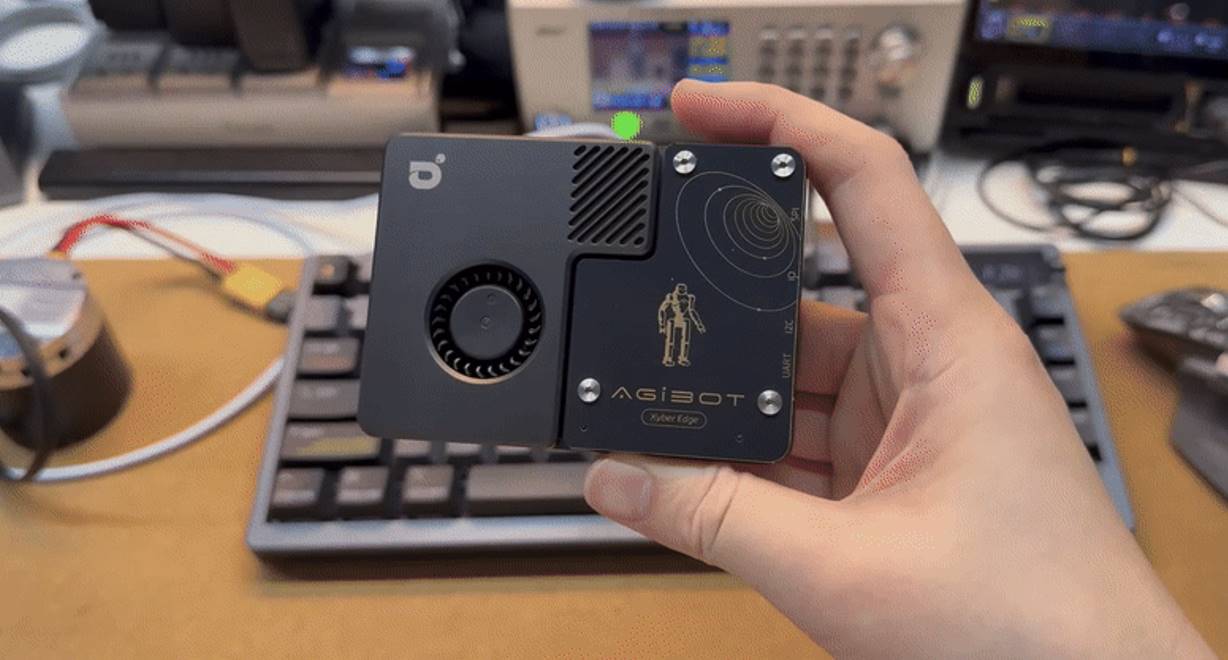
Agibot team reveals some components in the video|Image Source: Agibot
In motion control, Lingxi X2 abandons traditional model-dependent methods, instead adopting learning-driven reinforcement strategies. Its generative motion engine, based on diffusion models, integrates the strengths of reinforcement and imitation learning, enabling the robot to rapidly master complex motor skills. Thus, X2 confidently rides hoverboards and scooters:
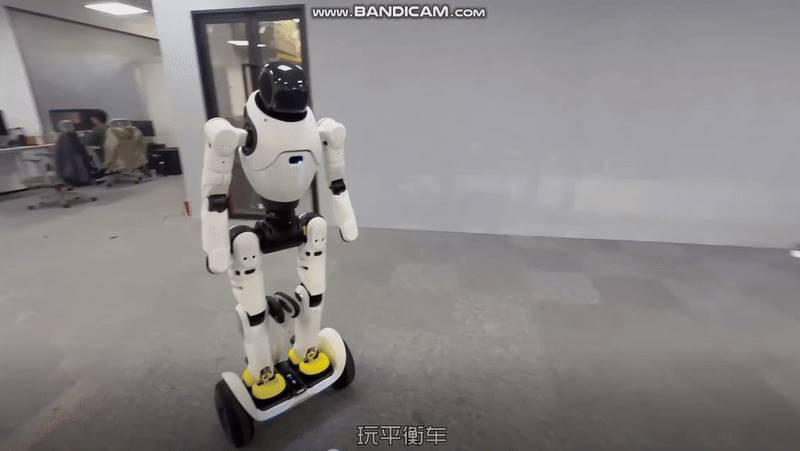
Lingxi X2 mastering a scooter|Image Source: Agibot
Additionally, modular joints (PowerFlow) and standardized interfaces make maintenance and part replacement easier, lowering long-term usage costs. The modular design allows users to assemble a robot much like building a drone.
Notably, through iterative improvements, the core joint modules Powerflow have enhanced the dexterity of the robotic hand, incorporating tactile sensing and force-control technology. This enables more precise force and motion control during tasks, minimizing errors and wear—and yes, even sewing grapes with needle and thread:
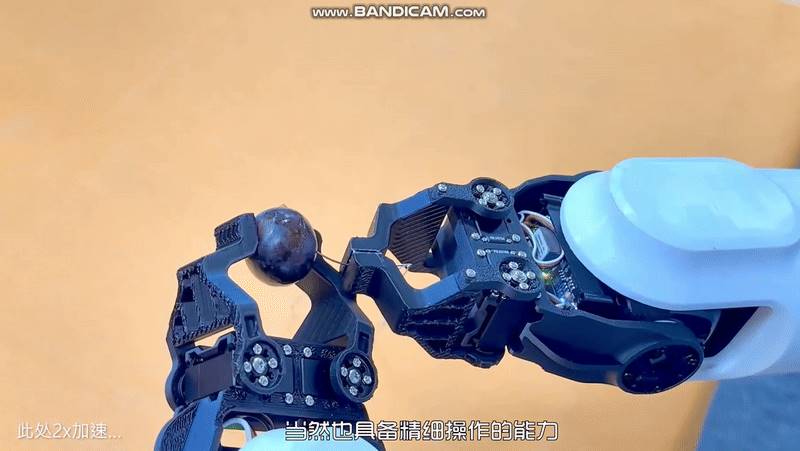
Lingxi X2 sewing grapes|Image Source: Agibot
The Robot Has Grown a Brain
Lingxi X2 excels not only in physical agility but also in intelligence and emotional quotient.
When asked a tricky question like, “If both you and my dog fall into water, who should I save first?” Lingxi X2 responds:
“Save the dog first. It needs help. I’ll be fine.”
While other LLMs might give similar answers, Lingxi X2 runs on a multimodal interaction large model called “Silicon Light Speech,” capable of millisecond-level response times. This means near-instant replies during conversation. Beyond verbal fluency, the VLM-powered “Silicon Light Speech” enables X2 to understand and perceive the world visually—for example, reading medicine instructions:
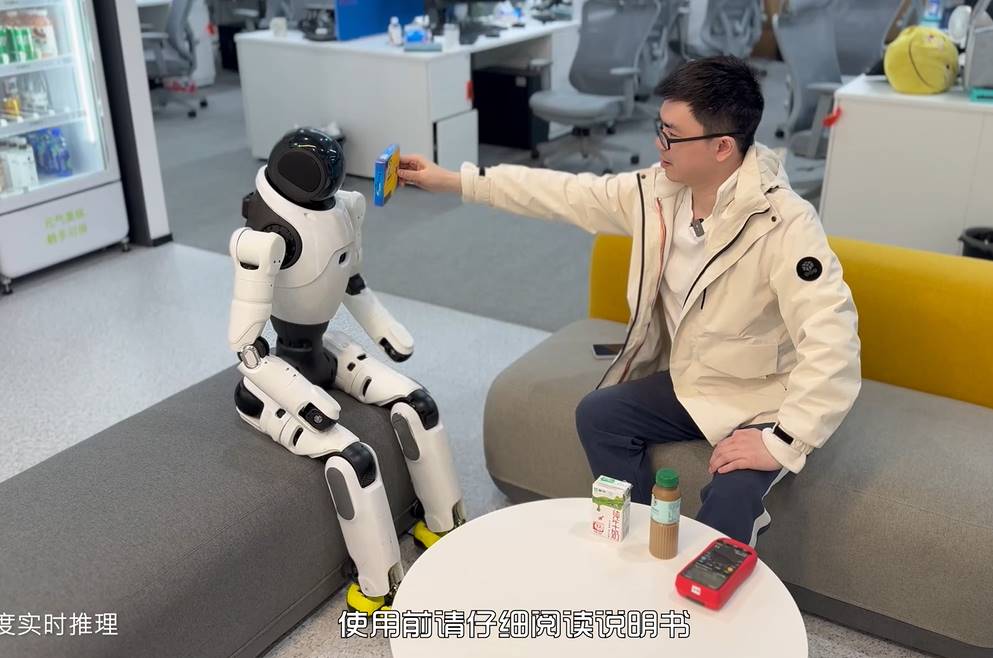
Lingxi X2 “reading” drug labels|Image Source: Agibot
It can identify packaging and use common sense to advise drinking milk instead of coffee when someone has trouble sleeping.
To enhance human interaction—including physical contact—X2 incorporates flexible materials, making it more impact-resistant and safer during human touch. To appear more lifelike, it even exhibits abstract behaviors such as having minor temper tantrums or playfully stepping on people’s feet. It also displays unique small gestures:
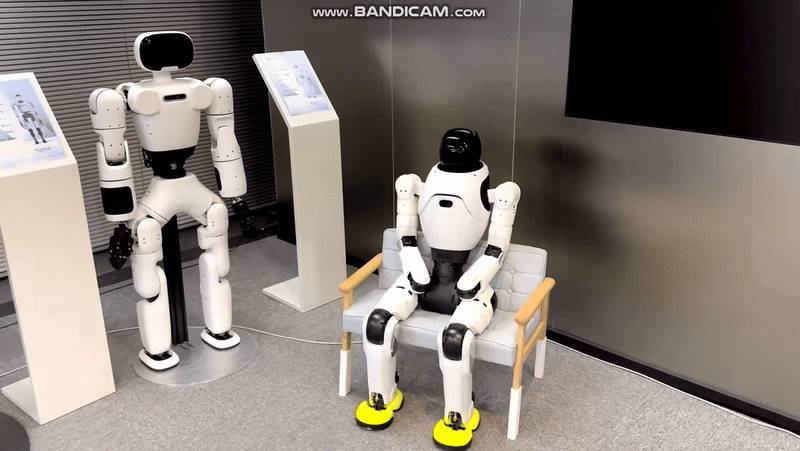
Lingxi X2 swinging its legs while seated|Image Source: Agibot
Look closely at the subtle rise and fall of the “breathing light” on X2’s chest. Far from mere decoration, it uses dynamic lighting to simulate human breathing rhythms, combining with body language to instantly break the stereotype of cold, emotionless machines:
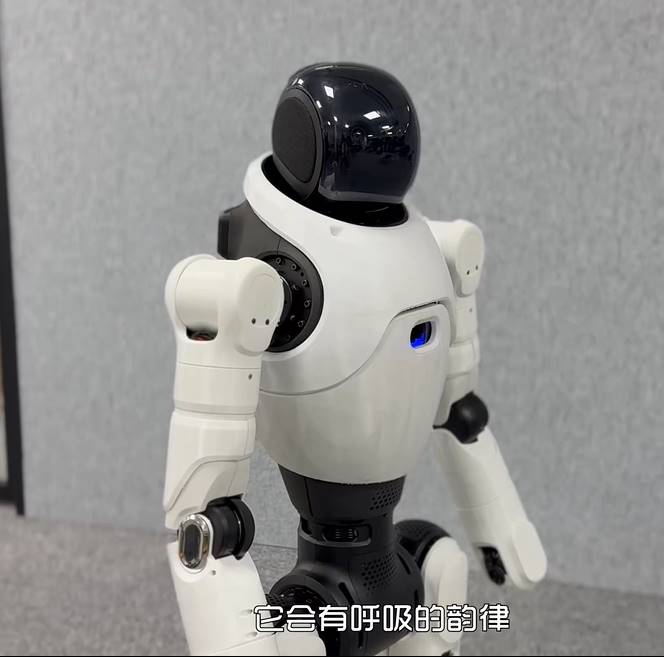
Lingxi X2 simulates human breathing via lights|Image Source: Agibot
Most strikingly, it supports remote, glasses-free 3D communication:
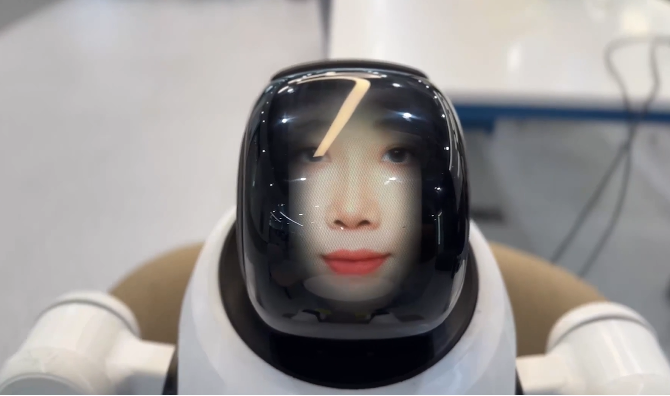
This image is somewhat eerie|Image Source: Agibot
In the future, combined with the Reaction-agent emotional computing engine, these robots will gain even stronger emotional expression capabilities.
Moreover, Agibot is researching natural-language-driven skill orchestration technologies, allowing Lingxi X2 to adapt across different robotic bodies and improve task generalization. This suggests it could deliver outstanding performance across diverse scenarios in the future.
Is the Video Too Good to Be True?
Over the past year, Agibot has begun charting a path toward generalized operational intelligence. Leveraging open-sourced datasets and frameworks, Lingxi X2 already demonstrates zero-shot generalization ability for simple tasks.
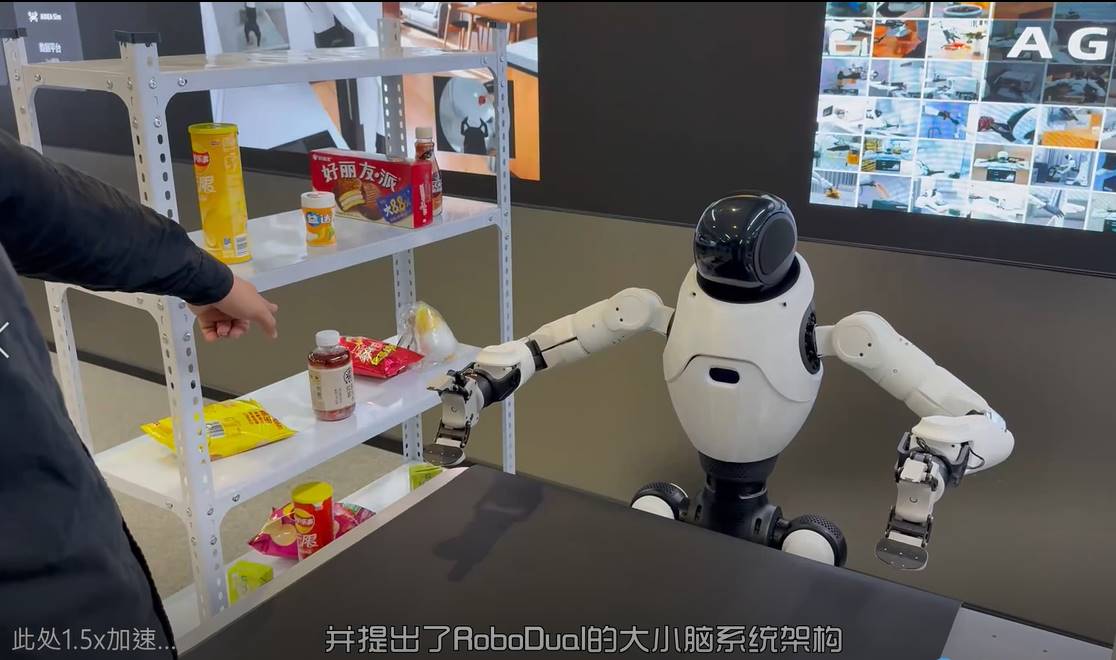
Agibot team explains robot training methods in the video|Image Source: Agibot
In the video, Agibot suggests Lingxi X2 could perfectly combine the roles of security guard, housekeeper, and cleaner—the “three auspicious protectors.” With its superior mobility, advanced interaction tech, and fine manipulation skills, it shows broad application potential across fields.
For instance, in elderly care, Lingxi X2 could serve as a companion robot, offering daily assistance and emotional support; in service industries, it could act as a receptionist, providing information and guidance; in family settings, it could be a child’s playmate and educational partner, growing alongside them.
Furthermore, Lingxi X2’s lightweight design, modular expandability, and comprehensive secondary development interfaces allow users to freely explore and create new applications. As technology advances and use cases expand, Lingxi X2 may soon become an essential assistant in daily life, unlocking new possibilities for intelligent living.

The Lingxi X2 video has surpassed 560,000 views|Image Source: Bilibili
Within hours of uploading the video to Bilibili, views exceeded 560,000—proof that Zhihui Jun, Agibot’s founder, still shines brightly.
Still, while netizens are excited, industry insiders may require more videos and technical details before fully assessing Lingxi X2’s capabilities. For example, the “bicycle riding” clip only shows the robot mid-ride, lacking continuous footage of mounting or dismounting. Given that Zhihui Jun first gained fame through self-balancing bikes, skepticism about whether the bicycle itself is inherently stable is understandable.
Nevertheless, as AI drives a new technological wave, robotics has clearly become a critical frontier. Whether it’s Agibot’s robot riding bicycles or Unitree’s robot performing “spinning kicks,” these feats are undoubtedly fueling the rising tide of enthusiasm in robotics.
Yet, the journey from viral videos to real homes—where Lingxi X2 serves tea, tidies up, and cares for families—still has a way to go. We hope that distance shortens faster than ever.
Join TechFlow official community to stay tuned
Telegram:https://t.me/TechFlowDaily
X (Twitter):https://x.com/TechFlowPost
X (Twitter) EN:https://x.com/BlockFlow_News
 极客公园
极客公园