On the Eve of a $5 Trillion Market: Where Are the Investment Opportunities in Embodied Intelligence × Web3?
TechFlow Selected TechFlow Selected
On the Eve of a $5 Trillion Market: Where Are the Investment Opportunities in Embodied Intelligence × Web3?
Embodied AI x Web3, structural solutions driving investable opportunities.
 Navigating Web3 tides with focused insights
Author: merakiki
Translation: TechFlow
For decades, robotics applications have been narrowly confined to structured factory environments performing repetitive tasks. However, today’s artificial intelligence (AI) is transforming the robotics field, enabling robots to understand and execute user instructions while adapting to dynamic environments.
We are entering a new era of rapid growth. Citibank predicts that by 2035, there will be 1.3 billion robots deployed globally, expanding their applications from factories into homes and service industries. Meanwhile, Morgan Stanley estimates that the humanoid robot market alone could reach $5 trillion by 2050.
While this expansion unlocks massive market potential, it also brings significant challenges in centralization, trust, privacy, and scalability. Web3 technologies offer transformative solutions by enabling decentralized, verifiable, privacy-preserving, and collaborative robotic networks to address these issues.
In this article, we will explore the evolving AI robotics value chain, with a focus on humanoid robots, and uncover the compelling opportunities arising from the convergence of AI robotics and Web3 technologies.
AI Robotics Value Chain
The AI robotics value chain consists of four fundamental layers: hardware, intelligence, data, and agents. Each layer builds upon the others, enabling robots to perceive, reason, and act in complex real-world environments.
In recent years, the hardware layer has seen remarkable progress led by industry pioneers such as Unitree and Figure AI. However, critical challenges remain in non-hardware areas, particularly the lack of high-quality datasets, absence of general-purpose foundation models, poor cross-device compatibility, and demand for reliable edge computing. As a result, the greatest current opportunities lie in the intelligence, data, and agent layers.
1.1 Hardware Layer: "The Body"
Today, manufacturing and deploying modern "robot bodies" is easier than ever. There are already over 100 different types of humanoid robots on the market, including Tesla's Optimus, Unitree's G1, Agility Robotics' Digit, and Figure AI's Figure 02.
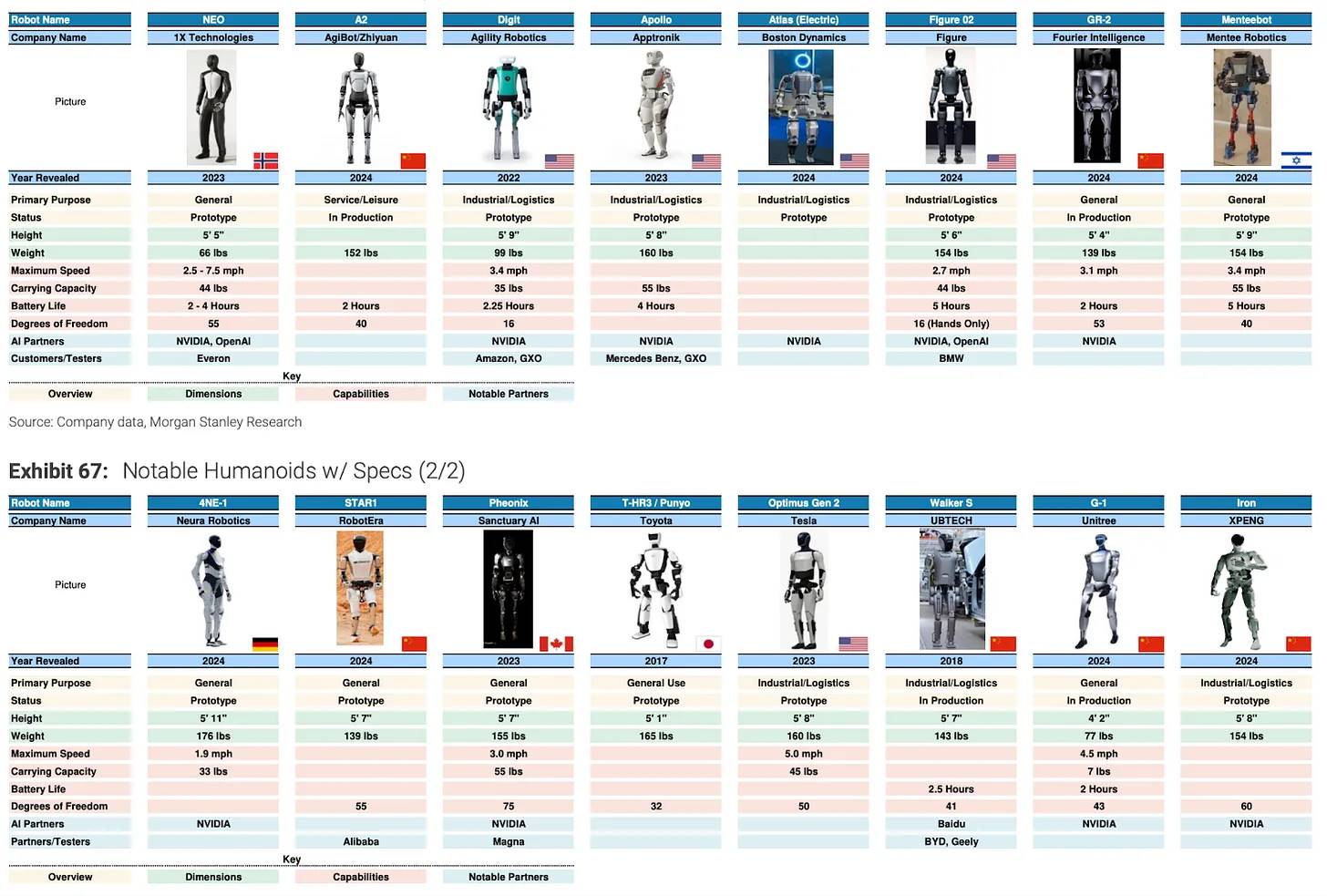
Source: Morgan Stanley, "The Humanoid 100: Mapping the Humanoid Robot Value Chain"
This progress is driven by technological breakthroughs in three key components:
-
Actuators: Acting as the robot’s “muscles,” actuators convert digital commands into precise motion. Innovations in high-performance motors enable fast and accurate movements, while dielectric elastomer actuators (DEAs) are suitable for fine manipulation tasks. These technologies significantly enhance flexibility—such as Tesla's Optimus Gen 2 with 22 degrees of freedom (DoF) and Unitree’s G1—demonstrating human-like agility and impressive mobility.

Source: Unitree showcasing its latest humanoid robot boxing at the 2025 WAIC World Artificial Intelligence Conference
-
Sensors: Advanced sensors allow robots to perceive and interpret their environment through vision, LIDAR/RADAR, tactile input, and audio. These support safe navigation, precise manipulation, and situational awareness.
-
Embedded Computing: On-device CPUs, GPUs, and AI accelerators (like TPUs and NPUs) process sensor data and run AI models in real time, enabling autonomous decision-making. Reliable low-latency connectivity ensures seamless coordination, while hybrid edge-cloud architectures allow offloading intensive computation when needed.
1.2 Intelligence Layer: "The Brain"
As hardware matures, the industry focus has shifted toward building the “robot brain”: powerful foundation models and advanced control strategies.
Prior to AI integration, robots relied on rule-based automation, executing pre-programmed actions without adaptive intelligence.
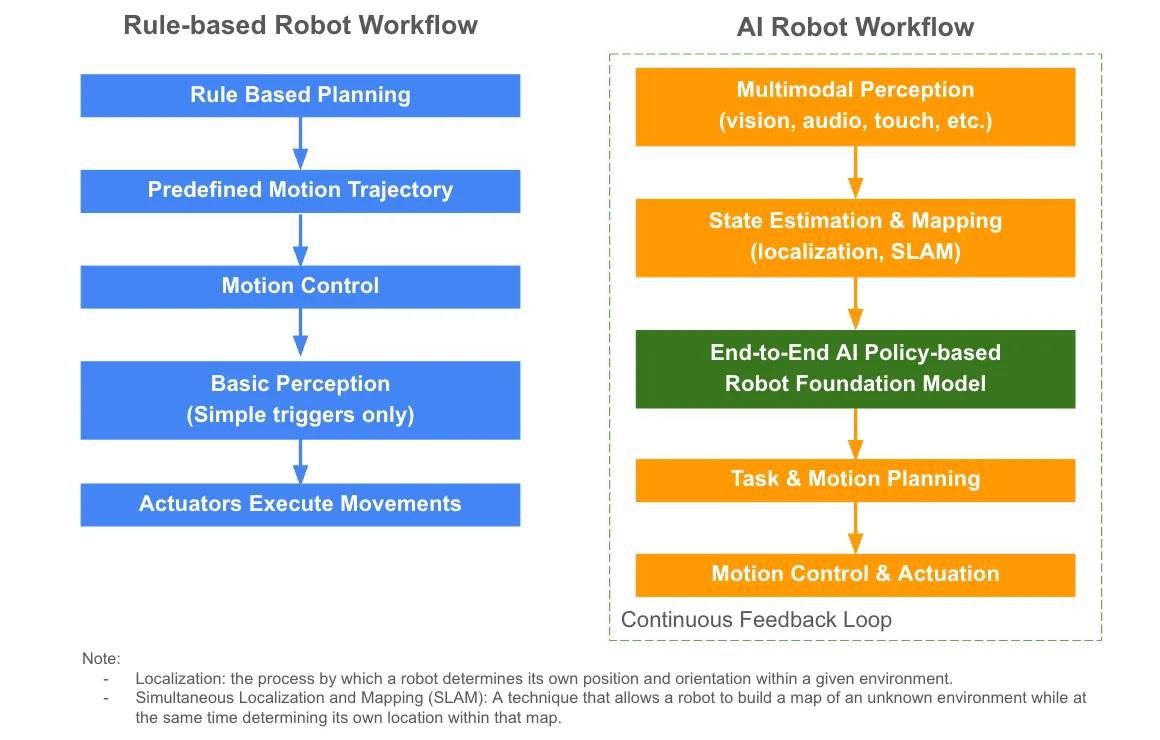
Foundation models are increasingly being applied in robotics. However, general-purpose large language models (LLMs) alone are insufficient, as robots must perceive, reason, and act within dynamic physical environments. To meet these needs, the industry is developing policy-based end-to-end robotic foundation models that enable robots to:
-
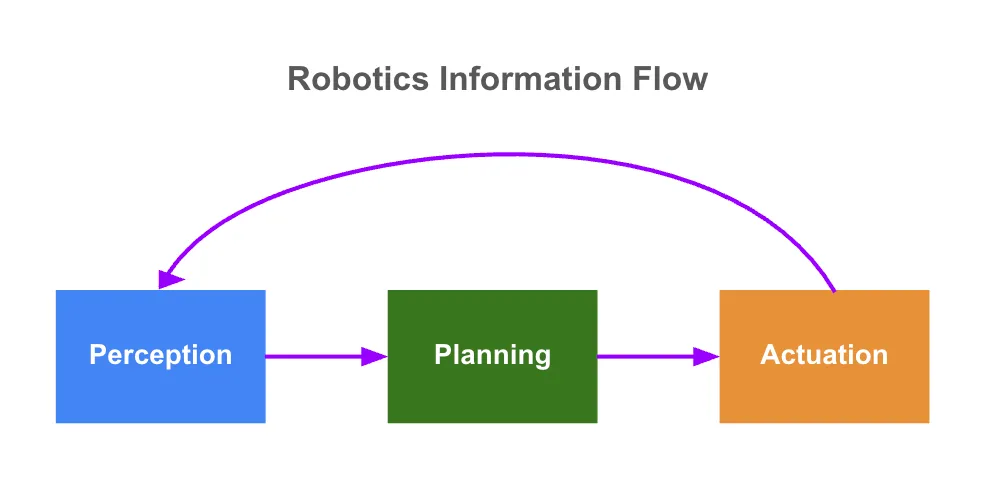
Perceive: Receive multimodal sensor inputs (vision, audio, touch)
-
Plan: Estimate self-state, map environments, and interpret complex instructions, directly mapping perception to action while minimizing manual engineering
-
Act: Generate motion plans and output control commands for real-time execution
These models learn general “policies” for interacting with the world, allowing robots to adapt across diverse tasks with greater intelligence and autonomy. Advanced models also incorporate continuous feedback, enabling robots to learn from experience and further improve adaptability in dynamic settings.
Vision-Language-Action (VLA) models directly map sensory inputs (primarily visual data and natural language instructions) to robotic actions, allowing robots to issue appropriate control commands based on what they “see” and “hear.” Notable examples include Google's RT-2, NVIDIA's Isaac GR00T N1, and Physical Intelligence's π0.
To enhance these models, multiple complementary approaches are often integrated:
-
World Models: Internal simulations of physical environments help robots learn complex behaviors, predict outcomes, and plan actions. For example, Google's recently launched Genie 3 is a universal world model capable of generating unprecedented interactive environments.
-
Deep Reinforcement Learning: Enables robots to learn behaviors through trial and error.
-
Teleoperation: Allows remote control and provides training data.
-
Learning from Demonstration (LfD)/Imitation Learning: Teaches robots new skills by mimicking human actions.
The diagram below illustrates how these methods function within robotic foundation models.
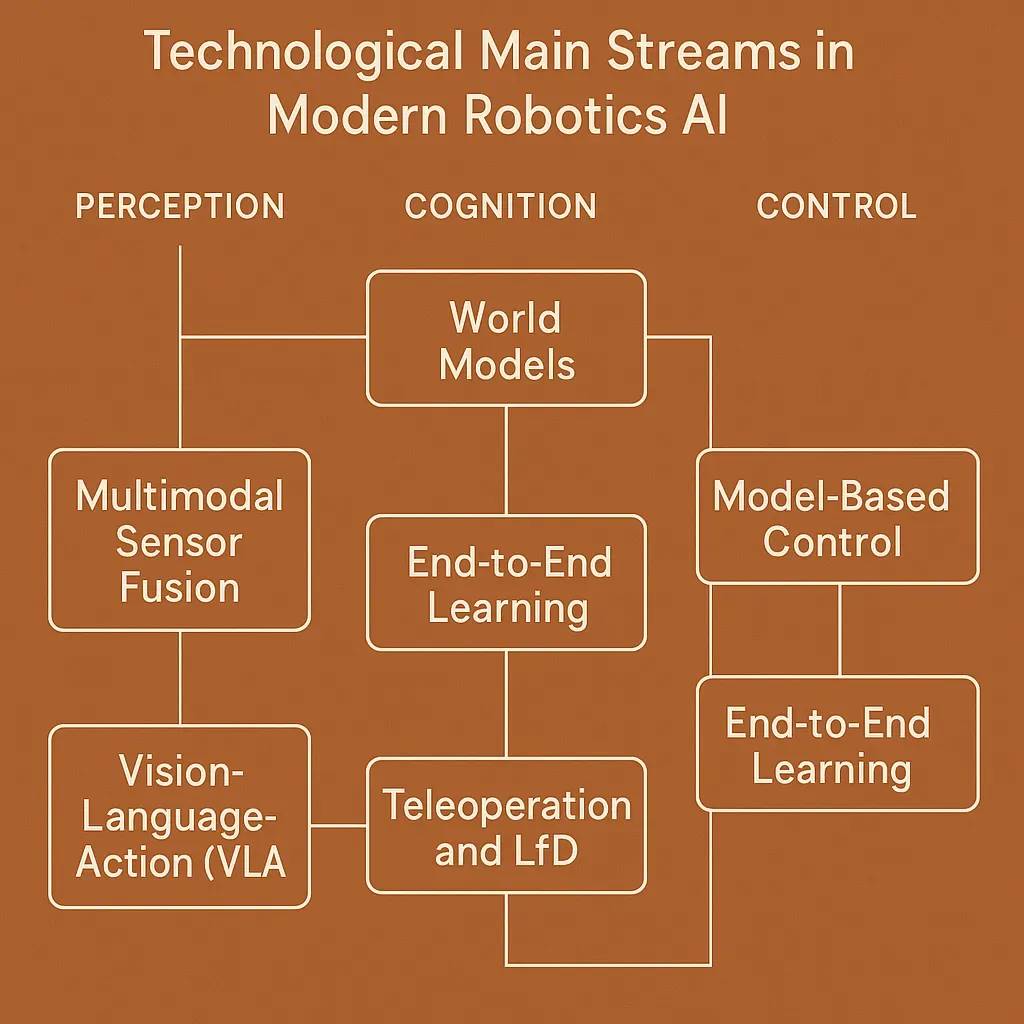
Source: World models: the physical intelligence core driving us toward AGI
Recent open-source breakthroughs such as Physical Intelligence's π0 and NVIDIA's Isaac GR00T N1 mark significant progress. However, most robotic foundation models remain centralized and closed-source. Companies like Covariant and Tesla retain proprietary code and datasets, primarily due to a lack of open incentive mechanisms.
This lack of transparency limits collaboration and interoperability across robotic platforms, highlighting the need for secure and transparent model sharing, community-governed on-chain standards, and cross-device interoperability layers. Such an approach would foster trust, cooperation, and stronger advancement in the field.
1.3 Data Layer: "Knowledge" for the Brain
Robust robotic datasets rely on three pillars: volume, quality, and diversity.
Although the industry has made efforts in data accumulation, existing robotic datasets remain vastly inadequate in scale. For instance, OpenAI’s GPT-3 was trained on 300 billion tokens, whereas the largest open-source robotic dataset, Open X-Embodiment, contains only over 1 million real-world robot trajectories across 22 robot types. This pales in comparison to the volume required for strong generalization capabilities.
Proprietary methods, such as Tesla’s data factory where staff wear motion-capture suits to generate training data, can collect more real-world motion data. However, these approaches are costly, limited in data diversity, and difficult to scale.
To address these challenges, the robotics field leverages three primary data sources:
-
Internet Data: Internet-scale data is abundant and easily scalable but mostly observational, lacking sensor and motor signals. Pre-training large vision-language models (e.g., GPT-4V and Gemini) on internet data provides valuable semantic and visual priors. Adding kinematic labels to videos can transform raw footage into actionable training data.
-
Synthetic Data: Simulated synthetic data enables rapid large-scale experimentation and diverse scenario coverage, but cannot fully capture real-world complexity—a limitation known as the “sim-to-real gap.” Researchers address this through domain adaptation (e.g., data augmentation, domain randomization, adversarial learning) and sim-to-real transfer, iteratively optimizing models and testing them in real environments.
-
Real-World Data: Though scarce and expensive, real-world data is crucial for model deployment and bridging the gap between simulation and reality. High-quality real data typically includes egocentric views capturing what the robot “sees” during tasks, along with motion data recording precise actions. Motion data is often collected via human demonstrations or teleoperation using VR, motion-capture devices, or haptic teaching, ensuring models learn from accurate real examples.
Studies show that combining internet, real-world, and synthetic data significantly improves training efficiency and model robustness compared to relying on any single source alone.
Moreover, while increasing data volume helps, diversity is even more critical—especially for generalizing to new tasks and robot morphologies. Achieving such diversity requires open data platforms and collaborative data sharing, including cross-instance datasets supporting multiple robot forms, to advance stronger foundation models.
1.4 Agent Layer: "Physical AI Agents"
The trend toward physical AI agents is accelerating—autonomous robots capable of independent action in the real world. Progress in the agent layer depends on fine-tuning models, continuous learning, and practical adaptation tailored to each robot’s unique morphology.
Emerging opportunities accelerating physical AI agents include:
-
Continuous Learning and Adaptive Infrastructure: Enables robots to continuously improve through real-time feedback loops and shared experiences during deployment.
-
Autonomous Agent Economy: Robots operate as independent economic entities—trading resources like computing power and sensor data in robot marketplaces and generating revenue through tokenized services.
-
Multi-Agent Systems: Next-generation platforms and algorithms enable robot swarms to coordinate, collaborate, and optimize collective behavior.
AI Robotics Meets Web3: Unlocking Massive Market Potential
As AI robots transition from research to real-world deployment, long-standing bottlenecks are hindering innovation and limiting the scalability, robustness, and economic viability of robotic ecosystems. These include centralized data and model silos, lack of trust and provenance, privacy and compliance constraints, and poor interoperability.
2.1 Pain Points in AI Robotics
-
Centralized Data and Model Silos
Robotic models require vast, diverse datasets. Yet, today’s data and model development is highly centralized, fragmented, and expensive, resulting in isolated systems with limited adaptability. Robots deployed in dynamic real-world environments often underperform due to insufficient data diversity and weak model robustness.
-
Trust, Provenance, and Reliability
The absence of transparent and auditable records—including data sources, model training processes, and robot operation history—undermines trust and accountability. This remains a major barrier to adoption by users, regulators, and enterprises.
-
Privacy, Security, and Compliance
Privacy is critical in sensitive applications like healthcare and home robots, requiring strict adherence to regional regulations (e.g., GDPR in Europe). Centralized infrastructures struggle to support secure, privacy-preserving AI collaboration, restricting data sharing and stifling innovation in regulated or sensitive domains.
-
Scalability and Interoperability
Robot systems face significant challenges in resource sharing, collaborative learning, and integration across platforms and morphologies. These limitations fragment network effects and hinder rapid capability transfer across robot types.
2.2 AI Robotics x Web3: Structural Solutions Driving Investable Opportunities
Web3 technologies fundamentally address these pain points by enabling decentralized, verifiable, privacy-preserving, and collaborative robotic networks. This convergence is opening new investable markets:
-
Decentralized Collaborative Development: Incentive-driven networks allow robots to share data and co-develop models and intelligent agents.
-
Verifiable Provenance and Accountability: Blockchain ensures tamper-proof records of data and model origins, robot identities, and operational histories—critical for trust and compliance.
-
Privacy-Preserving Collaboration: Advanced cryptography enables robots to jointly train models and share insights without exposing proprietary or sensitive data.
-
Community-Driven Governance: Decentralized autonomous organizations (DAOs) guide and oversee robot operations through transparent, inclusive on-chain rules and policies.
-
Cross-Morphology Interoperability: Blockchain-based open frameworks enable seamless collaboration across different robot platforms, reducing development costs and accelerating capability transfer.
-
Autonomous Agent Economy: Web3 infrastructure grants robots independent economic agent status, enabling peer-to-peer transactions, negotiations, and participation in tokenized markets without human intervention.
-
Decentralized Physical Infrastructure Networks (DePIN): Blockchain-powered peer-to-peer sharing of computing, sensing, storage, and connectivity enhances scalability and resilience of robotic networks.
Below are innovative projects advancing this space, illustrating the potential and trends of AI robotics and Web3 convergence. This is for reference only and does not constitute investment advice.
Decentralized Data and Model Development
Web3-powered platforms democratize data and model development by incentivizing contributors—through motion-capture suits, sensor sharing, visual uploads, data labeling, or synthetic data generation. This approach builds richer, more diverse, and representative datasets and models beyond what any single company can achieve. Decentralized frameworks also improve coverage of edge cases, crucial for robots operating in unpredictable environments.
Examples:
-
Frodobots: A protocol crowdsourcing real-world datasets through robotic games. Their “Earth Rovers” project—a sidewalk robot and global “Drive to Earn” game—successfully created the FrodoBots 2K Dataset, including camera footage, GPS data, audio recordings, and human操控 data across over 10 cities, totaling approximately 2,000 hours of remote-controlled robot driving.
-
BitRobot: A crypto-incentivized platform developed by FrodoBots Lab and Protocol Labs, built on Solana and subnet architecture. Each subnet hosts public challenges, rewarding contributors with tokens for submitting models or data, fostering global collaboration and open innovation.
-
Reborn Network: A foundational layer for an open AGI robotics ecosystem, offering Rebocap motion-capture suits enabling anyone to record and monetize their own motion data, helping open up complex humanoid robotics datasets.
-
PrismaX: Leverages a global community of contributors, using decentralized infrastructure to ensure data diversity and authenticity, implementing strong validation and incentive mechanisms to scale robotic datasets.
Provenance and Reliability Verification
Blockchain provides end-to-end transparency and accountability in robotic ecosystems. It ensures verifiable data and model provenance, authenticates robot identity and physical location, and maintains clear records of operational history and contributor involvement. Collaborative verification, on-chain reputation systems, and stake-based validation mechanisms safeguard data and model quality, preventing low-quality or fraudulent inputs from compromising the ecosystem.
Examples:
-
OpenLedger: An AI blockchain infrastructure that trains and deploys specialized models using community-owned datasets. Its “Proof of Attribution” mechanism ensures high-quality data contributors receive fair rewards.
Tokenized Ownership, Licensing, and Monetization
Web3-native IP tools support tokenized licensing of specialized datasets, robot capabilities, models, and intelligent agents. Contributors can embed licensing terms directly into assets via smart contracts, ensuring automatic royalty payments whenever data or models are reused or monetized. This promotes transparent, permissionless access and creates an open, fair market for robotic data and models.
Examples:
-
Poseidon: A full-stack decentralized data layer built on the IP-centric Story protocol, providing legally authorized AI training data.
Privacy-Preserving Solutions
High-value data generated in hospitals, hotel rooms, or homes—though hard to obtain publicly—contains rich contextual information that can greatly enhance foundation models. Cryptographic solutions transform private data into traceable, composable, and monetizable on-chain assets while preserving privacy. Technologies like Trusted Execution Environments (TEEs) and Zero-Knowledge Proofs (ZKPs) enable secure computation and result verification without exposing raw data. These tools allow organizations to train AI models on distributed sensitive data while maintaining privacy and compliance.
Examples:
-
Phala Network: Allows developers to deploy applications into secure TEEs for confidential AI and data processing.
Open and Auditable Governance
Robot training often relies on opaque, inflexible proprietary black-box systems. Transparent and verifiable governance is essential to reduce risks and build trust among users, regulators, and enterprises. Web3 enables collaborative development of open-source robotic intelligence through on-chain, community-driven oversight.
Examples:
-
Openmind: An open AI-native software stack helping robots think, learn, and collaborate. They proposed ERC-7777, aiming to establish a verifiable, rule-based robotic ecosystem focused on security, transparency, and scalability. The standard defines standardized interfaces for managing human and robot identities, enforcing social rule sets, and registering/removing participants with defined rights and responsibilities.
Final Thoughts
With the convergence of AI robotics and Web3, we are entering a new era where autonomous systems can achieve large-scale collaboration and adaptation. The next 3 to 5 years will be critical, as rapid hardware advancements drive more powerful AI models built on richer real-world datasets and decentralized collaboration mechanisms. We expect specialized AI agents to emerge prominently in industries such as hospitality and logistics, creating massive new market opportunities.
However, the fusion of AI robotics and crypto also presents challenges. Designing balanced and effective incentive mechanisms remains complex and evolving, requiring systems that fairly reward contributors while preventing abuse. Technical complexity is another hurdle, demanding robust and scalable solutions for seamless integration across robot types. Privacy-preserving technologies must be sufficiently reliable to earn stakeholder trust, especially when handling sensitive data. Rapidly changing regulatory landscapes also require careful navigation to ensure compliance across jurisdictions. Addressing these risks and achieving sustainable returns are key to driving technological progress and widespread adoption.
Let us collectively monitor developments in this space, advance through collaboration, and seize the emerging opportunities in this rapidly expanding market.
Innovation in robotics is best journeyed together :)
Finally, I’d like to thank Chain of Thought’s “Robotics & The Age of Physical AI” for providing invaluable support to my research.
Join TechFlow official community to stay tuned
Telegram:https://t.me/TechFlowDaily
X (Twitter):https://x.com/TechFlowPost
X (Twitter) EN:https://x.com/BlockFlow_News
 @merakiki2