








From Frenzy to Rationality: The Shift in Value of Crypto Investments in 2025
TechFlow Selected TechFlow Selected
From Frenzy to Rationality: The Shift in Value of Crypto Investments in 2025
The End of FOMO Investing?
 Navigating Web3 tides with focused insights
Author: Prathik Desai
Translation: Block unicorn
As we pass through three quarters of 2025, it seems like the right time to look back at how capital has been flowing into the crypto ecosystem.
While 2024 saw significant investments in Layer-1 and Layer-2 projects, developer tools, and AI products, this year’s funding has primarily focused on payments and enterprise-grade infrastructure.
Funds that last year chased every hot idea are now becoming more selective, concentrating on just a few specific areas. The result is fewer deals but larger checks, and the venture market appears to have a clearer view of where value lies in crypto.
Although overall fundraising declined year-on-year during the first nine months through September, the data suggests this may not be such a bad sign for projects building in the space.
Alright, let’s dive in.
From January 1 to September 30, crypto venture capital totaled $4.09 billion across 463 funding rounds, with 392 disclosing check sizes. According to Decentralised.co's funding tracker, this represents a 19% decline compared to the same period last year, when total funding reached $5.04 billion across 980 deals, with 725 disclosing amounts.
Despite the drop in total funding, the average disclosed deal size surged 50% to $10.4 million, while the median check rose from $3 million to $4 million in 2025. As a result, the market may appear calmer than the previous year, but capital density is higher.
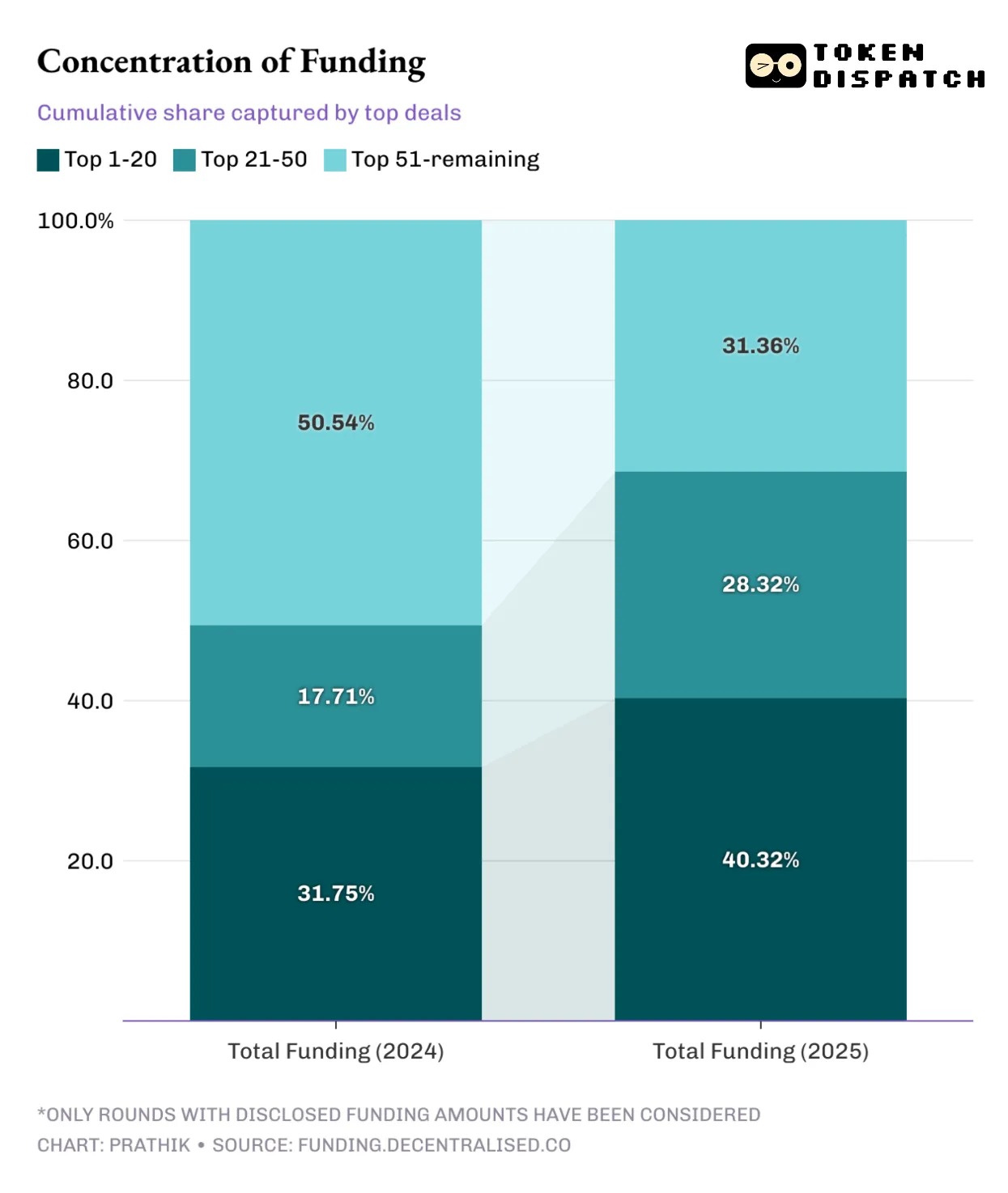
The top 20 rounds in 2025 accounted for 40% of all funding, up from 32% in 2024. Expanding to the top 50 rounds, the share grew from 49% in 2024 to 69% this year.
This year’s capital flows also show an upward shift in funding stages.
Seed and Series A rounds declined in share, while later-stage funding increased. Approximately 57% of capital went into early-stage crypto projects (seed and Series A), down from 80% in the first nine months of 2024.
This indicates investors are shifting risk away from the idea phase toward execution.
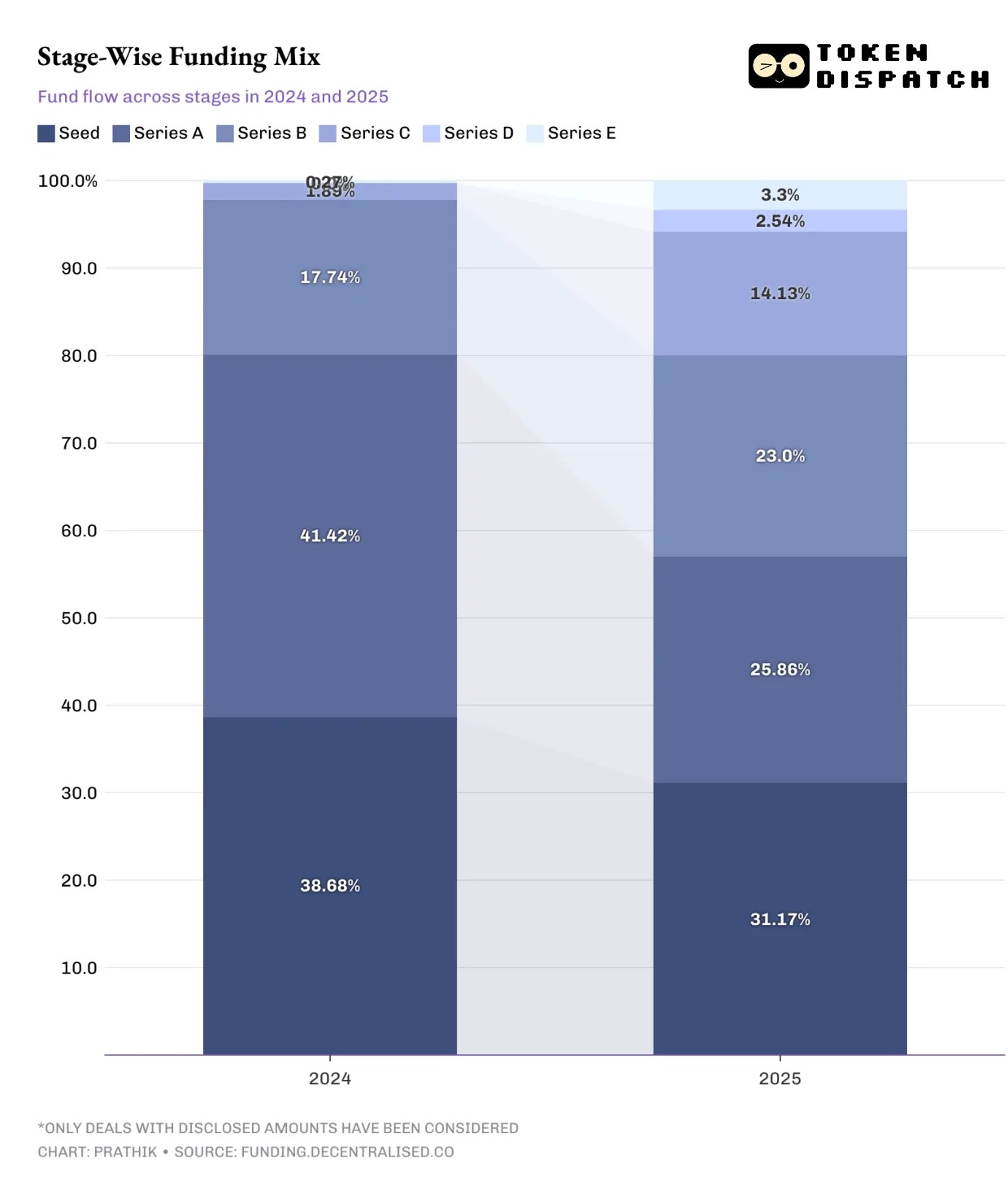
Risk capitalists today demand proof before investing. They are doubling down on projects with mature distribution systems and clear regulatory standing, rather than newcomers.
Deploying more capital in later stages means fewer failures and fewer moonshot opportunities. Returns are stabilizing, increasingly supported by cash flow. On the other hand, this could lead to a narrower pipeline of innovation in 2026. If seed and Series A activity doesn’t rebound soon, it may reduce venture interest in emerging domains.
The concentration of capital flows signals a shift in how VCs perceive sources of value.
Industry data shows that AI is the only sector consistently favored by investors in both 2024 and 2025. Fields that ranked among the top five funding recipients in 2024 failed to attract similar investor interest in 2025.
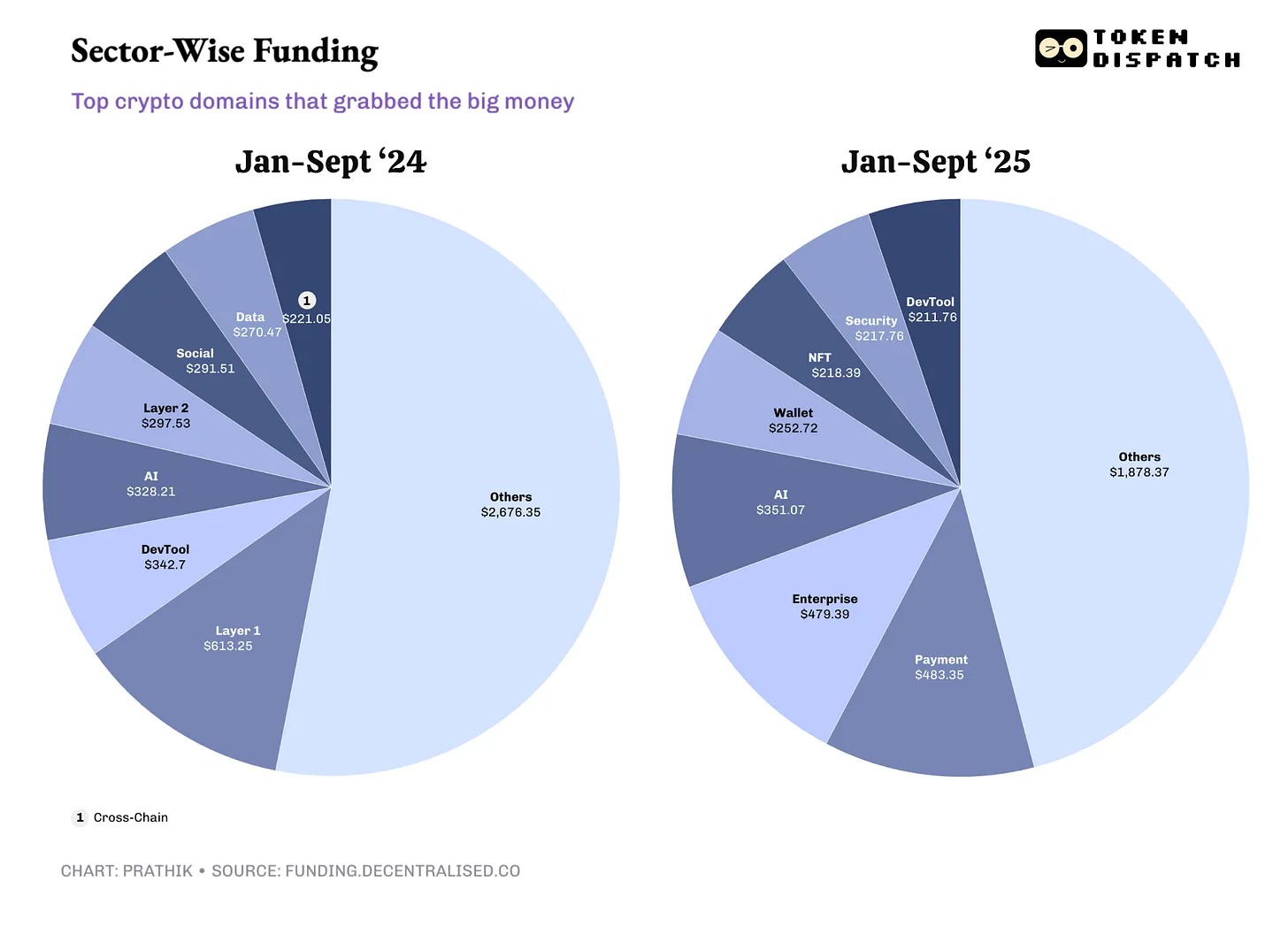
For founders, this means capital exists if you're building in AI, payments, enterprise infrastructure, or real-world asset tokenization (RWA). Outside these areas—such as Layer-1 and Layer-2 infrastructure, developer tools, and social—the funding has dried up, even though these were the core of the industry in 2024.
All of this conveys several key messages.
First, capital structures are shifting toward fewer but deeper anchor investors—a pattern common in mature industries. As the sector accumulates experimental experience over its lifecycle, investment becomes more cautious and calculated. This brings structural stability, benefiting later-stage projects, but leaves little room for small checks to new entrants.
Second, price discovery is moving from hype cycles to metric-based fluctuations. Investors now bet only when they see profits, not on hype.
Third, pace is slowing. Fewer newly funded experiments mean less innovation testing market demand in new domains. New products will still emerge, but are more likely to come from established players or self-funded projects, such as Aster (BNB Chain) and Hyperliquid (non-VC-backed).
This new approach rewards meaningful metrics like revenue generation and enterprise-grade storytelling. It also exposes optimistic bias by highlighting the fragility of ideas. Overall, the venture capital market, though smaller in scale, will become more stable.
We might wish to restore certain aspects of 2024, such as more evenly distributed investment and a thicker mid-tier. But until then, we must accept the current reality of fewer deals and larger checks.
That’s all for this discussion. See you in the next article.
Join TechFlow official community to stay tuned
Telegram:https://t.me/TechFlowDaily
X (Twitter):https://x.com/TechFlowPost
X (Twitter) EN:https://x.com/BlockFlow_News






