








A New World of Investment with Extreme Compression
TechFlow Selected TechFlow Selected
A New World of Investment with Extreme Compression
A new world ≠ merely “more MEMEs,” but rather “compressed cycles + narrative-driven trajectories.”
 Navigating Web3 tides with focused insights
Author: The Beauty of Bayes
Why This Title?
Since last year, I’ve written numerous articles analyzing the global asset “MEME-ification” trend—that is, assets increasingly becoming short-term博弈 symbols, drifting far from fundamentals and instead being entirely driven by grand narratives. This trend has grown ever stronger.
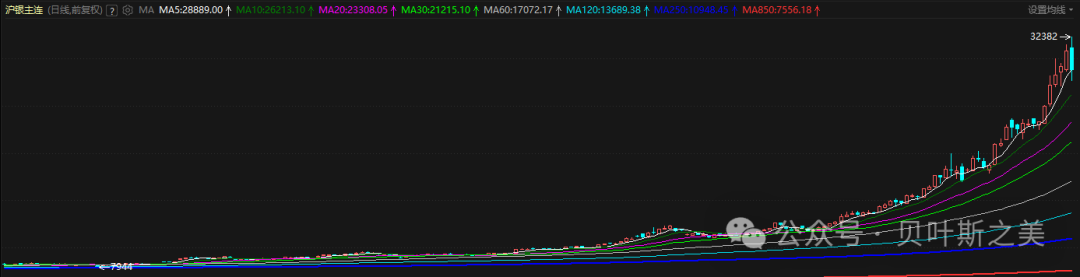
We now inhabit a new world where investment cycles are compressed to the extreme. Asset pricing, price movements, and time horizons are all drastically shortened—entirely due to AI—and reflect humanity at its most intense: herd-driven FOMO, rapid swings between extreme optimism and pessimism, and asset price surges and crashes that deviate massively from historical averages—all occurring in ever-shorter timeframes.
The “New World” ≠ simply “more MEMEs”; it means “compressed cycles + narrative-dominant pathways.”
MEME-ification, at its core, means that short-term narratives consistently override fundamentals across all assets. I use the term “New World” because the phenomenon is no longer just “a few more MEME stocks”—it’s:
(1) All assets converging toward “MEME-mode” within extremely short timeframes
Gold/Silver: Their long-term logic rests on monetary policy, geopolitics, and inflation—but from 2023–2026, they’ve been propelled by grand narratives like “currency debasement,” “war,” “sanctions,” and “de-dollarization.” Price paths increasingly resemble a composite function of “grand narrative + social media + ETF flows.”
Memory / HBM / DRAM: Slogans such as “HBM shortage until 2027” and “MU is the purest AI memory play this cycle” have transformed cyclical stocks into “TSLA/NVDA-style MEMEs.” Long-term drivers remain bit growth, process node advancement, and capex cycles—but the 2024–2025 rally has been powered entirely by the “AI Golden Age” MEME.
Software (Microsoft / SAP / NOW): Traditionally viewed as the epitome of “stable growth + subscription revenue,” these names are now uniformly re-rated under the meta-narrative: “AI will eat all SaaS; LLMs + agents will replace traditional software.”
As noted in my earlier pieces, the “MEME-ification trend” has evolved into this: “Assets are treated as symbols in the short term, and those symbols are linked to standardized narrative templates.”
(2) Cycles haven’t disappeared—they’ve been compressed to the extreme
What defines the “New World” is this shift: “From 10-year cycles → compressed into 2–3-year cycles—or even three mini-cycles per year.” Typical manifestations:
• DRAM/HBM prices rose over the same magnitude in two years as they did across an entire prior cycle;
• Micron surged 3–4x in eight months—even as discussions about “peak-cycle risks & oversupply” began;
• Gold rose 2.5x over three years, then added another ~80%, with multiple 15–20% pullbacks barely lasting long enough to catch one’s breath before breaking to new highs;
• Silver’s gold/silver ratio plunged from 120 to 48 in just nine months—a historic re-rating.
In other words: cycles haven’t vanished—they’ve been fragmented into tightly packed mini-cycles layered atop narratives. Where one used to take ten years to complete a full cycle, today’s markets can pack three to four ±30–50% mini-cycles into just three years.
The essence of the “New World” is this sentence: both upward and downward cycles have been compressed to the extreme.
I. Precious Metals: From “Long, Slow Bull Markets” to “High-Frequency, Extreme Segments” in Gold & Silver
1. Gold: A 10-Year Macro Narrative Compressed into 2–3-Year “Consecutive Breakouts”
How extreme has gold’s rhythm become?
• From October 2022 to October 2025, gold rose roughly 2.5x—Morgan Stanley dubbed it “the strongest major asset class globally in this cycle.”
• In the first five months of 2025 alone, gold surged from ~$2,600 to $3,300/oz (+25%), achieving in five months what would traditionally take a full year.
• The rally continued through all of 2025: Business Insider reported gold rose ~87% from early 2025 to early 2026, breaching $5,000 for the first time.
• By January 2026, Barron’s reported gold briefly surpassed $5,540/oz—up another 27% since the start of the year.
Demand structure has also “extremified”: According to the World Gold Council (WGC), global gold demand hit a record 5,002 tonnes in 2025, with investment demand surging +84% YoY to 2,175 tonnes—ETFs and physical investment became dominant drivers.
Historically, gold bull markets (e.g., 2001–2011) unfolded gradually over a decade, punctuated by multi-year corrections. This cycle? Less than three years delivered a 2.5x surge followed by another 80–90% rise—with pullbacks often lasting only 1–2 months and ranging 10–15%, quickly swallowed by new highs.
Drivers are clearly multidimensional—not a single story: inflation + “currency debasement trade”; geopolitical risk (war, tariffs, financial sanctions); central bank/sovereign de-dollarization allocations; and even hedging demand stemming from “AI bubble + overcrowded US equities.”
Defining trait: Long-term macro logic remains intact—but every leg up/down sees its slope doubled. “One big cycle = a series of extremely steep, short cycles strung together.”
2. Silver: An Amplifier Layered on Top of Gold
If gold is “orderly ascent,” silver this cycle is near-chaotic amplification:
• From mid-2025 to early 2026, silver doubled—briefly surpassing $60/oz, a new all-time high.
• Per CME data: Silver’s annualized volatility was ~32% in 2025; its 30-day volatility index stood at ~28.5% in early 2026—slightly below 2011’s >40% peak but still among the most volatile commodities.
• Exchanges were forced to repeatedly raise margin requirements on silver futures—many leveraged positions couldn’t meet margin calls, triggering forced liquidations that further amplified price moves.
The extreme compression of the gold/silver ratio is a textbook case of “cycle compression”:
• In April 2025, the ratio spiked to 100–120:1 (an extreme high, signaling silver’s extreme cheapness).
• Just nine months later, it collapsed to ~48:1—approaching a 15-year low.
• Historically, moving from such extremes took several years. This time, it happened in under one year.
3. Summary: “New World” Dynamics in Precious Metals
Structural long-term logic: High debt / high deficits / de-dollarization / geopolitical risk → strengthen gold’s long-term role; green transition + electronics + solar → add industrial elasticity to silver.
But cyclical behavior has transformed: A major bull market ≈ multiple extremely steep mini-cycles: gold’s 2.5x + 80% isn’t “slow climbing”—it’s three to four 20–40% surges and 10–20% rapid corrections crammed into three years. Silver adds another layer: doubling in price, >30% volatility, and a ratio collapse from 120 to 48—what historically took 5–10 years occurred in nine months.
II. Memory (HBM/DRAM): A “One-Year Compression of a Three-Year Price & Equity Rally”
The memory sector is essentially a real-world experiment in SuperVol + structural change.
1. Prices: Two Years’ Worth of Upside in One Full Cycle
The explosive price trajectory of DRAM / DDR / HBM:
• 2025: DRAM prices rose ~60%; forecasts call for another 30–40% rise in 2026—especially for DDR4/DDR5.
• September–November 2025: Samsung’s 32GB DDR5 contract price jumped from ~$149 to $239—a 60% surge in two months; other module capacities rose 30–50%.
• HBM: SEMI forecasts HBM equipment investment growing 15% annually in both 2025 and 2026; HBM prices have hit record highs and continue rising; Samsung expects shortages to persist through 2027.
Traditionally, a full memory price cycle might see prices double over 2–3 years, with modest corrections along the way. Now we see certain products gaining 60% in two months—and 60% in twelve months—with forecasts calling for another two years of 30–40% gains.
Drivers are clear: Explosive AI data center deployment of GPUs/HBM/DDR5; Samsung, SK Hynix, Micron proactively cutting capacity in legacy products (DDR4/general DRAM) to redirect production toward HBM/high-end products—squeezing supply of generic DRAM.
2. Stock Prices: Micron Up 3–4x in One Year—Then Immediate “Peak-Cycle Concerns”
Micron is the canonical case study:
• Low of $61.54 on April 7, 2025 → high of $264.75 on December 10, 2025: ~330% gain in eight months; YTD 2025 gain was 206%.
• Early 2026 saw a modest 10–15% pullback from highs—but multiple brokers continued raising targets: Bernstein and others labeled it “the largest price-upside cycle in history,” viewing Micron as the core beneficiary of the “AI memory golden age.”
Earnings & Forecasts: Analysts expect Micron’s FY2026 EPS to rise +149% YoY, and FY2027 EPS to rise another +27%—a direct bet on consensus expectations of “sustained price surges + prolonged supply tightness.”
Meanwhile, counter-voices emerged: analysts began warning that current gross margins are nearing “peak-cycle” levels, and FY2026 capex is set at $20B—a highly reflexive move that may sow seeds for the next oversupply cycle.
Rhythm vs. Traditional Memory Cycles:
• Past: Typically a full 3–5-year cycle—price → earnings → valuation → capacity expansion → oversupply → industry purge.
• Present: Less than one year—from cycle bottom → price explosion → profit explosion → capex peak → onset of “oversupply concerns & stretched valuations.”
Extreme compression: The fundamental cycle itself is shortening: suppliers deploy $20B-level capex the moment prices rise; markets begin flagging peak-cycle risks after just 2–3 quarters of strong profits—causing stock prices, valuations, and sentiment to complete a full “mania → blowoff → concern” emotional cycle within 1–2 years.
III. Underlying Both Trends: The Same “New World Mechanism”
To summarize, the “New World” we face is driven by at least three overlapping mechanisms:
1. Drastically Shortened Information Half-Life
AI/LLMs + high-frequency information/alternative data → any capex decision, capacity cut, central bank gold purchases/sales, or ETF flows get reflected in global risk models and narratives within hours.
Result: Markets no longer allow “three years to slowly discover the truth.” Instead, pricing-in happens in 3–6 months—or even weeks.
2. Leverage & Derivatives Lock “Price–Position–Risk” Into a High-Frequency Feedback Loop
Index/single-stock 0DTE options, short-dated commodity options, CFDs, leveraged ETFs, and high-frequency CTA/vol-target strategies cause any directional price momentum to trigger reflexive, passive acceleration.
Exchanges/clearinghouses then “apply the brakes” via margin adjustments and risk controls: COMEX raised silver futures margin requirements, forcing some participants to reduce positions or liquidate—ending accelerated moves faster.
Result: Sentiment in any one direction is rapidly amplified via derivatives → leverage → risk models, while pullbacks/forced liquidations/margin adjustments “force-reset” the system in short order. What you observe are a series of “short, violent” oscillations—but behind them runs a continuously operating high-frequency feedback loop.
3. Faster Real-World Supply Response Raises “Reflexivity Frequency”
Memory: Manufacturers completed large-scale capacity reallocation from DDR4 → HBM/DDR5 in under a year. SEMI forecasts HBM equipment investment rising +15% in both 2025 and 2026; NAND investment surged +45% in 2025 alone—and continues through 2027. Capex implies the next supply response arrives faster—not via “slow ramp-up.”
Precious Metals: Miners can’t ramp up physical output quickly (geological/project constraints), but financial supply (ETF shares, derivative positions) adjusts instantly—making “financial supply” itself a high-frequency variable.
Both real-world and financial-system feedback cycles have visibly shortened—and when overlaid, produce the “back-and-forth 50%” segments you see everywhere.
Overall Synthesis: From “Asset Pricing” to “Asset MEME-ification”
1.1 Old World vs. New World: What Determines Price?
Old World (Textbook Version):
• Long-term: Discounted cash flow / supply-demand balance;
• Medium-term: Earnings expectations / interest rates / risk appetite;
• Short-term: Noise trading + technical factors—viewed as “local disturbances.”
New World (Observed over the past two years):
• Short-term: Assets increasingly behave like “narrative tokens,” determined by grand stories (AI, de-dollarization, energy transition, defense rearmament) + trading structures (options, leverage, passive funds);
• Fundamentals have become a “long-term judgment” deferred 3–5 years out;
• The 6–12-month horizon is dominated by intense MEME/narrative fields.
Reiterating the core conclusion on “MEME-ification”: Assets are increasingly treated as short-term博弈 symbols—not claims on future cash flows.
Three Drivers of MEME-ification
Explosion of Narrative Bandwidth (LLMs + Social Media + Influencers): Information production cost approaches zero; meta-narratives like “AI Golden Age,” “de-dollarization,” “HBM shortage until 2027,” and “AI will consume all software” synchronize globally within hours.
Derivatives & Leverage Structures: 0DTE / short-dated options / leveraged ETFs / CFDs lock “emotion → position → price” into a high-frequency feedback loop; simple trading templates (sell-side structured products, gamma squeezes, FOMO call buying) replicate en masse.
Liquidity + Passive Capital: Passive ETFs + style/theme ETFs + CTA/vol-target strategies have institutionalized the “price → weight → passive buy/sell” dynamic—its resonance far exceeds that of a decade ago.
“Hard Features” of the New World: Cycles & Amplitude
Cycle Duration: Extreme Compression. Logic that once required 5–10 years to fully play out now completes three rounds in 2–3 years: inflection → peak → 30–50% pullback → narrative refresh → repeat.
This isn’t “no fundamentals”—rather, the synthesis of “fundamentals + narrative + structure” has been compressed. Capital still operating on old-world, slow metrics gets crushed by this new rhythm.
Thus, the “brand-new investment world” we must embrace is, in essence:
• More cycles × higher amplitude per cycle;
• Structural long-term logic remains intact (gold/silver/memory/AI aren’t short-term fads);
• Information/digital instruments/real-world supply collectively compress timing into “3–5 years packing 3–5 mini-cycles.”
Mastering it means: Within the same long-term logic, pre-designing Role + Seat + Gate + Cycle rules—and treating each mini-cycle as a reusable resource—to genuinely boost capital efficiency and seat-year output—not getting trapped in “eternal busyness, long-term futility” by 0DTE and volatility.
Join TechFlow official community to stay tuned
Telegram:https://t.me/TechFlowDaily
X (Twitter):https://x.com/TechFlowPost
X (Twitter) EN:https://x.com/BlockFlow_News


