Aster, CZ's market blade targeting Hyperliquid
TechFlow Selected TechFlow Selected
Aster, CZ's market blade targeting Hyperliquid
🤔"If the HYPE token continues to underperform in the coming months, it will be an excellent opportunity to buy heavily and build a long-term position."
 Navigating Web3 tides with focused insights
Author: Duo Nine
Translation: Saoirse, Foresight News
Since Aster's launch, the HYPE token has plummeted 27% in just five days. Worse still, with a large-scale HYPE token unlock approaching, its future outlook remains bleak.
What a coincidence.
For months, Binance founder Changpeng Zhao (CZ) has been advancing the Aster project and had already chosen the strategic timing to target Hyperliquid. This article will explain why he chose this moment to act.
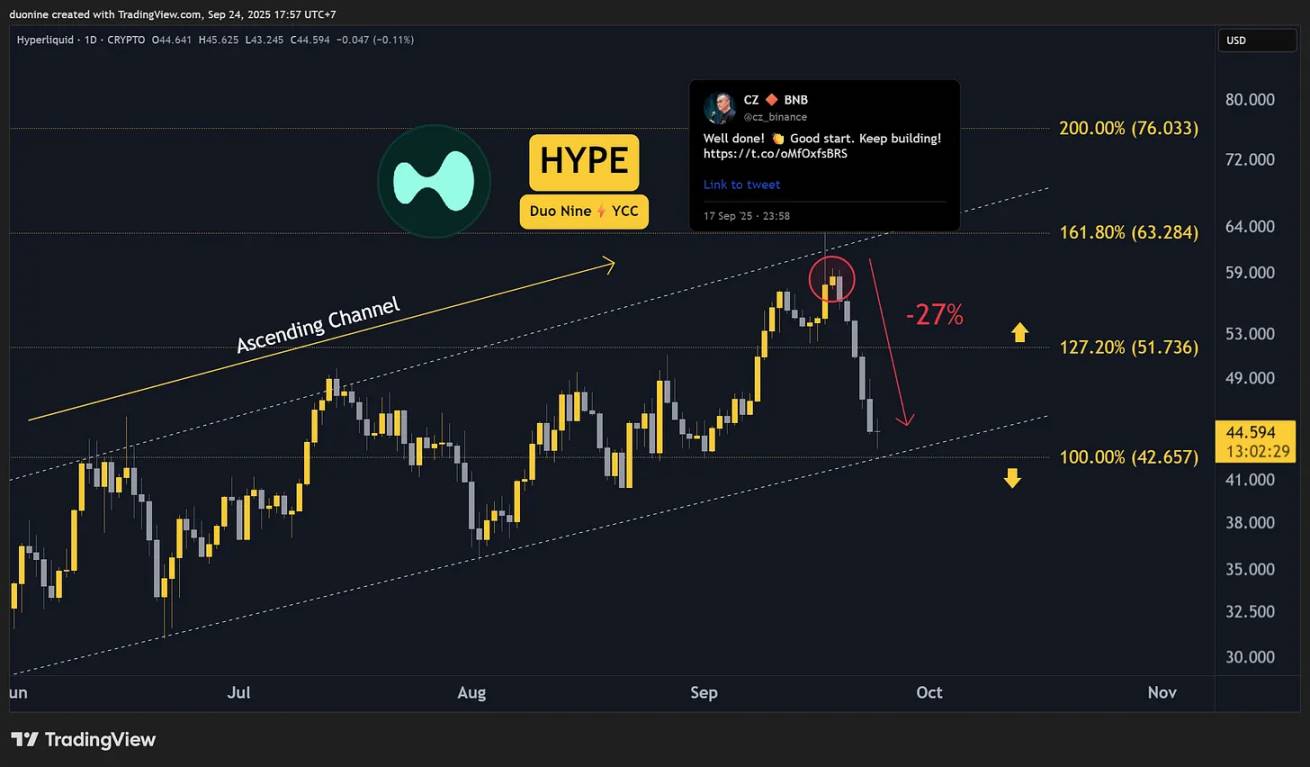
First, let’s examine the impact of this event. As shown in the chart, before the launch of the Aster token, Hyperliquid’s price kept hitting new highs. But when CZ posted about Aster on X, that upward momentum suddenly halted.
The result? The HYPE token dropped 27% within five days.
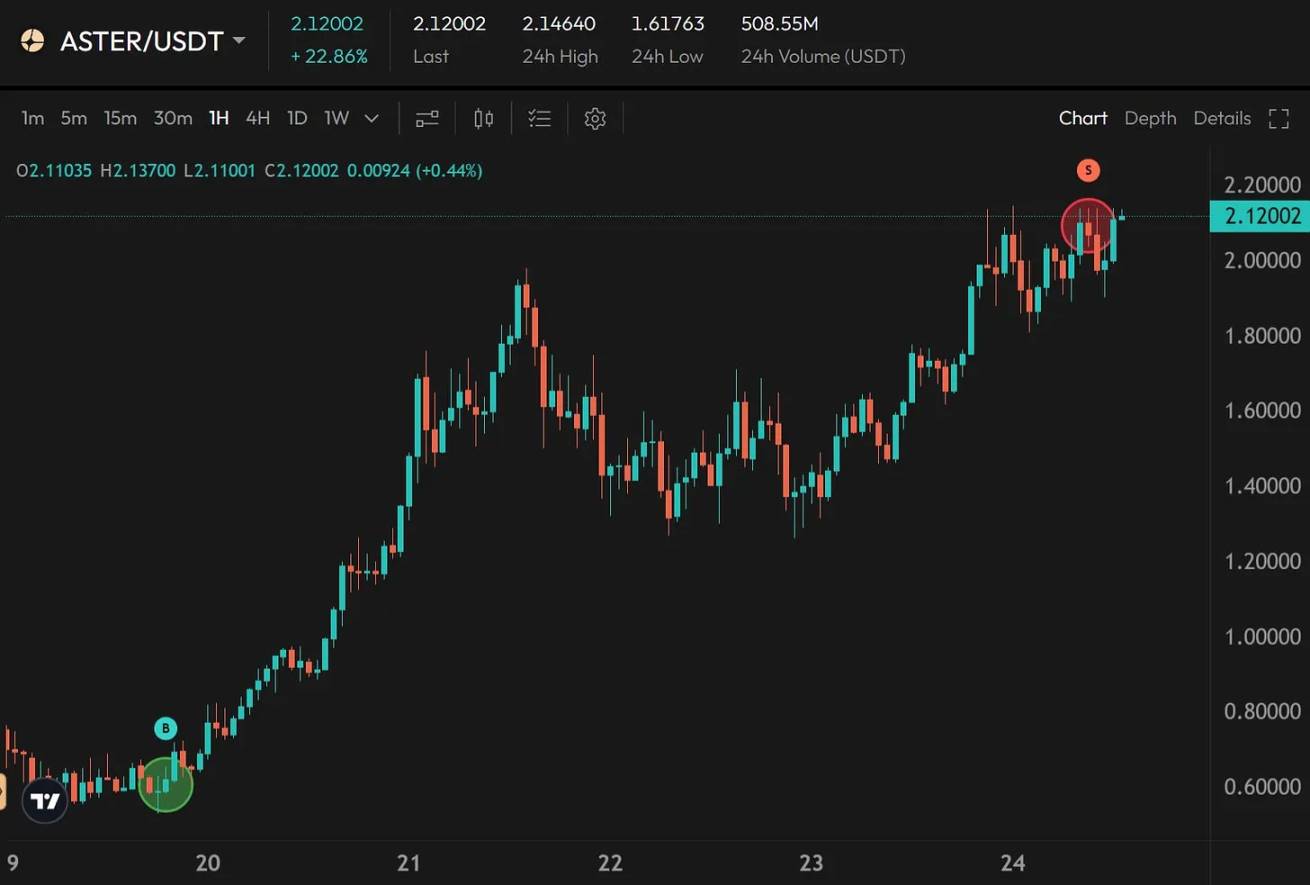
In contrast, Aster’s performance has been exactly the opposite. Since I shared my entry signal in the community, its price has tripled directly. As shown in the chart, I’ve already taken partial profits — holding from $0.06 all the way up to $2.10, achieving a 3x return in just five days.
As mentioned last Sunday, for months Hyperliquid has been a thorn in Binance’s side, posing a systemic threat. Its rapid rise has already disrupted Binance’s market position.
Immediately after his release from prison, CZ moved quickly to address this “problem.” Their plan was revealed as early as June this year—take a look at the timestamp of the following post on X.
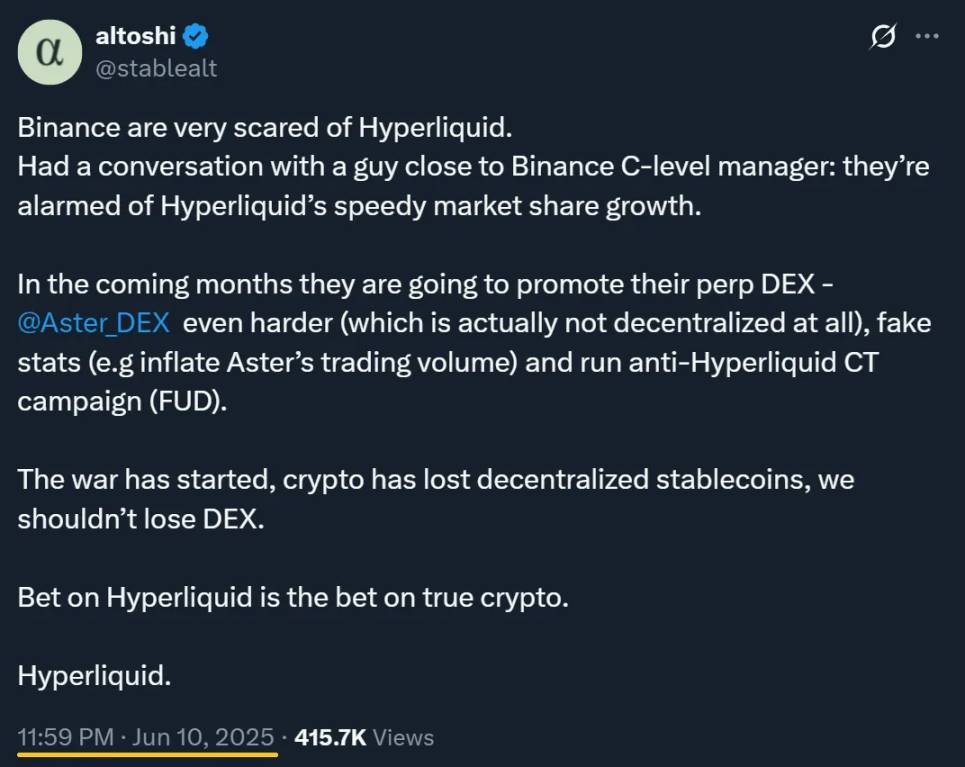
Clearly, the question wasn’t whether Binance would act, but when. In the past, they attempted to destroy the platform by liquidating Hyperliquid’s protocol treasury, but failed. So they shifted to Plan B: launching Aster.
Why act now?
CZ is no novice in crypto, and timing is everything. Previously, a single tweet from him severely damaged FTX, with near-perfect timing. The launch of Aster is no accident either—it comes precisely two months before Hyperliquid’s major HYPE token unlock.
In late November 2025, Hyperliquid will begin linearly unlocking 237.8 million HYPE tokens over 24 months. At $50 per token, this equates to a total value of $11.9 billion being released to the team, meaning nearly $500 million in nominal value could enter the market each month. Currently, there is no buyback mechanism capable of absorbing such massive sell pressure.
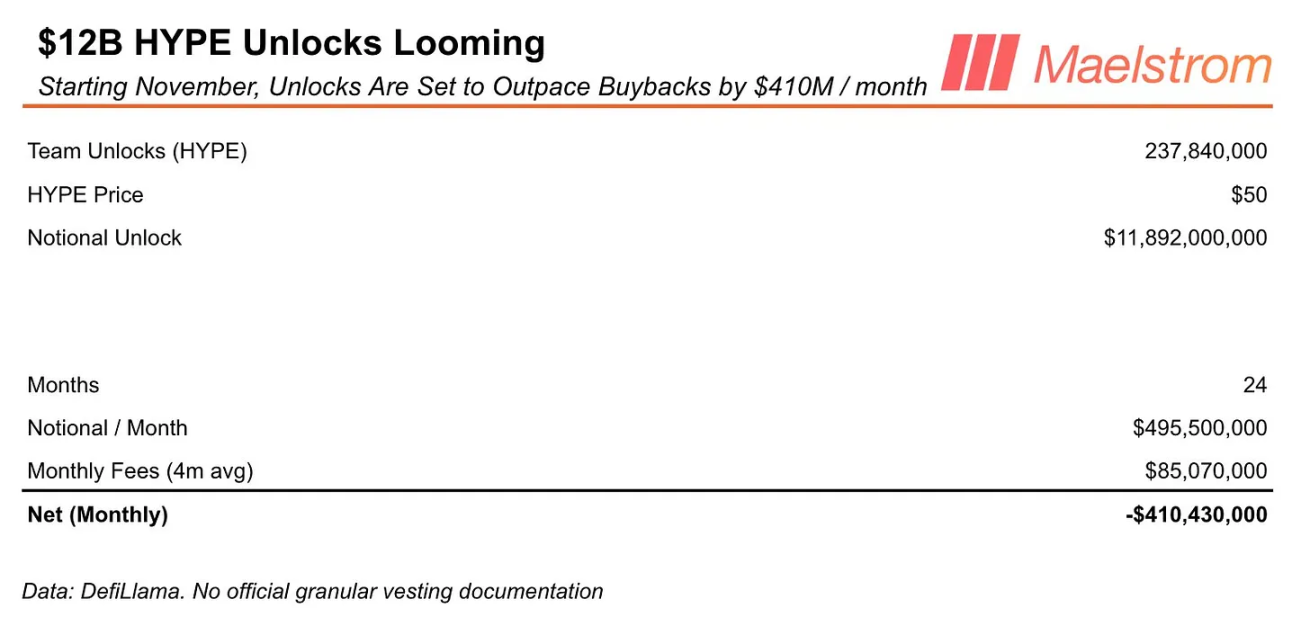
The above data comes from Maelstrom. Maelstrom is led by Arthur Hayes, who is also a key figure behind Ethena/ENA/USDe—a project where Binance is a crucial partner.
Interestingly, Arthur sold his HYPE holdings this week and was open about it. He explained that due to the upcoming unlock schedule, the HYPE token price is likely to collapse. Meanwhile, Aster’s price continues to climb.
Is this really a coincidence? Unlikely.
What CZ, Binance, and their affiliates are doing right now is essentially exploiting HYPE’s current weakness. Even if the Hyperliquid team chooses not to sell their vested tokens immediately, CZ doesn’t care.
All he needs to do is create the perception that “HYPE is weak,” while introducing a more attractive alternative—pushing Aster’s price to new highs to stabilize retail sentiment. With tight control over Aster’s token supply and deep pockets (billions of dollars), his strategy has so far been highly effective.
Having won this round, market momentum has clearly shifted toward Aster. Now the question is, can this momentum hold and sustain? With CZ and his network backing it, the answer is likely yes.
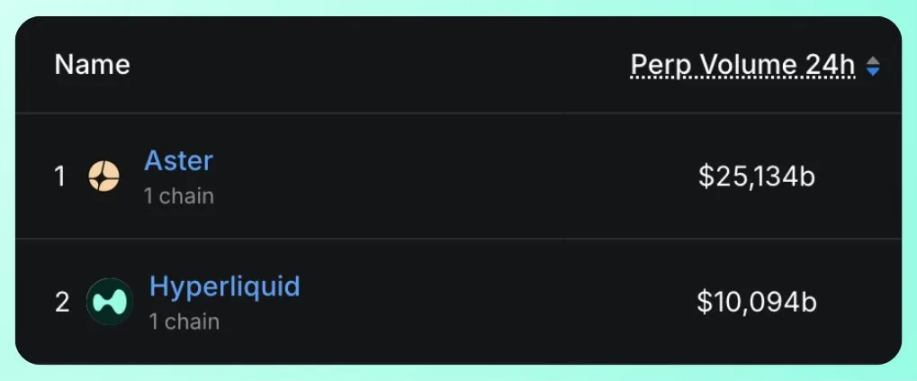
Taken together, it will be difficult for Hyperliquid to achieve market dominance over the coming months—especially considering Aster isn’t the only exchange trying to capture its share. Another strong contender is Lighter.
Lighter offers zero fees for retail traders, while Aster is backed by Binance-affiliated industry giants. Either way, this shows Hyperliquid has entered the top tier of the industry—after all, its competitors are now the most elite players in the field. Though the current situation is tough, it also sets the stage for a powerful rebound later.
Hyperliquid’s emergence wasn’t accidental either. In a sense, it was a direct outcome of FTX’s collapse—providing an alternative to centralized exchanges. From this perspective, CZ’s destruction of FTX indirectly gave birth to Hyperliquid. It’s a dramatically ironic cycle.
In crypto, whenever a platform offers better service, market liquidity and user attention can shift instantly. Hyperliquid is currently suffering such an impact. But by 2026, once the battle for DEX market share settles, I believe the HYPE token will regain dominance. Unless a black swan event occurs, its trajectory is unlikely to deviate significantly.
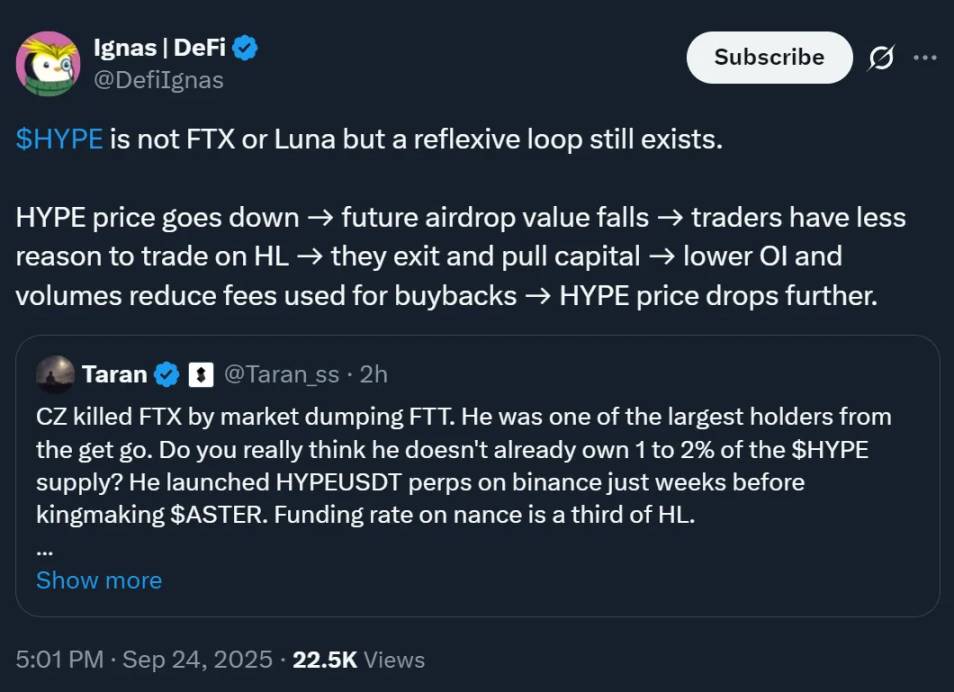
HYPE is not a blow-up project like FTX (the collapsed crypto exchange) or Luna (the failed algorithmic stablecoin), but it does exhibit a "reflexive loop" (a feedback cycle where price and market behavior influence each other), with the following logic:
HYPE price falls → future airdrop value diminishes → traders lose incentive to trade on Hyperliquid (HL, assumed platform issuing $HYPE) → traders leave and withdraw funds → open interest (OI) and volume drop, reducing fees available for buybacks → $HYPE price falls further.
If the HYPE token continues to underperform over the next few months, that would be an excellent opportunity to accumulate and build a long-term position. HYPE previously experienced a major correction (down 72%), and a similar scenario may unfold again, offering investors an ideal entry point.
Regardless, the crypto market always presents opportunities and unexpected turns. Doubling, tripling, or even multiplying capital in the short term is not uncommon—just as we’ve seen with Aster’s recent performance.
Join TechFlow official community to stay tuned
Telegram:https://t.me/TechFlowDaily
X (Twitter):https://x.com/TechFlowPost
X (Twitter) EN:https://x.com/BlockFlow_News
 @DU09BTC