Following the Money: Which Altcoins Are Enterprises Actually Paying for in 2025?
TechFlow Selected TechFlow Selected
Following the Money: Which Altcoins Are Enterprises Actually Paying for in 2025?
This round of treasury allocation marks the convergence of three important trends.
 Navigating Web3 tides with focused insights
Author: 0xResearcher
If market movements are the thermometer of sentiment, then "treasury allocation" is the corporate ballot. Who puts real money on the line and adds non-BTC, non-ETH tokens to their balance sheets—such as FET and TAO in AI, HYPE and ENA in next-gen DeFi infrastructure, legacy payment coins like LTC and TRX, or even community-driven DOGE—often provides a more reliable signal than social media hype. These holdings reflect not only business synergies and diversification strategies but also offer retail investors a window into market direction: who’s buying, why they’re buying, and how they plan to use these assets. Asking these questions helps distinguish strong narratives from weak ones and reveals which altcoins are being taken seriously by institutionalized capital.
Why Pay Attention to Treasury Allocations?
Use “corporate capital deployment” to identify strong narratives. First, because it's harder to fake. Once a company includes a token in its financial statements or regulatory filings, management must disclose details on position size, accounting policies, custody, and risk exposure—making it far more binding than mere marketing slogans. Second, it reflects “holding for use.” In this treasury wave, many companies aren’t just buying tokens—they’re simultaneously signing tech partnerships, integrating tokens into products, or staking them on-chain. Examples include Interactive Strength planning to acquire ~$55 million worth of FET and partnering with fetch.ai, Freight Technologies linking FET to logistics optimization, Hyperion DeFi using HYPE for staking and connecting yield and collateral paths with Kinetiq, and TLGY (planning to merge into StablecoinX) establishing an ENA treasury to bet on Ethena’s synthetic dollar and yield structure. The common thread? Tokens are no longer just price plays—they are “credentials” and “fuel.” Third, it offers retail investors an alternative path. You can research tokens directly, or gain indirect exposure by analyzing public companies holding them. Of course, this is a double-edged sword: small-cap stocks combined with high-volatility tokens often turn share prices into “token proxies,” amplifying swings. If taking the stock-based indirect route, position sizing and timing become especially critical.
In the 2025 market context, this trend is accelerating. Macro-wise, the approval of U.S. spot crypto ETFs has lifted risk appetite, and the strength of BTC and ETH has created a spillover effect, giving altcoins broader visibility and drawing attention to high-quality sectors. Corporate attitudes are shifting—from tentative “test holdings” to strategic allocations—and even new business models are emerging where crypto treasury management becomes the core business. On disclosure, companies are moving beyond press releases, increasingly reporting holdings, fair value, custody arrangements, and risk controls through regulatory filings, quarterly reports, and investor presentations, enhancing verifiability. In short, the heat is back, the path is clearer, and capital is becoming more serious. This means treasury activity is now a reliable lens for understanding industry direction.
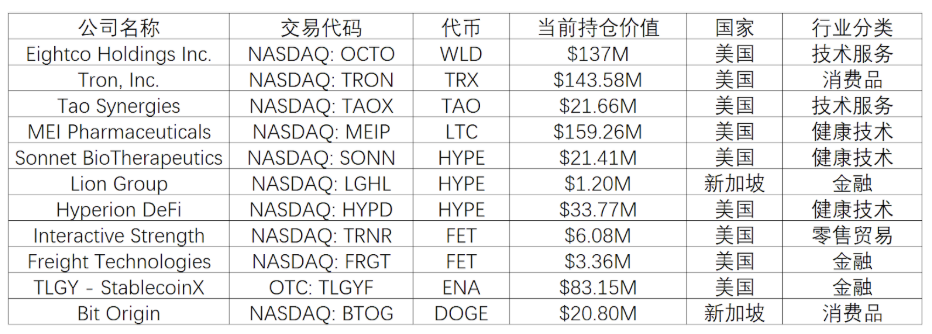
Recent Altcoin Holdings in Public Company Treasuries
Three Key Altcoin Themes: AI, New-Gen DeFi, and Legacy Payment Coins
AI Sector (FET, TAO): The key signal here is “holding for use.” Native AI network tokens are rarely pure speculation—they serve as access tickets and fuel for services like agent invocation, compute and model marketplace access, and network incentives. Corporate treasury entries are typically paired with technical collaboration and business integration, such as closed-loop applications in logistics optimization, compute orchestration, or agent deployment, making these more strategic and less speculative. However, uncertainties remain: the AI-blockchain convergence is still in validation phase, valuations may front-run fundamentals, and long-term tokenomic sustainability (inflation/deflation mechanisms, incentive design, fee capture) needs monitoring.
New-Gen DeFi Infrastructure (HYPE, ENA): This theme combines efficiency and yield. HYPE represents performance-oriented DeFi infrastructure—using a high-performance chain to support derivatives trading and liquid staking derivatives, enabling a capital cycle of “earning yield + re-pledging liquid staked tokens”—offering institutions and capital pools efficient asset utilization. Corporate interest lies not only in governance and yield generation but also in strengthening liquidity and ecosystem stickiness through this capital loop.
ENA’s appeal centers on its synthetic dollar and yield-hedging design. Ethena combines staking derivatives with hedging strategies to create a dollar-pegged stable asset without relying on traditional banking, while generating native yield. If this model integrates with exchanges, custodians, and payment systems, it could form a true closed-loop “crypto dollar + yield” ecosystem. For corporate treasuries, this means holding a stable unit of account that also delivers yield and volatility hedging. Yet risks are complex: liquidation safety, smart contract robustness, and stability under extreme conditions require rigorous auditing and risk controls.
Source: X
Payments & Legacy Large Caps (LTC, TRX, DOGE): These assets are more about “low-maintenance core holdings and payment rails.” With longer histories, stronger liquidity, and mature infrastructure, they function as “quasi-cash” in corporate treasuries—suitable for long-term value storage and payment use cases. LTC and TRX offer efficiency advantages in payment and settlement layers, serving as direct payment exposure; DOGE leverages community momentum and brand reach for lightweight payments and viral engagement. Overall, these play a stable, foundational role, though new growth narratives are limited, and they may face increasing competition from stablecoins and L2 payment networks.
Know What’s Being Bought—But More Importantly, Know How to Read It
Spot the trend, but don’t oversimplify. When a company adds a token to its financial statements, it’s casting a real vote with real money—helping filter out noise. But this isn’t a magic indicator. A more complete framework examines three layers: Is there business synergy? (Is the company actually using the token?), Is there formal disclosure? (Is the position reported in regulatory filings with details on size, custody, and risk?), and Do on-chain metrics align? (Are activity, depth, and liquidations stable?). The real value of treasury tracking isn’t investment advice—it’s uncovering the underlying logic of industry evolution. When traditional public companies begin large-scale allocations to specific tokens, it signals a structural shift in crypto—from pure speculation toward value anchoring.
From a macro perspective, this treasury wave marks the convergence of three major trends: regulatory maturation—companies disclosing crypto holdings in public filings indicates growing compliance frameworks; concrete use cases—moving beyond abstract “blockchain revolution” talk to measurable needs in AI training, DeFi yield, and cross-border payments; and institutionalization of capital—shifting from retail dominance to corporate participation, implying longer holding periods and more rational pricing. At a deeper level, treasury allocations are redefining the very nature of digital assets. We once saw cryptocurrencies as high-risk speculative tools, but as more enterprises treat them as operational assets or strategic reserves, they begin to resemble foreign exchange reserves, commodity inventories, or technology licenses. This cognitive shift may be more transformative than any single technological breakthrough.
Join TechFlow official community to stay tuned
Telegram:https://t.me/TechFlowDaily
X (Twitter):https://x.com/TechFlowPost
X (Twitter) EN:https://x.com/BlockFlow_News