








Decoding HIP-4 Proposal: Is Hyperliquid Entering Prediction Markets? The New Business Playbook of a DEX Giant
TechFlow Selected TechFlow Selected
Decoding HIP-4 Proposal: Is Hyperliquid Entering Prediction Markets? The New Business Playbook of a DEX Giant
For Hyperliquid, this could be a "natural" business.
 Navigating Web3 tides with focused insights
Author: David, TechFlow
Yesterday, Hyperliquid released a new proposal, HIP-4.
Amid the noise of various meme coins and buyback narratives, this proposal hasn't sparked much discussion within the crypto community. However, upon closer inspection, we find it points to another hot narrative in the current market — prediction markets.
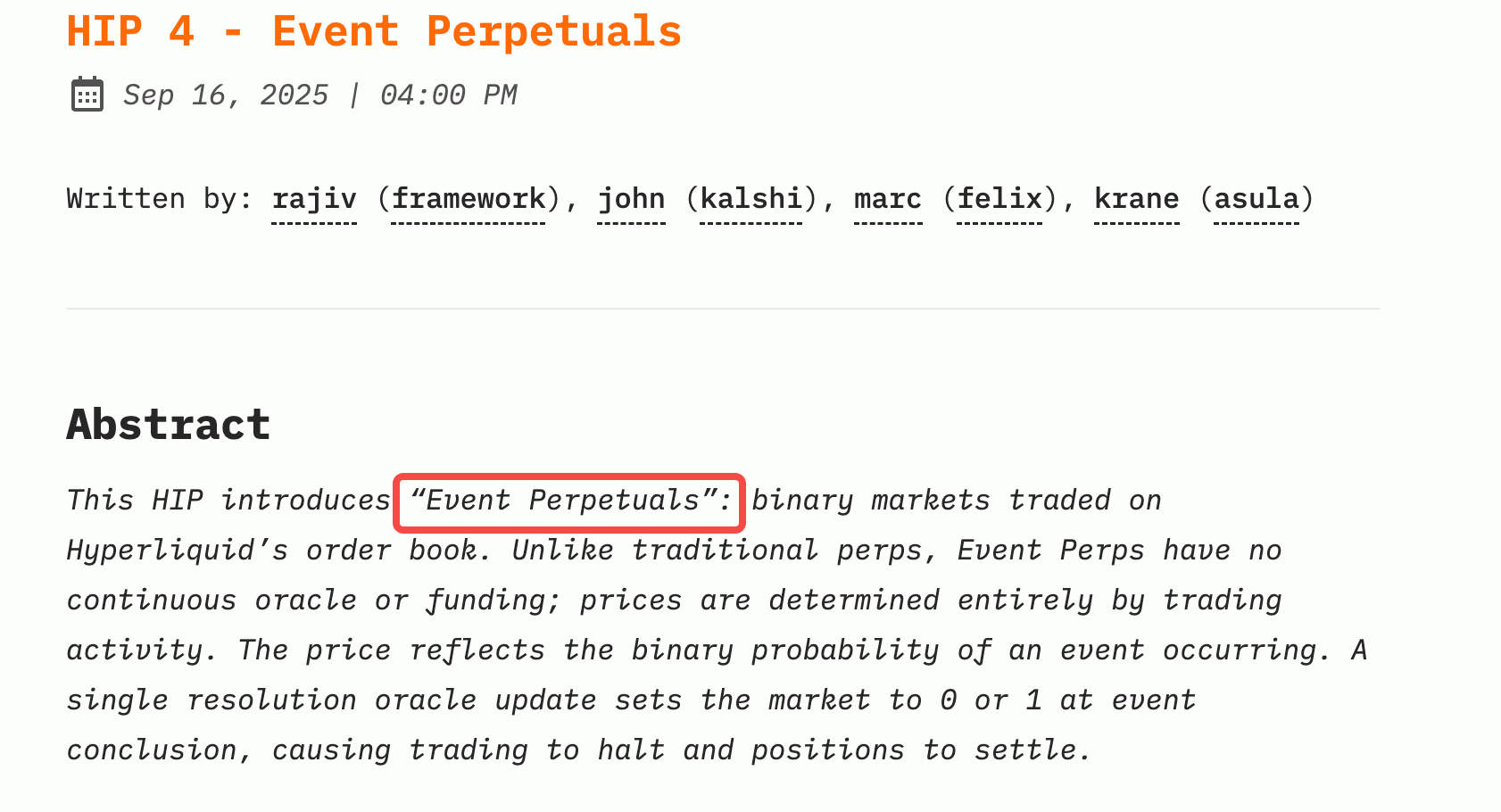
The core of the proposal is to launch a new trading product called "Event Perpetuals."
In simple terms, Hyperliquid wants to add binary prediction market functionality to its existing perpetual futures exchange. Users could then place bets on events such as "Will the Fed raise interest rates?" or "Will a certain token be listed on Binance this month?"
Notably, the authorship team behind this Hyperliquid proposal is quite interesting: it includes investors from Framework Ventures, members from the prediction market platform Kalshi, as well as developers from Felix Protocol and Asula Labs.
It's rare to see "competitors involved in drafting proposals." Kalshi itself is one of the key regulated players in the U.S. prediction market space.
This may suggest that Hyperliquid’s foray into prediction markets isn’t aimed at disrupting existing players, but rather exploring potential collaboration or differentiated positioning.
As the undisputed leader in the perpetual contracts sector, is Hyperliquid launching HIP-4 to capitalize on the vast potential of prediction markets, or is it seeking a new narrative to support the HYPE ecosystem?
Now It’s a Side Business
The 2024 U.S. presidential election propelled Polymarket into fame, with trading volume surpassing $3.6 billion. In 2025, prediction markets have become darlings of capital: Polymarket recently re-entered the U.S. market by acquiring QCEX for $1.12 billion, while Kalshi partnered with Robinhood to launch prediction market features, maintaining monthly trading volumes above $800 million. Even traditional financial giants are showing interest.
TIME Magazine previously named Polymarket one of the “100 Most Influential Companies of 2025.” The reason is straightforward: prediction markets are redefining how information discovers value.
Faced with such market热度, would Hyperliquid remain indifferent?
Although HIP-4 is currently just a proposal requiring community voting and technical validation, judging by its level of detail and the caliber of participants, this is clearly no impulsive move.
More importantly, for Hyperliquid, this might be a “side” business.
First, there’s high technical reusability.
Prediction markets and perpetual contracts share highly similar technical architectures: both require order books, matching engines, and margin systems. For Hyperliquid, adding Event Perpetuals entails relatively low development costs and manageable risks. Even if results fall short of expectations, the core business remains unaffected.
Second, user bases naturally overlap.
Traders in perpetual contracts and bettors in prediction markets are fundamentally speculators. They chase volatility, thrive on uncertainty, and are willing to stake their judgments. Hyperliquid has already gathered a large number of such users—why not offer them more games to play?
Finally, the HYPE ecosystem needs new stories.
As one of the most successful DEXs in 2024, Hyperliquid’s perpetual contract business is already mature. But capital markets always demand growth, and the $HYPE token needs more use cases to justify its valuation. Prediction markets aren’t just potentially good business—they’re also a compelling story: sexy, imaginative, and closely tied to trending topics.
Rather than a strategic pivot, this is better seen as a low-cost product line experiment. If it succeeds, a new track opens up; if not, the core business remains intact.
HIP-4: A Clever Product Extension
Let’s first address a key question: Why can’t Hyperliquid simply add prediction markets to its existing system?
The proposal gives a vivid example: NFL game predictions.
Suppose the prediction is “Will the Chiefs win the Super Bowl?” Using traditional perpetual contracts, you’d need continuous oracle price feeds updated every 3 seconds. But here’s the problem: sports betting odds don’t change continuously. After a single offensive play, the odds might jump instantly.
HIP-3 (Hyperliquid’s current market deployment standard) limits price changes to a maximum of 1% per tick. This means that if the outcome becomes certain, the price moving from 0.5 to 1.0 would take a full 50 minutes to complete.
During this period, traders who know the result could easily arbitrage.
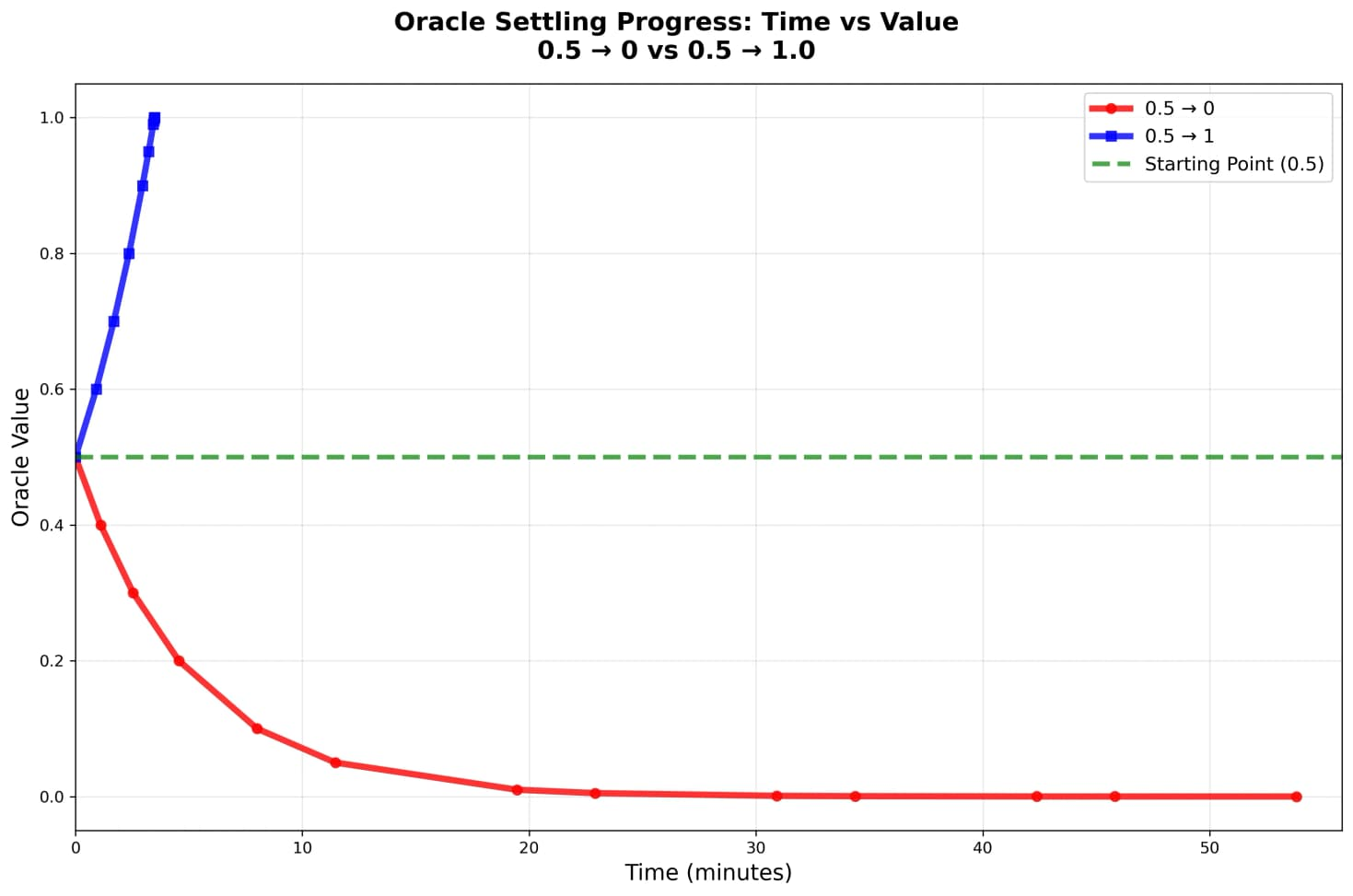
This is why the new Event Perpetuals under HIP-4 are needed.
Event Perpetuals remove two core mechanisms of perpetual contracts: continuous oracles and funding rates. Prices are determined purely by market trading, with final outcomes (0 or 1) resolved via oracle only when the event concludes.
Interesting design elements include:
-
Opening auction mechanism: 15-minute batch auction to prevent chaotic initial pricing
-
1x isolated margin: No leverage, reducing liquidation risk
-
Slot reuse: New markets can be deployed immediately after settlement, improving capital efficiency
On the surface, this is a technical innovation; in essence, it may represent Hyperliquid testing a new business direction.
The attempt to evolve from a single product to a product matrix is evident. No matter how successful perpetual contracts are, they’re still just one product. If Event Perpetuals succeed, it signals Hyperliquid’s infrastructure can support a wider range of financial products:
Today it’s prediction markets, tomorrow options, the day after structured products.
More importantly, Hyperliquid has chosen a smart expansion model: letting others create markets.
According to the proposal, any team wishing to create a prediction market on Hyperliquid (referred to as a "Builder") must stake 1 million HYPE tokens. These Builders are responsible for:
-
Deciding what markets to create (e.g., “Will Trump buy Bitcoin?”)
-
Setting market parameters (settlement time, oracle source, etc.)
-
Maintaining market operations (providing initial liquidity, promotion, etc.)
In return, Builders can earn up to 50% of the transaction fees generated by their market.
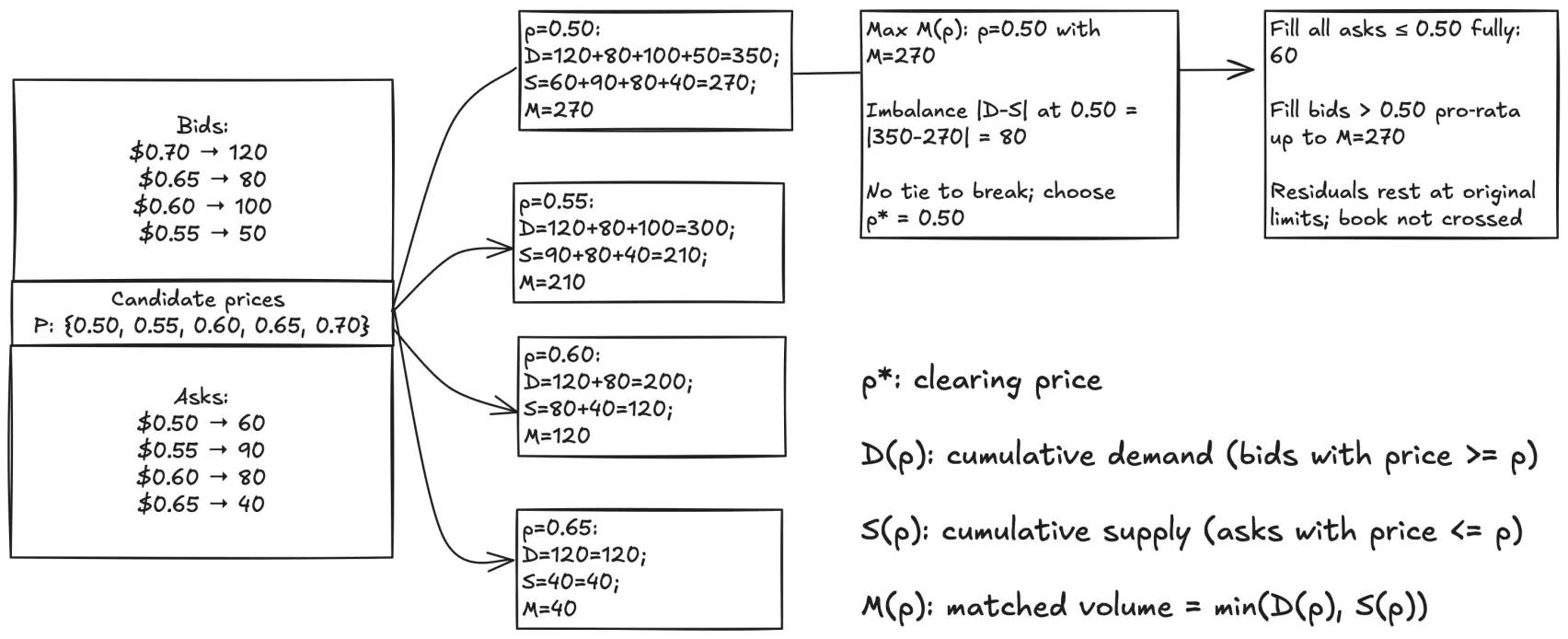
This design is clever. Hyperliquid doesn’t need to guess “which prediction markets will be popular”—it lets the market decide. Teams willing to stake 1 million HYPE will naturally choose markets with strong liquidity potential. If a Builder creates a dead market, the opportunity cost falls on them; if the market thrives, both Hyperliquid and the Builder win.
This also explains why members of the Kalshi team contributed to writing the HIP-4 proposal.
They may be exactly the kind of professional Builders Hyperliquid aims to attract. Kalshi has proven market operation experience and knows which types of prediction markets attract liquidity. If they choose to build on Hyperliquid, they bring not just one market—but an entire battle-tested operational methodology.
For a DEX with over $2 billion in TVL, this trial-and-error model is remarkably smart.
Challenges and Opportunities
Theoretically, it seems natural for a DEX to enter prediction markets.
Technical architecture is highly reusable. Order books, matching engines, settlement systems, margin management—core components of perpetual DEXs—are also essential for prediction markets.
But reality may not be so simple.
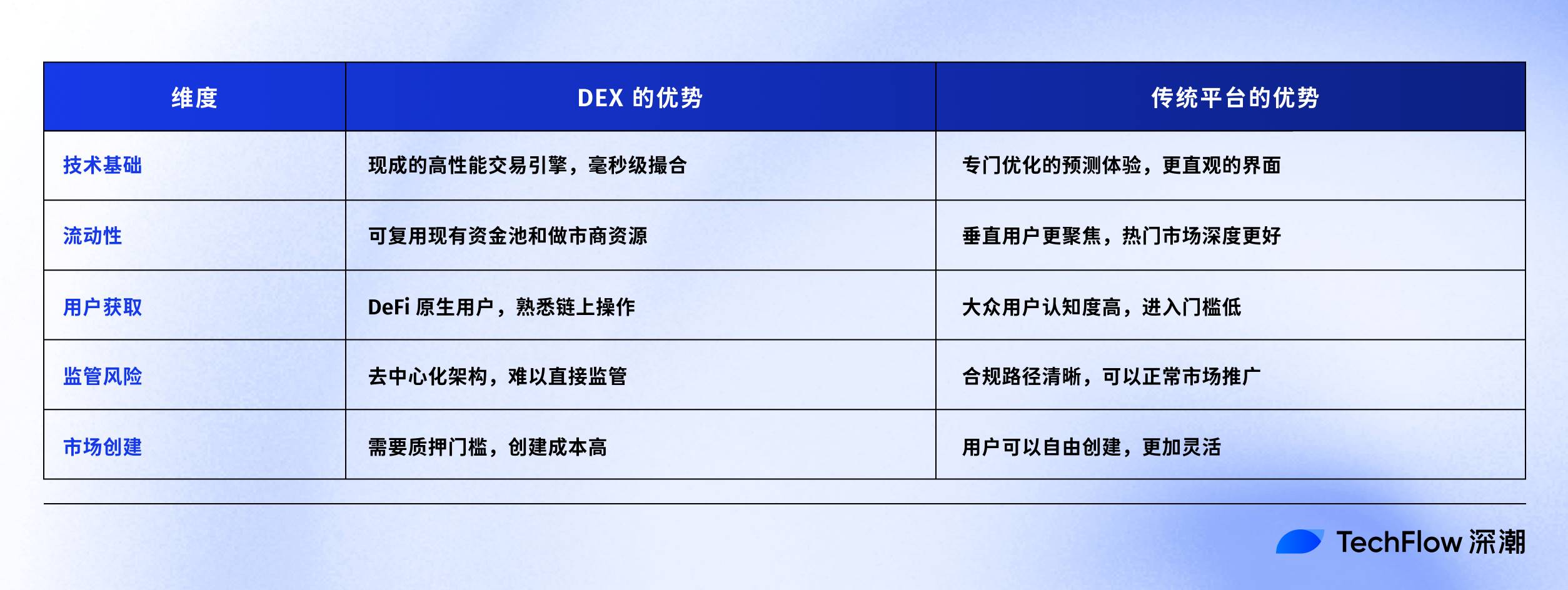
The vitality of prediction markets comes from diverse, user-created markets.
On Polymarket, any user can create a market. This UGC model keeps the platform fresh and topically relevant.
But under Hyperliquid’s HIP-4 proposal, creating a market requires staking 1 million HYPE. At current prices, this represents a multi-million dollar barrier. While this ensures market quality and prevents spam, it may also stifle innovation and diversity.
Another challenge is fragmented liquidity.
Perpetual contracts can share liquidity—the depth of ETH/USD supports all ETH-related trades. But prediction markets cannot. Each event is an independent pool of funds.
This means that even with $2 billion in TVL, once distributed across hundreds or thousands of prediction markets, each market may have very limited depth. Thin liquidity leads to high slippage and poor user experience.
Besides, users instantly recognize Polymarket and Kalshi as prediction platforms. Hyperliquid is still mentally associated with perpetual DEXs in the crypto world. If the proposal goes live, user education and marketing will be crucial.
So where does Hyperliquid’s opportunity lie?
Niche prediction markets focused on crypto-specific topics may be the most viable path. For example: Will a certain token be listed on a major CEX this month? Will Ethereum’s key upgrade be delayed?
For these markets, Hyperliquid’s users are more knowledgeable, more interested, and more willing to bet than Polymarket’s average user.
Is This Good for $HYPE?
In the short term, the impact may be limited.
First, this is only a proposal—not yet implemented. Even if approved, it will take months from development to launch to actual revenue generation. There might be some speculative hype, but sustained price support is unlikely.
Second, the revenue potential of prediction markets is uncertain. Even if Hyperliquid captures 10% of Polymarket’s market share (monthly volume of $80 million), with typical DEX fees around 0.1%, monthly income would be just $8,000. For a project with a multi-billion dollar market cap, this incremental revenue is negligible.
But in the medium to long term, the implications may go beyond direct financials.
First, increased staking demand.
If HIP-4 successfully attracts 10–20 Builders, that means 10–20 million HYPE tokens get locked up. While not massive relative to total supply, it’s a real reduction in circulating supply.
More importantly, it demonstrates HYPE’s value as a “license”—holding HYPE not only grants governance rights but also unlocks business opportunities.
Second, brand value expansion.
If professional teams like Kalshi are genuinely willing to stake HYPE to build markets, it sends a strong signal: established prediction market brands recognize Hyperliquid’s future. This endorsement effect may be more valuable than direct revenue.
Crypto markets never lack capital—they lack stories. The story of a perpetual DEX is already told. If Hyperliquid successfully enters prediction markets, each new possibility adds another variable to its valuation model.
Exploring the Boundaries of DEXs
I believe the interesting aspect of the HIP-4 proposal lies in a broader trend: DEXs are testing their own boundaries.
From simple token swaps to perpetual contracts, and now possibly to prediction markets, we see successful DEXs constantly expanding—turning adjacent opportunities into tools for growth and higher valuations.
And this expansion doesn’t follow the flashy playbook of many crypto projects, where every minor update is announced like breaking news. Instead, it’s a quiet test—of technological limits, user acceptance, and regulatory tolerance.
For those watching Hyperliquid, the best approach isn’t overanalyzing individual proposals, but observing the underlying trend.
HIP-4 itself may succeed or fail, but the direction it represents—platformization, ecosystem expansion, and diversification of DEXs—is likely the future. Projects that successfully expand their boundaries will command higher valuation multiples; those that stay stagnant will gradually fade.
Can Hyperliquid carve out a share in prediction markets with Event Perpetuals?
Let the market decide. After all, this itself is a prediction worth betting on.
Join TechFlow official community to stay tuned
Telegram:https://t.me/TechFlowDaily
X (Twitter):https://x.com/TechFlowPost
X (Twitter) EN:https://x.com/BlockFlow_News
 深潮TechFlow


