The era of retail investors' comeback
TechFlow Selected TechFlow Selected
The era of retail investors' comeback
Retail investors may indeed be smarter, more disciplined, and better informed than previous generations; or they may simply be beneficiaries of a bull market in which nearly all assets rose across the board.
 Navigating Web3 tides with focused insights
By Thejaswini M A
Translated by Saoirse, Foresight News
In 1979, Republic National Bank offered customers a choice: deposit $1,475 for 3.5 years and receive a 17-inch color television; extend the term to 5.5 years with the same amount and get a 25-inch model. Want a better deal? Deposit $950 for 5.5 years and walk away with a sound system complete with built-in disco lights.
This "product-for-deposit" strategy originated during the Great Depression, when banking regulations banned "competitive interest rates." In 1933, Regulation Q—part of the Banking Act—took effect, prohibiting interest payments on demand deposits and capping savings account rates. At the time, money market funds could offer higher returns, while banks had no choice but to lure customers with toasters, TVs, and other gifts, unable to compete on actual yield.
The banking industry labeled investors in money market funds as "smart money," while viewing their own depositors as "dumb money"—in their eyes, these savers simply didn't know they could earn more elsewhere. Wall Street readily embraced this narrative, using "dumb money" to describe all investors who "buy high, sell low, chase trends, and make emotional decisions."
Fifty years later, the once-mocked "dumb money" has had the last laugh.
The concept of "dumb money" is deeply rooted in Wall Street's investment worldview. Professional investors, hedge fund managers, and institutional traders have long seen themselves as "smart money"—believing they are "sophisticated players" who can cut through market noise and make rational choices when retail investors panic.
Past behavior seemed to confirm this view: during the dot-com bubble, day traders mortgaged homes and blindly bought tech stocks at peak prices; during the 2008 financial crisis, individual investors fled the market at its lowest point, completely missing the subsequent recovery.
The pattern was clear: professionals "buy low, sell high," while retail investors do the opposite. Academic research confirmed this behavioral bias, and professional fund managers used it as proof of their superior skill—justifying hefty management fees.
So why has everything changed now? The answer lies in three dimensions: "investment accessibility, investor education, and tool optimization."
A New Era for Retail Investing
Today’s data tells a very different story. In April 2025, when President Trump announced new tariffs, triggering a $6 trillion market sell-off over two trading days, professional investors rushed to dump stocks—while retail investors saw the plunge as a "buying opportunity."
During the market turmoil, individual investors snapped up equities at record speed: starting April 8, they injected a net $50 billion into U.S. stock markets, ultimately earning about a 15% return. During this period, Bank of America’s retail clients remained in “net buying” mode for 22 consecutive weeks—the longest such streak since the bank began tracking data in 2008.
Meanwhile, hedge funds and systematic trading strategies kept equity exposure at the “lowest 12th percentile,” completely missing the rebound.
A similar scenario played out during the 2024 market volatility. According to JPMorgan, retail investors drove most of the market gains in late April 2024. From April 28 to 29, individuals accounted for 36% of trading volume—the highest level on record.
Robinhood’s Steve Quirk described the shift: “Every IPO stock today sees oversubscription on our platform. Retail demand consistently exceeds supply, and issuers are happy to allocate shares to ‘brand fans.’”
In crypto, retail behavior has also evolved from the stereotype of “chasing pumps and dumps” to a more mature, strategically timed approach. JPMorgan data shows that between 2017 and May 2025, 17% of active checking account holders transferred funds into crypto accounts, with participation spiking at “strategic inflection points” rather than emotional peaks.
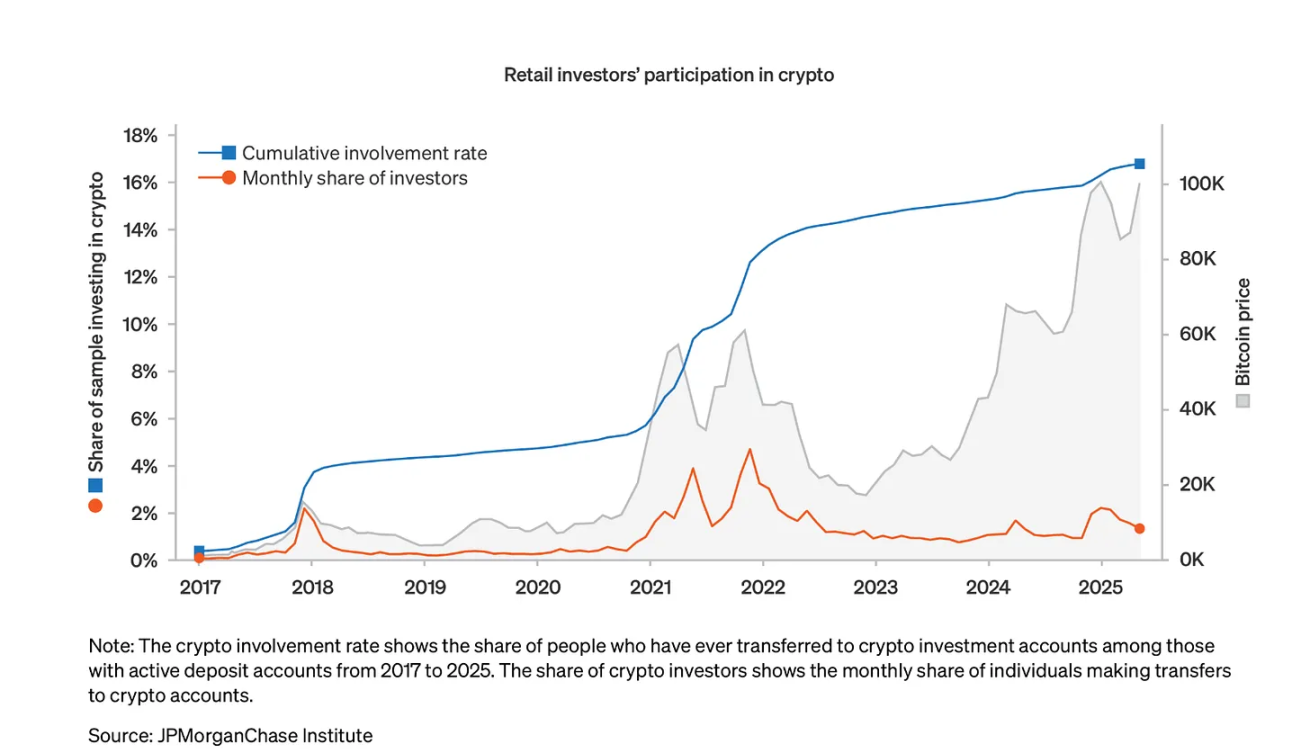
Source: JPMorgan
Data further reveals retail investors’ growing tendency to “buy the dip”: retail activity surged noticeably when Bitcoin hit new highs in March and November 2024; yet when BTC reached an even higher peak in May 2025, retail investors stayed cautious and avoided frenzy—indicating that crypto retail investors have moved beyond the traditional “FOMO (fear of missing out)” label, showing greater learning ability and self-discipline.
Moreover, retail investment sizes in crypto remain rational: the median investment amount is less than “one week’s income,” reflecting prudent risk management rather than excessive speculation.
Some might argue that gambling, sports betting, Memecoins, and similar areas still attract a steady flow of “dumb money”—but data suggests otherwise.
Indeed, casino and sports betting platforms see transaction volumes in the billions: the global online gambling market was valued at $78.66 billion in 2024 and is projected to reach $153.57 billion by 2030; in crypto, Memecoins often spark speculative frenzies, leaving latecomers holding worthless tokens.
Yet even in these supposedly “irrational” domains, retail behavior is maturing. Take Pump.fun, a Memecoin platform: despite earning $750 million from launching Memecoins, its market share plummeted from 88% to 12% when competitors introduced “more transparent and communicative” services. Clearly, retail investors aren’t blindly loyal to legacy platforms—they actively switch to options offering better value.
In fact, the popularity of Memecoins isn’t proof of “retail stupidity,” but rather reflects resistance to “VC-backed tokens” that often reject “fair access.” As one crypto analyst put it: “Memecoins give holders a sense of ‘belonging’ and form connections based on shared values and culture. They’re not just speculative tools, but a dual expression of ‘social + financial’ identity.”
Revolution in the IPO Market
The rise of retail influence is most evident in IPOs: more and more companies are abandoning the traditional model of catering exclusively to institutional investors and high-net-worth individuals, instead opening IPO allocations directly to retail investors.
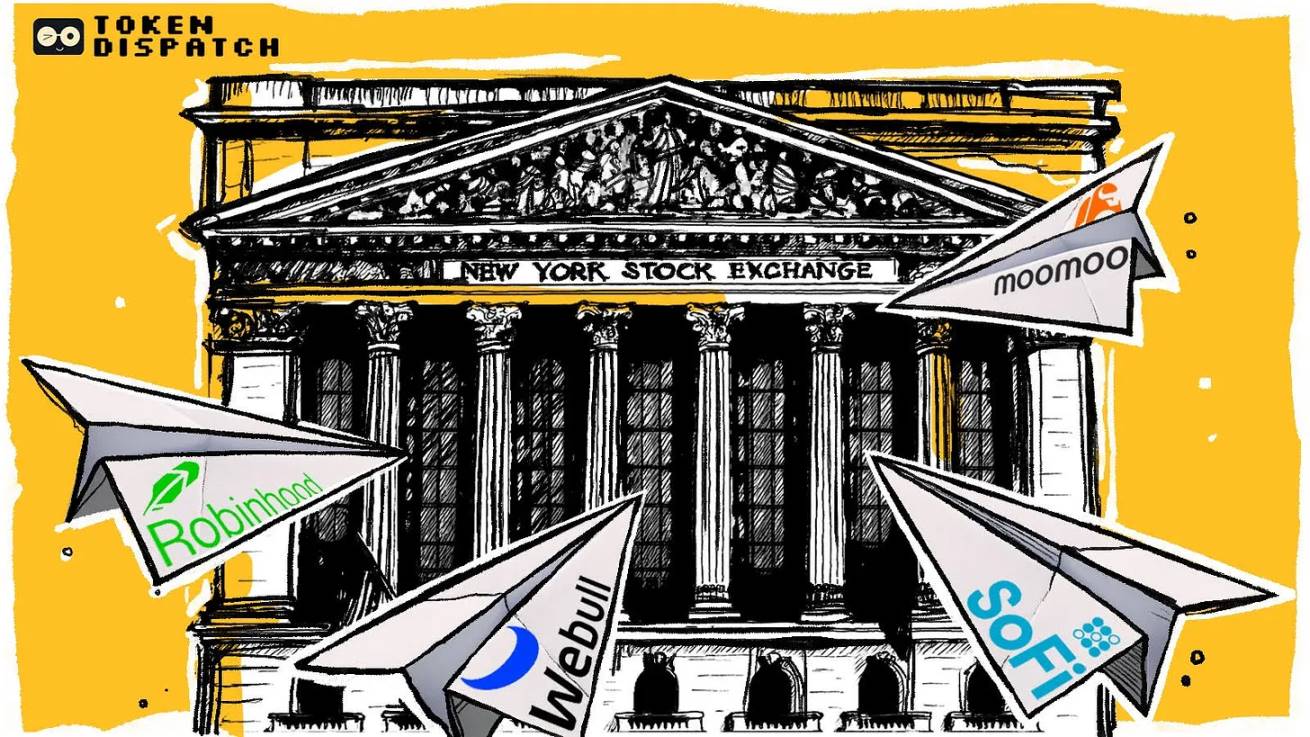
The IPO of Bullish marked a turning point in “corporate distribution models.” Founded by Block.one and backed by Peter Thiel’s Founders Fund and other institutions, Bullish operates both as a cryptocurrency exchange and an institutional trading platform. In its $1.1 billion IPO, Bullish allowed retail investors to participate directly via platforms like Robinhood and SoFi.
Strong retail demand pushed Bullish to price its shares at $37 each—nearly 20% above the initial range—and its stock surged 143% on the first trading day. Notably, Bullish allocated “one-fifth of its shares” (worth ~$220 million) to individual investors—four times the industry norm. Customers on the Moomoo platform alone placed orders exceeding $225 million.
This is no isolated case: Gemini, founded by the Winklevoss brothers, explicitly reserved 10% of its IPO shares for retail investors; Figure Technologies and Via Transportation also completed IPOs via “retail-focused platforms.”
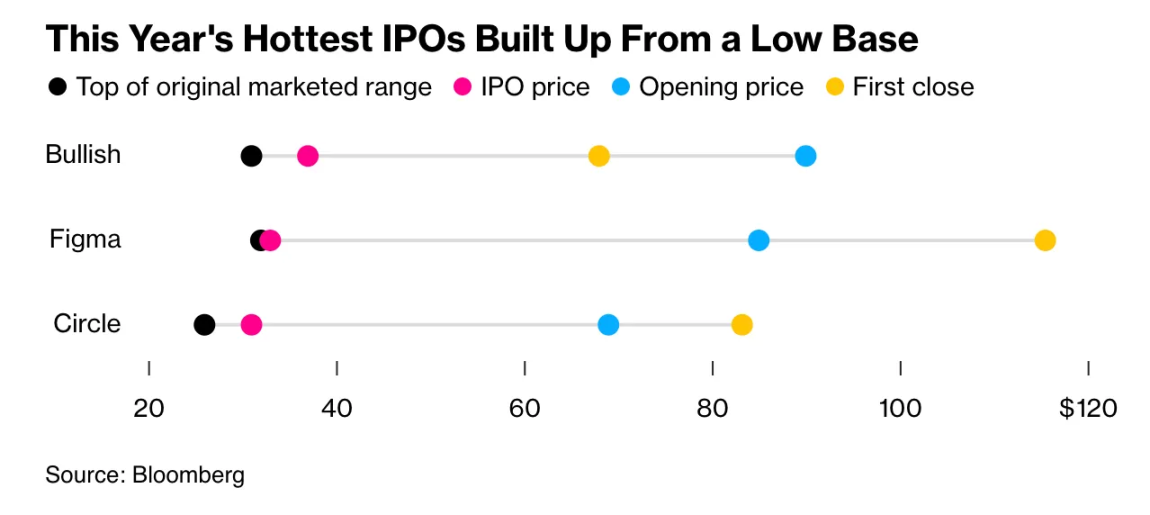
Source: Bloomberg
As Jefferies’ Becky Steinthal noted: “Compared to the past, issuers now have the option to let retail investors take a larger share in IPOs—all made possible by technology.” This statement captures the core logic behind the shift in corporate attitudes toward retail investors.
Robinhood’s data further confirms retail enthusiasm for IPOs: 2024 saw five times more IPO subscription demand on the platform than in 2023. To encourage more rational investing, Robinhood introduced a policy banning sales within 30 days post-IPO, fostering a “buy-and-hold” habit among retail investors—benefiting both company stock stability and long-term investor returns.
Retail influence extends beyond “investment behavior,” driving structural market changes: retail trading volume now accounts for about 19.5% of total U.S. equity volume, up from 17% a year ago and far above the pre-pandemic level of around 10%.
More importantly, retail investment philosophy has undergone a fundamental shift: in 2024, only 5% of investors in Vanguard’s 401k retirement plans adjusted their portfolios. Target-Date Funds now manage over $4 trillion. This indicates that retail investors are increasingly trusting “systematic, professionally managed investment solutions” over frequent trading—a shift that helps them avoid “emotion-driven, high-cost trading mistakes” and achieve better retirement outcomes.
eToro’s data is even more compelling: in 2024, 74% of the platform’s users were profitable, with advanced members seeing an 80% success rate—shattering the long-held belief that “retail investors are destined to lose to professionals.”
Demographic data further supports “retail maturation”: younger investors are entering the market earlier—Gen Z starts investing at an average age of 19, much earlier than Gen X (32) and Baby Boomers (35). Crucially, they have access to educational resources previous generations lacked: investment podcasts, premium newsletters, social media finance influencers, and zero-commission trading platforms—all helping build more sophisticated investment knowledge.
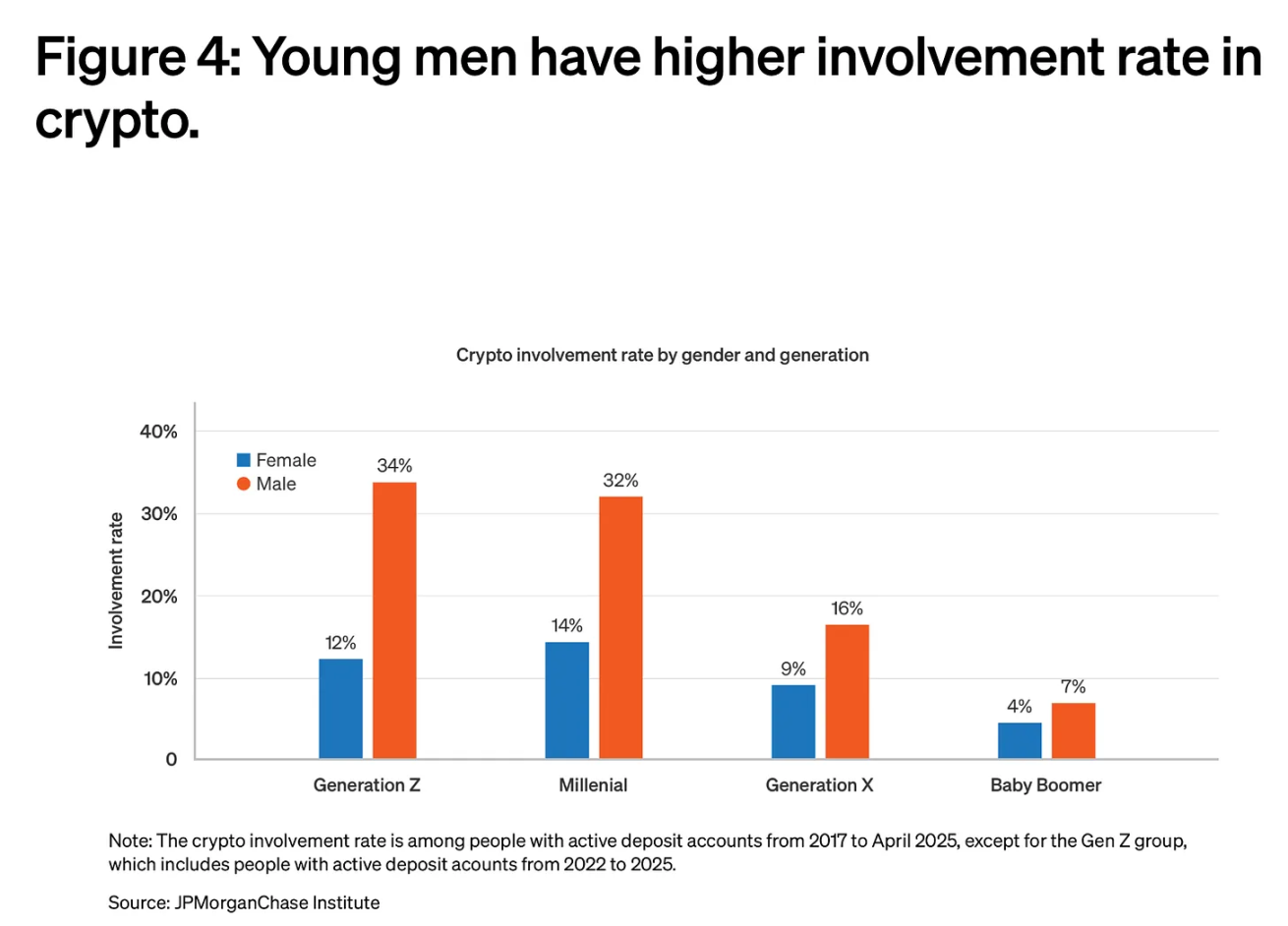
Source: JPMorgan
In crypto, retail “maturation” and “dominance” are especially pronounced: despite media focus on “institutional adoption of Bitcoin ETFs” and “corporate crypto holdings,” actual crypto usage is overwhelmingly driven by retail investors.
Chainalysis data shows India leads global crypto adoption, followed by the U.S. and Pakistan—reflecting grassroots use of centralized and decentralized services, not large-scale institutional accumulation.
Stablecoin markets further confirm this: in 2024, USDT’s monthly trading volume exceeded $1 trillion, while USDC ranged between $1.24 trillion and $3.29 trillion per month. These transactions aren’t “institutional capital flows,” but millions of retail-driven “payments, savings, and cross-border transfers.”
If crypto adoption is analyzed by World Bank income tiers, “high-income, upper-middle-income, and lower-middle-income groups” all show peak adoption simultaneously—indicating that current crypto penetration isn’t limited to wealthy early adopters, but has broad-based public support.
While Bitcoin remains the primary on-ramp for retail fiat deposits (exchanges saw over $4.6 trillion in BTC purchases from July 2024 to June 2025), retail portfolios are becoming increasingly diversified: Layer 1 blockchain tokens, stablecoins, altcoins, and others are attracting significant inflows.
The “smart money vs dumb money” narrative now appears especially ironic against recent institutional behavior: professional investors repeatedly misjudge major market turns, while retail investors demonstrate greater discipline and patience.
During the “institutional adoption phase” of crypto, hedge funds and family offices frequently made headlines—often adding Bitcoin to portfolios near cycle peaks. In contrast, retail investors steadily accumulated during bear markets and held firm through volatility.
The rise of crypto ETFs further highlights this contrast: over half of crypto ETF investors “had never directly owned crypto before,” indicating that traditional channels are expanding the investor base rather than diverting existing retail capital. Moreover, the median allocation to crypto among ETF holders is only “3%-5% of their portfolio,” reflecting cautious risk management, not blind speculation.
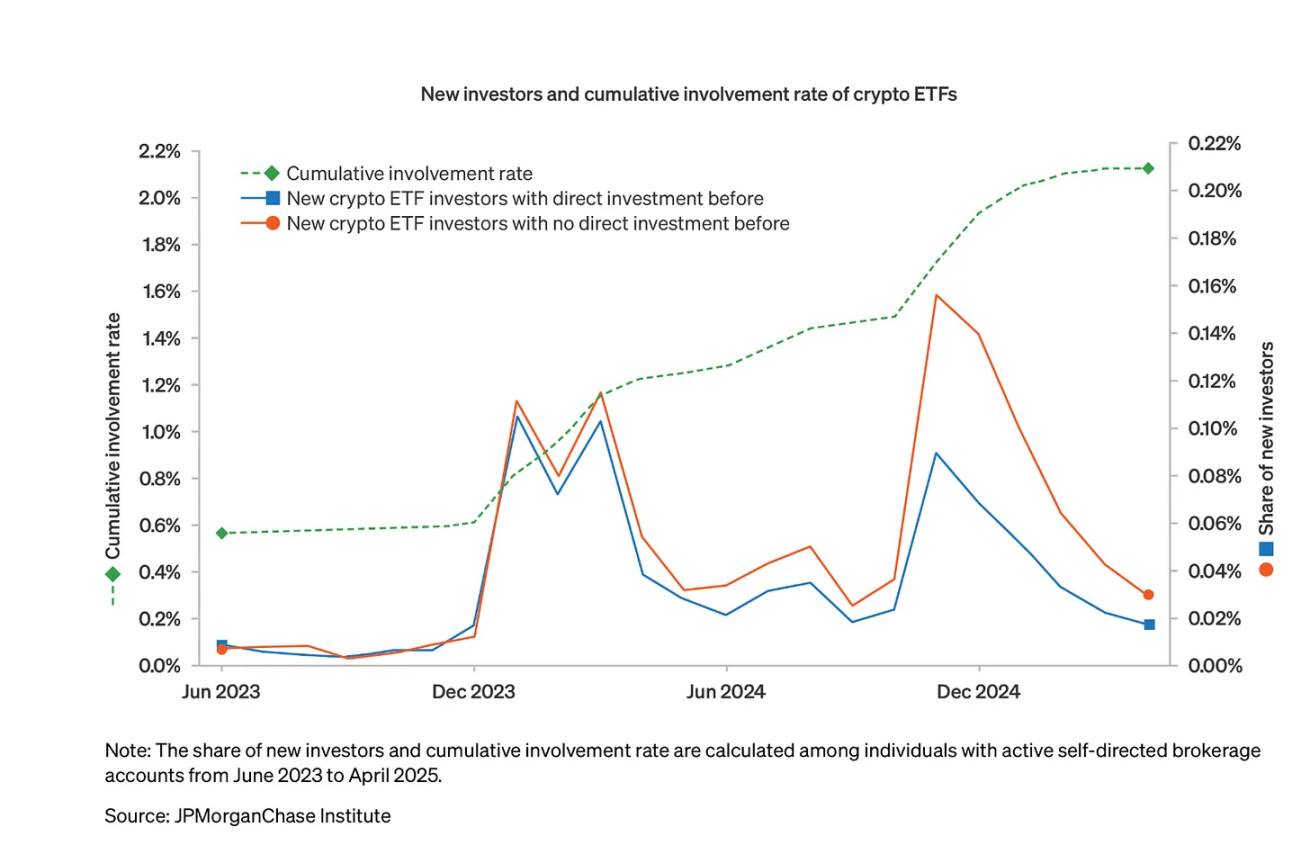
Source: JPMorgan
Today, professional investors are ironically repeating the very “retail mistakes” they once criticized: whenever market volatility spikes, institutions often flee to protect quarterly performance metrics, while retail investors buy the dip for long-term portfolio growth.
Technology: The Equalizer Reshaping Markets
The shift in retail investment behavior is no accident—technological advances have democratized information, tools, and market access once exclusive to professional investors.
Take Robinhood: its innovations go far beyond zero-commission trading. Offering tokenized U.S. stocks and ETFs to European users, enabling Ethereum and Solana staking in the U.S., and building a copy-trading platform that lets retail users follow “certified top traders”—each move lowers the barrier to entry for retail investors.
Coinbase continues improving retail crypto services, upgrading mobile wallet features, launching prediction markets, and simplifying staking. Stripe, Mastercard, and Visa have all rolled out “stablecoin payment functions,” allowing retail users to spend crypto at thousands of merchants.
Wall Street’s recognition of “retail influence” has created a positive feedback loop of further retail empowerment. After companies like Bullish succeeded with “retail-first IPO strategies,” more firms began following suit.
A Jefferies study also found potential investment opportunities in stocks with “high retail trading volume and low institutional attention” (including Reddit, SoFi Technologies, Tesla, and Palantir). The report notes, “When retail trading share rises, traditional notions of ‘stock quality’ seem to matter less”—not because retail decisions are inferior, but likely because retail investors apply valuation criteria different from institutions.
The crypto industry’s evolution toward “retail-friendliness” reflects this trend: mainstream platforms are shifting focus from “maintaining institutional relationships” to “optimizing user experience.” Features like “simple perpetual contracts,” “tokenized stocks,” and “integrated payments” are all designed to attract mass retail participation.
The persistence of the “dumb money” narrative partly serves the economic interests of professional investors: fund managers justify fees by claiming superior skill; investment banks maintain pricing power by restricting access to high-return trades.
But data shows these advantages are fading: retail investors are increasingly demonstrating the very traits—discipline, patience, and timing—that professionals claim as their own, while institutions frequently exhibit the emotional, momentum-chasing behaviors they once blamed on retail.
Of course, this doesn’t mean every retail investor makes optimal decisions—speculation, leverage abuse, and chasing trends still exist. But the key difference is that these are no longer “retail-exclusive problems,” but risks common to all investor types.
This shift will trigger deeper structural impacts: as retail gains influence in IPOs, they may demand “better terms, greater transparency, and fairer access”; companies embracing this trend will benefit from “lower customer acquisition costs” and “more loyal shareholder bases.”
In crypto, retail dominance means products and protocols must prioritize “usability” over “institutional features”—only platforms that “enable ordinary users to easily access complex financial services” will ultimately succeed.
Still, we must acknowledge a real caveat behind recent retail success: over the past five years, nearly all asset classes have been in bull markets—S&P 500 returned 18.40% in 2020, 28.71% in 2021, 26.29% in 2023, and 25.02% in 2024, with only a notable 18.11% drop in 2022, followed by an 11.74% gain YTD in 2025.
Bitcoin’s trajectory is similar: starting around $5,000 in early 2020, briefly surpassing $70,000 in 2021, fluctuating afterward but trending upward overall. Even traditional assets like government bonds and real estate posted strong gains during this period.
In a market where “buying the dip always pays off” and “holding any asset for over a year guarantees profit,” it’s hard to distinguish whether retail success stems from skill or luck.
This raises a critical question: can seemingly mature retail investment behavior withstand a “true bear market”? For most Gen Z and millennial investors, the longest market correction they’ve experienced was the 33-day plunge during the pandemic; the 2022 inflation scare caused short-term pain, but the market quickly recovered.
Warren Buffett’s famous quote—“Only when the tide goes out do you discover who’s been swimming naked”—feels especially relevant now. Retail investors may indeed be smarter, more disciplined, and better informed than previous generations—but they may also simply be beneficiaries of a bull market in which nearly all assets rose.
Only when the era of loose monetary policy ends and investors face sustained portfolio losses will we truly know: has the shift from “dumb money” to “smart money” been a permanent evolution, or merely a temporary phenomenon enabled by favorable market conditions?
Join TechFlow official community to stay tuned
Telegram:https://t.me/TechFlowDaily
X (Twitter):https://x.com/TechFlowPost
X (Twitter) EN:https://x.com/BlockFlow_News