Losers trade while winning retail traders rest
TechFlow Selected TechFlow Selected
Losers trade while winning retail traders rest
The more frequently you trade, the less you stop, and the harder it becomes to sustain profitability.
 Navigating Web3 tides with focused insights
Author: Pickle Cat
Translation: TechFlow
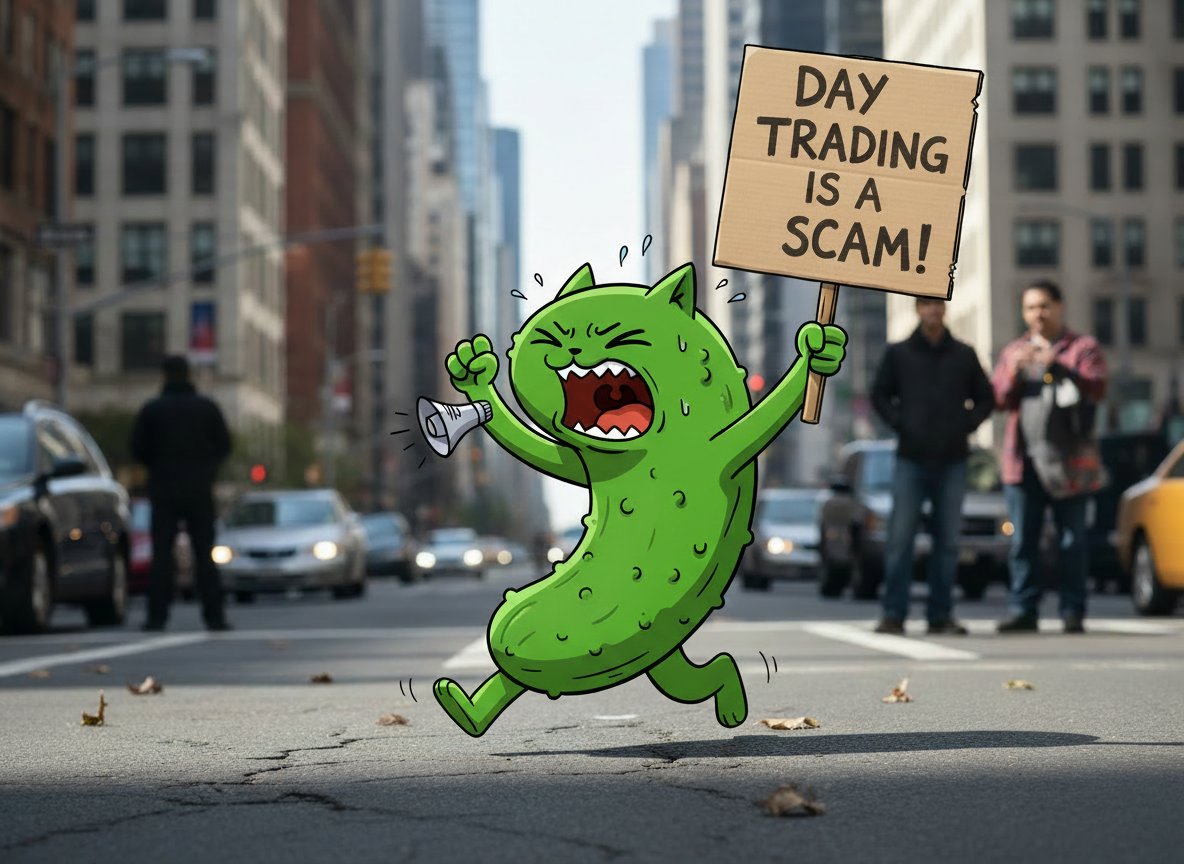
Want to stop losing money in the crypto market? Stop your day trading!
Because for ordinary investors, day trading is structurally a "scam."
This article is long, but if you're willing to spend 120 seconds reading it, I guarantee you'll thank yourself years from now.
I started trading as a teenager.
I've had victories that made me feel like "Batman," and devastating failures that shattered me internally—wounds I'm still healing from today.
I've tried every trading strategy available to the average investor.
At one point, I was obsessed with day trading for an entire year, believing it would finally turn my fortunes around. But I failed so badly that even thinking about it now brings pain.
My PnL was so terrible that even the automated Bitcoin purchase plan I set up for my grandmother made more money than I did.
Later, I shifted to being a low-frequency swing trader—rarely adjusting positions. After a profitable trade, I'd exit decisively and then pause trading for a while.
Only then did my life begin to improve, and everything start to become clear.
I'm no saint. I write this to save the younger, foolish, naive, and impulsive version of myself.
First, as an average day trader, you're engaging in high-frequency trading without any informational advantage (no real order flow, no clear liquidity map, no insight into market maker positions, no execution edge—nothing at all).
If you trade only a few times per quarter, you might survive.
But what if you trade more than 10 times a week?
Even with the world's strongest "discipline" and "risk management," math will eventually crush you completely.
The reason average investors fail isn't because they never win—it's because they never stop. There's only one end to high-frequency trading: destruction.
This is why I created a "penalty system" for myself—if I exceed my quarterly trade limit, I get penalized.
Every major loss I've ever experienced happened because I kept trading after a big win instead of stepping away.
And all my biggest wins (the ones where I actually held onto the profits for a long time) came because I caught a major move, then chose to rest and stay calm.
The pattern is so obvious it hurts.
"Winning" isn't suddenly making a lot of money. Real "winning" is holding onto that money—not losing it all the next year.
Now I see 14-year-olds on TikTok calling themselves day traders, drawing lines on TradingView, thinking that buying some "guru's" course or joining a Discord group gives them a daily executable trading system.
It makes me sick. If they knew they were gambling, I wouldn't mind—they'd at least understand they're playing a game.
But today's day trading trend is bigger than the "reselling craze" of 2016 and 2017. And we all know how that ended.
People underestimate the difficulty of trading and grossly overestimate their own abilities.
The problem isn't just mathematical. Yes, the more frequently you trade and the less you stop, the harder it becomes to sustain profitability.
The real issue is that young, average traders genuinely believe that with enough "discipline" and "risk management," they aren't gambling at all. They think day trading is a "skill" they can execute like a daily habit.
This applies not only to crypto day trading, but also to the U.S. stock market and nearly every other market.
High-frequency trading is only viable for institutions.
Take the U.S. stock market, for example.
Do you know what institutional traders never look at? Candlestick charts and TradingView.
They use Bloomberg terminals with data that retail investors will never see.
You probably already know this. But kids aged 14 to 18 don't. They think their indicators are the same tools used by all professional traders.
That's the real danger.
If you know you're gambling, at least part of you knows when to stop.
But once you believe it's a "system," you'll never stop.
You'll keep clicking until the market drains you completely.
Day Trading: A Casino Disguised as a Café
It really is like a disguised casino.
When you walk into Las Vegas or Macau, you know exactly what kind of place you're entering. You see lights, tables, dealers, noise. Your brain immediately recognizes: this is gambling.
But today's day trading is like a casino disguised as a café.
New traders walk in thinking they're there to "learn a skill," unaware they're already seated at a table designed to slowly empty their pockets.
So they don't stop.
That's the true tragedy—not the losses themselves.
The real tragedy is that they truly believe they're not gambling, and it's precisely this belief that keeps them going until they lose everything.
As for those average traders who appear to be "making money" (like I once did)... honestly, most of them just caught a lucky wave.
They got lucky at the right time, combined with a bit of discipline learned through prior losses, which finally taught them to stop after winning.
Even then, such lucky individuals make up less than one percent of all retail traders.
Making money in trading isn't actually hard—what's hard is keeping that money.
Join TechFlow official community to stay tuned
Telegram:https://t.me/TechFlowDaily
X (Twitter):https://x.com/TechFlowPost
X (Twitter) EN:https://x.com/BlockFlow_News
 @0xPickleCati