








Charlie Kirk assassinated, America loses its most effective Bitcoin promoter to youth
TechFlow Selected TechFlow Selected
Charlie Kirk assassinated, America loses its most effective Bitcoin promoter to youth
Kirk's death left a void that is difficult to fill.
 Navigating Web3 tides with focused insights
By David, TechFlow
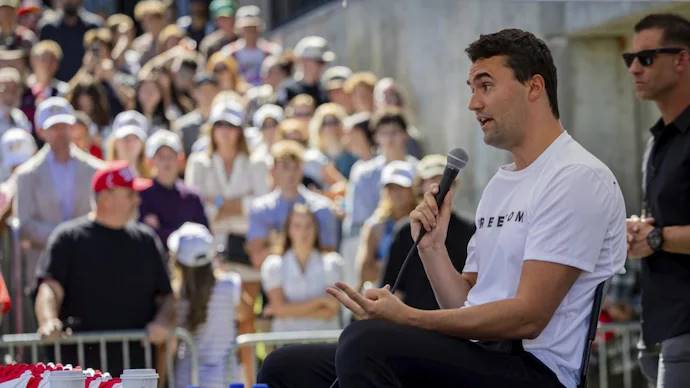
On September 10, a bullet ended the life of one of America's most influential Bitcoin evangelists.
At 31 years old, Charlie Kirk might not have been the best-known name in crypto circles; he was neither a developer, nor an exchange founder, nor a crypto fund manager.
But he may have been the most effective person spreading Bitcoin's philosophy to young Americans.
As the founder of Turning Point USA—a conservative organization with influence across thousands of campuses—Kirk brought the idea that "Bitcoin is free money" directly to millions of college students who had never encountered cryptocurrency before.
"Every student should at least understand how Bitcoin works," Kirk said during a 2024 campus speech. "If you don't, prepare to be ruled by those who do."
That very afternoon, moments after he collapsed on stage at Utah Valley University while answering a student’s question about mass shootings in America, he ironically became the latest victim of the very issue he was discussing.
In the aftermath, many lamented that Kirk was one of the few mainstream voices who truly understood Bitcoin—a tremendous loss for crypto advocacy.
Bitcoin Missionary
Why was Charlie Kirk able to get millions of young people to pay attention to Bitcoin?
In 2012, at just 18 years old, Kirk co-founded Turning Point USA with Bill Montgomery—an organization focused on promoting conservative ideas on campuses. Over more than a decade, according to its official website, TPUSA has established branches in over 3,000 high schools and university campuses nationwide, with more than 650,000 lifetime student members.
Kirk's signature event was the "Prove Me Wrong" campus debate, where students with opposing views were invited to challenge him directly.
Originally, these debates centered on traditional political issues—free speech, gun rights, immigration policy. But by the 2024 election cycle, a new theme increasingly dominated Kirk's rhetoric: Bitcoin.
Kirk's brilliance lay in not selling Bitcoin as an investment or technology, but embedding it within his existing political narrative framework.
"Cryptocurrency and Christians are two threats to the new world order," Kirk said on his radio program. In his context, the "new world order" represented the globalist control he opposed, and being a "threat" to it meant defending freedom.
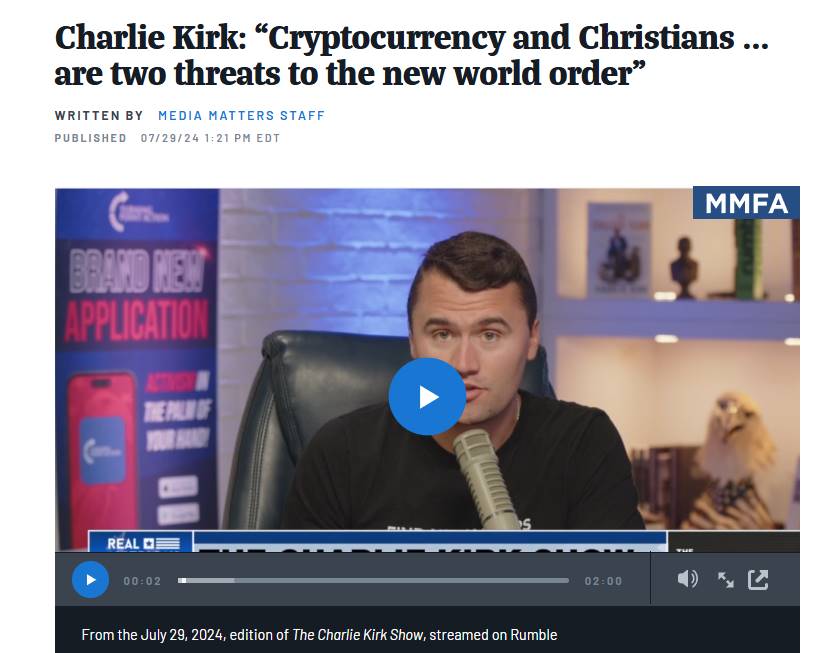
"You can have a currency not controlled by the federal government—one that directly competes with the U.S. Treasury, and that’s exactly how it should be." To his audience, this framing made clear it wasn’t a discussion about blockchain technology, but a battle between personal freedom and government control.
During campus debates, when students raised concerns about inflation and cost of living, Kirk would naturally pivot to Bitcoin:
"Your generation faces the worst monetary devaluation in history. Bitcoin’s 21 million cap means no one can arbitrarily print money and dilute your wealth."
He used economic pressures students felt firsthand—student loans, housing prices, inflation—as entry points, positioning Bitcoin as part of the solution.
During the 2024 election cycle, Kirk elevated this narrative even further.
According to TheStreet reporting, "Kirk heavily promoted pro-crypto policies at student events, often describing digital assets as generational hedges against inflation and regulation."
This ability to transform a technical issue into a fight for freedom got humanities students—those with zero interest in programming—to start paying attention to Bitcoin.
Three Key Crypto Views
"Bitcoin has more integrity than the dollar."
One of the most striking statements in Kirk’s crypto advocacy came from his radio show: "Bitcoin has more integrity than the U.S. dollar in some ways."
As reported by Media Matters here, he elaborated: "From knowing exactly how many Bitcoins exist, to the ledger, to blockchain technology."
This argument skillfully sidestepped technical details and appealed directly to moral judgment. By contrasting Bitcoin’s fixed 21 million supply with the Federal Reserve’s quantitative easing, Kirk helped young people see this not just as a technological difference, but a matter of integrity.
"If you don’t understand it, prepare to be ruled by those who do."
During the 2024 election cycle, Kirk positioned cryptocurrency as an economic weapon for the younger generation. He frequently described digital assets as intergenerational hedges against inflation and regulatory overreach.
Within his framework, the traditional financial system was portrayed as a rigged game disadvantaging youth, while Bitcoin represented a fresh opportunity.
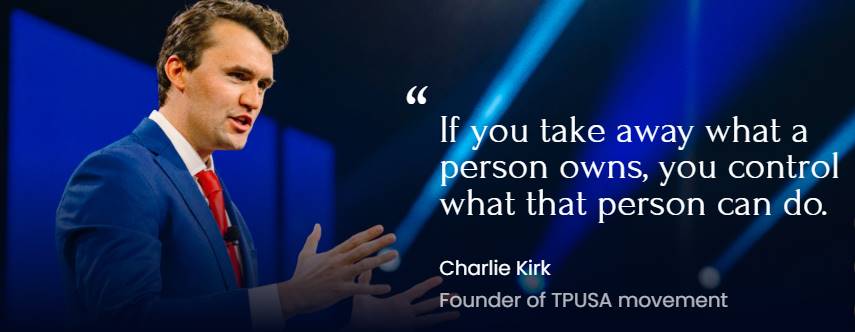
This led to the now-famous opening quote: If you don’t understand it, prepare to be ruled by those who do—elevating crypto to the level of an intergenerational wealth defense battle.
Kirk also tied this issue to broader political struggles. On his broadcast, he said: "We have $35 trillion in debt. Whether you like it or not, cryptocurrency is happening, and Donald Trump is on the right side of it."
He accused politicians opposed to crypto of being "controlled by big banks," framing it as grassroots resistance against entrenched interests.
"Bitcoin can fix national debt."
Kirk’s most radical and controversial view emerged in July 2025. According to a video interview posted by The Bitcoin Conference on X, Charlie Kirk claimed Bitcoin could repay national debt and cover deficit losses.

Though economically contentious, this idea successfully elevated Bitcoin from a personal investment tool to a strategic national asset.
It resonated with then-President Trump’s proposal to establish a "national Bitcoin strategic reserve." Kirk covered this policy on his website, noting Bitcoin’s price surge after Trump announced the creation of such a reserve.
These three core views formed the foundation of Kirk’s crypto evangelism:
More integrity than the dollar—giving Bitcoin moral superiority; promoting intergenerational justice—turning crypto into youth’s weapon; fixing national debt—aligning perfectly with the President’s vision.
From Campus to the White House
Kirk’s close ties to the Trump family were no secret. According to The New York Times, Kirk maintained a strong relationship with Donald Trump Jr., giving him direct access to policy-making channels.
And on cryptocurrency issues, this influence yielded tangible results.
On July 27, 2024, Trump delivered a historic speech at the Bitcoin Conference in Nashville. Kirk shared the moment on his X account: "President Trump declared at the 2024 Bitcoin Conference that America will become the cryptocurrency capital of the Earth and the world’s Bitcoin superpower."
This wasn’t mere amplification—Kirk’s organization, Turning Point Action, made crypto policy a key mobilization issue for young voters throughout the 2024 election cycle.
More importantly, Kirk helped mainstream the concept of a "national Bitcoin strategic reserve."
In March 2025, when Trump officially announced the plan, Kirk wrote on his website: "After years of corrupt attacks under the Biden administration, the American crypto reserve will elevate this critical industry."
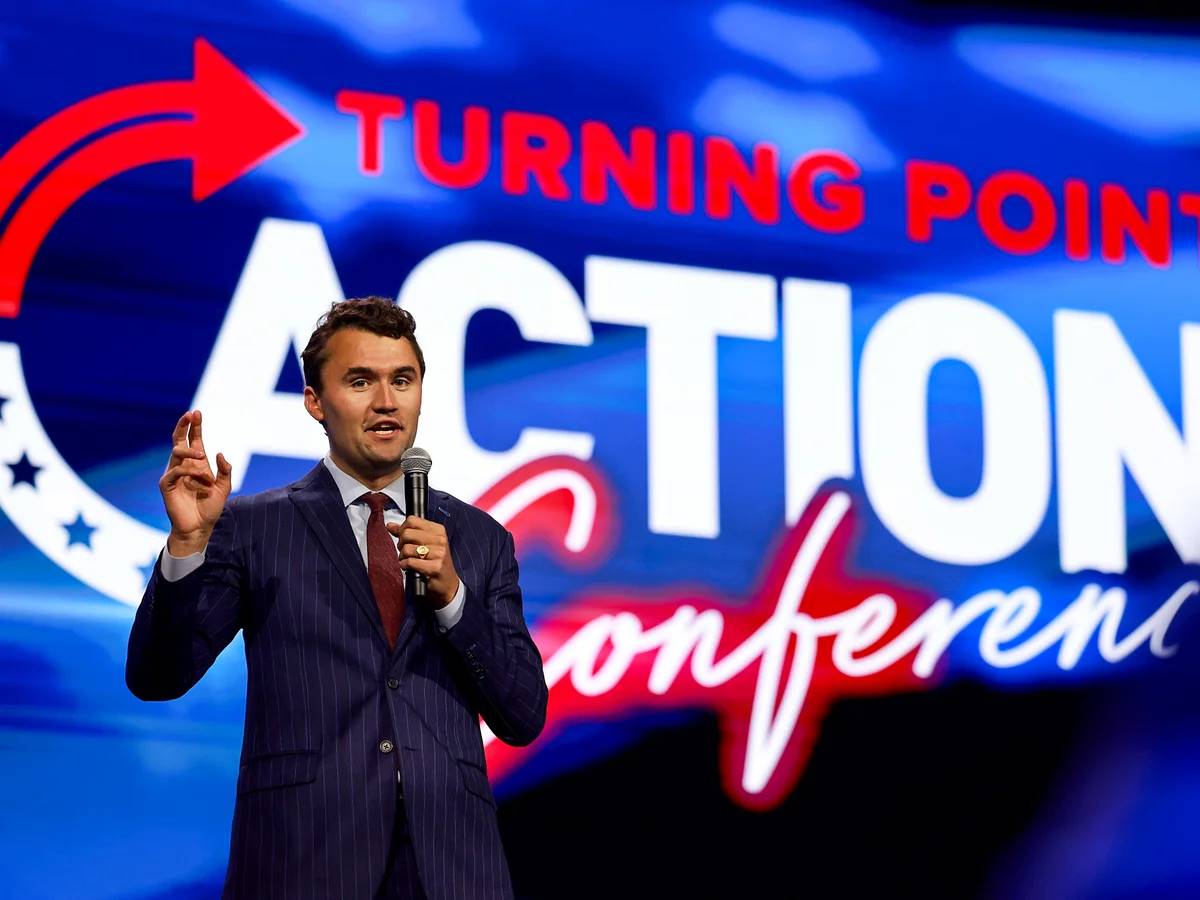
Before the 2024 election, Kirk launched a campus tour titled "You're Being Brainwashed." Public data shows the tour reached around 25 college campuses and generated approximately 2 billion viral impressions on social media. Forbes reported it was hailed as having played a "critical role" in helping Trump win.
Notably, Kirk even indirectly influenced personnel decisions in the Trump administration. According to Forbes reporting, Kirk assisted the president-elect in selecting government leaders, including cabinet positions. While there’s no direct evidence he shaped crypto-related appointments, his overall influence cannot be ignored.
By integrating Bitcoin into a broader conservative agenda, Kirk not only expanded crypto’s audience but also reshaped the political discourse around it. This double-edged sword brought mainstream attention and political support, but also entangled cryptocurrency in America’s increasingly polarized political climate.
Crypto Education: A Long and Difficult Road
Kirk’s death leaves a void difficult to fill.
His position was uniquely rare—not a technologist, not a financial tycoon, but a political activist with a vast youth network who genuinely believed in Bitcoin.
In 2016, he was the youngest speaker at the Republican National Convention; in 2020, he delivered the opening address. Wikipedia notes his podcast regularly ranked among the top ten on Apple News.
The combination of mainstream political standing, genuine belief in Bitcoin, and massive reach is nearly unmatched across the American political spectrum.
Looking back at Kirk’s success, one thing is clear: getting mainstream audiences to embrace Bitcoin requires not more technical whitepapers, but better storytellers.
Ironically killed while discussing the impact of gun violence, Kirk also reminds us of a harsh truth—that in today’s deeply polarized American environment, being a public advocate carries real risks. When technical issues become embroiled in fierce ideological battles, advocates can become targets.
Kirk is gone, but the question he raised remains: How can Bitcoin truly go mainstream?
He can no longer answer it. But the question he posed with his life deserves deep reflection from everyone who cares about cryptocurrency’s future.
Join TechFlow official community to stay tuned
Telegram:https://t.me/TechFlowDaily
X (Twitter):https://x.com/TechFlowPost
X (Twitter) EN:https://x.com/BlockFlow_News
 深潮TechFlow


