On the Eve of IPO, Kraken Awakens
TechFlow Selected TechFlow Selected
On the Eve of IPO, Kraken Awakens
The long-dormant siren suddenly stirred, sending shockwaves through Wall Street.
 Navigating Web3 tides with focused insights
By: Yanz, Liam
In July 2025, the crypto market reignited its bull run.
Unlike previous bull cycles, this time around cryptocurrencies like Bitcoin began deeply integrating with U.S. equities. While everyone focused on Robinhood’s stock tokenization efforts, a long-silent veteran exchange quietly opened the door to capital markets.
This exchange is Kraken.
Once dubbed the "elder brother of crypto," known for security and stability, it had long remained in the shadows cast by giants Coinbase and Binance. In Chinese-speaking communities, it was long labeled merely as a “safe off-ramp,” having been so low-key as to be nearly forgotten.
Now, things have changed.
In Kaiko’s Q2 2025 Global Spot Exchange Composite Ranking, Kraken ranked second with a score of 89, just behind Coinbase; quarterly revenue rose 18% year-on-year, reaching $186.8 billion in trading volume; it launched the Layer2 network Ink, the stock tokenization platform xStocks, and acquired NinjaTrader... The dormant kraken has suddenly awakened, sending shockwaves through Wall Street.
By late July, Kraken was preparing its final funding round at a $15 billion valuation, positioning itself for an IPO in 2026.
From being seen as the "geeky honest guy" to becoming the "next crypto unicorn," Kraken’s journey spans a 14-year transformation marked by prolonged internal struggles.
From Card Trader to Exchange Founder
In the 1990s, Jesse Powell was just a teenager obsessed with Magic: The Gathering.
Unlike other players focused on battles, he excelled at spotting arbitrage opportunities in the card market—his first realization that "anything of value can be priced and traded."
After the millennium, Powell worked in technical support at an internet service provider. Online games like Ultima Online became popular in the office.
This was the first major online game featuring real-money transactions—a virtual castle could sell for thousands of dollars. Trading virtual items for real cash revealed to Powell an early vision of "digitizing real-world assets."
Soon after, he became hooked on Diablo II. Initially, he farmed monsters and sold gear—earning $25 per hour was considered good for most players. But Powell quickly found a more efficient arbitrage model: buying rare items with $5 worth of in-game gold, then reselling them on eBay for $30, achieving sixfold returns per transaction. This side hustle eventually expanded across over 20 games, evolving into a small virtual currency empire.
Powell later described this experience as the "prelude to cryptocurrency."
In 2010, Bitcoin entered his radar.
At first, he thought it was just another form of "World of Warcraft gold." But soon he realized Bitcoin solved core problems in virtual currency trading—chargebacks, delivery issues, high cross-border fees. Its decentralized, low-cost transactions made Powell realize: "This won't just transform virtual gaming economies—it could reshape the entire real-world financial system."
Within a year, he transformed from a virtual currency trader into a Bitcoin enthusiast.
In 2011, a friend he met playing Magic: The Gathering invited him to visit Mt. Gox, then the world's largest Bitcoin exchange. The visit wasn’t social—it was essentially a rescue mission.
During this trip, the infamous hack resulting in the theft of 880,000 BTC occurred. Powell spent about ten days helping restore Mt. Gox’s operations—and gained firsthand insight into the massive risks within crypto:
"If cryptocurrency is going to go mainstream, it needs a more serious player—a secure, compliant exchange that earns regulatory and user trust."
Later that year, Jesse Powell and tech co-founder Thanh Luu officially founded Kraken in San Francisco.
Unlike entrepreneurs chasing speed, Powell spent an entire year building a security team, undergoing third-party audits, and pioneering two-factor authentication (2FA), becoming one of the first exchanges to publicly demonstrate its security capabilities.
For the next decade, Kraken pursued a slow, deliberate expansion path.
In 2013, it became one of the first overseas exchanges licensed by Japan’s Financial Services Agency; in 2014, it assisted in the asset liquidation following Mt. Gox’s collapse, further cementing its reputation for compliance and security; by 2020, it operated in over 200 countries and regions, holding licenses in the U.S., Canada, the U.K., Japan, Australia, and beyond, emerging as one of the most comprehensively regulated crypto exchanges globally.
The groundwork for steady growth was laid—Kraken now only needed the right moment to pivot.
The Evolution of a Veteran Exchange
For years, Kraken was labeled "veteran, secure, low-key"—but beneath that lay perceptions of "stiffness and obsolescence."
In Chinese crypto circles, it earned the label "safe off-ramp for USDT" due to its fast conversion of stablecoins into fiat currencies like USD and EUR. To the public, it resembled a traditional bank: stable and reliable, yet lacking brand edge or narrative leadership.
In contrast, Coinbase emerged as crypto’s "Apple"—polished, user-friendly, omnipresent.
Masterful at marketing—from Coinbase Learn educational content to its 2022 Super Bowl ad, NBA partnerships, esports sponsorships, and celebrity endorsements—it gradually became synonymous with crypto assets in the American mind.
By comparison, Kraken’s first thirteen years resembled a tech geek’s solitary training—like "Linux": powerful and professional, but confined largely to niche circles.
Social media metrics underscore the gap: while Coinbase amassed 6.5 million followers on X, Kraken lingered around 1.6 million.
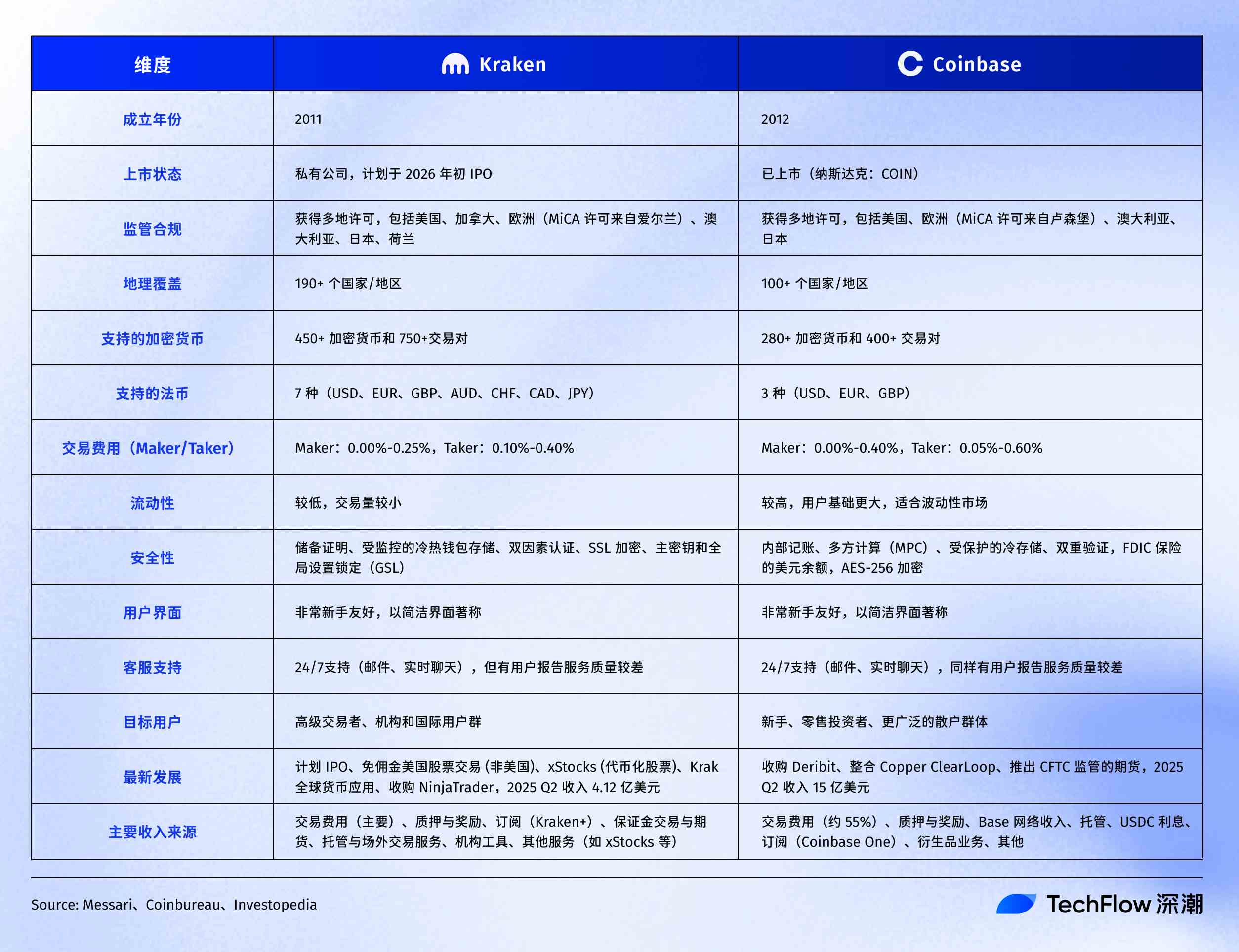
Yet all this shifted dramatically in 2025.
Kraken began dominating headlines. Its image as quiet and invisible vanished, replaced by that of a dynamic, action-driven crypto powerhouse:
-
Stock Tokenization (xStocks): Partnering with Backed Finance, launching tokenized stocks and ETFs on blockchain, covering 60+ U.S. equities including Apple, Tesla, and Nvidia.
-
Traditional Finance Acquisition: Acquired retail futures platform NinjaTrader for $1.5 billion, expanding into derivatives and futures trading.
-
Stablecoin Ecosystem: Strategically invested in stablecoin issuer StablR, advancing global adoption of EURR and USDR.
-
Layer 2 Network Ink: Building its own blockchain network to develop on-chain financial infrastructure.
-
Institutional Services: Kraken Institutional offers full-stack digital asset services to hedge funds and ETF issuers.
The marketing transformation began earlier. Starting in 2023, Kraken began addressing its branding shortcomings.
From 2023 to 2025, Kraken capitalized on a last-minute sponsorship deal with Williams Racing F1 team, boosting brand visibility and launching Grid Pass digital collectibles (NFTs) to attract high-net-worth individuals via global race broadcasts.

In 2024, Kraken partnered with Premier League’s Tottenham Hotspur, La Liga’s Atlético Madrid, and Bundesliga’s RB Leipzig on jersey sponsorship deals, placing the Kraken logo in front of global sports audiences.
These dual awakenings in brand and business were only surface-level changes. The true catalyst was crisis.
In 2022, Kraken faced a management crisis.
Then-CEO and co-founder Jesse Powell’s strong libertarian ideology clashed with team values, sparking internal discontent and instability. Former CMO Matt Mason left abruptly after just one year in February 2020, leaving the role vacant for two years; product leads rotated every 1.5 years over four years; the Chief Commercial Officer position remained unfilled since 2021, and was eventually eliminated altogether...
With persistent executive vacancies and team fragmentation, founder Powell stepped down as CEO in 2022, transitioning to Chairman of the Board.
This shift marked not just a transfer of power, but a deep cultural reckoning.
From that point on, Kraken began its transformation.
That same year, Mayur Gupta joined as CMO, spearheading a global brand overhaul. Sports sponsorships, NFT collectibles, and content-driven campaigns enabled this "tech-geek exchange" to finally engage with Gen Z.
His marketing strategies gained market recognition, earning him a spot on Business Insider’s list of "Most Innovative CMOs of 2024."
A more pivotal change came at the end of 2024, when Arjun Sethi, co-founder of Tribe Capital, joined Kraken as Co-CEO.
Notably, Tribe Capital is Kraken’s second-largest institutional investor, and Sethi had joined Kraken’s board in 2020—making this move widely seen as a shareholder-led turnaround.
Sethi, a Silicon Valley VC veteran, believed Kraken must undergo an identity upgrade, centered on one keyword: "breakthrough."
Transition from a standalone crypto exchange to a global digital finance platform.
Under Sethi’s leadership, Kraken launched the stock tokenization platform xStocks; acquired NinjaTrader to expand derivatives and futures offerings...
Sethi stated, "We remain open to further acquisitions in the future."
The Co-CEO sees corporate treasury management as a major new frontier for digital assets: "Many public and private companies are exploring crypto holdings."
Today, Kraken has moved past its internal conflicts. No longer the silent sea monster, it now has a new voice, a new brand, and a new story.
It no longer aims merely to be a secure harbor for crypto, but to build a bridge between crypto and traditional finance—and become a central player in the global wave of asset tokenization.
This 14-year-old veteran exchange is now charging toward the IPO stage with a completely renewed posture.
Toward IPO
By late July 2025, according to The Information, Kraken was raising $500 million at a $15 billion valuation, a 36% increase from its ~$11 billion valuation in 2022.
Data from Forge, an off-exchange equity trading platform, shows Kraken’s stock price has more than tripled over the past year, with current valuations surpassing $10 billion.
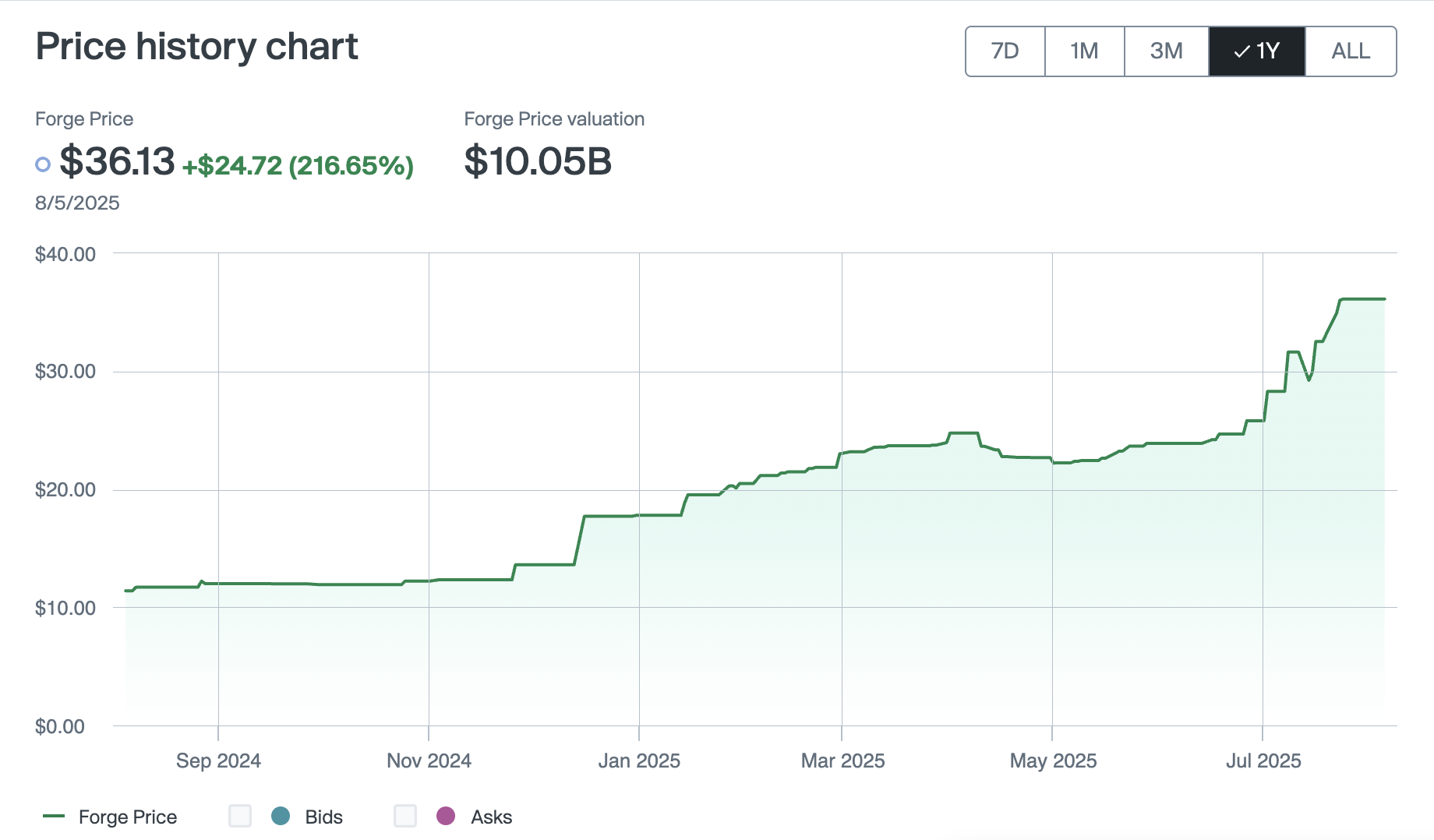
This funding round is widely seen as the final sprint before IPO, with Kraken expected to debut on public markets as early as Q1 2026.
For Kraken, this is an ideal policy window.
In March 2025, the U.S. SEC dropped its lawsuit against Kraken over securities violations; in June 2025, Kraken obtained a license under the EU’s Markets in Crypto-Assets (MiCA) regulation, enabling full compliance across Europe.
These milestones owe much to Trump’s pro-crypto policies—and to Kraken’s founder’s early bet on Trump.
In June 2024, Kraken co-founder Jesse Powell personally donated $1 million worth of crypto assets—mostly ETH—to Trump’s campaign. After Trump launched his meme coin TRUMP, Kraken became the first U.S. crypto exchange to list the TRUMP token.
Beyond favorable policies, Kraken also demonstrated strong operational and financial performance.
On the business side, Kraken’s revenue streams are diverse and expanding, primarily consisting of trading fees, staking rewards, leveraged and derivative services, asset custody, OTC brokerage, and institutional custom tools—with trading fees remaining the core.
In 2024, Kraken achieved $1.5 billion in revenue, with Q1 and Q2 2025 generating $472 million and $412 million respectively—representing 19% and 18% year-on-year growth. Adjusted EBITDA reached $187 million and $80 million for the two quarters.
In Q2 2025, Kraken recorded a total trading volume of $186.8 billion, up 19% year-on-year; platform assets under management hit $43.2 billion, a 47% increase; total users surpassed 15 million, supporting over 200 digital assets and six fiat currencies.
Compared to Coinbase, Kraken’s current daily trading volume of ~$1.37 billion is about half of Coinbase’s. Yet Kraken is carving out an independent path through differentiated narratives.
Foremost among these is stock tokenization.
Kraken is one of the biggest champions of stock tokenization. On its xStocks platform, developed with Backed Finance, over 60 tokenized stocks—including Apple, Tesla, and Nvidia—are now live, offering non-U.S. investors a new gateway to American equities, tradable 24/7. Users can also leverage xStocks in DeFi for collateral, liquidity pools, and smart contract execution—capabilities unattainable in traditional stock markets.
The future Kraken will no longer be limited to being an exchange—it may evolve into a "Kraken Bank."
As early as September 2020, Kraken became the first U.S. digital asset firm to receive a Special Purpose Depository Institution (SPDI) banking charter from Wyoming. This allows Kraken to offer digital asset custody, USD deposit accounts, and 24/7 settlement services like a traditional bank—but under a full-reserve model to avoid risks associated with fractional reserves.
In the future, Kraken plans to launch broader financial products, including debit cards, mobile banking integrated with crypto wallets, wealth management, and payment solutions for both institutions and individuals.
In official statements, Kraken consistently emphasizes its mission to bridge the future of crypto economy with existing financial systems. It echoes Jesse’s founding vision: To bring cryptocurrency into the mainstream, we need a truly serious player—one who operates reliably, collaborates with regulators and law enforcement, explains crypto to banks, and builds a bridge from traditional systems to the crypto world.
Join TechFlow official community to stay tuned
Telegram:https://t.me/TechFlowDaily
X (Twitter):https://x.com/TechFlowPost
X (Twitter) EN:https://x.com/BlockFlow_News
 深潮TechFlow