Ray Dalio's 50th Anniversary Dialogue with Bridgewater: From the Basement to Wall Street, Forging an Investment Legend Through Pain and Reflection
TechFlow Selected TechFlow Selected
Ray Dalio's 50th Anniversary Dialogue with Bridgewater: From the Basement to Wall Street, Forging an Investment Legend Through Pain and Reflection
Making money is secondary; the most important thing is to do your best.
 Navigating Web3 tides with focused insights
Compiled & Translated: TechFlow
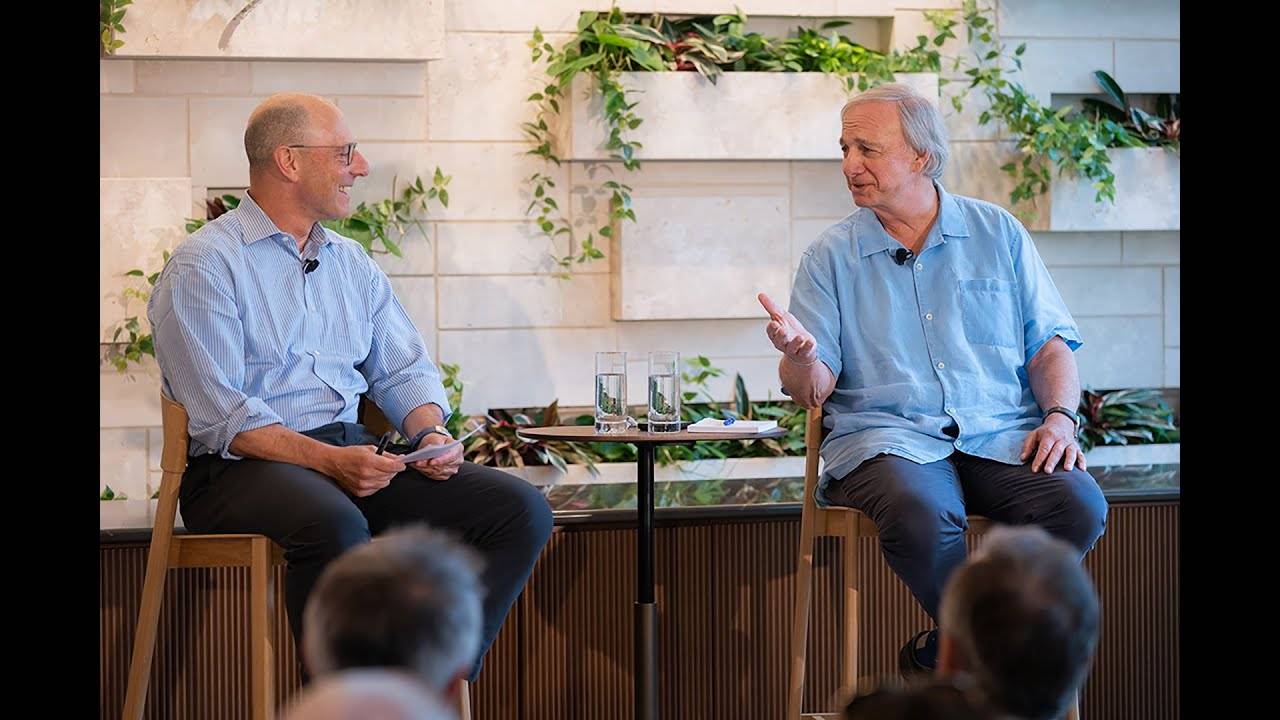
Guest: Ray Dalio, Founder of Bridgewater Associates
Host: Jim Haskel, Head of Client Service
Podcast Source: Bridgewater Associates
Original Title: Ray Dalio Reflects on Bridgewater’s 50-Year Anniversary
Air Date: August 1, 2025
Several weeks after officially stepping down from Bridgewater, Ray Dalio returned to the public eye in late July 2025 with a reflective dialogue at the firm's 50th-anniversary celebration—marking his graceful transition from leader to mentor.
The legendary investor reflected on five decades that began in a basement in 1975 and led to managing the world’s largest hedge fund, emphasizing how the philosophy of “pain plus reflection equals progress” shaped diversified investing and a unique culture.
Though he has sold his remaining stake and left the board, Dalio shared early setbacks (such as lessons from the 1982 debt crisis) and pivotal moments (like foreseeing the 2008 financial crisis), reminding successors to value meaningful relationships and humility amid uncertainty.
This conversation serves not only as a vivid footnote in Bridgewater’s history but also as Dalio’s farewell message to the future of investing.
TechFlow has compiled and translated the full dialogue below.
Key Takeaways
In this podcast episode, Bridgewater co-founder Ray Dalio sits down with client service head Jim Haskel to reflect on the company’s past, present, and future. This discussion was part of Bridgewater’s 50th-anniversary celebration held at its new New York office. Over the past half-century, while much has changed, Bridgewater has remained committed to its core values: a group of people united by the pursuit of meaningful work and deep relationships; a team dedicated to deeply understanding the world and transforming that understanding into unique insights that deliver real value and impact for clients.
Highlights Summary
-
Pain plus reflection equals progress.
-
Don’t wait until problems arise to take action.
-
If uncertain, don’t make large-scale moves.
-
Making money is secondary; what matters most is doing your best possible job.
-
When discussing performance and investment decisions, we must not overlook aspects that give life true meaning—meaningful relationships are especially important, and these choices require mindful decision-making.
-
The five-step cycle concept: You make progress, encounter problems and mistakes, then critically reflect and diagnose them, identify root causes, implement changes, and reach a new level—repeating this process continuously.
-
Everyone has the potential to succeed, provided they recognize their weaknesses and understand how reality works.
-
If you’re worried, you don’t need to worry; if you’re not worried, you should worry. Because if you are worried, you’ll pay attention and solve the problem.
-
We need to test decision rules more systematically and validate their effectiveness through backtesting—be very clear about what the decision rule is and examine its performance over time.
-
Bridgewater’s core principles are idea meritocracy, meaningful work and relationships, achieved through radical transparency and radical truthfulness.
-
The key to success lies in finding exceptional talent—people who not only excel at tasks but also create leverage for you and outperform you in certain areas.
-
Transparency helps us stay aligned and drives us to give our all.
-
"I learned humility from my own experiences, and also learned to fear making mistakes."
-
"First, I learned humility, began questioning my own judgments, and recognized the possibility of error. Second, I realized the power of diversified investing—by investing across 15 uncorrelated return streams, risk can be significantly reduced without sacrificing returns. Third, I understood the importance of building an environment centered on ideas."
Ray Dalio’s Personal Career Journey
Jim Haskel:
Looking back 50 years—we were also in New York City, just in a different location. You mentioned some pivotal moments earlier. Now reflecting back, how do you feel about where we stand today and the effort you’ve put in?
Ray Dalio:
These 50 years have been a deeply meaningful life journey. When I started, I was pursuing meaningful work and meaningful relationships. I never expected the journey to be this rewarding, nor did I anticipate so many challenges. Looking back, Bridgewater feels like my extended family. The transition process gave me the feeling of a father watching his children grow strong and independent—that brings me immense satisfaction.
Jim Haskel:
Fifty years ago, you had just graduated from Harvard Business School. Oil markets were extremely volatile, and you chose to enter the commodities brokerage industry—an unusual decision at the time. You mentioned it opened many doors that might otherwise have been inaccessible to someone young. Could you talk about the sense of responsibility behind that choice?
Ray Dalio:
I had already begun investing in markets when I was young, later moving into commodity futures because of low margin requirements. I believed that if my judgment was right, I could generate higher returns with lower capital. When I graduated from Harvard in 1973, I was hired by a brokerage firm as director of commodities. In hindsight, this may not have been a smart move, but they hired me anyway. As the stock market declined, the firm nearly went bankrupt, while commodity and futures markets surged. Eventually, I was laid off in 1975.
Yes, it was in a two-bedroom apartment. My roommate moved out, so I took over the space. I had a friend who played football—he was kind of my assistant, helping me handle various things. There was also a woman who helped in certain ways. Later, I needed more room, so I moved into the basement of a brownstone building I lived in. It was literally a boiler room, with a boiler inside. We worked there—that’s where Bridgewater began.
1975–1985: Bridgewater’s Founding and Early Exploration
Jim Haskel:
I suspect most people don’t know that in Bridgewater’s first decade—from 1975 to 1985—we weren’t managing any client funds. What were we doing during that time?
Ray Dalio:
During that period, our main work involved advising corporations on hedging strategies and helping them manage risk exposures. That’s when Bob joined. Global markets were turbulent, and many companies faced various risks requiring expert guidance. Since I previously handled institutional hedging, these firms wanted to receive services from us. So, I traded using my own account while providing advice. At the time, we communicated with clients via telegrams—the World Bank president received our recommendations. Eventually, the World Bank gave us our first $5 million account, marking Bridgewater’s beginning. Later, Bob joined in 1986, and we became a leading global bond manager. (Bob Prince, Co-CIO and Board Director at Bridgewater.)
Jim Haskel:
That was a major turning point, but let’s go back to the early days. The client service model you described was highly unique—you sought to deeply understand clients’ needs, constraints, and opportunities, even imagining how you’d act if you were in their shoes. This approach wasn’t common in asset management at the time, was it?
Ray Dalio:
This approach actually extends the way we think about human relationships. We constantly asked ourselves: If I were the client, what would I do? This mindset profoundly shaped our work—you’re absolutely right.
In client relationships, we emphasized daily observation. Clients needed our input almost every day, wanting updates on market developments. Back then, I was in the basement, communicating via telegram. I’d dictate messages, and my assistant would type and send them. This built a close connection with clients, letting us understand their needs and even manage parts of their portfolios. This work brought me great fulfillment—and still does today. But clearly, this couldn’t scale indefinitely—I couldn’t personally handle everything. So we introduced the concept of client advisory to help clients better manage their assets.
Jim Haskel:
Before Bridgewater transformed into an asset management firm, let’s discuss a period you often mention. From 1979 to 1982, you gained recognition for predicting that Paul Volcker raising interest rates could trigger a recession. But in fact, you were wrong. Can you share what happened during that time and what you learned?
Ray Dalio:
In 1979 and 1980, I calculated that U.S. banks had lent more to countries than those countries could repay, along with interest rate trends. I realized we were heading toward sovereign defaults. In August 1982, Mexico defaulted on its debt. Over the next decade, many other nations followed. At the time, I believed we were entering a debt crisis—but I was completely wrong.
In August 1982, Mexico defaulted on its debt. My assessment of the debt situation wasn't wrong, but I misjudged the market reaction. I thought markets would crash, but instead they rose sharply. As a result, I lost money for both myself and clients. I had to lay off staff and ended up completely alone. I remember thinking: What should I do now? Should I put on a tie and commute into the city for a regular job? That was one of the most important learning experiences of my life. It taught me the principle of “pain plus reflection equals progress.”
I learned several transformative lessons. First, I learned humility—questioning my own judgment and recognizing the possibility of being wrong. Second, I discovered the power of diversified investing: by allocating across 15 uncorrelated return streams, we could significantly reduce risk without lowering returns. Third, I realized how crucial it is to build an environment centered on ideas. These lessons became Bridgewater’s foundation. From that low point, we rebuilt the firm’s direction. Despite subsequent challenges, Bridgewater’s overall performance remained stable. These experiences deeply influenced our portfolio design and company development model.
Jim Haskel:
The cyclical diagram you describe in your book embodies this philosophy, doesn’t it?
Ray Dalio:
Exactly. I believe evolution applies not only to organizations but also to personal growth. It’s a five-step cycle: you advance, encounter problems and errors, reflect and diagnose them, identify root causes, make changes, and rise to a new level. This repeats continuously. By 1994, we had developed a methodology for learning from mistakes. In fact, I began appreciating errors because they offered the best learning opportunities.
Jim Haskel:
While people have heard these stories, they may not fully realize how impactful concepts like the “15 uncorrelated return streams” from 1982 were for clients. Also, the “dumb shit” concept became a foundational element in internal training to keep employees humble. Do you think such profound insights can only come through experiencing setbacks?
Ray Dalio:
I believe so, although other factors matter too—experiencing setbacks is indeed key. Everyone has the potential to succeed, provided they recognize their weaknesses and understand how reality operates. When you begin to appreciate the diversity within your team and can assemble a high-standard group to collaborate, you can achieve results like those at Bridgewater.
1985–1995: Transformation and Development of Investment Philosophy
Jim Haskel:
Back to 1985. Did you already know you wanted to enter investment management, or did that realization come only after the World Bank entrusted you with capital—making you realize you were an investment manager?
Ray Dalio:
Ever since I was 12, I’ve been passionate about financial markets and performed well. I always knew this was the field for me. Working with the World Bank reinforced that desire, and later, taking others’ advice, I embarked on the asset management journey.
Jim Haskel:
Bridgewater’s first major breakthrough in managing money came in 1987, during the severe stock market crash, which you successfully navigated. Could you share your experience during that event?
Ray Dalio:
I remember it vividly. Markets showed clear signs of a bubble and fragility. I recall the morning of the crash—a storm hit London, and multiple signals pointed to extreme volatility. So we decided to short the market, which proved correct. However, the following year lacked the expected volatility, teaching me we needed to systematically test decision rules and validate them through backtesting. In other words, be crystal clear about the decision rule and examine its historical performance. That helped us greatly.
Jim Haskel:
The next major milestone was in 1990 and 1991, when you introduced the concept of “separating alpha and beta,” which deeply influenced investment strategy and Bridgewater’s business model. Could you explain the origin and significance of this idea?
Ray Dalio:
At the time, investment managers typically operated within mandates for stocks or bonds, trying to add value within those boundaries. Traditional benchmarks were usually equity indices—people tried to optimize returns by timing the market.
But alpha refers to returns above the benchmark, which can come from sources beyond equities. I realized alpha could be sourced from different domains and “transplanted” onto a benchmark, enabling more efficient portfolio construction. This gave us a significant competitive edge—we could integrate alphas from multiple fields to build a more diversified portfolio and generate superior excess returns.
We advised clients that if they allowed us to structure portfolios this way, they could retain the S&P 500 or another benchmark while gaining additional alpha. Specifically, we’d replicate or hold the client’s chosen benchmark, then overlay diversified alpha strategies separately. This innovation stemmed largely from my deep understanding of futures and derivatives, realizing that benchmark and alpha could be entirely decoupled. This separation gave us a powerful advantage.
Jim Haskel:
This meant that while we initially focused on pure alpha, by 1991 we had built a comprehensive diversified alpha portfolio. Yet we could tailor portions based on client needs. For example, if a client wanted currency overlay, we could start there and gradually expand alpha applications through our client service model.
Ray Dalio:
Yes, clients choose their beta benchmark, and we design alpha strategies for them. Then we combine both into a more optimized portfolio. This approach gave us a clear competitive edge.
Jim Haskel:
Thus, we could enter currency overlay, global bond markets, or emerging market debt. In fact, we could apply our alpha strategy in any domain. I still haven’t seen another firm achieve this—it’s what makes us truly distinct.
Jim Haskel:
Regarding team building, Bob joined in 1986—before these businesses launched. But Bob, Giselle Wagner, and Dan Bernstein all eventually joined Bridgewater. How did you attract such top talent when Bridgewater wasn’t yet a well-known brand?
Ray Dalio:
Each person has their story. Bob was working at First Oklahoma Bank—a fascinating background. He wrote me a letter. I had a subscription newsletter costing $290. Bob subscribed, then paid $18,000 for my consulting services. He was only 27, but already exceptionally talented.
We started discussing markets, conversations deepened, and things evolved. We asked: What’s your life goal? You can work at an established bank like First Oklahoma, or join us and pursue entrepreneurial spirit. We both loved markets, so he decided to join Bridgewater.
Let me explain why we succeeded. These are Bridgewater’s core principles: idea meritocracy, meaningful work and relationships, achieved through radical transparency and radical truthfulness. The culture is like an intellectual “SEAL Team”—we hold each other to high standards, pursue excellence, and maintain rigorous discipline.
Through these asset management activities, our advantages were clear and risks relatively low. Moreover, our performance was uncorrelated with other managers, and we always thought from the client’s perspective. Today, clients read our Daily Observations—we communicate with them at high quality. This successful model stems from multiple factors, and I believe it will continue driving Bridgewater forward.
1995–2005: Rapid Growth and Internal Debate
Jim Haskel:
In 1996, Greg officially joined Bridgewater. But prior to that, in 1995, he was an intern. At the time, Esquire magazine contacted you saying, “Ray, we’d love to interview you in Wilton.” You readily agreed. But during scheduling, you were unavailable, so you asked intern Greg Jensen to take your place. As a result, Esquire featured our intern on its 1995 cover story. What was that experience like for you?
Ray Dalio:
Greg was an intern, but very intelligent and capable of grasping complex matters. I don’t recall how many experienced people we had at the time. The interview turned out great—he shared many insightful thoughts.
Jim Haskel:
There’s another story from the 1980s. You used to write the “Bridgewater Daily Observations” every day. But once you had to travel, so you called Bob and said, “Bob, I’m going on a trip, I can’t write the Daily Observations.” Bob had just joined, and you told him, “You write it instead.” Bob was nervous: “I usually read the Daily Observations, not write them.” But he tried anyway. Later, you reviewed his piece—it was excellent.
From then on, you told him: “Bob, starting today, you’re responsible for the Daily Observations.” He continued this for the next 30 years, didn’t he?
Ray Dalio:
The key to success is finding exceptional talent—people who not only perform tasks excellently but also create leverage for you, and even outperform you in certain areas.
Jim Haskel:
After this period, Bridgewater faced a major internal debate about its future. As I mentioned, the 1990s brought incredible growth and success, despite a painful drawdown from 1999 to 2001. Overall, this decade laid Bridgewater’s foundation. The debate centered on whether Bridgewater should remain a boutique firm or fully scale into a large institutional organization. Who stood on which side?
Ray Dalio:
Our former CFO supported staying boutique; I advocated for full scaling.
The debate revolved around culture and quality. The key question: Can we maintain quality as we grow from our current size to something much larger? I believed quality was paramount. When we examined all needs—back-office, legal, compliance, finance—we saw that greater resources could better meet them. So we chose to scale. I also saw it as a challenge: how to make it happen.
This also ties closely to culture. I connected it to “radical transparency.” First, we began with investment principles that could be backtested. Then, we documented decision criteria every time we made decisions, making them visible to everyone. We revealed everything—including our mistakes. This transparency helped us stay aligned and pushed us to go all in. Shared mission is an incredibly powerful force—you either have it or you don’t. Ultimately, this approach succeeded remarkably.
Jim Haskel:
During Bridgewater’s shift from boutique to institutional, what aspects proved harder than expected?
Ray Dalio:
The hardest part was technology. We faced many challenges. Initially, I believed in rapidly building systems to adapt to changing needs. But this led to technical chaos due to lack of documentation. As personnel and technologies changed, we found ourselves in a tech trap—our biggest hurdle. Other areas went smoothly, like bringing in top talent to solve issues. This was also when the client advisory team formed. You may recall that when I or others couldn’t participate directly, we’d run simulations—I’d play the client, you’d play the advisor, and I’d grill you rigorously.
Jim Haskel:
At the time, I was a strategist, and you were “testing” my abilities. We also had a strategy team, and client advisors underwent similar training.
Ray Dalio:
The role of strategists was to replicate my role—or Bob’s, Greg’s, etc. This enabled scalable growth. In other words, I couldn’t do everything personally, but through exceptional talent, we created leverage and solved problems.
2005–2015: Navigating the Global Financial Crisis and Solidifying Position
Jim Haskel:
Let’s fast-forward to another pivotal moment—a major turning point for Bridgewater. Around 2006, housing markets began flashing warning signs of overheating, with increasing speculative homebuilding. These signals appeared in our Daily Observations. Looking back, research began highlighting market dangers and bubbles.
Ray Dalio:
If we hadn’t studied the “Great Depression,” we couldn’t have grasped the nature of these risks. For instance, central banks could cut rates or inject liquidity to ease stress. But what happens when rates hit zero? The last time this occurred was in 1933. Without studying the dynamics of March 1933, when rates dropped to zero, we wouldn’t understand this mechanism. At that time, quantitative easing was implemented. Without understanding this, we couldn’t have predicted the 2008 downturn. By 2009, we were nearly neutral.
Jim Haskel:
I’d like to explore this further. By the way, if you review the Daily Observations, starting around 2001, you’ll see references to a concept called “pulling on a string.” You suggested we might be in an environment where escape becomes impossible.
(TechFlow note: “Pulling on a string” in markets typically describes a strategy or behavior—using small, incremental efforts to influence or drive larger change. This approach can apply to investing, marketing, or other business activities, emphasizing subtle adjustments to guide market trends or consumer behavior.)
Ray Dalio:
2008 was the crash, but in 2009 I truly didn’t know what would happen.
Jim Haskel:
You consistently emphasized internally that higher debt levels increase sensitivity to interest rates. Thus, further rate cuts become necessary—but options are limited. That’s the crux, isn’t it? Let’s return to 2007. I remember many people coming to us then.
Ray Dalio:
Banks and brokers were in serious trouble. Yes, we lived through these events, and our predictions proved correct. Then we helped others—for example, the head of Standard & Poor’s needed to assign ratings. We reviewed his ratings and pointed out flaws, like misalignment with market pricing. Many began seeking our help. I suppose that’s what you’re referring to.
Jim Haskel:
Let’s revisit 2007 and early 2008. In hindsight, how confident were you that we had correctly assessed the market and understood the severity of the situation—even when others were only beginning to realize or still failing to grasp it? How much confidence did you have in your own judgment?
Ray Dalio:
I learned humility and the fear of making mistakes through my own experiences. At the time, conditions clearly matched our forecasts, and similar patterns had occurred before—so it felt logical. But the key question is how much conviction and capital you commit. So when you ask about confidence, my habit is to first build a forecasting template—predicting how things might unfold—then track actual developments against it. At that time, reality aligned with the template, but you still need to observe market reactions. I’d say I had about 70% confidence.
Jim Haskel:
As events unfolded according to your predictions, were you concerned that even if your forecast was correct, the entire financial system might collapse, making it impossible for Bridgewater to operate? How worried were you about that?
Ray Dalio:
I was certainly concerned about the terrifying nature of such an extreme scenario. But mainly, I felt I was delivering real value to clients—while others were losing money, we were generating gains for them. It was like being in battle—focused on fighting, then thinking about the future afterward.
Ray Dalio:
I remember a meeting where everyone wanted to celebrate our success, saying we’d done brilliantly. I recall saying: Stop—otherwise you’ll become complacent and miss critical risks. I have a principle: If you’re worried, you don’t need to worry; if you’re not worried, you should worry. Because if you are worried, you’ll focus on the issue and resolve it. That way, you’ll be safe.
Jim Haskel:
Then came 2013, because in 2013, Europe seemed at risk of collapse.
Ray Dalio:
Actually, it started in 2010. In 2009 and 2010, my view on Europe mirrored my 2007 trip to Washington. In 2007, I went to Washington—I remember a Financial Times article describing me arriving with stacks of documents to explain the situation. They threw the documents in the trash. Same thing before the 2009–2010 European crisis. Luckily, Mario Draghi was willing to sit down and discuss with us, though they still didn’t believe. They trusted markets to self-correct, believing markets were right, etc. They failed to grasp a crucial principle: supply-demand imbalances cannot be ignored—don’t wait until problems occur to act. So this really began in 2009–2010, and we gradually worked through these issues. I was fortunate to help them think through responses—like how to monetize in Europe, despite constraints from Germany’s constitutional court, etc.
Jim Haskel:
These countries—especially Spain, Italy, and Greece—had little fiscal flexibility because power was centralized. That’s what you highlighted. How did you advise them to handle this?
Ray Dalio:
Because Germany’s constitutional court blocked certain actions, proportional adjustments across the board could allow QE and other measures—exactly what they later implemented. I want to emphasize: many Bridgewater people participated in these discussions. It was a great team, collaboratively tackling these issues.
2015–2025: Challenges and Legacy
Jim Haskel:
By the mid-2010s, you had become a widely recognized figure, and Bridgewater a highly prominent firm.
Ray Dalio:
And therein lay the problem. I recall a year when we wanted to stay low-profile. But after becoming the largest hedge fund, people started seeing us as a strange place—even a “cult.” Stories about the “cult” spread. I faced a dilemma: How should I respond? I decided to publish the book *Principles*. Originally, it wasn’t a book but a manual. I posted it online—it got 3 million downloads. Then people began discussing Bridgewater’s culture and unique operating model. As we grew into the largest hedge fund, this visibility intensified. We had to confront what “going public” truly meant—it was unavoidable.
Jim Haskel:
Now let’s fast-forward to late 2019. The pandemic began spreading in China and gradually expanded globally. Our only comparable historical precedent might be the 1918 flu, but we lacked sufficient epidemic data and effective management models. Looking back, how did you and your team handle these challenges? Any reflections?
Ray Dalio:
My approach has always been: Has something similar happened historically? How did it play out? But this time, sample size was insufficient—so the pandemic caught us off guard. We decided to take protective measures—like using options to hedge investments, because others might recommend going long, but we recognized this situation was unique. This was our response. My principle: If uncertain, don’t make large-scale moves. So we reduced positions or protected them via options.
But I’d like to highlight something else: culture has been vital to Bridgewater’s development. Certain decisions along the way were crucial. For example, when team members fall ill, family members pass away, or weddings and funerals occur—we attend together as a team. I remember many such moments: attending funerals, celebrating weddings, welcoming newborns. These things matter deeply.
I want to convey this: in pursuing meaningful work and building meaningful relationships, these actions are indispensable. I believe you still uphold these values today. I just want to emphasize: when discussing performance and investment decisions, we must not overlook aspects that embody true meaning—especially during difficult times, meaningful relationships become even more important, and these choices require thoughtful decisions.
Certain principles need to be explicitly documented—like how to respond when someone or their spouse faces cancer and needs personal space. Documenting such principles encourages deeper reflection, which is also critically important.
Another key area is China. I went to China in 1984 purely out of curiosity and interest—it wasn’t just a profit-driven venture. Making money is secondary; what matters most is doing your absolute best.
Out of curiosity, I went to China, helped them build markets, and develop relationships. These dimensions can now be passed on. Similar situations arose elsewhere—like Indonesia, which now has a new sovereign wealth fund needing support. We must consider how to build such relationships. Before answering your question, I wanted to highlight this.
Looking Ahead: Bridgewater’s Generational Transition and Continuation of Principles
Jim Haskel:
Last question. Now we celebrate Bridgewater’s 50th anniversary. The next 50 years will be carried forward by the people here and the teams on screen. What key principles do you believe we must internalize to increase the likelihood of short- and long-term success, helping Bridgewater continue advancing?
Ray Dalio:
All these principles are in my book—*Principles: Life and Work* details them thoroughly. They’re rich and comprehensive. But I also want to emphasize: you must live them in your own way. It’s like generational inheritance. I see it from a parent’s perspective—you are the next generation. I hope you achieve your goals in your own way. Just as parents want their children to succeed independently, while maintaining strong relationships, that’s my wish too. You need to learn through practice and experience—facing setbacks and reflecting on these principles. How to build an ideal, capability-driven environment—those are the best principles I can pass on. How to execute them, however, is entirely up to you.
Few companies survive 50 years, let alone maintain industry leadership. That proves our principles and methods truly work.
Jim Haskel:
I want to tell you again—I don’t know if I’ll ever get another chance to speak with you like this. It’s deeply special to me. I hope you enjoy everything you’ve contributed and continue engaging with us through Daily Observations, podcasts, and more. We all deeply admire and love you—you’ll always be Bridgewater’s founder and guiding light. Ray, congratulations on all you’ve achieved.
Join TechFlow official community to stay tuned
Telegram:https://t.me/TechFlowDaily
X (Twitter):https://x.com/TechFlowPost
X (Twitter) EN:https://x.com/BlockFlow_News
 深潮TechFlow