The "D-Day" for Crypto ETFs: SEC's New Rules Implicitly Allow Staking Yields, Coinbase Emerges as the Biggest Winner
TechFlow Selected TechFlow Selected
The "D-Day" for Crypto ETFs: SEC's New Rules Implicitly Allow Staking Yields, Coinbase Emerges as the Biggest Winner
The new regulations will accelerate the integration of crypto assets into traditional finance, and Coinbase's ecosystem advantages position it as a key hub connecting the two domains.
 Navigating Web3 tides with focused insights
Author: Luke, Mars Finance
In January 2024, the approval of spot Bitcoin ETFs marked a successful "beachhead landing" for crypto assets into the fortress of traditional finance. Yet the true "D-Day"—the decisive, large-scale, full-force invasion—is quietly beginning with a seemingly mundane regulatory filing.
Recently, rule change proposals (e.g., SR-CboeBZX-2025-104) submitted by Cboe BZX Exchange and Nasdaq aim to create a fast-track "universal listing standard" for altcoins. This is not a minor reinforcement, but a carefully orchestrated "institutionalized landing." Its core strategy has two parts: first, building a standardized highway to allow a continuous flow of follow-on forces (altcoin ETFs); second, quietly introducing a new "weapon" into the arsenal—staking yields tacitly accepted by regulators.
Amid this sweeping financial transformation, when we examine the location of the "landing zone" and the controller of the "logistics supply chain," one name stands out: Coinbase. The largest U.S. crypto exchange is being thrust, almost incidentally by these new rules, into the position of the biggest winner, thanks to its unrivaled ecosystem advantage.
From Case-by-Case Approval to the Highway
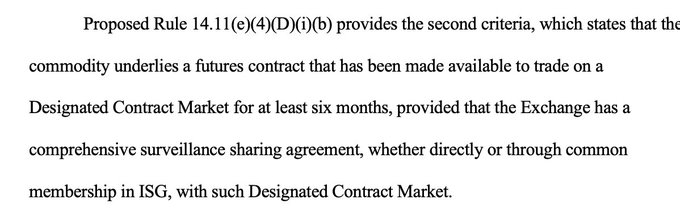
Previously, every crypto ETF had to undergo the SEC’s lengthy and stringent "case-by-case" review process, filled with uncertainty. The new "universal listing standard" completely changes the game. Its core principle is simple: any crypto asset whose futures contract has traded stably for six months on a market regulated by the CFTC (such as CME or the Coinbase Derivatives Exchange), qualifies for fast-track listing of its spot ETF.
The SEC intends to establish a scalable regulatory framework, but objectively, this shifts part of the approval power away. The new center of authority moves from SEC offices in Washington to the gatekeepers capable of offering compliant futures trading.
While CME is also on this list, it focuses primarily on mega-cap assets like Bitcoin and Ethereum. For the vast world of altcoins, the real "beachhead" is undoubtedly the Coinbase Derivatives Exchange. It has both the flexibility and willingness to list a wider range of altcoin futures. As a result, the first and most critical hurdle for any project seeking an ETF becomes less about lobbying SEC commissioners and more about getting its futures product listed on Coinbase Derivatives.
The First Wave of Landing Forces: The Candidate List Is Clear
This clear set of rules allows us, for the first time, to move beyond speculation and identify the initial "landing force" using a precise formula. These "vanguard units" have already completed their "pre-combat drills" in compliant futures markets, are fully armed, and await only the signal to advance.
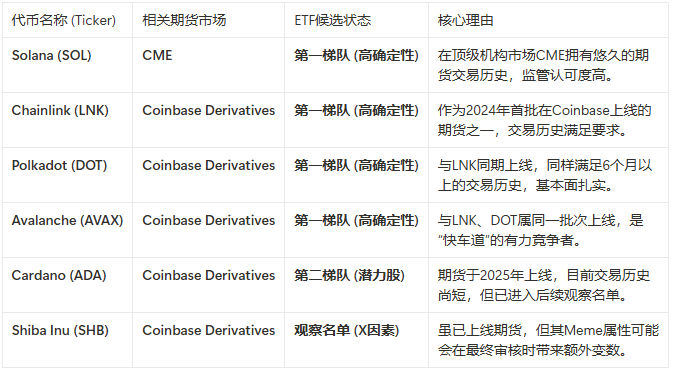
Based on this logic, the list of the most likely first-wave altcoin ETF candidates emerges clearly:
Candidates from the Coinbase camp include Avalanche (AVAX), Chainlink (LINK), Polkadot (DOT), and even the highly popular Shiba Inu (SHIB). Futures contracts for these tokens were filed or launched on Coinbase Derivatives in 2024, meaning they will far exceed the six-month minimum requirement by the time the new rules are formally adopted.
-
The heavyweight contender from the CME camp is Solana (SOL), whose futures product has been operating stably on the institution-heavy CME, giving it strong compliance credentials.
-
Thus, while the market continues debating "who will be next," the answer is already hidden in public exchange data. These assets will be the first ETF products to storm Wall Street once the rules pass. Following closely behind will be assets like Cardano (ADA), whose futures launched slightly later, forming a "second wave."
Why Coinbase Is the "Chosen One"
If becoming the "gatekeeper" is a strategic advantage granted by the new rules, then the provisions regarding staking point directly to massive commercial benefits. When we envision the arrival of a "Solana ETF with staking yield" or a "Polkadot ETF," the power of these clauses becomes evident.
Rule 14.11(e)(4)(G) cleverly states that as long as an ETF issuer ensures 85% of its assets are redeemable at any time, or establishes a comprehensive "liquidity risk management plan," ETFs including staking yields are permitted. This effectively "tacitly approves" packaging DeFi’s native yield mechanisms into Wall Street’s most mainstream financial products.
And who benefits most from this? Again, Coinbase. As one of the largest and most trusted institutional-grade staking service providers, Coinbase Custody is the default partner for nearly all ETF issuers. Whether any of the tokens on the above list gets ETF-ized with staking, Coinbase will earn fees and revenue shares by providing custody and staking services, leading to explosive growth in its staking business division.
Overall, the SEC's new rules appear tailor-made as a gift to Coinbase’s "full-stack" business model. They seamlessly connect every component of Coinbase’s ecosystem into a powerful business flywheel:
-
Futures Market (Entry Point): Coinbase Derivatives becomes the "qualification certification center" for ETFs, attracting all projects seeking mainstream acceptance to "make pilgrimage," bringing trading volume and listing fees.
-
Staking & Custody (Engine): Coinbase Custody becomes the "core infrastructure" for staking-enabled ETFs, servicing underlying assets like AVAX, SOL, DOT, and future ETFs.
-
Spot Market (Foundation): The ETF creation and redemption mechanism will bring massive trading depth and fee revenue to Coinbase’s spot markets.
-
Regulatory Collaboration (Moat): ETF issuers must sign "surveillance sharing agreements" with the underlying futures market, making Coinbase an indispensable "regtech" partner for Wall Street giants like BlackRock and Fidelity in the altcoin space.
This interconnected set of advantages transforms Coinbase from a crypto industry leader into the central hub connecting the crypto world with traditional finance.
Conclusion: From Watching the SEC to Watching Coinbase
Just as the D-Day landings marked a turning point in WWII’s European theater, the proposal of this "universal listing standard" signals a turning point in crypto’s integration into mainstream finance. It heralds the arrival of a new era—one driven by clear rules and capable of mass replication in the tokenization of altcoin ETFs.
Within this grand historical shift, the SEC, through a clever institutional design, has solved its own regulatory challenges while inadvertently crowning a new king. Market attention may now shift from daily speculation about the SEC’s stance to a more practical focus on Coinbase’s next move—because every futures listing decision it makes could be sounding the assembly call for the next ETF, with a candidate list already clearly visible, preparing to land on Wall Street.
Join TechFlow official community to stay tuned
Telegram:https://t.me/TechFlowDaily
X (Twitter):https://x.com/TechFlowPost
X (Twitter) EN:https://x.com/BlockFlow_News