Reviewing 30 Years of Tech Stock Returns: Top Companies, Technology Waves, and 6 Investment Lessons
TechFlow Selected TechFlow Selected
Reviewing 30 Years of Tech Stock Returns: Top Companies, Technology Waves, and 6 Investment Lessons
Which company will be the next to reach a billion-dollar valuation?
 Navigating Web3 tides with focused insights
Author: Eric Flaningam
Translation: TechFlow
This is an article analyzing 30 years of tech company returns, value growth, lessons learned, and their implications for the future.
The next billion-dollar company will be different from the last one.
This sounds obvious, yet we can't help but fall into the trap of pattern matching—looking for the next Google/Meta/Amazon, or Uber in industry X, Airbnb in industry Y, or AI agents in nearly every sector.
Well, to avoid being swept away by weekly trends, we must look back. As Churchill said, "The further back you look, the farther forward you can see."
So I want to analyze the largest companies founded in recent history. Free ourselves from narratives and instead focus on what the data tells us—adopting what Mauboussin calls the outside view!
Causal thinking is our natural storytelling mode. It’s compelling both for predicting the future and explaining the past. Our brains are excellent at creating simple narratives to explain what happens around us.
The second approach is statistical thinking, often called the outside view. Instead of weaving stories based on causality, the statistical method looks at reference classes of similar past cases and analyzes their outcomes. These reference class outcomes are known as base rates.
So we’ll dive into:
-
Data on technology value growth over the past 30 years
-
Lessons learned from value creation
-
What these lessons mean for technology investing today
TL;DR
-
The next billion-dollar company will be radically different from those of the past
-
Clarify the game you're playing: a home run, grand slam, or aiming for outer space like Space Jam?
-
Software is like chicken—80% tastes the same
-
"Market size" might be the biggest reason great investors miss great companies
-
Companies are often tied closely to the technological wave they ride
-
And finally: never underestimate the power of the power law!
Also, last week we launched the Felicis Call for Startups. Check out the areas we’re excited to invest in.
About the methodology: the vast majority of tech value is concentrated in the largest companies, so I selected all companies tagged as IT on Pitchbook with $5B+ valuation founded since 1995. (Note: this excludes Amazon, Nvidia, Microsoft, and Apple.) I used Claude to help categorize these companies, so I believe the exact numbers are directionally accurate but not precise.
Let’s begin.
30 Years of Tech Company Returns
This dataset covers 65 categories, over 300 companies, and $13 trillion in value created. Here are highlights from the most successful ones:
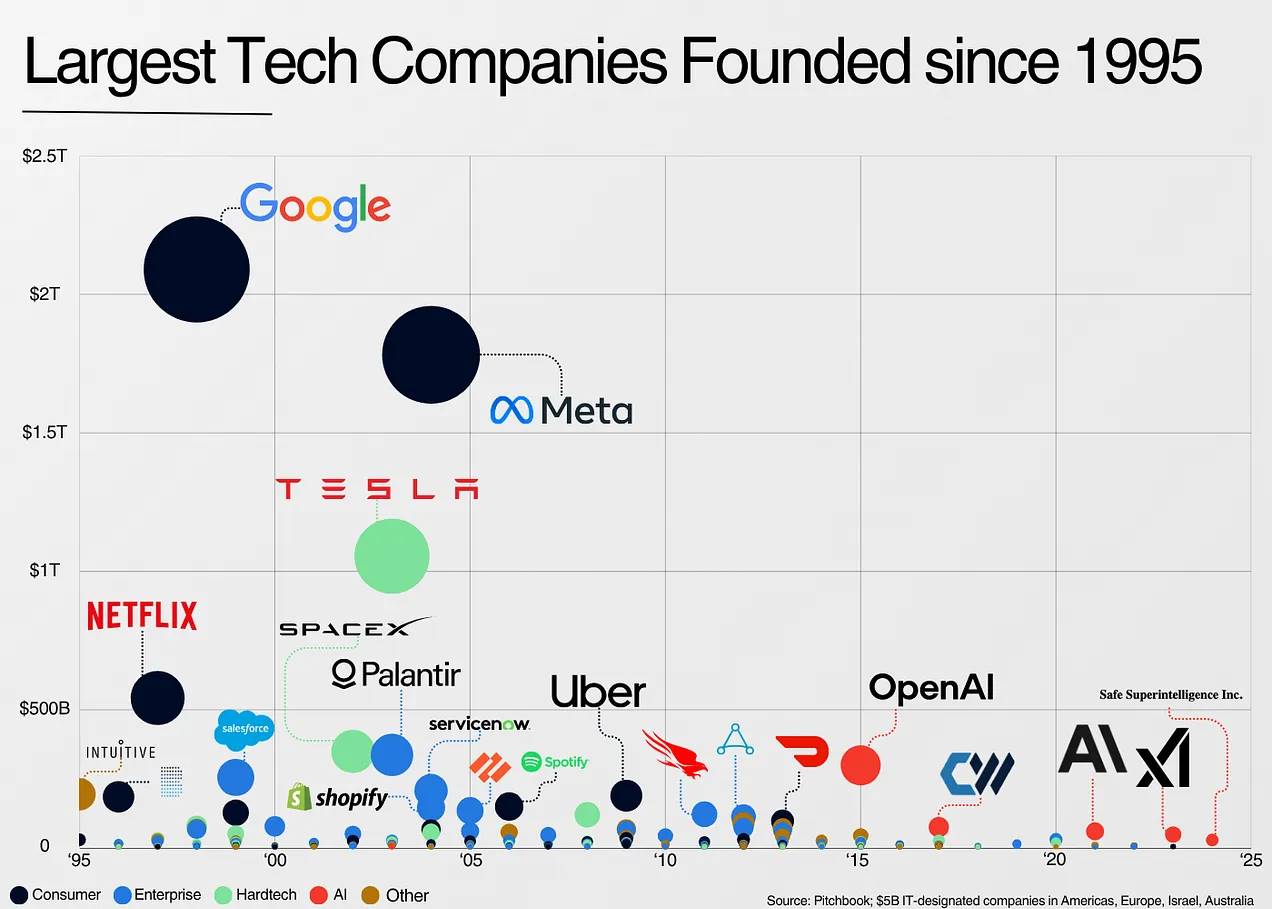
I won’t go deeper into the power law now, but the top seven companies account for nearly 50% of this dataset.
This leads to the first and most important conclusion:
1. The next billion-dollar company will be radically different from the past
First, tech value is primarily driven by unique companies, often founded by unique individuals. Because of their “uniqueness,” relying on pattern matching makes it easier to miss great companies rather than find them.
If a company has no precedent, it's hard to imagine its future. How could you estimate Google’s market size in 1998? Or Meta’s in 2004? It was simply impossible.
Take OpenAI, currently the most distinctive AI company. It started as a nonprofit research lab with no clear technical vision, lost co-founders, and has a complex governance structure. Yet it’s gradually becoming one of the most important companies in history. This is uniqueness at its peak.
The most successful companies have no “public comparables.” They are one-of-a-kind. The biggest companies often create entirely new categories—and that’s precisely why they’re hard to spot.
Neil Mehta defines this as seeking founders who are among the rare few globally capable of creating most of the value humans enjoy.
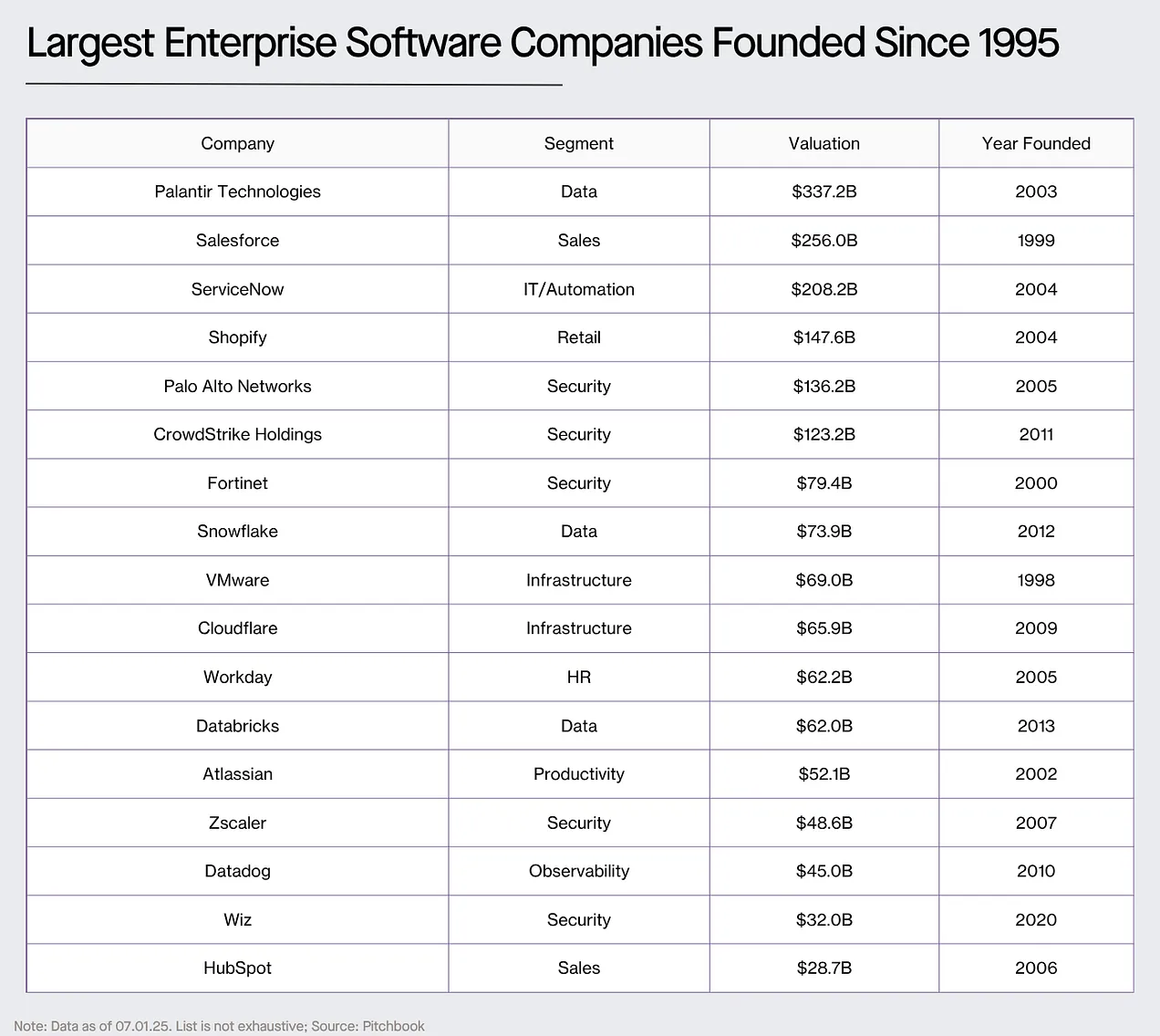
To get a sense of the data, here are the largest companies founded since 1995:
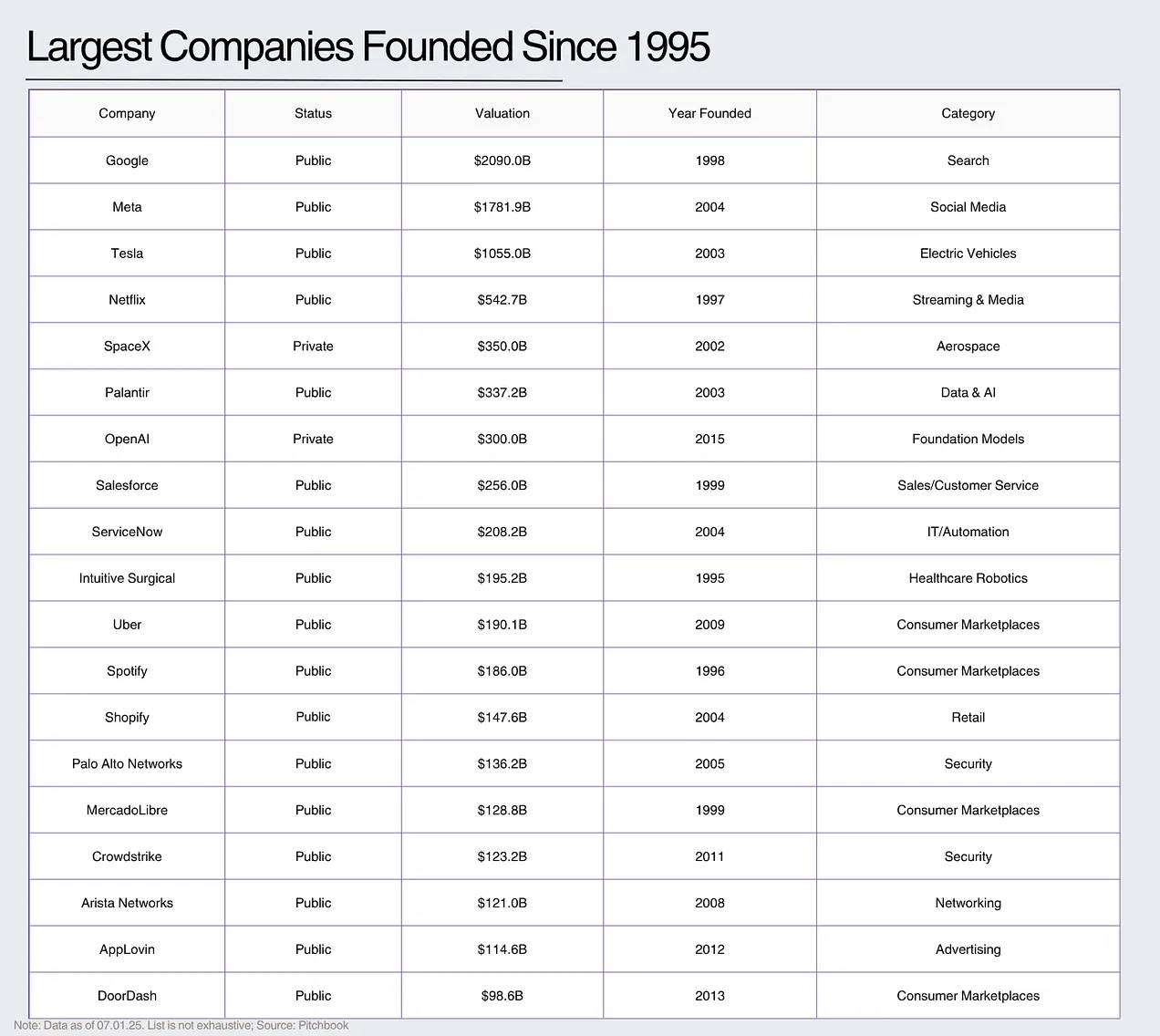
Most of these companies either created entirely new industries or reshaped existing ones so dramatically that it’s almost equivalent to creating their own (e.g., Tesla).
Looking at the data by category leads to the following conclusion:
2. Clarify the game you're playing: a home run, grand slam, or a Space Jam-style super-challenge aimed at outer space?
If we revisit Mauboussin’s concept of base rates, I think we need different mental models for investing across these categories.
Most value has been created by consumer companies (dominated by the power law). Yet enterprise software companies are nearly twice as numerous as consumer companies.
To illustrate this more clearly, I added a column called “Slugging Ratio”—the “total company value / number of companies” ratio—to gauge the degree of power law distribution across industries.
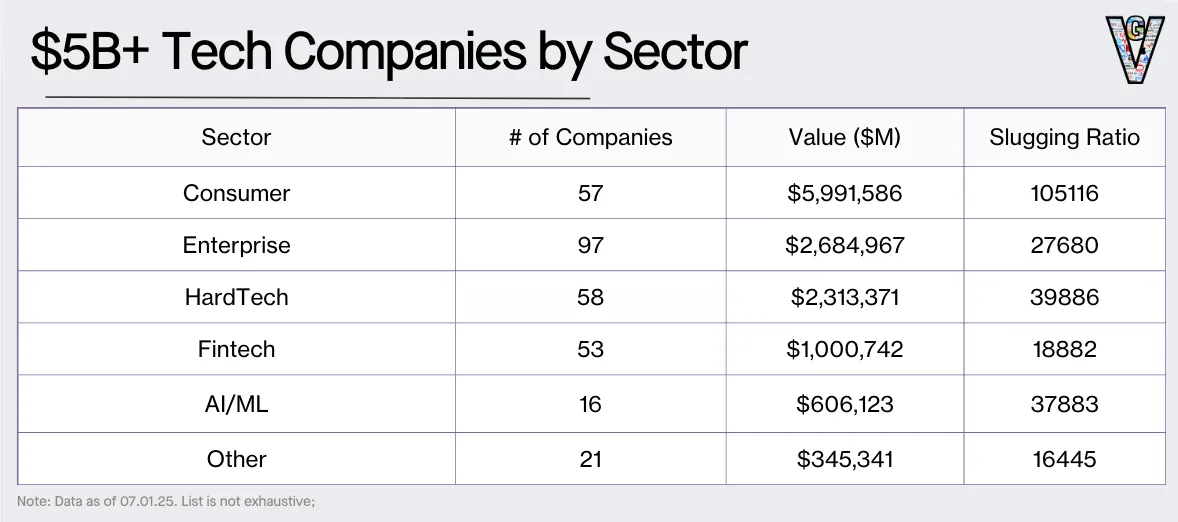
Over the past 30 years, consumer companies have typically been network-driven markets with true winner-take-most dynamics. If you happened to invest in one of the giants, your only mistake was usually underestimating its future scale. Yuri Milner’s $10B bet on Facebook is a prime example.
If a company can truly bake network effects into its business model, its advantage compounds quickly.
Hard tech companies (any company building hardware) have the second-highest “slugging ratio,” largely because hard tech is harder to survive in. Typically, these companies require more capital, take longer to scale, face tougher product development challenges, are more vulnerable to funding crises, and find it harder to disrupt incumbent giants.
However, if they overcome these hurdles, the market opportunity can be enormous.
Yet there are fewer spots available for consumer and hard tech companies. That’s why enterprise software has become the ideal expanding investment vehicle in venture capital.
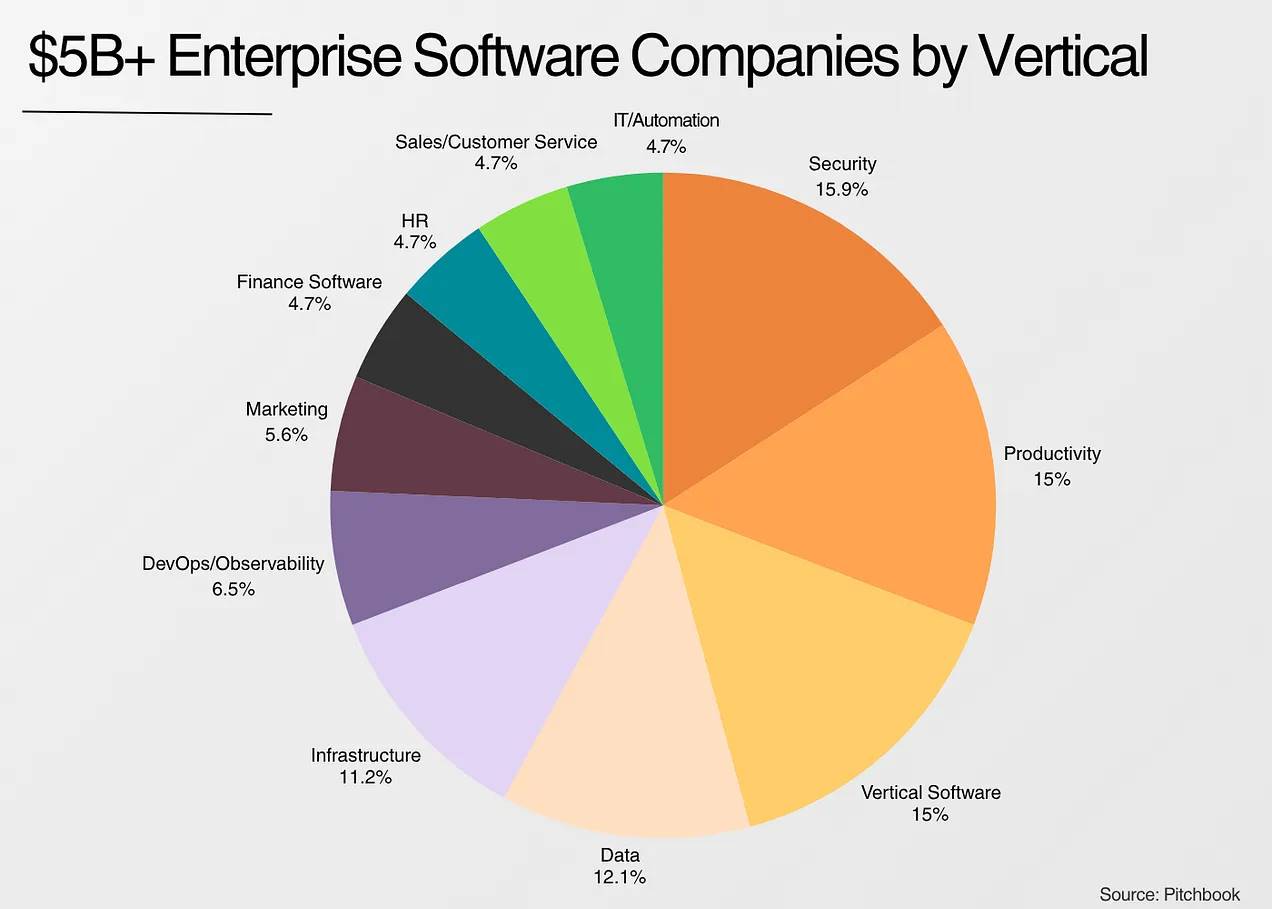
In non-winner-take-all markets, fast-growing enterprises can build strong moats with lower operating costs. In an environment with many VC funds, there are more winners to chase, more mature markets, and overall less risk. But when things go right, the upside is massive. It’s a good way to de-risk an inherently high-risk industry.
3. Software is like chicken—80% tastes the same
I’m borrowing a phrase from Robert Smith, founder of Vista Equity Partners: “Software companies taste like chicken… they sell different products, but 80% of what they do is almost the same.”
If we look at most of the largest enterprise software companies, they are either:
-
Applications built on databases with unique workflows
-
Infrastructure that builds these applications
-
Security protecting these applications
This isn’t to say these companies aren’t differentiated—it’s just that their differentiation is far more subtle than it appears. Sales, marketing, and brand awareness are as important, if not more so, than technical differentiation.
In a world where software is easier to build, features can be copied in days, and AI coding tools are improving rapidly, technical moats in software may be limited to unique data or integration.
The point is that technical differentiation is often not the deciding factor for enterprise software companies.
In this context, I find the “GPT wrapper” argument interesting—the idea that AI application companies are merely repackaging LLMs. Most enterprise software companies use SQL (or NoSQL) databases and build unique workflows for specific customer segments.
If we look at the largest recent AI enterprise applications, they are all “large language model wrappers.” But this is no different from the largest enterprise software companies of the past decade, many of which grew into multi-billion dollar giants!
As I mentioned earlier, enterprise software is lower risk and more predictable than other categories. However, beyond horizontal enterprise software, market size doesn’t seem as important as it first appears. “How big can this company get?” and “How big is the market?” are two very different questions.
4. “Market size” might be the biggest reason great investors miss great companies
If there’s one thing humans struggle with most, it’s uncertainty—and that’s exactly what new markets bring.
Palantir, Shopify, Uber, and many others created new markets that didn’t previously exist.
Even attempts to impose certainty on fundamentally uncertain questions lead to foolish behavior.
Take the famous debate between Aswath Damodaran and Bill Gurley on valuing Uber. Gurley concluded Uber’s potential market size could be 25 times larger than Damodaran’s initial estimate.
I studied companies founded since 2010 that achieved the highest multiple returns in public markets—an indicator of underestimation.
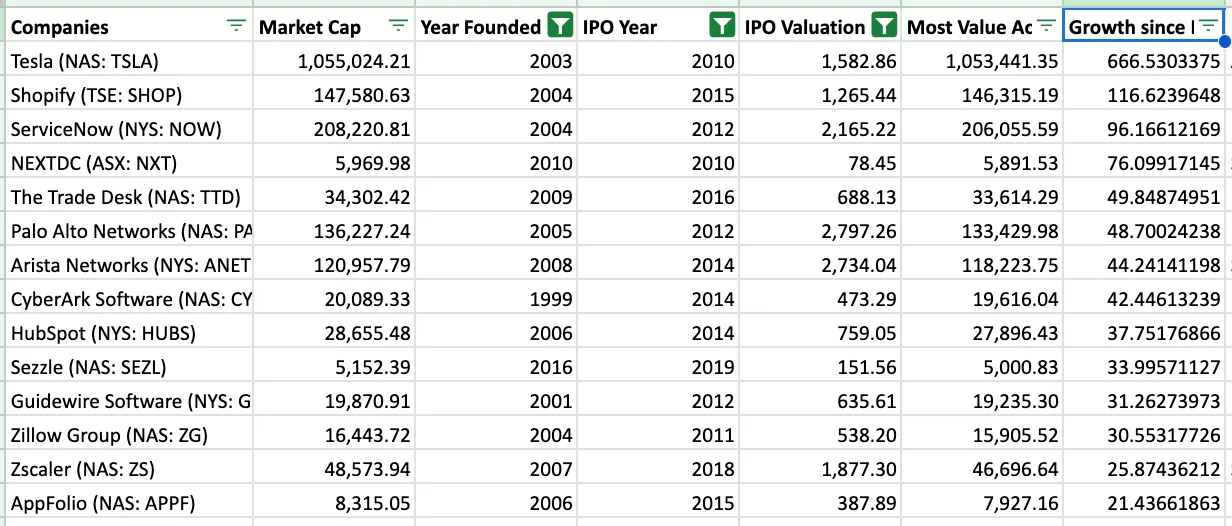
Several patterns emerged:
-
Investors underestimated market size, especially for market-expanding companies or verticals: Shopify, Guidewire, Zillow, AppFolio were all undervalued. Similarly, in private markets, investors underestimated vertical software companies like Toast and ServiceTitan.
-
As new business models surpassed old ones, companies rode tailwinds of multiple expansion: Tesla (the most extreme case), and to a lesser extent all listed software companies, saw their multiples redefined compared to incumbent competitors. Today, Tesla alone is worth close to $1T—more than double the combined value of all major automakers when it entered the market.
-
Investors underestimated the power of platforms: ServiceNow, Palo Alto, Crowdstrike, Workday, Atlassian, and Datadog all expanded their markets by broadening product lines. As software development gets easier and technical differences between platforms shrink, customers increasingly prefer platforms over point solutions. In an era of consolidation, being platformed is good!
This isn’t to say market size doesn’t matter—it’s to emphasize that market size is easily miscalculated.
5. Companies are often tied closely to the technological wave they ride
If the previous section was the “market size” part, this is the “why now?” part. A well-known VC question is “Why now?”—why couldn’t this company have been built before? What’s newly possible that enables this company to exist today?
Most often, the answer is a new technological wave enabling the company’s existence. Today, that wave is artificial intelligence (AI). In the past, it was the internet, then mobile, then the fusion of internet and mobile, followed by cloud computing.
We can see below the timeline of when $5B+ companies emerged by sector:
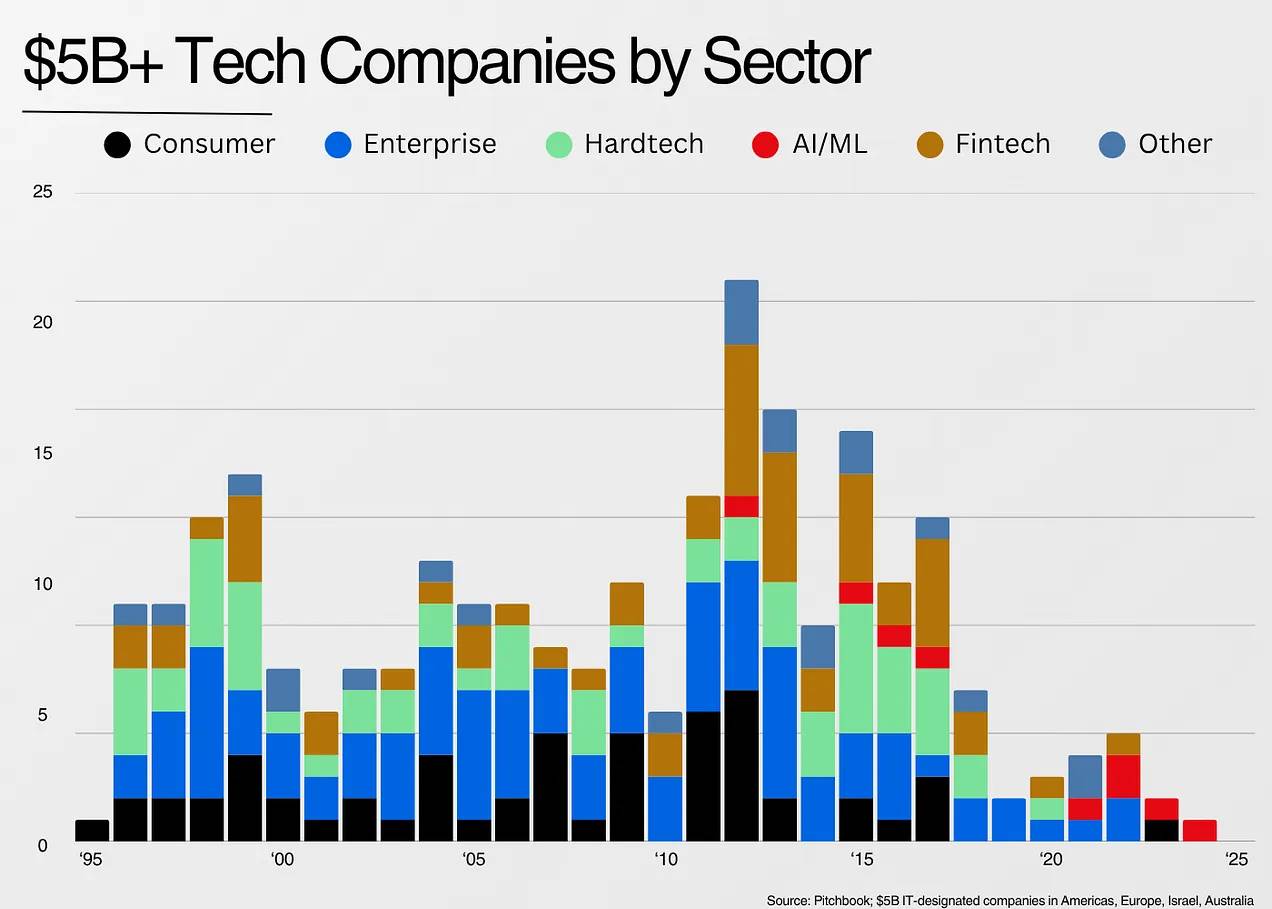
The internet connected the globe, giving rise to aggregation-based business models.
Mobile went further, putting the internet in everyone’s hands, opening new frontiers in consumer markets.
Fintech is a rare example showing how regulation can drive new tech industries. Especially after the 2010s, the Durbin Amendment helped fuel fintech’s boom.
Cloud computing was the most disruptive wave in tech history, allowing companies to build software with a credit card instead of relying on data centers.
Now, with the rise of AI, which companies will be unlocked? What will they look like?
-
AI programming tools are pushing cloud computing further, enabling anyone—not just developers—to create software. This will trigger a software explosion similar to the cloud era.
-
AI also unlocks automation of voice and text workflows. We’re already seeing this in programming, customer service, and AI note-taking, but it will expand into many more use cases.
This expands the software market in ways we’ve never seen. For example, in this dataset, no legitimate software company reached a $5B valuation. Harvey hit $5B in just three years.
Rex Woodbury offers a great thought experiment on the state of AI:
I like Alfred Lin’s analogy comparing mobile and cloud. In the mobile era, a valuable exercise was breaking down iPhone capabilities and predicting which companies each feature could empower. He gave an example: GPS enabled delivery drivers to navigate with Google Maps, leading to DoorDash.
Technological waves open narrow windows for new companies—and we’re seeing that window emerge now.
6. What comes next?
Last week, while reading Will and Ariel Durant’s “The Lessons of History,” I came across this line: History laughs at all attempts to fit it into theoretical molds or logical frameworks; it always mocks our generalizations and overturns all rules. History itself is complex and unpredictable, baroque in its wonder and anomalies.
Perhaps this article is foolish—trying to fit the most outlier-driven industry into a logical framework!
What remains constant is human nature. Viewed inversely, humans struggle to imagine exponential growth, handle outliers, or deal with uncertainty.
To manage this uncertainty, our best options are:
-
Understand the “base rates” of company categories (what’s likely to happen)
-
Understand where differentiation really comes from (in software, sometimes it’s mostly sales and marketing)
-
Treat market sizing as a first-principles exercise in problem-solving, not a simple pattern-matching activity
-
Recognize that each wave of companies is unique, unpredictable—and that’s precisely where its value lies.
Steve Jobs once said about computers: “I think one of the real distinctions between us and higher primates is that we’re tool-builders… The computer is the most remarkable tool we’ve ever come up with. It’s the equivalent of a bicycle for our minds.”
Jobs was right. Computers unleashed an unprecedented wave of creativity.
Today, we’re witnessing the birth of the greatest “bicycle for the mind” in history. What an exciting time to be alive!
Join TechFlow official community to stay tuned
Telegram:https://t.me/TechFlowDaily
X (Twitter):https://x.com/TechFlowPost
X (Twitter) EN:https://x.com/BlockFlow_News
 @EricFlaningam