








Animoca Research Report: Sidekick, Building Real-Time Trading LiveFi Infrastructure
TechFlow Selected TechFlow Selected
Animoca Research Report: Sidekick, Building Real-Time Trading LiveFi Infrastructure
Just as live streaming once completely transformed the e-commerce landscape, Sidekick hopes to bring about an equally profound change in the Web3 ecosystem.
 Navigating Web3 tides with focused insights
TL; DR
-
Sidekick is a Web3-native live streaming platform that integrates TikTok-style content feeds, Huya-like monetization mechanisms, and on-chain execution capabilities. During live streams, users can send tips, participate in airdrops, and creators become real-time distributors of digital assets.
-
As the crypto attention market becomes increasingly saturated, marketing tweets and leaderboard campaigns are losing effectiveness. In contrast, live streaming offers a more trustworthy and higher-conversion communication format, ideal for building visibility and credibility for meme tokens and VC-backed projects.
-
The platform has achieved initial success in Asian markets, attracting over 1,000 KOLs focused on live streaming. Sidekick now plans to expand its content scope and incentivize deeper community engagement.
-
The team primarily comes from Web2, with extensive experience in live streaming platforms and global market expansion. Sidekick has entered BNB Chain's Season 7 MVB Accelerator Program and received support from YZi Labs, Altos Ventures, Fenbushi Capital, and Hashkey Capital. It also partners with Solana Foundation, Base, and OKX Wallet, and has joined the Google Cloud Web3 Startup Program.
-
Looking ahead, Sidekick has the potential to evolve from a streaming platform into a modular infrastructure layer, driving diverse on-chain activities through real-time content and becoming a core operational component for projects.
Why Live Streaming Is Crucial for Web3 Promotion
Sidekick is a Web3 content platform built around live streaming, covering market commentary, blockchain gaming, and more. It applies the "live commerce" model to the crypto market, building LiveFi infrastructure where KOLs, traders, and project teams interact within the same space.
The rise of Web3 live streaming is not accidental but reflects a structural issue in the crypto ecosystem: inefficient marketing and an increasingly saturated attention market.
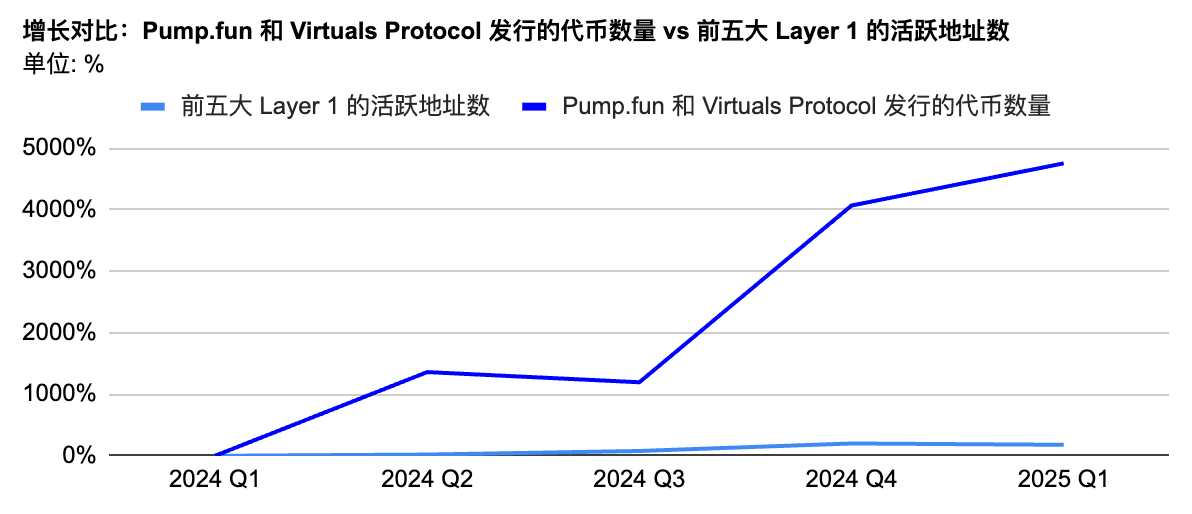
Since Q1 2024, the emergence of tools and platforms such as Pump.fun, BONK’s LetsBonk, and Raydium Launchpad has significantly lowered the barrier to token issuance. AI-driven smart tokens have further accelerated this trend. Token creation volume has grown over 50x since Q1 2024, while active wallet counts on major Layer1s have doubled. However, exposure mechanisms for new tokens haven’t scaled accordingly, making it difficult for early-stage projects to gain visibility.
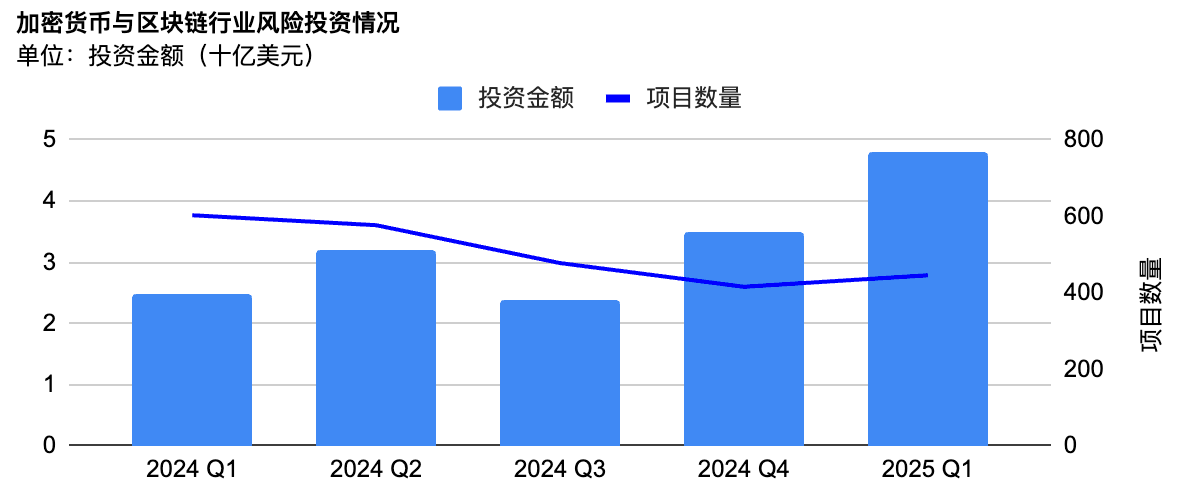
Institutionally, from Q1 2024 to Q1 2025, VC investment amounts continued to grow, but capital is increasingly concentrated among a few star projects. These projects face high valuation and liquidity pressure, demanding even greater market attention.
Under these conditions, “distribution efficiency” and “information delivery” have become more critical than ever. Project teams must not only build products but also win the game of capturing attention. As Sidekick founder Jonny puts it, the evaluation criteria for token projects have shifted from fundamentals to their ability to attract early attention.
Among all options, KOLs are key drivers in generating project awareness. While marketing agencies can help connect with top-tier KOLs, it's costly and limited in reach. A new challenge arises: how can projects effectively reach and activate mid-tier KOLs to improve marketing ROI?
Many InfoFi platforms address this by introducing leaderboard-based airdrop mechanisms—projects distribute rewards based on virality metrics on Twitter/X. This indeed broadens participation and motivates mid-tier KOLs to create content. But it also brings side effects: KOLs tend to produce uniform, repetitive content, leading to homogenization, audience fatigue, and reduced promotional impact.
Thus, the question evolves: how can projects, especially startups, stand out amid information overload, quickly establish trust, and consistently deliver differentiated content?
Live streaming demonstrates multiple structural advantages in the context of Web3 promotion. Compared to static tweets or pre-recorded videos, live streams allow creators to engage in real-time, unscripted interactions with viewers. This dynamic exchange enhances transparency, enabling audiences not only to evaluate content but also observe the presenter’s behavior, intent, and credibility—precisely why live commerce rose to prominence in Web2. In 2023, China’s live e-commerce GMV surpassed 4.9 trillion RMB, and similar models are gaining traction in Western markets.
Given the inherent information asymmetry and high trust costs in Web3, live streaming serves as an effective tool to reduce uncertainty and build trust.
The demographic profile of crypto users further supports adoption of this format. Globally, about 60% of crypto users are aged 25–44, a group that overlaps closely with Twitch’s core user base (nearly 50%). This indicates strong cultural and behavioral alignment between crypto users and live streaming.
Industry trends already reflect growing adoption: in 2024, Pump.fun integrated live streaming, allowing creators to introduce tokens in real time. The "Crypto" category on Twitch now attracts over 4,600 daily viewers—comparable to mainstream categories like NBA 2K25 and Call of Duty.
Beyond structural benefits, live streaming aligns with actual user discovery behaviors. The Sidekick team identified a typical five-step path:
- A token contract address is shared in Telegram/Discord groups;
- Discussed within private communities;
- Recommended by platform KOLs to their followers;
- Gains broader visibility on X;
- Ultimately converts into trading volume.
This shows that a project’s dissemination relies on trusted individuals who narrate stories, verify legitimacy, and establish early trust. Live streaming, as a form of real-time human interaction, is the ideal tool to accelerate this process.
Sidekick: From Attention to Action
Sidekick is a live-streaming-centric crypto market discovery platform focused on real-time market analysis and project engagement. It responds to deep shifts in Web3 user behavior: scarce attention, rapidly changing narratives, and trust as a key determinant in user adoption.
By deeply integrating live streaming with trading modules, Sidekick enables real-time interaction among project teams, creators, and viewers. It brings the logic of live commerce into LiveFi scenarios, merging storytelling with community participation.
Platform Features
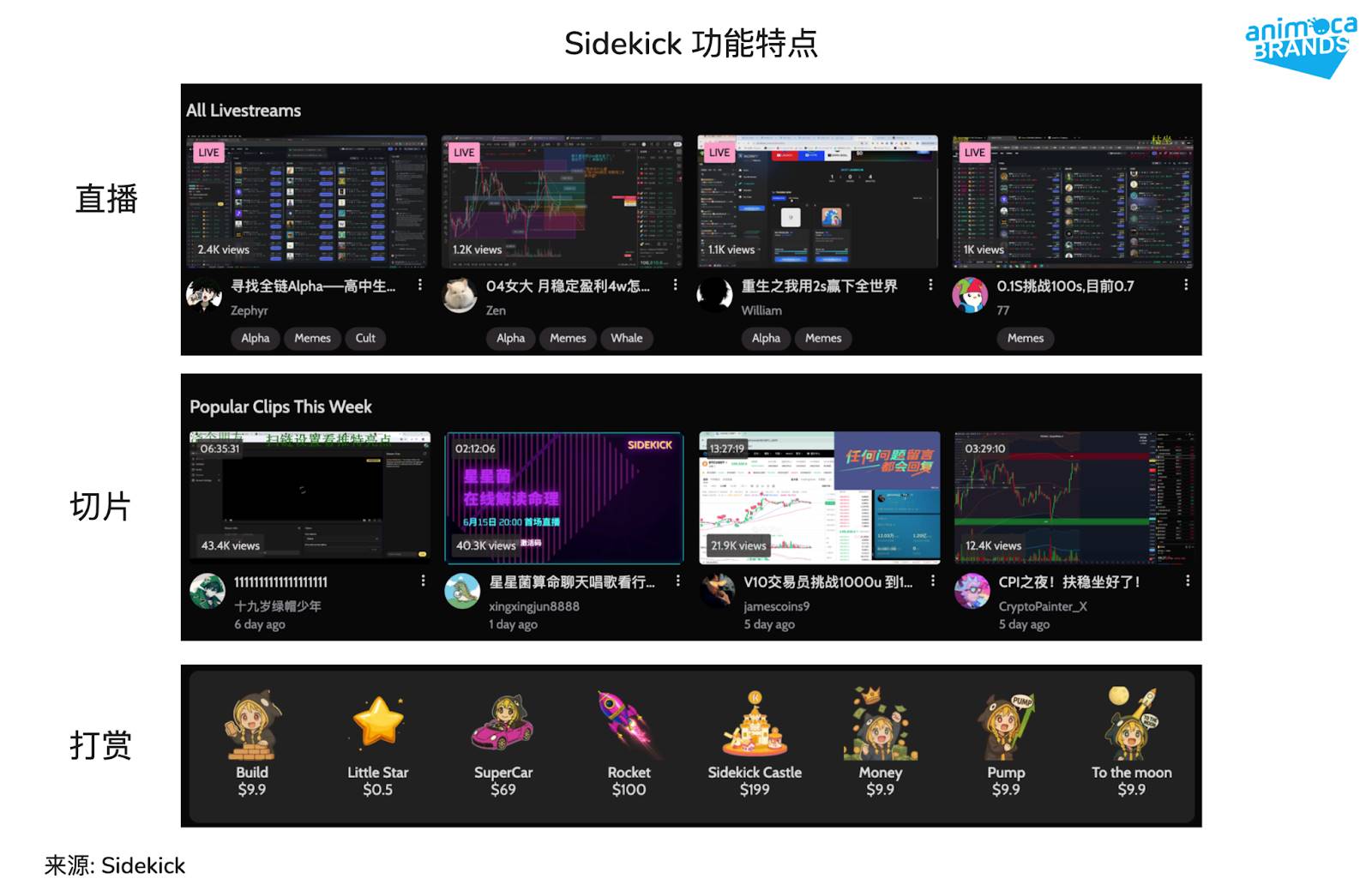
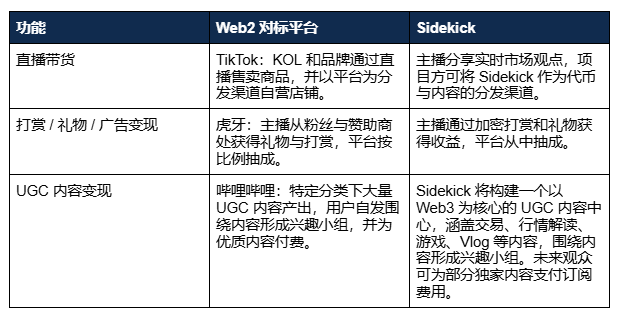
The "trust-to-action" loop in Sidekick stems from product design: combining Web2-style interactive mechanics with Web3 transactional capabilities. It integrates core features from TikTok, Huya, and Bilibili:
Creators produce content in real time, while viewers can monetize their support through tipping, gifting, advertising, or subscriptions—forming a highly interactive and convertible content ecosystem.
Business Model
Sidekick offers two primary revenue streams for streamers: viewer tips via virtual gifts, and platform-led creator incentive programs.
Regular users play another essential role. They watch streams, access market insights, participate in real-time discussions, and earn rewards through in-platform airdrop events.
The third stakeholder group consists of projects or advertisers. They use live AMAs, airdrop campaigns, or product placements to boost visibility and community engagement, or collaborate with streamers as performance-based marketing channels.
As an infrastructure and matchmaking platform, Sidekick earns commission fees from partnered projects, similar to intermediary service charges.
Team Overview
Sidekick is led by founder Jonny, who has extensive experience in gaming, live streaming, and investing. He began his career at Wangyu Internet Café, China’s largest internet café chain, managing its European expansion. Later, he founded BiXin, a gaming companion platform, gaining deep insight into player behavior and live streaming ecosystems.
Under Jonny’s leadership, Sidekick was selected for BNB Chain’s Season 7 MVB Accelerator Program and secured backing from YZi Labs, Altos Ventures, Fenbushi Capital, and Hashkey Capital. It also established partnerships with Solana Foundation, Base, and OKX Wallet, and joined the Google Cloud Web3 Startup Program.
Market Strategy
Sidekick’s market expansion follows a three-phase roadmap, targeting different user segments and content structures:
Phase One: Focus on crypto-native users, particularly Chinese-speaking communities active in private groups but underrepresented on public platforms like Twitter/X. This phase emphasizes building a loyal user base.
Phase Two: Expand to general entertainment creators. These individuals may not be professional gamers but excel at enhancing stream experiences through humor, storytelling, or emotional appeal, boosting user stickiness and retention.
Phase Three: Enter additional vertical content areas. Rather than directly competing with giants like YouTube, Huya, or Douyu—platforms with strong IP licensing and esports resources—Sidekick targets the niche segment of “real-time crypto market content.” This differentiation provides flexibility to explore new content formats, creators, and monetization models.
This three-phase strategy is community-driven. Many users voluntarily adopt Sidekick-themed avatars and create tutorial content without direct incentives, creating a grassroots growth cycle that reinforces engagement and loyalty.
The team itself remains deeply embedded in crypto communities, regularly participating in meme coin trading and KOL discussion groups to gather frontline feedback and track shifts in attention flows and narrative trends.
Competitive Landscape
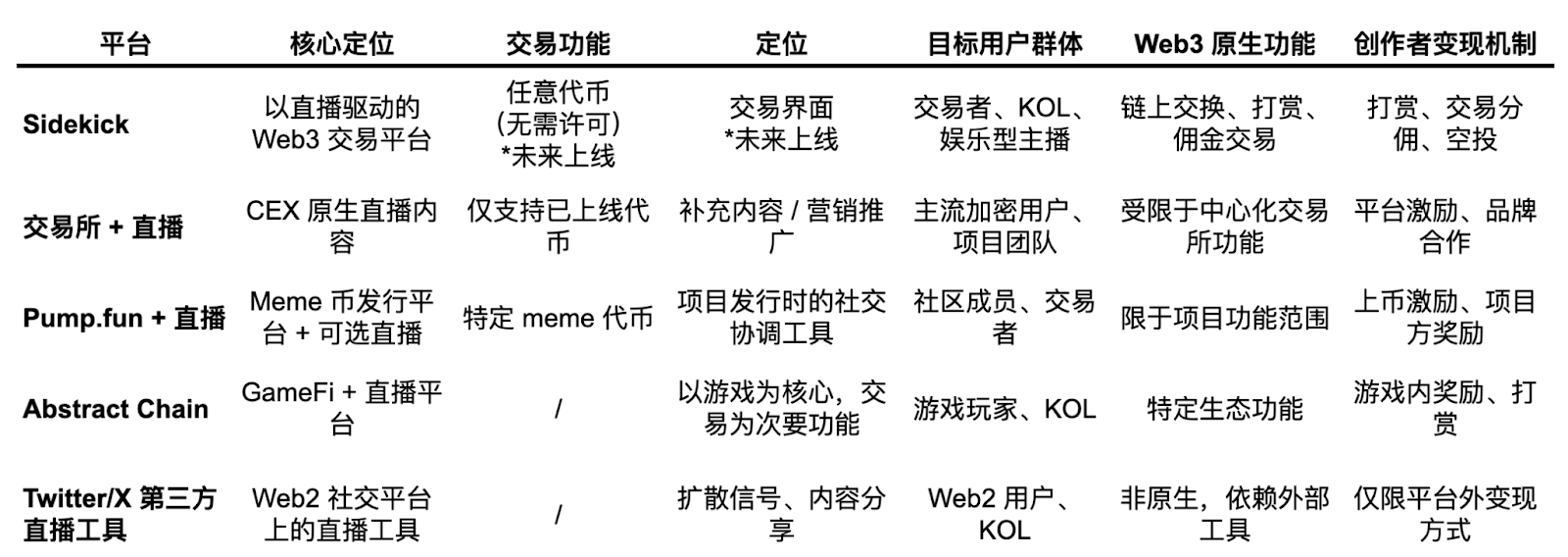
As live streaming and crypto market analysis converge, the so-called "LiveFi" sector is seeing diverse product approaches. These can be broadly categorized: third-party live platforms for Twitter/X, token launch platforms with optional streaming (e.g., Pump.fun), game-integrated streaming models (e.g., Abstract Chain), and native exchange streaming interfaces (e.g., Binance’s developing product).
These paths reflect differing views on “what role live streaming should play in the crypto ecosystem”:
- Third-party Twitter/X tools were first to implement streaming but lack Web3-native features like crypto tipping;
- Pump.fun’s streaming function focuses on how meme coins can generate viral liquidity via live streams—streaming here is more of a supplementary promotional tool;
- Abstract Chain concentrates on GameFi projects, mainly serving Western creators and users.
At a foundational level, most platforms still treat video content as a “promotional layer” or “add-on feature.” In contrast, Sidekick positions live streaming as the core interface for trading—not a supporting act, but the central product axis. It integrates content creation, token trading, and community interaction, embedding native monetization tools like tipping and airdrop incentives, so that both creators and viewers naturally revolve around on-chain interactions.
Meanwhile, exchanges like Binance are also deploying live streaming, but their streams only cover already-listed tokens. Sidekick creators, however, can freely stream around any asset—whether newly deployed tokens or obscure narrative-driven ones. This gives Sidekick stronger adaptability to emerging trends and allows it to敏锐ly capture community-driven hype cycles and speculative waves.
A recent case exemplifies this: a streamer broadcasted his entire meme coin pump-and-dump operation live, culminating in a Community Takeover (CTO). Viewers could see his actions in real time and actively participate in discussions. This format made the content itself transparent and participatory.
In terms of regional positioning, Sidekick has established a solid foundation among Chinese-speaking creators and audiences, signing over 1,000 KOLs focused on live streaming. This dual advantage of “breadth in content supply + depth in creator stickiness” will play a crucial role in the fiercely competitive battle for attention.
Conclusion: The Next Step Toward Protocol Integration in LiveFi
As the market evolves, Sidekick is gradually transforming from a content platform into a Web3-capable infrastructure layer. It is no longer just an information dissemination tool but a real-time discovery engine—tightly coupling content delivery with user action. In this evolution, Sidekick transcends being merely a “content layer” to become an actionable “execution layer,” converting viewing behavior into on-chain operations.
Going forward, Sidekick has the potential to expand into more on-chain scenarios, such as token launches, IDO rushes, whitelist registrations, and even lending activities. The platform will continue introducing modular components to serve a wider range of protocols and applications.
Just as live streaming once revolutionized e-commerce, Sidekick aims to drive similarly transformative change within the Web3 ecosystem.
Join TechFlow official community to stay tuned
Telegram:https://t.me/TechFlowDaily
X (Twitter):https://x.com/TechFlowPost
X (Twitter) EN:https://x.com/BlockFlow_News
 @animocaresearch







