A Brief History of Stablecoin Development
TechFlow Selected TechFlow Selected
A Brief History of Stablecoin Development
The reshaping of traditional roles such as central banks, commercial banks, payment institutions, and even securities and insurance firms by stablecoins has only just begun.
 Navigating Web3 tides with focused insights
Author: 10K Ventures
This article attempts to comprehensively map the technological pathways, market landscape, institutional evolution, and profit logic of stablecoins, constructing a panoramic framework for understanding stablecoin trends. This piece is also the first in our research series, with follow-up reports on topics such as RWA and tokenized stocks to come.
Evolution of Stablecoins
The emergence of stablecoins was a natural outcome of the crypto asset ecosystem's effort to solve the fundamental challenge of "price volatility." Whether Bitcoin, Ethereum, or other decentralized assets, their openness and scarcity form the foundation of the digital asset system. However, their high price volatility and lack of a stable pricing anchor make them ill-suited for everyday transactions and payments. The concept of stablecoins aims precisely to bridge the gap between "censorship-resistant settlement" and "predictable value."
Tether and the First Attempt at On-Chain Dollars
In 2014, the launch of Tether marked the first structural attempt at a stablecoin. Its mechanism was simple: users deposit U.S. dollars into Tether’s corporate account, and Tether issues an equivalent amount of USDT on the blockchain, promising 1:1 redemption. This model—“fiat collateral + off-chain custody + on-chain issuance”—effectively outsourced the issuance rights of dollar deposits to a private entity, forming a business model akin to a narrow bank.
Tether’s success stemmed from its first-mover advantage, network effects in on-chain liquidity, and its ability to fill the void in crypto trading demand for dollar-denominated settlements. At the same time, USDT’s off-chain custodial asset structure sparked controversy. Its holdings were not entirely cash or Treasury bonds but included commercial paper, precious metals, and even Bitcoin. While this mixed-asset approach enhanced yield potential, it left regulatory gray areas in terms of trust and transparency.
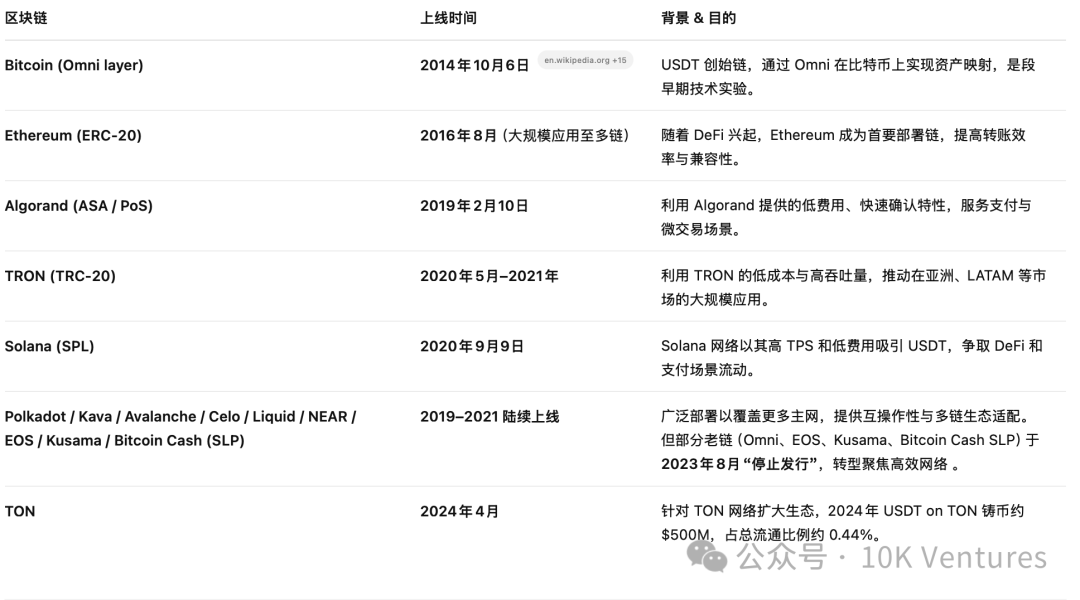
Timeline of USDT Launches Across Chains
Proportion of USDT Usage by Blockchain
As regulatory requirements increased and market demand for transparency grew stronger, Circle’s USDC stablecoin gained mainstream institutional favor starting in 2018. Unlike Tether, USDC was co-founded by Circle and Coinbase and operates within the regulated U.S. financial system. Its reserves consist entirely of cash and short-term U.S. Treasuries and are regularly audited and disclosed by third parties. USDC represents the path toward stablecoin compliance and has since become a reference model for U.S. government proposals like the “Payment Stablecoin” regulatory bills.
Collateralized Cryptocurrency Stablecoins: The Rise of DAI and the Foundation of DeFi
If Tether and USDC represent centralized versions of on-chain dollars, then the launch of DAI opened a new paradigm under decentralized finance (DeFi). Introduced by MakerDAO in 2017, DAI no longer relied on fiat deposits or bank accounts. Instead, it was minted and burned automatically via smart contracts using on-chain staked Ethereum assets as collateral.
DAI issuance relies on an over-collateralization mechanism. Users must deposit ETH worth more than 150% of the desired DAI amount, reclaiming their collateral after repaying the loan. Initially, this model worked well, meeting the demand for decentralized dollars among on-chain users and serving as the foundational currency for interest markets and leveraged structures within the rise of DeFi applications.
However, this ETH-centric collateral model faced risks related to volatility and liquidation efficiency. During the March 12, 2020 market crash, DAI experienced clogged liquidations and debt black holes, prompting widespread community reflection on the model’s safety. Since then, MakerDAO has added diversified collateral types—including USDC, WBTC, and even real-world assets (RWA)—significantly reducing its decentralization while enhancing stability. DAI has gradually evolved from a purist “crypto-collateralized stablecoin” into a “multi-collateral synthetic dollar system.”
The Rise and Fall of Algorithmic Stablecoins: Systemic Lessons from the UST Collapse
While fiat-backed stablecoins like Tether and USDC offered compliance and stability, and crypto-collateralized models like DAI explored decentralization, another category—algorithmic stablecoins claiming to require no collateral—quickly attracted market attention. These models aimed to maintain price pegs through protocol-driven supply-demand adjustments, relying purely on mathematical mechanisms for stability.
UST from the Terra ecosystem was the most representative case. UST did not rely on fiat or crypto assets as collateral. Instead, it used a dual-token rebalancing mechanism with its sister token LUNA: when UST traded above $1, users could mint 1 UST with $1 worth of LUNA; when below $1, they could burn 1 UST to claim $1 worth of LUNA, creating arbitrage incentives. But this model lacked underlying real assets—the entire stability depended solely on market confidence in LUNA.
As Terra’s incentive mechanisms expanded, UST’s total supply surpassed $10 billion by late 2021, making it the third-largest stablecoin after USDT and USDC. However, a massive redemption wave in May 2022 triggered UST’s de-pegging. The protocol’s automatic LUNA minting mechanism failed to stem collapsing confidence, sending LUNA into a “death spiral” and rendering UST worthless. This collapse wiped out hundreds of billions of dollars in value and effectively removed algorithmic stablecoins from global regulatory consideration.
New Forms Emerge: USDe’s Financial Engineering and On-Chain Interest Arbitrage
The failure of UST did not end innovation in stablecoin design—it instead catalyzed the emergence of next-generation mechanisms. In late 2023, Ethena launched USDe, introducing a novel approach: leveraging a “delta-neutral” hedging strategy to offset price volatility while relying on on-chain interest arbitrage for backing.
USDe is issued based on a basket of primarily Ethereum-based collateral, combined with short perpetual futures contracts to hedge price risk. Users can deposit ETH, stETH, or USDC, which the platform converts into a delta-neutral asset structure before issuing USDe. By combining long spot positions with short derivatives, the model theoretically stabilizes net asset value. Additionally, Ethena introduced sUSDe, allowing users to stake USDe and share in protocol-generated yields derived from the combination of perpetual funding rates and stETH staking rewards—reaching annualized returns of 20–30%.
The key innovation of USDe lies in its “yield-generating stability mechanism” rooted in real on-chain arbitrage income. Unlike traditional stablecoins that depend on external assets or redemption trust, this model uses on-chain yield spreads as reserve support, tightly binding the stablecoin to on-chain liquidity and market expectations. Ethena also provides additional insurance mechanisms and redemption windows to enhance systemic resilience and transparency.
The effectiveness of this model remains to be tested across market cycles—especially during periods of low funding rates or volatile on-chain liquidity. Nevertheless, USDe points to a new direction: generating sustainable income via on-chain mechanisms, supporting assets through market-neutral strategies, and embedding native protocols directly into DeFi use cases. It represents an experimental shift from static “token mirroring” to dynamic “yield-bearing assets.”
Current Stablecoin Landscape: Four-Class Framework and Institutional Restructuring
With the introduction of the U.S. Generative Innovation in Stablecoins Act (GENIUS Act), the global stablecoin market is entering a new phase of institutional restructuring. This legislation clearly defines issuance thresholds, reserve structures, payment functions, and tech company participation paths. Its impact is profound—akin to a watershed moment. Under this new framework, the stablecoin market is showing clearer factional divisions, broadly categorized into four major camps: compliant sovereign-aligned, efficiency-pragmatic, political-capital-driven, and institutional counterattacks by traditional banks and tech giants.
Compliant Sovereign-Aligned: The USDC Alliance
Representatives: Circle (USDC), Paxos (PYUSD), Gemini (GUSD)
As regulations have become clearer, early adapters to the regulatory framework have gained a first-mover advantage. Take Circle: by June 2025, USDC’s market cap approached $61 billion, with reserves composed entirely of cash and short-term U.S. Treasuries—fully compliant with the STABLE Act requirement that reserves consist of assets maturing in ≤93 days.
Stablecoins like USDC strictly follow GENIUS Act guidelines, maintaining reserve structures primarily composed of 100% cash and short-term Treasuries, with regular audit disclosures. Their strong compliance makes them popular among institutional clients, custodians, and mainstream financial infrastructure.

USDC Total Market Cap, Source: Defillama
These issuers typically possess:
-
State-chartered banking or trust licenses
-
Monthly reserve audit reports
-
A clear 1:1 redeemability mechanism
However, Circle faces significant dependency on Coinbase’s distribution channels. In 2024, Circle reported $1.68 billion in revenue but only $167 million in profit, largely because Coinbase captured most of the channel fees and marketing incentives. (Detailed analysis in “Profit Models of Leading Stablecoin Companies” section.)
In terms of revenue structure, stablecoin issuers earn substantial annual interest from managing reserve assets (e.g., U.S. Treasuries). For example, over 99% of Circle’s $1.68 billion in 2024 revenue came from reserve investment yields.
Circle successfully went public in 2025. The strategic intent behind its IPO was clear: reduce reliance on Coinbase, strengthen independent issuance and compliance capabilities, and attract more institutional and bank-grade users. However, challenges remain—strict regulation brings “channel dependency.” Although much of USDC’s transaction volume occurs on-chain, Coinbase still dominates issuance and holds partial custody rights, giving it leverage to suppress Circle’s margins. This “compliant stablecoin × distribution oligopoly” structure introduces new risks around centralization and platform lock-in.
Efficiency-Pragmatic: The USDT Alliance
Representatives: Tether (USDT), Ethena (USDe), DAI (MakerDAO)
Tether has built a classic operating model of “off-chain regulatory flexibility + on-chain high efficiency.” USDT, issued by Tether, has consistently ranked first in global stablecoin market cap. As of June 2025, USDT’s circulating supply neared $150 billion. Its strength lies in extreme efficiency and powerful network effects. Its reserve strategy is relatively flexible, allocating some funds to higher-yield non-Treasury assets (like Bitcoin, gold, private debt), forming a “high-yield arbitrage” type of stablecoin.
Tether’s advantages include:
Negligible global distribution costs; critical liquidity provider on chains like TRON and Solana; reserve structure offers higher yields (including Bitcoin, precious metals, non-Treasury bonds); strong demand moats established in emerging markets with weak financial infrastructure, such as Latin America and Southeast Asia.
Unlike Circle, Tether leverages its dominant position to reverse-collect channel fees. Major exchanges actively integrate USDT to meet user demand, helping Tether drastically reduce issuance costs—and enabling per-capita profitability that once surpassed traditional financial giants.
Facing the “high-pressure regulation” of the GENIUS Act, Tether has adopted a “dual-track strategy”: maintaining USDT’s flexibility in overseas markets while preparing to launch a fully compliant new stablecoin for entry into the U.S. market. Even with partnerships like Cantor Fitzgerald and political backing, however, its “global stablecoin” model remains in a gray zone within the U.S.
Another group, represented by USDe (Ethena) and DAI (MakerDAO), moves toward on-chain synthetic models. DAI has transformed into a quasi-compliant hybrid model through integration of RWA, DSR, and veToken governance. USDe uses a “ETH collateral + arbitrage hedging” model to create a “pseudo 1:1” redeemable yield-bearing stablecoin mechanism.
Common characteristics: native to the blockchain, interest-rate sensitive, highly composable—but face “regulatory uncertainty,” such as potential blanket restrictions under STABLE Act clauses targeting “endogenously collateralized stablecoins” from being classified as “payment stablecoins.”

Tether Q1 2025 Reserve Composition, Source: BDO Audit Report
Political-Capital-Driven: USD1 and the Construction of Sovereign Transaction Systems
Representative: USD1 (World Liberty Financial)
USD1, led by World Liberty Financial and closely linked to the Trump family, exemplifies how political capital and sovereign funding can drive market adoption. Notable features include leveraging political connections and sovereign capital for real-world applications—such as a $2 billion investment partnership with UAE sovereign fund MGX and deep liquidity integration with Binance.
Moreover, such projects prioritize “use-case construction” over “technical breakthroughs.” The decision to issue on the TRON chain, with Justin Sun as a strategic advisor, represents a deliberate strategic blend of “technical foundation + political protection.”
While USD1 bypasses parts of the traditional financial pipeline, its heavy dependence on geopolitical stability and Middle Eastern resource relationships introduces future uncertainties.

USD1 Trading Volume Trends, Source: Artemis
Market Structure of Stablecoins: Scale, Participants, and Competitive Landscape
As stablecoins evolve from crypto trading tools into global digital payment infrastructure, their market structure is becoming increasingly layered and differentiated. From issuance models and asset reserves to circulation mechanisms and regional compliance, various stablecoins now form a complex network woven from multiple rule systems, stakeholder interests, and usage scenarios.
Market Size and Share Distribution

Global stablecoin market cap growth trend (2019–2025): Total stablecoin market cap has grown from under $10 billion at the end of 2019 to over $250 billion by Q2 2025. This represents more than a fivefold increase since late 2020, reflecting explosive demand and rapidly rising importance within the crypto market.
The total stablecoin market cap now accounts for approximately 7–8% of the overall crypto market. Among all stablecoins, USDT and USDC dominate, collectively holding over 88% market share (USDT: 63.5%, USDC: 24.9%).
USDT remains the largest stablecoin, surpassing $118 billion in supply in 2024—nearly 75% of the stablecoin market at the time. By mid-2025, USDT’s circulation had further increased to about $150 billion, accounting for roughly 63% of the global stablecoin total.
USDC ranks second, with a market cap ranging between $40–50 billion, representing about 20%. Other stablecoins—including DAI, FDUSD, TUSD, USDe, PYUSD—make up the remaining share, each exerting influence in specific user groups and use cases.

Stablecoin Market Share by Market Cap
As of the latest quarter, USDT accounted for ~69.0%, USDC ~20.7%, DAI ~3.1%, FDUSD ~1.7%, emerging yield-bearing stablecoin USDe ~1.5%, and others ~4.0%. Clearly, USDT and USDC dominate the stablecoin landscape. USDT leads due to its long-standing transaction network effects, broad user trust, and abundant liquidity—its user base values network breadth, market depth, and relatively stable operational history. USDC, meanwhile, wins institutional and enterprise users with its high compliance and transparent reserve management—such as weekly audits by licensed accounting firms and reserves composed mainly of cash and short-term U.S. Treasuries. This transparency and compliance edge grants USDC greater trust and adoption in banks and payment companies.
Notably, in a high-interest-rate environment, fiat-collateralized stablecoin issuers themselves earn substantial returns. For example, Tether disclosed holding about $97 billion in U.S. Treasuries and repos in Q2 2024, generating nearly $400 million in monthly interest income. This shows that as scale grows, the stablecoin business itself is becoming a major profit center, further reinforcing the financial and reputational advantages of leading players.
Looking ahead, with global regulation gradually clarifying and user demand continuing to grow, the stablecoin market still has room for expansion. In June 2025, news of the U.S. Senate passing a stablecoin bill briefly pushed the global stablecoin market cap to a record high of $251.7 billion, indicating that favorable policy could further boost market confidence. While the dominance of major stablecoins appears solid, the rise of new types (such as endogenous-yield stablecoins like USDe) continues to expand the boundaries of the stablecoin market, injecting fresh competitive dynamics.
Regional Distribution
The global usage map of stablecoins is showing significant geographic divergence. On one hand, stablecoins enable the “spillover” of dollar value, serving as inflation hedges and dollar substitutes in emerging markets. On the other, differing regional regulatory environments affect local preferences for specific stablecoins and levels of on-chain activity.
United States and Developed Markets: In the U.S., stricter regulations lead institutions and enterprises to prefer compliant, transparent stablecoins. For example, Circle’s USDC and PayPal’s PYUSD are widely adopted by financial institutions and tech companies. Visa and Mastercard now use USDC for cross-border clearing and merchant settlements, enabling instant digital dollar payments. In June 2025, Shopify announced integration with Coinbase and Stripe to accept USDC payments, enabling digital dollar transactions across a global e-commerce network worth over $140 billion. In these contexts, stablecoins serve as a transparent, traceable payment loop, where transparency and regulatory registration are crucial. Thus, the U.S. market is dominated by stablecoins like USDC and PYUSD, anchored to the dollar and issued via Ethereum mainnet and trusted banking channels. Speculative and trading demand is relatively limited. Similarly, Europe, Singapore, and Japan have developed stablecoin regulatory frameworks (e.g., EU MiCA, MAS regulations), fostering compliant local stablecoins (e.g., EURS, XSGD). These developed regions emphasize issuer licensing and reserve audits, with stablecoin usage focused on B2B cross-border payments, trade settlements, and wealth management—not individual hedging.
Emerging Markets and Developing Countries: Demand for stablecoins is particularly strong in Latin America, Africa, the Middle East, and South Asia, where they are seen as dollar alternatives and tools for financial inclusion. In high-inflation, depreciating-currency countries, residents and businesses buy stablecoins to hedge against currency depreciation, conduct remittances, or settle daily transactions. According to Chainalysis, Latin America leads in real-world stablecoin adoption: 71% of surveyed organizations cite cross-border payments as their primary stablecoin use, far above the global average of 49%. Many Latin American firms combine stablecoins with local payment networks to achieve cross-border remittance efficiencies unattainable through traditional banking. For instance, Brazil received about $90.3 billion in crypto inflows from July 2023 to June 2024, ranking among the highest in Latin America. Of crypto flows from local exchanges abroad, stablecoins accounted for 70%. As the real weakened, stablecoin trading volume on Brazilian exchanges surged 207.7% year-on-year, far exceeding growth in Bitcoin or Ethereum. This reflects how local businesses and individuals turn to stablecoins as vehicles for cross-border capital movement to gain dollar exposure and avoid exchange rate risks.
In Africa, stablecoins play a similar role in everyday finance. Nigeria received $59 billion in crypto inflows from 2023–2024, with about 85% of transfers under $1 million—indicating a retail-dominated, grassroots adoption pattern. Many Nigerians bypass banking restrictions, using P2P markets to replace Naira with USDT for savings and transactions. The cost advantage over traditional remittance channels is stark: stablecoin remittances cost as little as 0.1% of the transfer amount, versus 7–8% or more for traditional methods. This means up to 98% lower remittance costs, with near-instant settlement (within minutes), compared to 2–5 days for traditional wire transfers. For example, after Ethiopia’s birr depreciated by 30% in 2024, citizens flocked to stablecoins for protection, driving a 180% year-on-year surge in retail-level stablecoin transfers. Stablecoins now account for about 43% of total crypto transaction volume in sub-Saharan Africa. In financially underserved African nations, stablecoins offer unprecedented low-cost, high-speed value transfer—seen as a “revolutionary” tool for improving remittance and payment systems.
Asia and Other Regions: Stablecoin usage in the Asia-Pacific region is more diverse, combining institutional applications in advanced economies with retail demand in developing markets. India tops global crypto adoption indices, with about 68.8% of its crypto transaction volume coming from large transfers over $1 million—indicating institutional and whale-driven activity, with stablecoins widely used for trade settlements and capital allocation. In Southeast Asia, Singapore’s XSGD stablecoin has processed over S$10 billion in on-chain transactions since its 2020 launch. In Q2 2024, Singapore’s stablecoin payment volume reached about $1 billion per quarter, showing growing interest from fintech firms and cross-border e-commerce in compliant stablecoin payments (with ~25% small retail, 75% corporate payments). Indonesia has emerged as a leader in Asia: from 2023–2024, it received ~$157.1 billion in crypto inflows—third globally—with an annual growth rate close to 200%. While most trading occurs on decentralized exchanges and token markets, stablecoins still play a vital role, saving local users about $300 million annually in cross-border payments and dollar preservation.
Overall, stablecoin penetration is much higher in developing countries than in developed ones. This stems from strong dollar demand amid currency volatility and inflation in emerging markets, as well as stablecoins’ ability to lower financial barriers and fill gaps left by traditional banking. As noted by the World Economic Forum, stablecoin adoption surges when local currencies depreciate—a pattern confirmed across Latin America, Africa, and Southeast Asia. Conversely, in the U.S. and EU, stablecoins are more often tools for tech firms and financial institutions to improve payment efficiency, rather than essential consumer needs. Thus, we see “dollar stablecoins” spreading globally—but adoption varies by region: one end sees Stripe and Visa integrating stablecoins into payment rails; the other sees Nigerian street vendors quoting prices in USDT. This uneven geographical distribution suggests that future regulatory developments and market education will profoundly shape the regional evolution of the stablecoin landscape.
Use Cases and Ecosystem Integration
Stablecoin applications have long transcended mere trading facilitation, deeply integrating into payments, lending, wealth management, remittances, and other financial services—becoming indispensable infrastructure in the blockchain ecosystem. More cross-border payment firms are adopting stablecoins: Visa allows partial cross-border credit card settlements via Circle’s USDC; MoneyGram offers stablecoin-to-fiat cashout services, enabling users in developing countries to receive and instantly convert USDC into local currency. In e-commerce, platforms like Shopify now allow small merchants to easily accept digital dollars from overseas without worrying about high processing fees or delayed settlements typical of traditional acquiring.
Global Payments and Remittances
Stablecoins excel in remittances due to significantly lower costs and faster speeds:
-
Transaction Fees:
Traditional cross-border remittances via bank wires or money transfer operators (e.g., Western Union) average 5–8% in fees, with some small-value channels reaching double-digit percentages. In 2023, the average remittance fee in Latin America was 5.8%, and over 8% in Africa.
In contrast, stablecoin remittances only require gas fees, often just a few cents flat rate. In Africa, sending $200 via stablecoin averages about 60% cheaper than traditional methods.
-
Settlement Speed:
Traditional SWIFT cross-border transfers often take 2–5 business days, involving multiple intermediary banks and limited to working hours—delays worsen over weekends and holidays. Stablecoins transfer peer-to-peer via blockchain, typically confirmed within minutes. On high-performance chains, a stablecoin transfer settles in seconds.
Additionally, stablecoin networks operate 24/7, unaffected by time zones or business hours. This is especially critical for micro-households reliant on immediate cash flow. Faster settlement also reduces exchange rate risk: in traditional remittances, significant FX fluctuations during multi-day transit can erode value, whereas stablecoins lock in value upon instant conversion.
In summary, stablecoins are transforming cross-border remittances in emerging markets. Over the past year, the number of active stablecoin wallets grew 53% year-on-year to over 30 million; monthly on-chain transfer volume jumped from $1.9 trillion in early 2024 to $4.1 trillion in early 2025, cumulatively handling about $35 trillion in value transfers annually—rivaling or even exceeding traditional international payment networks.
Success stories in Latin America, Africa, and Southeast Asia show that stablecoins’ low cost and high efficiency meet urgent needs of ordinary users and small businesses. However, widespread adoption still depends on regulatory support and coordination, especially improvements in AML and user protection frameworks.


Source: aremisanalytics, Stablecoin Settlement Volume Surpasses Visa to Become World's Second-Largest Settlement Infrastructure
On-Chain Lending and Synthetic Finance
In DeFi, stablecoins are the most important base currency, widely used for collateralized lending, leveraged trading, and yield farming. Users deposit stablecoins into lending protocols to earn interest or use them as collateral to borrow other assets. Many leveraged traders borrow stablecoins to amplify positions—since stablecoin prices are stable, this avoids the extra volatility risk of borrowing BTC or ETH. Stablecoins are also commonly used for arbitrage and market-making: arbitrageurs borrow stablecoins to exploit price differences across exchanges; market makers hold both tokens and stablecoins in AMM pools to provide liquidity and collect fees. Indeed, without stablecoins, today’s thriving DeFi ecosystem would not exist.
OTC Trading and Off-Exchange Markets
Clearing Medium Function in Emerging Markets
Due to foreign exchange controls and fiat on/off-ramp restrictions, OTC networks in emerging markets heavily use stablecoins for clearing. USDT serves as a “shadow dollar” in Nigeria, Argentina, Venezuela, etc., used for pricing goods, exchange, and savings. Residents use Telegram and other channels to complete payments with USDT, forming parallel financial systems.
After Nigeria imposed forex controls, U.S. dollars became scarce on the black market, so citizens turned to Telegram groups to use USDT for import/export payments. In high-inflation countries like Argentina and Venezuela, people immediately convert salary in pesos into USDT for value preservation, spending or exchanging back into cash via P2P channels. In effect, stablecoins function as parallel financial systems: USDT/USDC as dollar substitutes, exchanges and wallets as bank accounts, blockchains as clearing networks. Though largely outside traditional regulation, these activities satisfy real market demand and objectively drive global stablecoin circulation growth.
Commercial Payments and Supply Chain Finance
Multinational enterprises are beginning to adopt stablecoins for B2B settlements, shortening settlement cycles and lowering exchange costs. Cross-border e-commerce uses USDC to pay overseas suppliers directly; mining firms use USDT to pay equipment invoices with minute-level settlement. In supply chain finance, stablecoins provide technical tools for receivables securitization, accelerating cash flow. Some government agencies now accept tax payments in stablecoins.
Competitive Landscape and Ecosystem Strategy
Stablecoin competition has shifted from mere price stability to ecosystem battles. USDT dominates crypto trading and OTC; USDC leads in compliant payments and enterprise services. Issuers are aggressively expanding use cases: Circle offers USDC enterprise integration APIs, Tether invests in cross-border payment channels, and decentralized communities explore integrating DAI with credit systems.
In summary, stablecoins are moving from crypto circles into mainstream finance, becoming bridges between different economic systems. Future competition will focus on who can deliver more efficient stablecoin services under conditions of safety and compliance. The market structure is evolving toward multi-layered, collaborative specialization, with stablecoins poised to become key financial infrastructure in the digital economy era.
Profit Models of Leading Stablecoin Companies
Circle
-
Circle Internet Financial generates core revenue from USDC reserve interest: over 90% of Circle’s income comes from interest on USDC reserves, primarily from investments in U.S. Treasuries and repurchase agreements, with a small portion from bank deposit interest;
-
Its partnership with Coinbase results in most interest income being distributed to holders as “user rewards,” treated as marketing expenses;
-
By reclassifying part of “distribution expenses” as marketing costs, Circle significantly improves its reported gross margin;
-
Additionally, Circle’s enterprise payment network, developer APIs, and other revenues currently contribute less than 5%, but have future growth potential.


Interest Income Composition and Trend
Reserve interest is Circle’s overwhelmingly dominant revenue source. Circle’s revenue model is extremely simple: invest the dollar reserves obtained from issuing USDC into safe, short-term interest-bearing assets and earn interest income. According to Circle’s disclosures, over 99% of its 2024 revenue came from interest generated by USDC reserves—a proportion that was 98.6% in 2023 and 95.3% in 2022, showing increasing concentration as interest rates rose.
Specifically, Circle earned $735 million in reserve interest in 2022, surged to $1.43 billion in 2023, and further grew to $1.66 billion in 2024. This was largely due to soaring short-term interest rates under the Fed’s hiking cycle—even as USDC circulation declined slightly in 2023, interest income still doubled.

Reserve Asset Composition
Primarily U.S. Treasuries and reverse repos, supplemented by bank deposits. According to Circle’s S-1 filing, the company follows strict reserve management standards: 80–90% of USDC reserves are allocated to short-term U.S. Treasuries and overnight reverse repos (cash equivalents), with the remaining 10–20% held as bank demand deposits for liquidity.
Since January 2023, Circle has consolidated its reserves into the Circle Reserve Fund, a government money market fund managed by BlackRock and exclusively available to Circle. This fund invests in U.S. Treasuries maturing within three months, overnight U.S. Treasury repos, and minimal cash. For example, in 2024, Circle held an average of about $37.5 billion in this fund and approximately $6.4 billion in deposit accounts at globally systemically important banks (GSIBs). Bank deposits also generate interest (~3.96% average rate in 2024), but due to their smaller share, their contribution is far less than that from Treasuries and repos. In short, Circle’s interest income comes mainly from Treasury and repo yields, with bank deposit interest playing a minor role.
Trend: Rising Rates Drive Surge in Interest Income
The Fed’s rapid rate hikes pushed the yield on Circle’s reserve investments from under 0.5% in early 2022 to around 5% in 2023. Circle’s average reserve yield was only 2–3% in 2022 but exceeded 5% in 2023. Despite a drop in USDC circulation after the Silicon Valley Bank incident in mid-2023, rising rates still doubled Circle’s interest income. In 2024, rates remained high (3-month U.S. Treasury yield ~5.1%), and Circle’s reserve interest continued to grow. In short, during the analysis period, Circle’s revenue benefited greatly from macro interest rate conditions: rate hikes boosted profits, while a rate-cutting cycle would bring downward pressure. According to sensitivity analysis in the prospectus, a 200-basis-point rate cut could reduce Circle’s annual profit by $414 million—nearly 1.6 times its 2024 net income.
Partnership Mechanism with Coinbase and USDC Interest Sharing
Coinbase is both a major USDC distribution channel and a key partner to Circle. In 2018, both parties co-founded the Centre consortium, initially agreeing to share interest income based on the proportion of USDC each issued or custodied. This model incentivized Coinbase to actively promote USDC adoption: “the more USDC you issue or custody, the more interest you earn.” In August 2023, the Centre consortium dissolved, with Circle taking full control of USDC governance, granting Coinbase minority equity, and signing a new three-year Collaboration Agreement.
The new agreement adjusted the revenue-sharing mechanism: Circle first deducts a small issuer retention fee to cover compliance and operational costs, then splits the remaining interest income with Coinbase in two layers:
-
Platform Slice: Based on the proportion of USDC custodied on Coinbase relative to total circulation, Coinbase receives a corresponding share of interest income; Circle’s own platform earns a proportional share based on its custody ratio.
-
Ecosystem Slice: After the above allocation, if any surplus remains, Circle and Coinbase split it 50/50, but Coinbase must fulfill obligations to promote USDC (ensuring easy purchase, integration into key products, and policy advocacy).
-
This new arrangement means Coinbase earns substantial interest regardless of whether USDC is on or off its platform. The higher the proportion of USDC custodied on Coinbase, the larger its share; conversely, if more USDC circulates on Circle or third-party platforms, Coinbase’s share decreases. In recent years, the proportion of USDC on Coinbase has risen significantly—from about 5% at the end of 2022 to about 20% at the end of 2024, reaching 25% by March 2025. Coinbase has become one of the most important issuance and custody channels for USDC—driving scale for Circle but also capturing a large portion of the revenue.
Coinbase uses the interest share from Circle to pay “rewards” to users holding USDC on its platform—essentially subsidizing user yields to increase USDC’s appeal. For example, in late 2023, Coinbase raised the annual reward for general users holding USDC to nearly 5%, significantly boosting USDC retention and growth on its platform. Accounting-wise, Coinbase treats these USDC user rewards as marketing expenses under sales and marketing costs. In 2024, Coinbase spent $224 million on USDC user rewards—up 542% from $34.94 million in 2023. Coinbase explains that raising the USDC reward rate aims to enhance customer acquisition, retention, and platform engagement, classifying it as marketing investment. Thus, although this interest originates from USDC reserves, it is ultimately treated as Coinbase’s marketing cost in the form of “user rewards.”
In 2024, the scale of revenue sharing brought huge benefits to Coinbase. As USDC interest income surged, so did Coinbase’s share. According to the prospectus, Circle recognized $1.017 billion in “distribution, transaction, and other costs” in 2024, of which about $908 million was paid to Coinbase.
In other words, Circle transferred approximately 54% of its total revenue to Coinbase as partnership payouts in that year. This figure was about $248 million and $691 million in 2022 and 2023, respectively—representing 40% and 50% of annual revenue. Clearly, Coinbase, with its massive user base and distribution power, is capturing an ever-larger share of the USDC ecosystem’s revenue. Some analyses suggest that after deducting user rewards, Coinbase’s net profit from the USDC business may even exceed Circle’s own. This highlights Coinbase’s dominant position in the USDC ecosystem: both a “rainmaker” for Circle’s revenue growth and a “toll booth” extracting value.
Distribution Cost Classification Lowers Reported Gross Margin
Circle classifies channel-sharing expenses related to USDC issuance and circulation as “distribution and transaction costs,” directly charging them to operating costs and deducting them from revenue. In 2024, the $908 million paid to Coinbase and $74.1 million in strategic fees to Binance were handled this way, resulting in a reported gross margin of only 39%.
These distribution expenses are economically equivalent to customer acquisition costs and have the nature of marketing expenses. If reclassified as marketing expenses rather than cost of goods sold, Circle’s gross margin would approach 100%, as earning interest income incurs almost no direct cost. Regardless of accounting classification, however, Circle must still share over 60% of its revenue with partners—distribution costs have risen from 40% of revenue in 2022 to over 60% in 2024.
Marginal Revenue: Enterprise Payment Network and API Services
Currently insignificant other revenue. Besides reserve interest, Circle earns small amounts from transaction and infrastructure services—labeled “other revenue.” This includes fees from APIs providing enterprise payment settlement, digital wallets, and blockchain access, as well as technical service fees for assisting new blockchains in integrating USDC. However, this revenue stream remains small.
The prospectus reveals that Circle’s other product revenue accounted for only 1% of total revenue in 2024 and 2023, and 5% in 2022. In dollar terms, other revenue in 2024 was about $36.17 million—just a fraction of the $1.676 billion total revenue. Circle has yet to effectively diversify beyond interest income dependence.
Growth Prospects
There is strong market hope that Circle can expand beyond interest-based revenue. Investors expect tangible progress in areas like the cross-chain bridge CCTP, merchant payments, and enterprise APIs, thereby “improving revenue quality.” According to Tanay Jaipuria’s analysis of the S-1, public markets already price in expectations of double-digit USDC circulation growth and significant traction in fee-based products. Management has stated ongoing investment in new product development and gradual revenue diversification. However, as of early 2025, these marginal revenues remain in incubation, contributing little to overall performance. Circle’s short-term performance will continue to depend heavily on USDC interest income. Only by deepening its stablecoin ecosystem and offering differentiated value-added services can it gradually increase non-interest revenue and strengthen business resilience.

Incremental Curve of USDC Users, Source: Token Terminal
Tether
Treasury Interest Income
Tether’s primary revenue currently comes from interest generated by its large holdings of U.S. Treasuries. As the Federal Reserve’s rate hikes pushed up Treasury yields, Tether’s portfolio of short-term Treasuries has become its core source of “low-risk, high-return” income in recent years.
Tether currently holds $98.524 billion in direct U.S. Treasury bills, $6.286 billion in money market fund shares, $4.885 billion through funds, $15.094 billion in overnight reverse repos, and $15.087 billion in Treasuries used as collateral.
-
Direct U.S. Treasury exposure: $98.524 billion in Treasury bills
-
Indirect holdings (via money market funds): $4.885 billion
-
Controlled via collateral: $15.087 billion
-
Total Treasury-related exposure: ~$118.496 billion, about 79.4% of total reserves of $149.275 billion.
In Q1 2024, Tether reported a record net profit of $4.52 billion, of which about $1 billion came from Treasury interest income. This marks a sharp increase from previous quarters, reflecting the combined effect of rising Treasury yields and Tether’s expanding reserve size. In a high-interest-rate environment, Tether’s quarterly interest income has entered the billion-dollar range.
Exchange and Transaction Fee Revenue
Tether also earns transaction fees from issuing and redeeming stablecoins. According to its rules, direct USDT purchases or redemptions on the Tether platform require a minimum of $100,000 per transaction, with a 0.1% redemption fee (minimum $1,000) and a 0.1% purchase fee. These fees meet institutional demand for large-scale exchanges and provide Tether with stable cash flow. During periods of market volatility, large redemptions translate into company revenue: for example, during the 2022 crypto market turmoil, Tether settled over $20 billion in redemptions in just a few weeks while maintaining stability—generating tens of millions in fees in Q2 alone.
Additionally, frequent USDT transfers and trades across multi-chain environments highlight its role as crypto market infrastructure. As of April 2025, Tether’s cumulative annual revenue reached approximately $1.46 billion—significantly higher than other blockchain platforms (Ethereum: ~$157 million, Circle: ~$620 million in profit). Overall, while subscription/redemption and transaction fees are secondary to massive interest income, they serve as stable supplementary revenue, reflecting USDT’s widespread use in transaction settlements.
Asset Allocation and Evolution of Profit Model
Tether’s profit model is closely tied to its reserve composition, which has undergone significant changes over time:
Early Stage (2019–2021):
In a global low-interest-rate environment, Tether allocated significant portions of its reserves to credit assets and high-yield investments to boost returns, with very low allocations to cash and Treasuries and higher risk assets. In its first reserve disclosure in March 2021 (audited by Moore Global, a Caribbean firm with only five employees), only 2.94% of reserves were U.S. Treasuries, 49% were relatively illiquid commercial paper, and the rest consisted of secured loans (12.55%), corporate bonds and precious metals (9.96%), and other investments (1.64%, including small amounts of digital currencies).
With near-zero Treasury yields, the company pursued additional returns through commercial paper and corporate loans—accepting higher credit and liquidity risk. At the time, Tether’s revenue model could be described as “high-risk, low-return”: limited interest income, relying on risky investment returns and transaction fees for profit, while facing market skepticism (e.g., lack of independent audits, opaque commercial paper quality).
Tether’s reserve structure at the time:
-
Commercial paper: 65.39% of cash and cash equivalents
-
U.S. Treasuries: 2.94%
-
Secured loans: 12.55% of total reserves
-
Corporate bonds and precious metals: 9.96%
-
Other investments (including digital currencies): 1.64%

Transition Phase (2022):
Facing regulatory pressure and industry scrutiny over reserve safety (triggered by events like the TerraUSD collapse), Tether significantly adjusted its asset allocation in 2022. The company gradually reduced commercial paper holdings and announced in October 2022 that it had completely eliminated commercial paper, shifting instead to U.S. Treasuries and bank deposits as
Join TechFlow official community to stay tuned
Telegram:https://t.me/TechFlowDaily
X (Twitter):https://x.com/TechFlowPost
X (Twitter) EN:https://x.com/BlockFlow_News