








In-depth Analysis of Pharos Network's Technical Architecture: Scalability, Interoperability, and Security
TechFlow Selected TechFlow Selected
In-depth Analysis of Pharos Network's Technical Architecture: Scalability, Interoperability, and Security
Pharos Network redefines the Layer-1 blockchain infrastructure standard.
 Navigating Web3 tides with focused insights
Pharos Network is a high-performance, modular Layer 1 public blockchain whose core advantages lie in scalability, interoperability, and security. Pharos is committed to providing efficient execution, consensus, and customizable support for the next generation of blockchains, capable of processing 50,000 transactions per second (50K TPS), achieving 2 Gigagas throughput, and delivering DP 5-level performance—the highest standard among current EVM-compatible chains.
This article will deeply explore the architectural design of Pharos Network across the following dimensions: consensus mechanism, execution model, storage innovation, network layer optimization, pipeline efficiency, and the modular SPN framework.
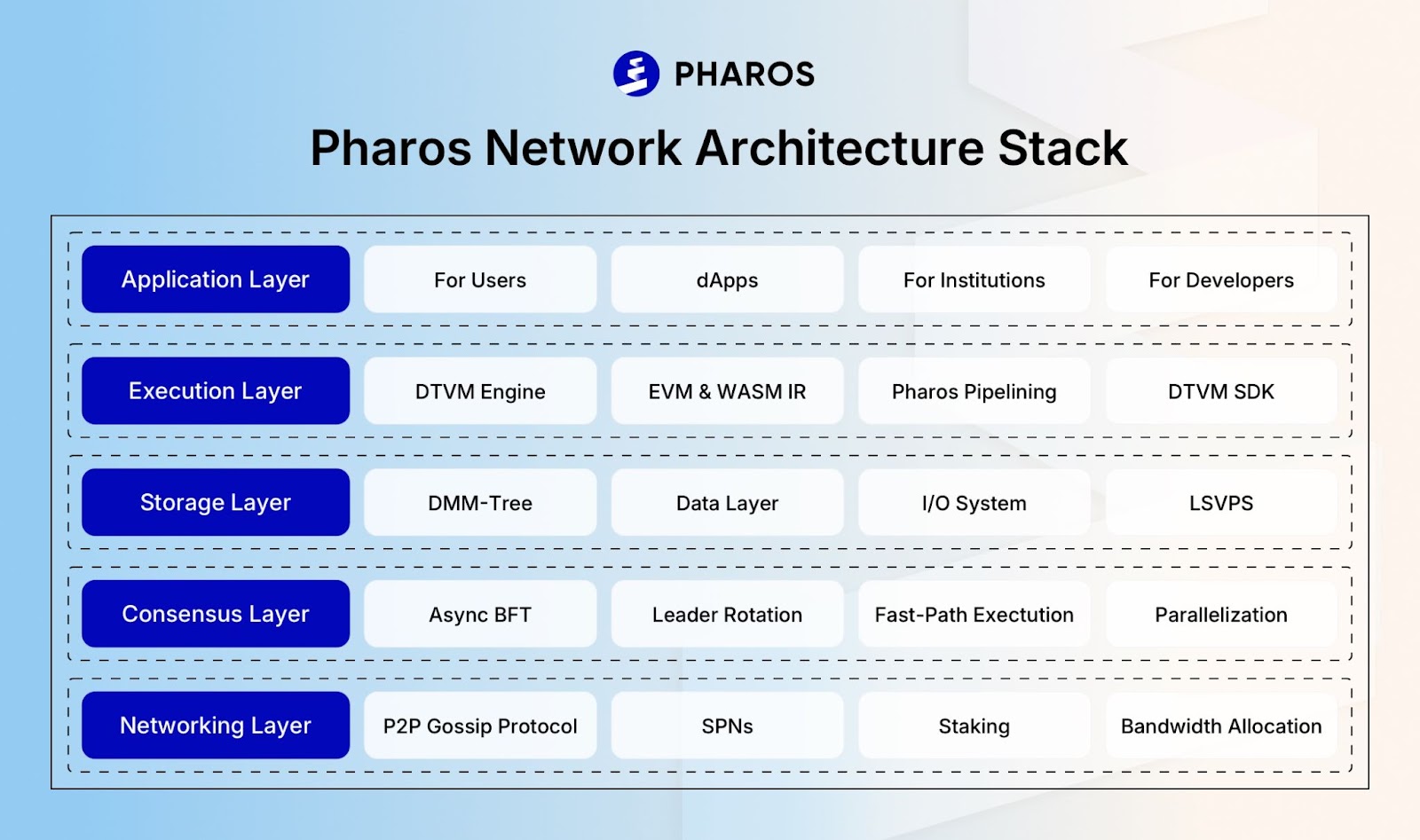
Pharos Network Architecture Overview
Pharos Network adopts a modular and customizable layered architecture, decoupling the execution, consensus, settlement, and data availability layers to achieve both high performance and flexible upgradability. Below, we break down the core technical designs layer by layer.
-
Network Layer
-
Optimized P2P Gossip protocol enabling low-latency message transmission
-
Built-in cross-SPN (Special Processing Network) communication channels
-
-
Consensus Layer
-
Adaptive asynchronous BFT consensus protocol combining high fault tolerance with low latency
-
Transaction ordering optimization algorithm reducing validator node load and improving efficiency
-
-
Execution Layer
-
Dual virtual machine support: EVM compatibility layer + WASM high-performance execution environment
-
Equipped with LLVM-based execution engine, parallel transaction processing, optimistic execution, and SALI (Smart Access List Inference)
-
-
Settlement Layer
-
Cross-chain re-staking mechanism for validators, enabling shared security within the ecosystem
-
Sub-second transaction finality across multiple execution environments
-
-
Data Availability & Storage Layer
-
Pharos Store: Efficient blockchain storage model supporting multi-version control
-
ADS pushdown compression and Delta encoding techniques for dynamic I/O optimization, reducing disk read/write overhead
-
-
SPN (Special Processing Network) Framework
-
SPN allows developers to customize blockchain execution layers and freely configure consensus models
-
Semi-independent operation mode: maintains independent scalability while benefiting from mainnet security and data availability
-
Next, we will delve into the key technological implementations and innovative designs at each layer.
Network Layer
The network layer forms the foundation of all system communications, using an optimized P2P Gossip protocol to efficiently propagate blocks, transactions, and consensus messages. The protocol features adaptive bandwidth allocation, dynamically adjusting resources based on real-time network load to ensure high-speed transaction and data transmission even under heavy stress. Additionally, this layer supports cross-SPN communication channels, providing low-latency interoperability between different execution environments.
Pharos Consensus Mechanism
Pharos Network employs an innovative consensus design that combines BFT fault tolerance with asynchronous execution and a fast-path commit protocol, enhancing system throughput, transaction fairness, and final confirmation speed. Unlike traditional BFT implementations, Pharos does not require a fixed leader role or round-based communication; instead, it enables multiple validators to concurrently initiate, validate, and commit transactions—effectively eliminating performance bottlenecks caused by single-leader architectures.
This consensus mechanism also features dynamic transaction ordering, ensuring fairness, minimizing bias during block creation, and maintaining global transaction order consistency even under significant network fluctuations. Notably, the fast-path execution mechanism allows transactions meeting specific conditions to bypass the full consensus process and proceed directly to confirmation, thereby reducing average confirmation time and increasing overall system throughput. This carefully engineered consensus mechanism enables Pharos Network to support stable, high-throughput, and low-latency operations globally.
Main Features:
-
Asynchronous execution architecture
-
Dynamic transaction ordering
-
Fast-path execution
-
Optimized leader rotation and voting mechanisms
Pharos Execution Layer
The core of the Pharos execution layer is its innovative execution engine, which offers exceptional flexibility to developers through a dual virtual machine environment (EVM + WASM). The engine integrates LLVM-based intermediate representation (IR) transformation and speculative parallel processing, incorporating multiple performance optimizations such as opcode fusion, register promotion, and speculative execution. These techniques enable parallel smart contract execution while preserving deterministic outcomes.
To further enhance execution efficiency, Pharos introduces Smart Access List Inference (SALI) technology. SALI predicts state entries a contract will access via static or dynamic analysis, allowing the execution engine to group and execute transactions with non-overlapping state access patterns in parallel—avoiding state conflicts. Additionally, this technology preloads contract state objects to accelerate execution speed.
Pharos also provides Ph-WASM, a blockchain-optimized WASM runtime environment. Ph-WASM supports deterministic, high-speed execution and natively supports programming languages like Rust and Go, enabling developers to build high-performance, portable dApps and AI models directly on-chain.
Main Features:
-
Support for optimistic execution and transaction batching
-
Smart Access List Inference (SALI) technology
-
Ph-WASM environment supporting multi-language smart contracts
Pharos Store Storage System
Pharos Store is a scalable, high-performance blockchain storage system specifically designed to address state bloat and inefficient I/O. This innovative data storage engine is built for verified, versioned state storage, leveraging two core technologies: Delta-encoded Multi-Version Merkle Tree (DMM-Tree) and Log-Structured Versioned Page Storage (LSVPS), effectively overcoming efficiency limitations of traditional Merkle Patricia Trie-based systems.
Compared to Ethereum’s trie storage model, Pharos Store achieves faster state retrieval, supports parallel Merklization, and reduces overall storage overhead by 80%. By storing only incremental changes to modified states and using version-based indexing, the system significantly mitigates write amplification, boosting I/O throughput by up to 15.8x.
Pharos Store uses an append-only storage model, ensuring data safety during concurrent writes and enabling rapid recovery after node crashes. Moreover, the system can generate efficient verification proofs for light clients and supports intelligent tiered storage management for hot and cold data.
Main Features:
-
Delta-encoded Multi-Version Merkle Tree (DMM-Tree) technology
-
Log-Structured Versioned Page Storage (LSVPS) scheme
-
Lightweight SPN asset transfer protocol
Pharos Pipeline
The Pharos pipeline utilizes a multi-stage parallel execution architecture, effectively addressing performance bottlenecks in traditional blockchain systems caused by synchronous state execution and sequential block validation. By parallelizing critical processes such as execution, Merklization, and state confirmation, it maximizes utilization of CPU, disk I/O, and network resources.
Main Processing Stages:
-
Parallel Block Processing:
-
Concurrent execution, Merklization, and state updates
-
-
Dynamic Resource Scheduling:
-
Real-time allocation of CPU, I/O, and network resources based on demand
-
-
Flexible Finality Mechanism:
-
Ordering, transaction, and block finalization implemented across different layers
-
Each stage of the Pharos pipeline supports dynamic resource allocation based on real-time throughput requirements. The system innovatively implements a flexible finality layer, allowing dApps and clients to receive early confirmation of transaction ordering and execution results before full block finalization—crucial for latency-sensitive applications such as high-frequency trading and DeFi.
Through its intelligent adaptive scheduling algorithms and efficient resource coordination, the Pharos pipeline achieves over 200,000 TPS throughput on a 64-core execution framework, while reducing latency by 30%–50% compared to standard blockchain pipeline models.
Pharos SPN Architecture
Pharos SPN (Special Processing Network) refers to execution environments tailored for specific applications—deeply integrated into the Pharos mainnet architecture while maintaining independent business logic and configuration systems. Each SPN has its own fully independent execution engine, validator cluster, re-staking incentive mechanism, and governance rule framework.
SPN Architecture
-
SPN Manager:
-
Handles lifecycle management, node registry, and enforcement of governance rules
-
-
SPN Adapter:
-
Facilitates cross-SPN communication and message verification
-
-
Re-staking and Shared Validator Security:
-
Enables validators to re-stake assets into multiple SPNs
-
SPNs are ideal for compute-intensive tasks such as zero-knowledge machine learning proofs (zkML), secure multi-party computation (SMPC), AI model training, and DeFi derivatives. They support forced inclusion and emergency mechanisms, ensuring censorship resistance while safeguarding user asset sovereignty.
In terms of interoperability, SPNs interact via cross-SPN interoperability protocols, enabling atomic execution and data sharing across SPNs and the main chain. Validators can re-stake $stPHRS into any SPN and receive corresponding $rstPHRS tokens, which can be used for governance, delegation, and liquidity mining.
Cross-SPN Interoperability
-
Cross-SPN Message Passing Protocol:
-
Enables seamless coordinated execution across multiple blockchain layers
-
-
Censorship Resistance and Emergency Mechanisms:
-
Protects users from forced transaction censorship
-
Interoperability and Cross-Chain Communication
From inception, Pharos Network was designed with native support for cross-chain applications, offering two primary communication protocols—inter-SPN (within-network) and cross-chain (external blockchain connectivity). The cross-SPN messaging framework ensures trustless message relaying between SPNs, using cryptographic proofs and consensus signatures for authenticity verification.
Main Features:
-
Cross-chain message passing
-
Cross-SPN data synchronization
-
Multi-VM smart contract interaction
These capabilities provide essential support for use cases such as cross-chain DeFi, real-world asset (RWA) settlements, oracle networks, and collaborative AI models across execution environments.
Overall, Pharos Network redefines the standard for Layer-1 blockchain infrastructure by integrating modularity, high-performance processing, parallel computing, and composability at every architectural layer. The unique combination of adaptive consensus, parallel execution engines, multi-VM architecture, high-speed storage, and modular SPN frameworks empowers developers to build highly scalable, censorship-resistant, and secure applications.
Pharos Network is dedicated to seamlessly connecting traditional finance (TradFi) with decentralized finance (DeFi), delivering institutional-grade blockchain infrastructure for AI-driven dApps, private financial transactions, and scalable DeFi ecosystems.
Join TechFlow official community to stay tuned
Telegram:https://t.me/TechFlowDaily
X (Twitter):https://x.com/TechFlowPost
X (Twitter) EN:https://x.com/BlockFlow_News
 @pharos_network






