








Interview with Blockworks Research Head: Pump.fun Raises $1 billion through token launch—business expansion or exit scam?
TechFlow Selected TechFlow Selected
Interview with Blockworks Research Head: Pump.fun Raises $1 billion through token launch—business expansion or exit scam?
Pump clearly wants market growth, not just yield optimization.
 Navigating Web3 tides with focused insights
Compiled & Translated: TechFlow
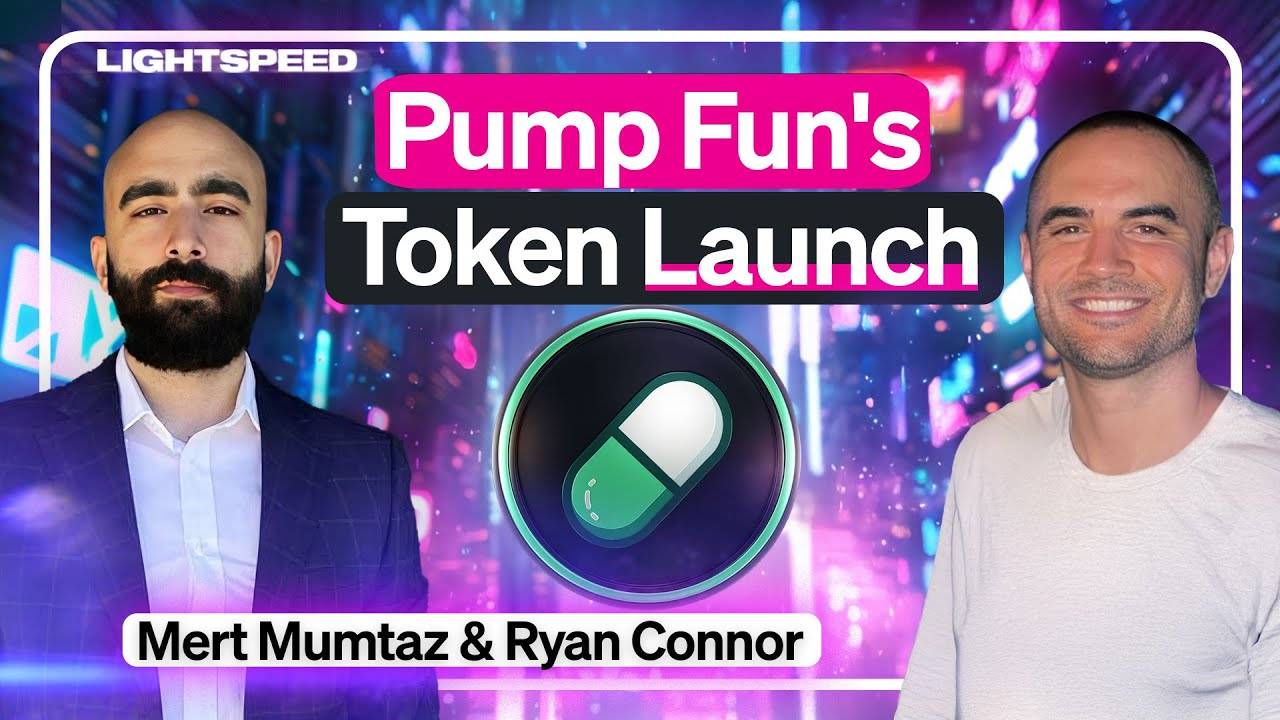
Guest: Ryan Connor, Head of Research at Blockworks
Hosts: Mert Mumtaz; Jack Kubinec
Podcast Source: Lightspeed
Original Title: How Will Pump Fun's Token Impact Solana? | Weekly Roundup
Release Date: June 6, 2025
Key Takeaways
This week we bring you a fresh episode of our weekly roundup, featuring special guest Ryan Connor. We dive deep into Pump.fun’s token launch plans, why Pump is aiming to raise $1 billion, the Alpenglow project, and how to scale the Solana network, among other hot topics.
Highlights Summary
-
A project token must have some value accrual mechanism—tokens without it tend to go to zero. If this token is just a meme, I struggle to imagine $1 billion in market demand.
-
Some speculate they’ll take the money and “rug” into luxury lifestyles, but in reality, they could already do that without fundraising—so this concern doesn’t hold up.
-
Pump.fun doesn’t fully control user discovery or front-end distribution channels yet, making their service somewhat commoditized and vulnerable to disintermediation.
-
I suspect they may use raised capital to develop new products—perhaps a tool competing with Axiom, improvements to Pump Swap, or a dedicated wallet to own front-end distribution.
-
Pump.fun delivers services users genuinely want. Whether those services are morally sound isn’t the point—the fact is, users are willing to pay for them.
-
While Pump offers competitive asset launch services, it remains fundamentally a "commoditized" offering. In crypto, first-mover advantage isn’t enough—owning the front end is key to long-term success.
-
Fundraising reduces risk for your next move. There are two main ways: scaling existing operations or exploring new ventures. Capital enables any business goal, especially during bear markets when cash reserves become critical.
-
Cash reserves can be a “curse,” but they also enable building powerful network effects.
-
In crypto, exchanges are among the most profitable and influential businesses.
-
The crypto community sometimes over-focuses on L1s and L2s while overlooking what truly matters—the business itself.
-
Pump clearly wants market growth, not just yield optimization.
-
Performance optimization matters, but shouldn’t be over-prioritized. Today’s crypto market is mature—performance and track record are now baseline expectations.
Pump Fun's Token Launch
Jack Kubinec:
The main topic today is ICOs (Initial Coin Offerings). Recently, one of the biggest token-related developments on Solana—arguably the most significant since Trump coin—was an exclusive report this week: Pump.fun plans to raise $1 billion by selling its token, valuing the company at $4 billion.
This news sparked widespread discussion across crypto Twitter. I expect heated debates. But I find it fascinating, especially the ICO aspect. The amount they’re aiming to raise is staggering.
What was your initial reaction—and how do you feel about it now?
Mert Mumtaz:
My first instinct was to seek more details. We know they'll launch a token, likely split between private and public sales. Beyond that, much of the commentary seems driven less by facts and more by people projecting their current market sentiment—currently quite bearish. Almost every comment says things like “Solana is dead,” “Are they building their own chain?” or “Is this a scam?” Some even speculate about the founders’ backgrounds.
There’s actually a lot worth discussing. For example, a token airdrop is nearly certain. Anyone following recent trends would see clear signs pointing toward a major airdrop.
Another key question: Why do they need to raise funds at all? Many are puzzled. After all, they’ve generated roughly $700 million to $800 million in revenue since inception. So why fundraise? This reflects a broader misunderstanding of startups, business strategy, and founder incentives.
From a business standpoint, why not raise capital while market conditions are favorable, to expand further? Pump.fun’s core business relies on the meme market. They weren’t the first, but they’ve scaled it to unprecedented levels. They’re also pushing into new areas—like streaming—with plans to compete against platforms like Twitch, which requires massive spending on influencer partnerships.
Put differently, if I were them, I’d view my business as dependent on the meme economy. Raising capital now secures long-term runway, enabling bolder bets to grow or improve the market. Some fear they’ll take the money and “rug” into luxury lives—but they could already do that without fundraising, so this argument doesn’t stand.
As for leaving Solana? That seems illogical. Their success is deeply tied to Solana’s ecosystem. Staying put is clearly the rational choice. While full details remain unclear, I believe much of the negative reaction is unfounded. Let’s revisit these points later.
What Is Pump Fun’s Core Strategy?
Jack Kubinec:
As Mert noted, there’s confusion around Pump.fun’s strategy due to its complexity. Personally, I believe Pump.fun will execute a large-scale airdrop. They’ve made substantial profits and need goodwill via airdrops.
Based on available information, Pump.fun appears to plan combining an airdrop with an ICO, reserving portions for founders and early investors. The ICO may include select institutional participation, while most tokens are offered publicly. This hybrid model might be central to their strategy. Ryan, what’s your take?
Ryan Connor:
This plan is indeed intriguing—it’s been brewing for a while. The market has long expected Pump.fun to launch a token, only debating the timing. Despite strong profitability and minimal operating costs, the team clearly has bigger ambitions—grand visions and plans to expand influence through live streaming.
Business-wise, their strategy may involve leveraging existing market network effects to gradually build social network effects and attract more users. This dual effect would make their product stickier. However, their model isn’t flawless. The biggest challenge? They don’t fully control user discovery or front-end distribution, making their service somewhat commoditized and vulnerable to disintermediation.
Hence, I suspect they’ll use raised capital to build new products—perhaps a tool rivaling Axiom, enhancements to Pump Swap, or a proprietary wallet to capture front-end distribution. Controlling distribution unlocks massive potential. Without solving this, their long-term vision could stall. As for launching their own blockchain, no clear signals yet—but it’s worth watching.
Why Is Pump Planning to Raise $1 Billion?
Jack Kubinec:
Setting aside the hype, when talking to investors, Pump.fun’s token fundraising plan is controversial. Some question whether there’s real $1 billion demand. Do you think they can pull it off?
Ryan Connor:
This is a great question. I find this ICO highly anticipated. Our research team at Blockworks has tracked investor sentiment—we see many crypto investors skeptical about Pump.fun’s fundamentals. Yet, considering they’ve already raised over $100 million in venture capital, that skepticism may be misplaced.
Raising $700 million to $800 million won’t be easy for such a polarizing project. But ultimately, rational judgment should prevail. The Pump.fun team is exceptional, and their profitability is proven. When Libra launched, many doubted its potential—yet it became one of the most profitable on-chain projects. I see similar upside for Pump.fun. My prediction? They’re likely to raise $700 million to $800 million.
Jack Kubinec:
This is just speculation—I have no inside info. But to me, Pump’s plan to sell $1 billion in tokens feels like a direct challenge to critics who claim Pump is purely speculative with no long-term value. It’s almost saying: “You don’t believe in our product or utility. Watch us raise $1 billion via ICO—a feat unseen in crypto for eight years.” So this feels intentional—a power move.
I suspect Pump will design the token to be attractive—perhaps adding buyback mechanisms, value accrual features, or positioning it as the native token for their planned Twitch-like streaming platform. I don’t believe Pump.fun would casually launch a token and shrug off price collapse. They’re now a major company with reputational stakes. So I expect serious value management and strategies to stimulate demand.
That said, if the token is purely a meme, I can’t envision $1 billion in demand. But maybe that’s not bad. Recall how 2024’s airdrop culture alienated many participants—people expected free money, got disappointed, and some projects secretly paid manipulators to prop up prices. From that angle, an ICO might be healthier. Just speculation, though.
Ryan Connor:
Hearing Pump aims to raise $1 billion at a $4 billion valuation is eye-catching. In theory, you could allocate most of it given the strong business model—but actual allocations may differ. What matters is what investors see in the terms: potential token burns or value accrual mechanisms. Ultimately, you need to examine how value accumulates in the token. Given the current valuation, it’s unlikely all value flows to the token. If a project launches a token, it needs a value accrual mechanism—otherwise, it usually goes to zero. I expect Pump’s token will have such a mechanism, appealing to fundamental-focused investors. The real questions are: how much value accrues, and what’s the justified post-launch valuation?
Mert Mumtaz:
So the real question is: why raise so much? One way to frame it: they need capital to grow the business. Look beyond crypto—at the broader VC landscape—and you’ll see many massive fundraises. Some argue those companies had deeper tech, but ultimately, if you’re building something big, capital is essential.
Take Pump: if they’re serious about challenging Twitch, it’s an enormous undertaking. But based on past performance, they’ve proven execution capability. Calling them greedy extractors isn’t fair—no one forces users onto Pump. Other platforms exist, yet users choose Pump. That speaks volumes.
Why do users pay more to use Pump? Competition exists, yet Pump dominates. Clearly, they offer something users want. Whether it’s ethically sound is irrelevant—the fact is, users willingly pay. No law says you must use Pump.fun, yet people do.
Their execution is undeniable. People say, “Oh, they’re just extracting.” But building a platform that generates $700 million in Year One is incredibly hard. So why raise more? More capital allows higher-risk investments. They could pursue M&A—acquire a small social network, invest in infrastructure, or back DeFi teams. These moves let them enter new domains or regulated spaces—expensive endeavors, but feasible with funding.
Pump may aim to boost token value, making it a compelling investment. But that’s not easy. They need financial buffers to reduce future risks. When you fundraise, you’re de-risking your next step—either by scaling current ops or entering new ones. Simply put: why raise funds? Because capital underpins any business ambition. With ample cash, they can survive bear markets.
I think many in crypto have forgotten what real bear markets feel like—they arrive suddenly, last long, and hit hard. Pump’s war chest ensures stability during downturns and fuels strategic actions like acquisitions. I doubt they’ll merge, but they can afford to challenge big incumbents.
Critically, Pump’s market, revenue, and future depend on the meme economy—so they’re highly incentivized to grow and improve it. Some claim fundraising kills the meme market, but that logic contradicts their stated intent: to enhance it.
Execution is key. If they wanted to cash out, they already could’ve done so without raising another $1 billion. Beyond that, I suspect they may start investing in MEV infrastructure and core DeFi primitives. These sectors have high supply-chain value, requiring deep pockets. So this capital could serve multiple purposes—not just short-term needs. Those claiming Pump will ruin everything are shortsighted; their goal is clearly market development, not destruction.
Jack Kubinec:
I don’t think Pump.fun will blow $1 billion on lavish lifestyles. But here’s a question: They already have ~$700 million—why haven’t they been more active in M&A? Why haven’t we seen more app development?
Ryan Connor:
Running a business costs money. Assuming ~50% margins, their liquid balance isn’t $700 million—it’s closer to $400 million. Excess capital can create problems. We’ve seen in many crypto foundations that large treasuries can breed complacency—a “curse.” Some orgs handle it well—Solana and Helium, for example—but for many teams, it becomes a burden. We must watch whether Pump.fun can manage its treasury effectively.
On M&A, there’s logic—but discipline is key. Historically, many crypto acquisitions lacked strategic coherence. Watching whether Pump’s buys align with core goals will be crucial. If going global, their current base is likely U.S.-centric. But consider Uber: until 2020, they burned $1–4 billion annually fighting local taxi regulations. Not identical, but navigating global securities laws is similarly expensive—requiring upfront capital.
I find grassroots efforts more interesting—targeted ads for crypto users or partnering with Twitch creators. Building networks is hard—many underestimate the grind. People think Instagram booted network effects overnight, but it required massive ground-level work: Uber and Airbnb signed suppliers door-to-door; Tinder promoted on college campuses. These tasks are demanding—and require funding.
So while cash reserves can be a “curse,” they also enable powerful network-effect businesses. Now we wait to see if Pump can turn capital into outsized outcomes.
Will Pump Launch Its Own Blockchain or Exchange?
Jack Kubinec:
Do you think Pump needs to own the front end to succeed long-term?
Ryan Connor:
I believe so. Without front-end control, Pump remains stuck in the middle layer. In crypto, L1s capture value by controlling blockspace. In traditional internet markets, front-end aggregators dominate by directly serving or bundling users.
We see proof in Uniswap’s front-end revenue, wallet profitability, and CEX performance—all highlighting front-end importance. While Pump excels at asset launches, its service is still fundamentally “commoditized.” Even as pioneers, first-mover advantage isn’t enough in crypto—disintermediation risk is real. Thus, controlling the front end is critical for Pump’s longevity—likely a top priority ahead.
Mert Mumtaz:
I agree—especially if they raise $1 billion. But I doubt they’ll launch their own blockchain. Instead, I see them launching an exchange. In crypto, exchanges are among the most profitable and influential businesses—Binance, Coinbase, Hyperliquid being prime examples.
Currently, centralized exchange competition isn’t as fierce as assumed. Coinbase focuses on the U.S., Binance leads internationally, and Hyperliquid sits between—more crypto-native. So I believe Pump is more likely to enter the exchange space, possibly via acquisition.
Will Pump launch its own chain or exchange within 12 months? Practically, an exchange is far more feasible. It’s user-proximate and easier to regulate. Launching a chain distances them from users. In crypto, vertical integration means convincing every exchange, bridge provider, and wallet to support your chain—an extremely complex task.
Ryan Connor:
Absolutely. Launching a chain complicates user flow. Users currently need 1–5 clicks; moving chains could push that to 5–10, increasing drop-off risk. History shows more failed than successful chain launches. I’m sure Pump’s team knows this well.
Right now, launching their own chain feels premature. They might consider it later, but within the next 12 months, it’s unlikely.
Will Pump Fun Continue Operating on Solana?
Jack Kubinec:
We’ve agreed Pump likely won’t build an L1 anytime soon. But what stops them from building a custom L1 or more compelling L2? For instance, Pump generates huge revenue for Solana validators and stakers. To capture more fees, they could move execution to their own sequencer while settling data on L1—still benefiting from Solana’s network effects.
Mert Mumtaz:
Think of startups in two phases. First, “growth mode”—like Ryan mentioned Uber, where Travis spent billions capturing market share. Second, efficiency-focused mode—like Amazon or Walmart, obsessed with margins,cutting costs, even skimping on office equipment.
So what motivates Pump to launch a chain? Everyone says it’s for better yields—i.e., improved margins. Margin is net income over net cost. Suppose Pump earns $800 million on Solana—not because of Solana per se, but on it. It’s fair to assume Solana hasn’t capped their growth; rather, it helped them become one of history’s fastest-revenue-growing companies. So if they raise $1 billion just to bump margins from 80% to 85%, that feels uninspiring. As an investor, I’d ask: “What are you doing? I want 10x growth, not a few percentage points.”
Launching a chain isn’t free. You lose liquidity, integrations, and must build full-time teams to manage Phantom and exchange relationships. Improving margins takes immense effort—effort that looks like early-stage optimization. If Pump wants real growth, bolder moves—like challenging Twitch—make far more sense than building the 100th L2.
I’ve said before: use capital to de-risk bold experiments—like media and entertainment—rather than average L1s. Anyone can spin up an L2 today; even launching a basic L1 isn’t hard. So what’s Pump’s real incentive?
I believe the crypto community sometimes obsesses over L1s and L2s while missing the real prize—building a business. No company or app has achieved 100x or 1000x growth simply by launching a blockchain. The closest analogy is the so-called “L1 premium”—where tokens on L1s get higher valuations—but that doesn’t drive real market expansion. Pump clearly wants market growth, not just yield optimization.
Overall, launching a chain doesn’t align with Pump’s current trajectory. Their fundraising goal is transformative growth—not incremental tweaks. If they ever leave Solana or build a chain, Solana participants should ask: “What makes Solana insufficient for them?” But currently, projects like Axiom, Phantom, Magic, and Jito thrive on Solana, earning hundreds of millions. So despite flaws, Solana isn’t nearly as broken as critics claim.
If not for yield, then for UX? Solana’s congestion issues causing unstable transactions are valid. But these are being addressed—so launching a new chain isn’t urgent.
Jack Kubinec:
Did you mention “application-specific sequencing” earlier? Whenever I ask others about Pump launching a chain, they cite upcoming app-specific sequencing reducing its appeal.
Mert Mumtaz:
Yes, app-specific sequencing is emerging. And there are other paths. Crypto sometimes hyper-focuses on minutiae—e.g., “If Pump controlled transaction ordering at the L1 level, it’d revolutionize their business.” But this is just one optimization—and achievable otherwise. Polymarket, for instance, barely relies on-chain in some aspects.
Pump has many shorter-term, direct optimizations available. If your entire business is on-chain—like Hyperliquid—app-specific sequencing or advanced tech matters more. But Pump’s business isn’t fully on-chain.
More importantly: does this optimization actually grow their business? Compared to redefining global media, social, and entertainment—or creating a new market category—launching an L1 pales in revenue impact. That’s why they need capital. Achieving that could grow their business from $1B to $10B+—something no chain launch or sequencing tweak can deliver.
Understanding Alpenglow and Accelerate
Jack Kubinec:
Ryan, what are your thoughts on Alpenglow and Accelerate?
Ryan Connor:
I see this as a testament to Solana’s ability to break norms and challenge assumptions—one of its defining strengths.
On Alpenglow, historically, validator performance lagged. Recently, they’ve invested heavily—key hires, for example—but the ecosystem spends too much energy attracting talent. Why top performers leave is puzzling. I lack insider knowledge, though.
Jack Kubinec:
Ryan, one more question. Alpenglow reminds me of Ethereum’s Merge—different, but both pivotal. Alpenglow may be Solana’s most important upgrade; the Merge was Ethereum’s landmark moment. Back in 2022, I covered it at Blockworks—everyone focused on the Merge. Daily, I interviewed investors. ETH surged pre-merge, then dumped after as investors exited. Performance suffered.
Now, with Alpenglow boosting Solana’s efficiency, how should investors respond?
Ryan Connor:
Performance optimization matters, but don’t over-optimize. Today’s crypto market is mature—optimization and track record are table stakes. Hedge fund managers may not dive into technical specs; they care about market direction, distribution, and customer acquisition.
This is where we are. Tech details matter, but Solana’s lead is massive—even beyond competitors’ roadmaps.
To me, Solana’s standout trait is founders praising the Solana Foundation’s operational efficiency. Hearing founders appreciate working with a high-functioning org means more than tech upgrades alone. I know Solana’s technical goals and trust they’ll deliver—they’ve consistently kept promises. That confidence is invaluable.
Solana’s Scaling Strategy
Jack Kubinec:
What is Solana’s long-term scaling strategy? The team seems focused on optimizing the current stack, not architectural expansion. Beyond codebase tuning, does Solana have other scaling paths—or is boostingthroughputvia software the sole focus? Mert, your thoughts?
Mert Mumtaz:
The standard approach to performance engineering and system scaling is: build a system, stress-test it, identify bottlenecks, optimize them, then retest. Distributed systems are complex—component interactions grow exponentially. For example, eight components with mutual communication create immense hidden complexity, impossible to predict theoretically. The only viable method is designing a simple, scalable architecture and iteratively tuning it in production.
This approach drives real progress. The team found strange bugs—duplicate data structures, basic errors. Fixing these builds deep insights into further scaling.
It’s like F1 car design. You might have a powerful engine and grippy tires, but if the car’s too light, it underperforms in corners. The challenge? Solve one issue without harming others. In distributed systems, as long as physics is obeyed, other problems can be optimized. That’s what initially drew me to Solana—maximizing physical resources via bandwidth and latency reduction.
Currently, bandwidth is the main bottleneck—especially with async execution coming, opening new scaling vectors. Multiple concurrent proposals enhance fault tolerance; async execution targets scalability. Solving bandwidth requires combining techniques: zero-knowledge proofs, new consensus designs for efficient bandwidth use, and async execution to optimize utilization.
Traditional “paper-driven” approaches—solving via theoretical assumptions—fail in distributed systems. Nonlinear complexity reveals unexpected issues in practice, unanticipatable in design. Hence, Solana’s strategy is iterative: fix bottlenecks, gain insights, evolve core architecture. Alpenglow’s optimizations combined with async execution exemplify this—synergistic upgrades driving scalability forward.
Join TechFlow official community to stay tuned
Telegram:https://t.me/TechFlowDaily
X (Twitter):https://x.com/TechFlowPost
X (Twitter) EN:https://x.com/BlockFlow_News
 深潮TechFlow


