Bitwise: What Happens If You Allocate 10% to Bitcoin?
TechFlow Selected TechFlow Selected
Bitwise: What Happens If You Allocate 10% to Bitcoin?
Because Bitcoin has low correlation with both stocks and bonds, historically adding it to a portfolio can enhance returns without significantly increasing risk.
 Navigating Web3 tides with focused insights
Author: Matt Hougan, Chief Investment Officer at Bitwise
Translation: AIMan@Jinse Finance
Bitcoin is a highly volatile asset. By the most common measure of volatility, it's about three to four times more volatile than the S&P 500 Index.
However, that doesn't mean adding Bitcoin to a portfolio will significantly increase the portfolio’s overall volatility.
As Bitcoin advocates like me often point out: because Bitcoin has low correlation with both stocks and bonds, historically, adding it to a portfolio has increased returns without significantly increasing risk.
The typical way researchers demonstrate this is by starting with a traditional 60/40 portfolio (60% stocks, 40% bonds) and gradually shifting a small portion into Bitcoin.
The table below compares risk and return metrics for portfolios with 0%, 1%, 2.5%, and 5% allocations to Bitcoin over the period from January 1, 2017, to December 31, 2024. The calculations were performed using Bitwise’s free portfolio simulation tool available on its Advisor Portal.
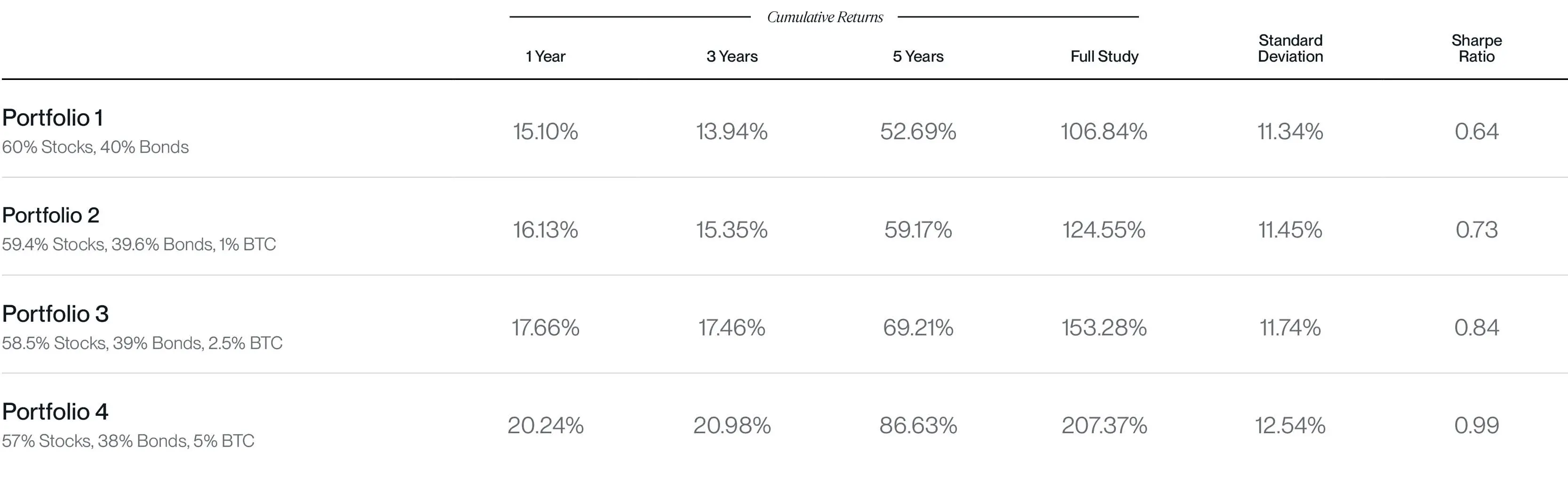
Portfolio performance metrics by Bitcoin allocation. Source: Bitwise Asset Management, data from Bloomberg. Data covers January 1, 2017, to December 31, 2024. "Stocks" represented by SPDR S&P 500 ETF Trust (SPY). "Bonds" represented by iShares Core US Aggregate Bond ETF (AGG). Bitcoin represented by spot Bitcoin price. Taxes or transaction costs not considered. Past performance is not indicative or guarantee of future results. No content herein is intended to predict the performance of any investment. Historical performance of sample portfolios is generated and maximized based on hindsight. Returns do not represent actual account performance and do not include fees and expenses associated with buying, selling, or holding funds or crypto assets. Performance information is for reference only.
For example, notice that allocating 5% to Bitcoin increases your total return from 107% to 207%—a 100 percentage point gain! Meanwhile, your portfolio’s standard deviation (a measure of volatility) increases only slightly, from 11.3% to 12.5%.
I find studies like this quite compelling. They align with how most investors think about allocating to Bitcoin. But recently I’ve been wondering—could there be a better way?
Can you get higher returns and lower risk?
There’s a secret among people in the cryptocurrency industry: their personal portfolios often look different from the one I described above. In my experience, crypto enthusiasts tend to have levered portfolios—large allocations to crypto, large allocations to cash (or money market funds), and little in between. (My own portfolio is roughly one-third each in crypto, stocks, and cash—I’m not crazy enough to recommend others do the same. But hey, let’s just put it out there.)
This reflection led me to ask: when adding Bitcoin to a portfolio, does it make sense to offset the risk elsewhere in the portfolio?
In the earlier example, we created room for a 5% Bitcoin allocation by proportionally reducing the 60/40 stock/bond portfolio—taking 3% from stocks and 2% from bonds.
But what if we could:
-
Invest 5% in Bitcoin while increasing bond exposure by 5%, theoretically reducing equity risk;
-
Shift bond exposure from broad-market bonds to short-term Treasuries, theoretically reducing bond risk?
Portfolio 3 shows the result:
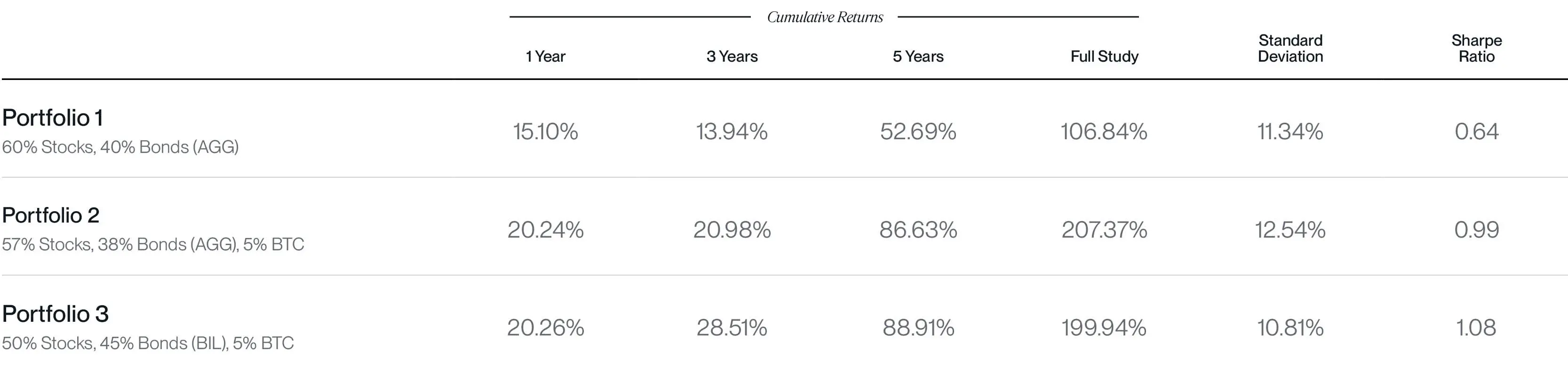
Source: Bitwise Asset Management, data from Bloomberg. Data covers January 1, 2017, to December 31, 2024. "Stocks" represented by SPDR S&P 500 ETF Trust (SPY). "Bonds" represented by iShares Core US Aggregate Bond ETF (AGG). Bitcoin represented by spot Bitcoin price. Taxes or transaction costs not considered. Past performance is not indicative or guarantee of future results. No content herein is intended to predict the performance of any investment. Historical performance of sample portfolios is generated and maximized based on hindsight. Returns do not represent actual account performance and do not include fees and expenses associated with buying, selling, or holding funds or crypto assets. Performance information is for reference only.
Interesting, right? Portfolio 3 delivers higher returns than Portfolio 1, similar returns to Portfolio 2, but with lower risk than both.
This makes you wonder: what if we pushed further?
The next table introduces a fourth portfolio, reducing equity exposure to 40%, increasing bonds to 50%, and allocating 10% to Bitcoin.
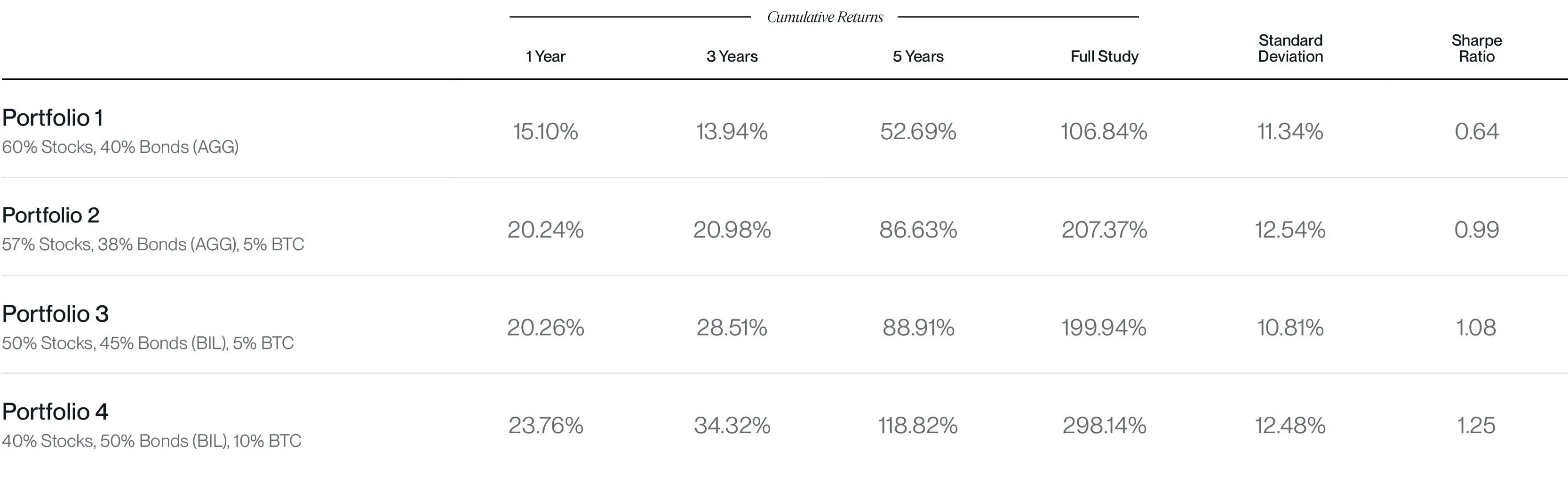
Source: Bitwise Asset Management, data from Bloomberg. Data covers January 1, 2017, to December 31, 2024. "Stocks" represented by SPDR S&P 500 ETF Trust (SPY). "Broad Bonds" represented by iShares Core US Aggregate Bond ETF (AGG). "Short-Term Treasuries" represented by SPDR Bloomberg 1-3 Month T-Bill ETF (BIL). Bitcoin represented by spot Bitcoin price.
Compared to Portfolio 2, you achieve higher returns with lower risk.
Of course, there’s no guarantee this will continue in the future—Bitcoin’s early returns were exceptional, and future returns may not match those seen during this study period.
But the data highlights an important point: when considering adding Bitcoin to your portfolio, don’t do it in isolation. Consider it within the context of your overall risk budget. You might be surprised by the results.
Join TechFlow official community to stay tuned
Telegram:https://t.me/TechFlowDaily
X (Twitter):https://x.com/TechFlowPost
X (Twitter) EN:https://x.com/BlockFlow_News
 @BitwiseInvest