Robinhood Acquires Bitstamp for $200 Million: Recapping This Year's Top 5 Major Crypto Acquisitions
TechFlow Selected TechFlow Selected
Robinhood Acquires Bitstamp for $200 Million: Recapping This Year's Top 5 Major Crypto Acquisitions
The 2025 crypto M&A boom is a two-way rush of exits and entries.
 Navigating Web3 tides with focused insights
Text: TechFlow

The ups and downs of secondary markets are no longer the whole story of the crypto industry.
Mergers and acquisitions (M&A) are becoming the new norm in the crypto space this year.
On June 3, Robinhood—known for its low-barrier stock and cryptocurrency trading—acquired Luxembourg-based crypto exchange Bitstamp for $200 million in cash.
In the crypto market, buying an established business is far more cost-effective than building one from scratch. Rather than enduring years of struggle, companies are opting for M&A to gain efficiency.
This strategy appears to be spreading across the crypto industry. From exchanges to payment infrastructure, and into derivatives markets, major capital-driven acquisition moves have been frequent this year. While each participant has unique interests, their motivations are largely similar:
New entrants seek strength through consolidation; those exiting aim to sell high and move on.
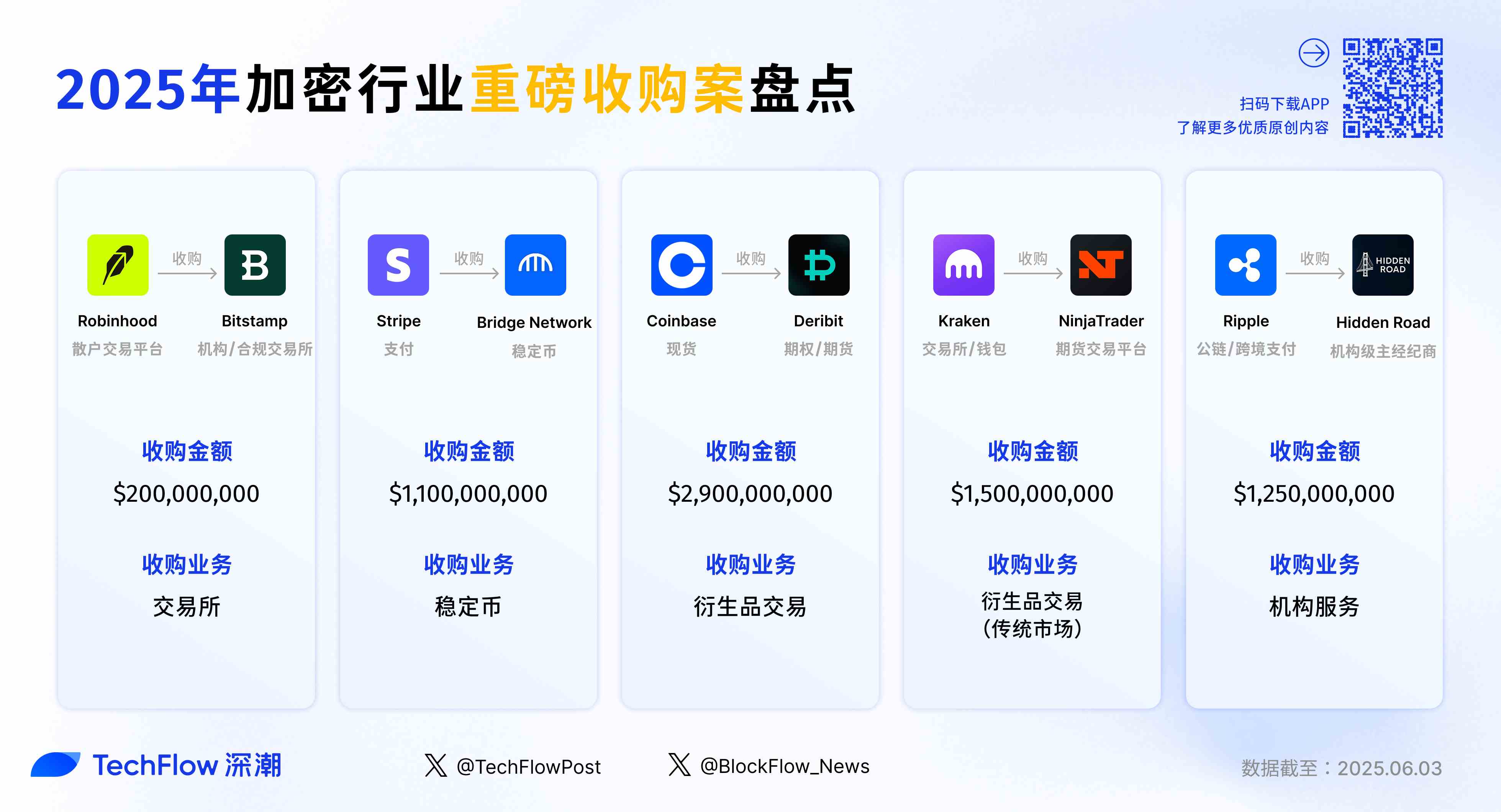
Counting Robinhood, there have already been five major acquisition cases in the industry this year. Below we summarize them to uncover the strategic calculations behind these capital moves.
1. Robinhood Acquires Bitstamp: A Fast Track to Global Licenses
Acquisition amount: $200 million
Business acquired: Exchange
First, it’s important to note that Bitstamp holds over 50 regulatory licenses and is known for its compliance standards and institutional client base.
One of the oldest cryptocurrency exchanges, public data shows it currently serves 5,000 institutions and 50,000 retail users.
Robinhood needs little introduction—it's a leading U.S. retail trading platform, historically reliant on revenue from retail stock and crypto trading. Analysts suggest that by acquiring Bitstamp, Robinhood instantly gains access to global markets, bypassing lengthy licensing processes and customer acquisition cycles, enabling rapid expansion into Europe, the UK, and Asia.
More importantly, with Bitstamp’s existing institutional clients, Robinhood can convert institutional trading volume into a new growth engine.
Institutional volume provides Robinhood with a stable revenue stream, offsetting the volatility of retail markets.
The significance of this deal goes beyond numbers.
Robinhood not only saves massive costs associated with building a global platform but also leverages Bitstamp’s compliance reputation to win trust from institutional players. In the broader market, this may signal Robinhood challenging crypto giants like Coinbase, potentially reshaping its brand identity by balancing retail and institutional focus.
2. Stripe Acquires Bridge Network: A Payment Giant’s Crypto Move
Acquisition amount: $1.1 billion
Business acquired: Stablecoin
In early 2025, payments giant Stripe made its first major move into crypto by acquiring stablecoin startup Bridge Network for $1.1 billion.
Bridge Network specializes in stablecoin infrastructure, offering cross-border payment and settlement solutions primarily to small and mid-sized financial institutions.
Stripe, a leader in global online payments, had previously taken few steps in the crypto space. This acquisition clearly reflects the company sensing opportunities within stablecoins—one that aligns well with its existing payment channels.
Stripe’s calculation is shrewd: rather than spending years developing technology internally, integrating Bridge’s ready-made solutions accelerates commercialization of crypto payments.
The acquisition gives Stripe immediate access to mature stablecoin technology and an established client network, avoiding complex processes such as building a payment blockchain or issuing a stablecoin from scratch.
This deal strengthens Stripe’s competitiveness in the global payments arena, giving it a new edge against rivals like PayPal and Square. At the industry level, Bridge’s stablecoin solutions could help push crypto payments into mainstream retail use cases.
However, despite its size, entering the stablecoin market requires Stripe to balance the demands of traditional finance clients with crypto-specific compliance requirements. Given that the GENIUS stablecoin bill is likely to pass, this acquisition appears highly forward-looking.
3. Coinbase Acquires Deribit: Fierce Competition in Crypto Derivatives
Acquisition amount: $2.9 billion
Business acquired: Derivatives trading
In May 2025, Coinbase acquired Dubai-based crypto derivatives exchange Deribit for $2.9 billion—the largest crypto M&A deal in history.
Deribit is a global leader in crypto options and futures, dominating half of the options trading market, with a clientele primarily composed of institutions and high-net-worth investors. Coinbase, the largest U.S. crypto exchange, already dominates spot trading but has lagged in derivatives. By acquiring Deribit, Coinbase inherits a mature trading system and institutional user base, skipping the long development cycle of building its own derivatives platform.
This move not only fills a critical gap in Coinbase’s offerings but could also propel it to become a dominant force in global derivatives, intensifying competition with Binance in the futures market.
Additionally, Deribit’s compliance framework may drive standardization in the crypto derivatives market, attracting more institutional participation. However, $2.9 billion is no small sum—high acquisition costs and integration challenges will test Coinbase’s operational capabilities, and how it recoups this investment remains to be seen.
4. Kraken Acquires NinjaTrader: Transitioning from Crypto to Multi-Asset Trading
Acquisition amount: $1.5 billion
Business acquired: Derivatives trading (traditional markets)
In March 2025, Kraken acquired futures trading platform NinjaTrader for $1.5 billion, marking a significant step toward becoming a multi-asset trading platform.
NinjaTrader is a leading retail futures platform with a large, active trader community, covering traditional financial assets such as equities, futures, and forex.
Kraken, a veteran crypto exchange, has faced user growth stagnation in recent years.
The acquisition grants Kraken immediate access to proven futures trading technology and an established user base, eliminating the need for costly internal development of a multi-asset platform.
Kraken’s ambition is clear: through M&A, rapidly transform from a single-focus crypto exchange into a comprehensive trading venue, drawing traditional finance users into the crypto ecosystem. This deal could redefine Kraken’s brand and strengthen its position in the North American market.
At the industry level, the convergence of crypto and traditional finance is accelerating. Kraken’s move offers traditional investors—especially current NinjaTrader users—a new gateway into crypto assets.
Conversely, integrating stocks and crypto on one platform also gives crypto-native users greater diversification.
5. Ripple Acquires Hidden Road: A New Kingpin in Institutional Crypto Services
Acquisition amount: $1.25 billion
Business acquired: Institutional services
In April 2025, Ripple acquired multi-asset prime broker Hidden Road for $1.25 billion, positioning itself as a pioneer in institutional crypto services.
Hidden Road provides brokerage services in equities, crypto, and forex to institutional clients including hedge funds and asset managers. Ripple, known for XRP and cross-border payments, recently launched its own stablecoin RLUSD.
By acquiring Hidden Road, Ripple gains direct access to a global brokerage network and institutional clients. It not only expands RLUSD’s institutional use cases but also becomes the only crypto company owning a global multi-asset brokerage—securing a foothold in a market otherwise dominated by USDT and USDC.
In terms of market impact, Hidden Road’s compliance strengths could attract more institutions into crypto, promoting industry standardization. However, Ripple’s ongoing XRP litigation remains unresolved, and regulatory risks could complicate integration efforts.
M&A Moves: The Push and Pull of Market Entry and Exit
Looking back at these major deals in the first half of 2025, this wave appears to be more than just capital exuberance—it resembles a strategic game between market entry and exit.
On one side are crypto firms seeking exit opportunities, hoping to lock in profits via IPO, acquisition, or merger. On the other are traditional enterprises and “old money” capital, eager to enter this high-growth sector through M&A.
Many crypto companies do have exit motivations, and their options are generally limited to IPO or acquisition.
IPO is a visible path. For example, stablecoin issuer Circle plans to go public in 2025 with a valuation as high as $9 billion. Circle rejected Ripple’s $5 billion acquisition offer, choosing instead to pursue an IPO for greater value—an indication of mature crypto firms’ confidence in public markets.
Yet IPO is not the only route.
Robinhood’s $200 million acquisition of Bitstamp exemplifies how crypto firms can quickly realize value by selling to strategic buyers—especially those with strong compliance credentials and solid customer bases.
The long timelines and high costs of building businesses from scratch deter many smaller crypto firms and non-crypto players alike, making acquisition by larger players a more practical option.
This exit trend signals industry maturation: profit pressures and tightening regulations are forcing companies to reevaluate long-term strategies.
Meanwhile, traditional firms and legacy capital are rushing in, viewing crypto as a new growth engine.
Payment giant Stripe’s move mirrors a broader trend—private equity firms and traditional financial institutions (“old money”) are using M&A to stake their claims.
A report from Financial IT shows that in the first half of 2025, 88 crypto M&A deals totaled $8.2 billion—nearly triple the total value of all 2024 deals.
Participation from traditional finance is rising sharply.
These players aren’t just chasing technology—they’re after established customer networks, compliance frameworks, and market share. Acquiring mature firms allows them to establish a foothold in minimal time. Especially under tightening regulation, licenses and compliance have become scarce and valuable resources.
The influx of traditional capital is blurring the lines between crypto and traditional finance, accelerating the industry’s legitimization.
Overall, I believe the 2025 crypto M&A boom represents a two-way rush: exits meeting entries.
It brings to mind one saying:
The crypto world is only so big—when some are coming in, others must be leaving.
Join TechFlow official community to stay tuned
Telegram:https://t.me/TechFlowDaily
X (Twitter):https://x.com/TechFlowPost
X (Twitter) EN:https://x.com/BlockFlow_News
 深潮TechFlow