Newton: Verifiable On-Chain Automation Layer
TechFlow Selected TechFlow Selected
Newton: Verifiable On-Chain Automation Layer
The team behind has raised approximately $90 million in cumulative funding, with investors including PayPal Ventures and Tiger Global.
 Navigating Web3 tides with focused insights
By KarenZ, Foresight News
In Web3, issues such as blockchain ecosystem fragmentation, low capital efficiency, and lack of automated trust still persist. In this context, Newton Protocol aims to build a verifiable automation infrastructure for the on-chain economy.
Through verifiable automation—combining Trusted Execution Environments (TEEs) and Zero-Knowledge Proofs (ZKPs)—Newton allows users to delegate agents to perform on-chain operations while ensuring actions comply with predefined rules. This article will cover four aspects: an introduction to Newton, team and funding background, operational mechanisms, and how to participate.
What is Newton Protocol? What’s the background?
Newton Protocol is an infrastructure jointly developed by Magic and the Magic Newton Foundation, aiming to introduce a verifiable automation layer to the on-chain economy. Newton ensures that every agent's operations are executed within boundaries set by users and cryptographically verified using a combination of Trusted Execution Environments (TEEs) and Zero-Knowledge Proofs (ZKPs).
Magic Labs, the team behind Newton, was founded in May 2018. Magic Labs eliminates the complexity of seed phrases and browser extensions through embedded wallets, enabling ordinary users to easily enter the Web3 world.
Magic Labs was co-founded by engineers Sean Li and Jaemin Jin from the University of Waterloo in Canada.
-
Sean Li: Serves as CEO of Magic; previously co-founded Kitematic, which was later acquired by Docker and evolved into Docker Desktop, used by millions of developers monthly.
-
Jaemin Jin: Chief Product Officer at Magic; worked as a software engineer at Uber from September 2015 to June 2018 and spent 10 months as a software engineer on Apple’s Siri team.
Magic says its team brings together talent from tech and crypto companies including Coinbase, OpenSea, and Alchemy.
Since its inception, Magic has focused primarily on embedded wallets and API wallets. Its SDK can be integrated into any web or mobile application, enabling passwordless authentication, non-custodial wallet-as-a-service, customizable embedded wallet widget UIs, and compatibility with over 30 blockchains. As of April 2025, Magic reports integration with over 50 million wallets and support for applications such as Polymarket, WalletConnect, Helium, and Immutable.
In terms of funding, Magic has raised approximately $90 million to date.
In July 2021, Magic completed a $27 million Series A round led by Northzone, with participation from Tiger Global, Placeholder, SV Angel, Digital Currency Group, CoinFund, and Cherubic. Angel investors included Reddit co-founder Alexis Ohanian, former Coinbase CTO Balaji Srinivasan, former Adidas VP Ben Pruess, Vercel CEO Guillermo Rauch, GitHub CTO Jason Warner, and AngelList co-founder Naval Ravikant.
In late May 2023, Magic announced a $52 million strategic financing round led by PayPal Ventures, with participation from Cherubic, Synchrony, KX, Northzone, and Volt Capital.
How does Newton work?
The operation of Newton Protocol involves participants such as users, developers, operators, and validators, along with components like smart accounts, zkPermissions, and execution coordinators.
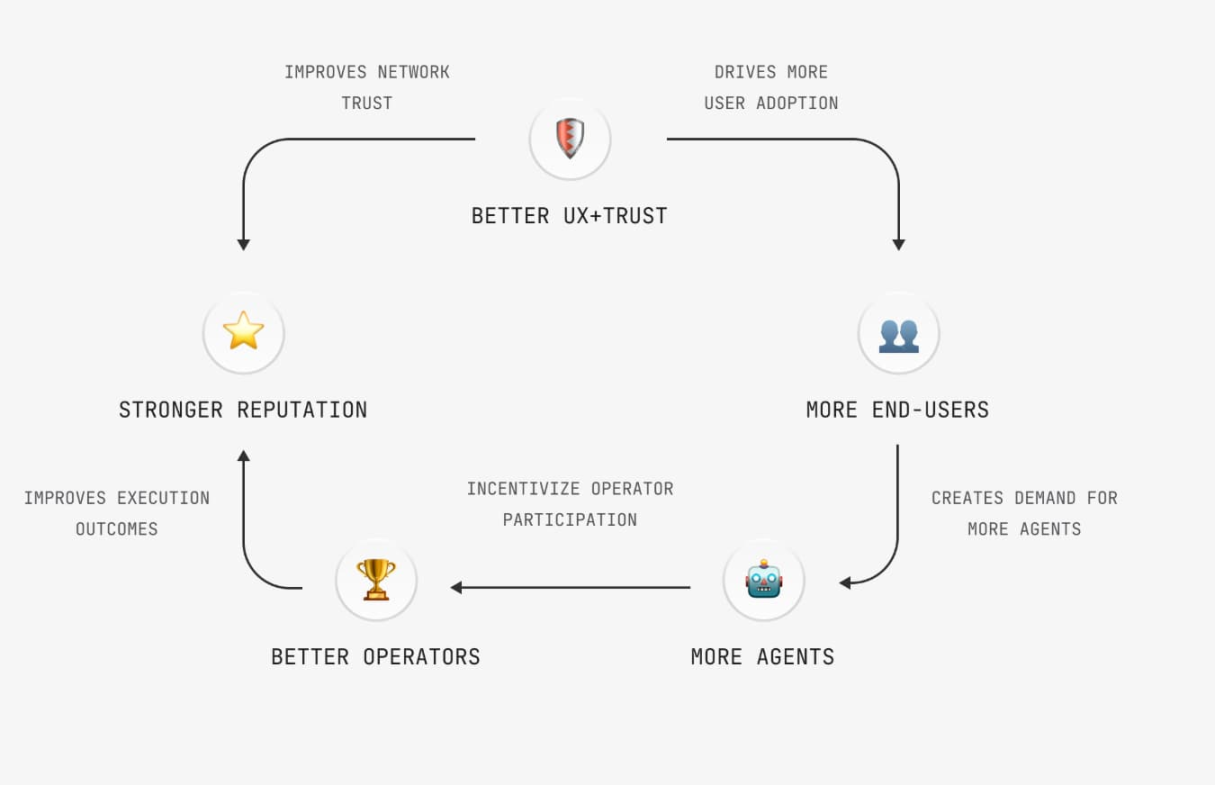
Below is the workflow of Newton:
1. Developers build automation agents and package them as containerized applications: Using the Newton SDK and zkML framework, they define the logic, constraints, and interfaces governing how agents interact with users and protocols, transforming off-chain services into verifiable agents.
2. Users submit requests: Users place orders expressing their intent for automation.
3. Order matching and task assignment: The execution coordinator matches user automation intents with operators via a limit order book mechanism, selecting suitable operators to execute tasks.
4. Operator executes the task: Upon accepting the task, the operator performs the defined automation logic off-chain, using TEEs (Trusted Execution Environments) to ensure trusted computation, or running zero-knowledge proof circuit machine learning models where verifiable execution is directly embedded into ZKPs. After completion, the operator generates and submits TEE proofs and ZKPs.
5. Result verification and execution: TEE attestations and ZKPs are verified on-chain. If valid, approved operations are executed via restricted session keys, completing the task and updating relevant states. If invalid, the task is rejected, and the operator may face economic penalties.
6. Reputation system update: Operators' reputations are updated based on execution history, task success rate, and user feedback. High-performing operators gain better reputation, attracting more user orders, while underperformers may suffer financial loss and reputational damage.
According to Newton, its three core components are:
1. Smart Accounts: Utilize smart account standards such as ERC-4337 and EIP-7702 to secure user wallets, supporting fine-grained, revocable permission delegation via encryption. Allows users to securely delegate operational rights to automation agents through policy-based delegation without sharing private keys.
2. zkPermissions: A zero-knowledge proof-based permission system where each session key is bound to a zkPermission circuit encoding automation rules. Core permission types include:
-
Data-driven execution conditions: Execute transactions only when on-chain sentiment data is bullish; additionally, advanced trading strategies such as golden cross, slippage, liquidity conditions, gas settings, or even CPI data requiring inflation below 2% after release can be configured.
-
Risk checks: For example, volatility-gated execution, oversold buy triggers, or spread-triggered limit orders.
-
Volume, frequency, and time limits: For instance, setting maximum daily transaction counts or per-transaction volume caps.
-
Enforce baseline session key permissions for each agent, covering common types such as spending limits, expiration dates, and token allowlists.
3. Execution Coordinator: Acts as a decentralized automation marketplace, matching user intents with operators and verifying the correctness of execution.
In summary, Newton Protocol transforms automation into verifiable on-chain primitives, combining the efficiency of TEEs with the verifiability of ZKPs. It provides new infrastructure for integrating AI agents with DeFi, advancing programmable economies and user-driven on-chain ecosystems.
How to interact?
1. Earn points on the https://www.magicnewton.com/portal/rewards portal through:
-
Dice rolling;
-
Minesweeper-style game;
-
Social tasks (side quests).
2. Register on the Newton App (https://newton.xyz/app) and complete agent tasks. Note: It is currently not recommended to deposit large amounts, as the Newton App currently supports fund deposits but not withdrawals.
3. Post high-quality content on X (formerly Twitter). The Newton Foundation will allocate 0.75% of its token supply as rewards to the Kaito community: 0.5% allocated to quality yapping and successful referrals, and 0.25% distributed to the broader Kaito community (stakers, holders, yapppers) based on community milestone achievements.
Join TechFlow official community to stay tuned
Telegram:https://t.me/TechFlowDaily
X (Twitter):https://x.com/TechFlowPost
X (Twitter) EN:https://x.com/BlockFlow_News
 Foresight News